
By Marc S. Sanders
You never know when God may come knocking. You never know when Jonas Nightengale may come knocking either. If you’re fortunate enough to reside in small town Rustwater, Kansas, you sir, or you ma’am, or you dear child may be blessed by the healing powers of Reverend Nightengale.
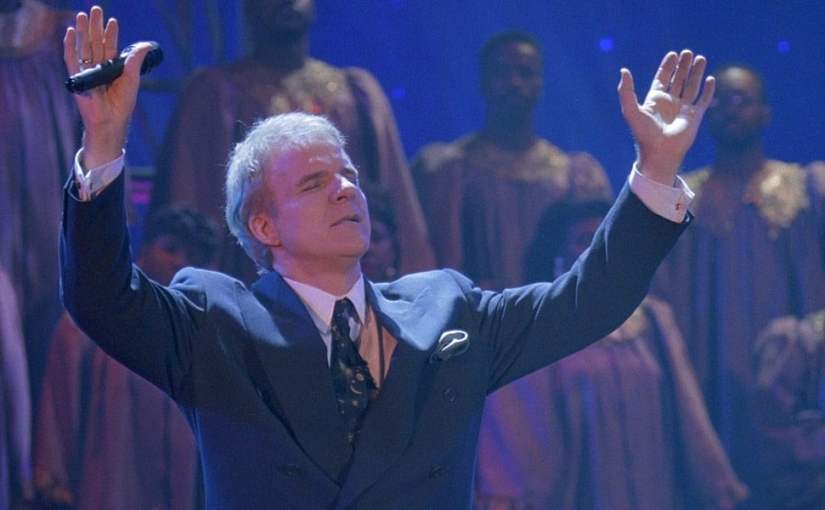
On the surface, Jonas appears like a comedic role for Steve Martin, but in actuality it is not aiming for laughs at all. When it comes to the confidence scheme that Reverend Jonas offers the townsfolk of Rustwater, Steve Martin plays the phony preacher with nothing but a serious operandi.
Jonas and his crew travel the states from one big city to the next where he preaches his gospel of deceitful hope in exchange for donations to his traveling church that supposedly serve the almighty lord. When one of their trucks breaks down in Rustwater, Jonas and his top aide, Jane (Debra Winger) use it as an opportunity for easy cash. This Kansas town relies on harvests and the infrequent rain that feeds the crops. Otherwise, this sleepy town has one diner, a movie theater, and a sheriff named Will (Liam Neeson) who is out to reveal the false Oz behind the curtain. At the same time, Will is romancing Jane who has been eagerly seeking out a flame that never had a chance to flourish because she is on the road so often.
Jonas is wooing Marva (Lolita Davidovich), a waitress at the diner who is also skeptical of the whole act and is protective of her younger handicapped brother, Boyd (Lukas Haas) who suffered a permanent leg injury in a car accident that killed their parents. Boyd was once told by a preacher that there is not enough faith in his heart for him to be the receiver of healing powers. Lukas Haas was not just cast because he’s a talented actor. He also has that angelic face that suggests he’s never committed a sin.
The tricks of Jane and Jonas’ trade are all revealed here. Jane hides in the back feeding information about certain audience members and their ailments into Jonas’ earpiece. Eavesdropping by the crew (including an early appearance by Phillip Seymour Hoffman) ahead of the show provides Jane with all the data. It’s neat to see and it is likely how these outrageous televangelists pull off their miraculous “gifts.”
There’s an interesting argument to Leap Of Faith. Jane defends Jonas’ façade to Will by him just selling fairy tales that make people feel good and fulfilled. Will sees the obvious moral dilemma. Jonas offers another defense. Is this any different than a circus act that presents the fantastic for an audience to witness. Personally, I think Jonas and Jane’s defense is a bunch of hooey. Yet, the residents of Rustwater buy into the act and soon people from all over the Midwest are lining up to listen to the gospel and witness the miracles of Reverend Nightengale.
Jonas has a dilemma himself though. He has a fondness for Marva, and he likes Boyd. Boyd is not a plant in the audience to go along with the healing power showmanship. So, how is Jonas going to explain his position? He’s quick on his feet to fend off public accusations from Will, but how can someone who is not a miracle worker perform a miracle while maintaining his illusion.
I like the set up and questions that Leap Of Faith asks. It’s the story of the arriving snake oil salesman which I do not see too often in films. The showy pieces of the movie are wonderful with terrific singing from the choir under the big top circus tent with the enormous crucifix of Jesus in the center. There’s also an enthusiastic supporting cast from Phillip Seymour Hoffman, as well as Meat Loaf as the church keyboardist. The crowd extras are wonderful with their vocal responses. I also especially love how Jonas ups the ante with a terrific sight gag to silence his biggest doubter, namely Will.
The film is different, especially for Steve Martin. He’s a ball of energy on the stage. He does his one-foot slide that was often seen on Saturday Night Live and his stand-up acts, but here it is not done for laughs. Instead, Martin’s recognizable schtick upholds the public persona of Judas, and it works.
Still, I do not think I got what I would have prayed for from the film. I could not get past how Liam Neeson does not work as a Midwest sheriff in this Podunk town. His boyish good looks from the early 1990s are right for the romance, but he makes no effort to hide his native Irish dialect. He just doesn’t blend into the Americana canvas very well. Debra Winger is great and it’s a shame I do not see her in enough films. Almost everything she does I like. She just has a natural vibe about her. She has good scenes with Neeson, but just like his character, their storyline belongs in another movie very distant from the prime directive of Leap Of Faith.
The romance between Martin and Davidovich does not amount to much either. Frankly, it feels as if the story editors opted to abandon this angle midway through the making of the film. I do not recall how the relationship resolved itself and the ending certainly does not generate any kind of response for how either character regards one another.
Towards the end of Leap Of Faith, the unexpected occurs twice, sort of like what happens in the end of Magnolia. I found it interesting, but then the credits roll and the gospel choir sings on until the screen goes dark. I’m leaping from my chair asking but wait, what about this and what about that. Nevertheless, the choir keeps on singing, deafening my concerns. Janus Cerone’s script seems to paint itself into a corner just when a brilliant irony arrives and hardly an acknowledgement, and certainly no explanation, is offered for the new phenomena that occurs.
Leap Of Faith begins with a prologue between Jonus and a traffic cop. It’s a brilliant scene demonstrating right away how smooth this “preacher” is when it is a one on one grift. (Celebrated trickster and former con man Ricky Jay was a consultant on the film.) Later, we see how mesmerizing Jonus is in front of hundreds of people. I was very excited during the first hour and a half of the picture, but then the movie gives up on itself. The best way to describe this viewing experience is to say that Leap Of Faith simply loses faith in itself.
 2 UNPAID MOVIE CRITICS!!!!