THERE’S SOMETHING ABOUT MARY

By Marc S. Sanders

Love never dies.  Sometimes it just gets jammed in your zipper.

Ted (Ben Stiller) can’t put his finger on it.  Neither can Pat (Matt Dillon) or a couple of other obsessed, stalking paramours.  There’s Just Something About Mary.

In 1985, brace faced, insecure Ted gets the opportunity to go to prom with the prettiest girl in school, Mary (Cameron Diaz).  He’s a good guy, but disaster strikes in truly one of the most unimaginable ways and prom never works out for these kids.

Jump thirteen years later to 1998 and Ted gets the idea to hire Pat, a private investigator, to track down Mary in hopes of rekindling a new romance.  She’s in Miami, Florida now, working as a chiropractic surgeon and even more beautiful than ever.  Problem is that Pat has lied to Ted about what has come of Mary and wants to pounce on her all for himself.  Ted eventually gets up the gumption to trek from Rhode Island to Florida anyway.  Along the way complications ensue.  Let me change topics for one second and remind you to be mindful of rest stops when you are road tripping.

There’s Something About Mary is one of the all-time great comedies and my favorite of the Farrelly Brothers’ collection (Kingpin, Dumb & Dumber, Me, Myself & Irene).  I’ve described the spine of this film, but it’s the guts of endless sight gags within that uphold this picture.  Everything from a dog that gets drugged, electrified, drugged a lot more, and body casted to a handicapped friend of Mary’s who simply cannot pick up his keys without instigating terribly guilt-ridden chuckles. (I’m laughing as I write this.)  Special needs adults lend to the comedy as well.  The Farrellys are proudly nowhere near politically correct. Yet the material manages to not be horribly offensive either.  You need not worry, you will still get into heaven even if you laughed at There’s Something About Mary.  Still, that’s what comedy is.  Somebody always needs to be the victim of the stooges who lend to the mayhem.

This comedy is also perfectly cast from the three headliners all the way down to the extras.  A South Carolina jail cell setting draws big laughs at poor Ted’s demise. 

Cameron Diaz is such a sport though, always looking beautiful while willing to be the fool.  It was great to watch this with my seventeen-year-old daughter since she had no idea of that hair gel scene.  If you don’t know, don’t read about it.  Just watch and look at how well Diaz holds the moment together.  I remember SCREAMING in the movie theatre next to Miguel.

Stiller and Dillon are two dumbasses you likely never would have envisioned in a film together.  Nevertheless, they are perfect foils of stupidity against one another.  Matt Dillon is often recognized for his tough guy dramatic roles.  Yet, he puts it all on the line.  Stiller is primarily known for comedy, and this film is the first of a series where he becomes the unfortunate victim of circumstances (Along Came Polly, Meet The Parents).  I wouldn’t want anyone else in these scenarios though.  You laugh at what Ben Stiller ends up in but also feel sorry for the poor guy.  I would have no objection if Matt Dillon and Ben Stiller paired up again for another comedy, even all these years later.

Other cast members also lend their level of comedy from Chris Elliott to Lin Shaye to Sarah Silverman, Jeffrey Tambor, Markie Post and especially Keith David, who knows he belongs nowhere in this movie, but that’s exactly why he should be part of the cast.  He’s utterly hilarious.

A nice touch to the movie are the series of outtakes during the end credits while the cast lip sync to The Foundations celebratory number “Build Me Up Buttercup.”  This had to have been such a party to film and finally the audience is assured that they can laugh along in front or behind the camera as well. 

There’s Something About Mary is the movie so many of us need right now.  Turn off the news and turn on what went on between Ted and Pat and their pursuit of Mary. 

THE OUTSIDERS

By Marc S. Sanders

As we are about to embark on a trip to New York City to celebrate my wife’s half century milestone (wish her a Happy Birthday, please), we decided to watch the film adaptation of S.E. Hinton’s celebrated novel The Outsiders, read by many high school juniors and seniors, and now a beloved Broadway musical.  The play has to be better than the movie.  It truly would not take much.

Francis Ford Coppola is the director of this very amateur piece that is best known for introducing a who’s who of the brightest actors that would go on to occupy some of the biggest films of the 1980s and 90s.  One of these guys, someone named Tom Cruise, is still a money maker elite. Ironically, he’s got one of the smallest roles in this film.

I can see the potential talent of C Thomas Howell, Ralph Macchio, Patrick Swayze (age 29 here), Emilio Estevez, Rob Lowe and Matt Dillon.  Diane Lane is likely giving the best performance in a next to nothing role as a could’ve been puppy love interest.  However, I said potential.  Had they been directed with just a little bit of passion, it’d be nothing but apparent. Coppola didn’t put enough work into getting this cast into shape.

Hinton’s story focuses on two factions of kids from small town Oklahoma, the greasers dressed in jeans with slicked back hair and tough guy attitudes all portrayed by the gang listed above and the Socs (pronounced Sosh), who are the spoiled rich kids dressed in school letterman jackets and khakis.  Their leader is Leif Garrett, the only known celebrity name at the time of this film’s release.  The antagonism between the groups is as evident as the Jets and Sharks.  The greasers flash their switchblades, curse and strut, particularly Matt Dillon as the fearless tough guy leader Dallas. Yet, within this screenplay, and among the performances by the whole cast, Coppola often relies on hokey, cornball drama that is on par with an after school special.  This is a lousy, rejected Hallmark card come to life. I’ve cried more at “Deep Thoughts With Jack Handy.”

The edits of the picture hide much of the bloodshed until a climactic rumble in the pouring rain presents itself with many endless, overdramatized punches and kicks that clearly don’t make contact.  Yes.  I heard Tom Cruise broke his teeth from a slug to his jaw. Otherwise, the ballet boxing of West Side Story has much more threatening smacks and cracks. 

C Thomas Howell is Pony Boy and Ralph Macchio is Johnny – the sixteen-year-olds who are overtaken by the Socs in the middle of the night. One of the prep kids turns up dead as the two young greasers defend themselves.  They hop a freight train and hide out of town, only to be brought into the spotlight when they rescue a group of little kids from a burning church. Pictures are smack dab on the front page.

The Outsiders is a very brief ninety-minute film that does not do enough to establish relationships among these kids.  Howell has the most fleshed out role.  With his two older brothers (Swayze and Lowe), Pony Boy dresses the part but his appreciation for literature and poetry by Margaret Mitchell and Robert Frost says that his life as a greaser is not for him.  His current situation does not allow for any other opportunities, though. Howell is just mediocre in his performance.  I cannot say I related to his supposed anguish and conflict.  He’s a body saying the lines and standing on his mark for the camera.

Just as in The Karate Kid, Ralph Macchio is an annoying over actor.  His character has an abusive relationship with his parents. However, we never see the parents. Frustratingly speaking, I’d question if this kid Johnny is simply a storyteller looking for attention. Why would Coppola leave out this dimension of one the main character’s home life that is frequently mentioned? Macchio looks more concerned with making sure the collar on his jean jacket is popped up with his bangs hanging down just right for a cover photo on Seventeen Magazine.  The profile that has the cute scar imbedded in his tan complexion is front and center. He always looks like he’s posing for a still shot in front of Coppola’s movie camera.  Macchio delivers the final monologue of the piece, and it’s near impossible to believe the actor truly embraced any of the dialogue of the script.  His performance appears mechanically memorized. 

Matt Dillon looks like he was genuinely trying to turn in a tough guy performance, but his moments on film, especially his final scene, look terribly edited and off kilter.  The cutaways that Coppola uses are awful, like a TV movie that is interrupted by commercials.  Only someone axed the ads from the final print and did not tape the film reel properly together.  

The Outsiders is a coming-of-age story hinged on tragedy and the yearning for a better life, particularly for Pony Boy.  Hinton’s book remains essential reading for young adults needing to relate to characters their own age.  It also serves as an effective homework assignment.  Francis Ford Coppola’s film though offers little focus on what makes any character tick or why there’s a conflict between the rival groups.  Where’s the history and backstory?  Most of the actors, especially Estevez and Cruise, come off as if they are high on sugar with incomplete sentences for lines. What are you guys doing here if not to look anything but hyperactive?

West Side Story and Stand By Me quickly found their footing for adolescent boys with insecurities and uncertain futures.   The respective settings of those films knew these misfit kids, and they in turn interacted within the environments. Coppola went the wrong route because there is hardly any bond between the kids and the other folks who reside in this picture.

From a technical standpoint, The Outsiders is a muddled mess of poorly timed original scores, from Carmine Coppola, wedged into scenes that do not call for anything to enhance the emotional heft.  The director often puts one actor’s close up at a zoom in, while a buddy will be in the foreground. This technique looks like an Olan Mills family photograph you get in the mall.  It’s cringey.  It’s hard to take seriously as well.  

The Outsiders simply does not work to acquire an emotional punch of despair and loss.  These pretty boy tough guys have no effective humor even with Tom Cruise behaving like an ugly, incomprehensible wild man and Emilio Estevez donning a Mickey Mouse t-shirt with his signature cackle.  There’s just too little to relate to anything in this picture that S. E. Hinton magnetically achieved within her pages.  Her book was published when she was age seventeen by the way. What an amazing accomplishment!

Regrettably, the filmmaker who upped the scales of the war picture (Apocalypse Now) with terror and disillusionment, and successfully delivered two of the greatest, most operatic films of all time (The Godfather movies), not to mention his smaller but shocking films like The Conversation offered little attention to what S.E. Hinton captured and impressed upon young readers.  If anything, Coppola was more concerned with shooting picturesque, midwestern sunset landscapes that honestly have an artificial texture to the eye.  Nothing from the music to the photography to the editing to the overt contrivances or the acting seems natural here.

The Outsiders is equally regarded as assembling one of the most impressive groupings of eventual male box office stars, as it is for Francis Ford Coppola’s lazy and uninspired film work.

ASTEROID CITY (2023)

by Miguel E. Rodriguez

DIRECTOR: Wes Anderson
CAST: More Actors Than You Can Shake a Stick At
MY RATING: 5/10
ROTTEN TOMATOMETER: 76% Certified Fresh

PLOT: In the mid-1950s, a roadside motel in a fictional mid-Western flyspeck plays host to a junior stargazing event that unexpectedly escalates, changing everyone’s world view forever.  …sort of.


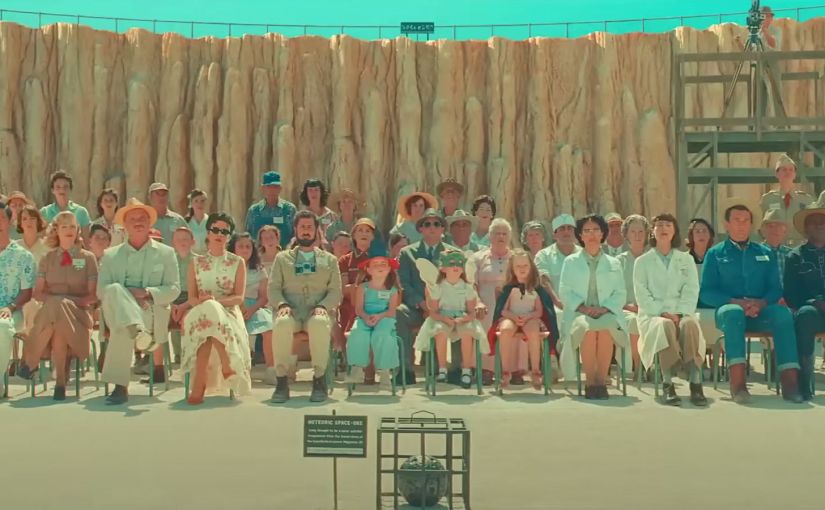
Asteroid City, Wes Anderson’s latest film, feels like a collector’s edition box of Cracker Jack with no prize inside.  Or a cake that has prize-winning decorations, but it’s hollow inside.  It looks phenomenal; one of my fellow cinephiles, Anthony, predicts it will be nominated for cinematography and production design, and I agree with him.  But where the heart of the film should be is simply a crater like the one around which the fictional town of Asteroid City was built.  This is yet another star-studded cast for Wes Anderson, but Anderson has given them very little to do other than wear colorful costumes, look solemnly into the camera, and speak in very precise phrases.

This strategy has served him very well…no…EXTREMELY well in the past.  Moonrise Kingdom (2012) and Grand Budapest Hotel (2014) spring immediately to mind.  But some crucial piece of machinery is missing from Asteroid City.  The characters are colorful and quirky, but at the end of the day, I simply didn’t care about what they did or said.  (Well…except when actress Midge Campbell [Scarlett Johansson] decides to rehearse her nude scene for her next-door neighbor…I did care about that.)

The film opens with a pillarboxed segment in black-and-white.  Our host (Bryan Cranston) explains that we’re about to watch a staged presentation of the newest play from author Conrad Earp (Edward Norton), who proceeds to lay out the “set” for us.  “Upstage right is the crater…upstage left are the motel cabins”, etc.  Then the screen expands to full letterbox and we are treated to eye-popping Kodachrome desert landscapes as we follow a 165-car freight train as it passes by Asteroid City.  Well, “City” should be in quotes…the population is officially listed at eighty-seven.

This is some wacky city.  It’s as if Wes Anderson watched every Coen Brothers film set in the Midwest, from Raising Arizona to No Country for Old Men, and filtered them through a Looney Tunes cartoon written by Charlie Kaufman.  Vending machines on the porch of the rental office sell everything from snacks and drinks to martinis and parcels of local real estate.  (Cost for the real estate parcels: forty quarters…they’re not big parcels.)  An abandoned highway overpass lurks on the outskirts.  Periodically, a police chase roars down the otherwise empty highway, guns firing and sirens blaring.  The residents say nothing about this phenomenon.  And every now and then, the town shakes from nuclear testing being done hundreds of miles away, but close enough that the mushroom clouds are visible.

Man, I love this kind of thing.  The stage is set for one of the all-time great satires, or maybe just a flat-out fairy tale.  We meet the cast of characters who have congregated here to honor young geniuses who have invented everything from rocket packs to particle guns to a projector strong enough to project an image on the moon.  A full rundown of all these characters would wind up being a novella, but if you’re acquainted with Anderson’s work, they will all be familiar to you in one way or another.  (Not least because many of them have worked on Anderson’s other films.)  They have also gathered to witness a rare astronomical event: a solar ellipse.  Not an eclipse.  An ellipse.  The mechanism required to view an ellipse without damaging your retinas looks like something out of Brazil.

Again, I normally love this kind of stuff, really, I do.  But…okay, look, first of all, the film intermittently takes a break from the movie itself to yank us out of the story and show us an event in the playwright’s life that led to the casting of Augie Steenbeck.  Or to show us a rehearsal where an acting coach (Willem Dafoe) encourages the actors – that we’ve already been watching perform in the movie/play – to improvise what it’s like to wake up by first falling asleep.  There’s even a moment where the host shows up where he really shouldn’t be.  And when one of the actors has a moment of existential crisis concerning the character he’s playing, he simply walks off the set, goes backstage and asks the director (Adrien Brody) why he’s doing what he’s doing.

…I mean…what IS this?  Conceptually, I get it, even if it’s a little heavy-handed.  (“What’s my motivation?”  “You’ll have to figure it out as you go along.”  “That’s too hard!”  “Well, that’s life.”)  But…why is it here?  Anderson worked with non-linear structure before in Grand Budapest Hotel, and it worked marvelously.  Here, it feels indulgent.  In fact, many of the scenes in the movie feel that way.  There’s a moment where an army general (Jeffrey Wright) announces he’s going to deliver a speech he’s prepared for the occasion of the “ellipse.”  But this is no ordinary speech.  It’s practically beat poetry, delivered with the kind of conviction that only Jeffrey Wright’s magnificent voice can provide, but…but…why is it here?  Even in this weird, cotton-candy, retro-fever-dream of a movie, this “speech” felt out of place and just plain goofy.  In fact, quite a lot of the scenes between characters felt less like story and more like the kind of dialogues you find in source books for actors.  (101 Scenes for Two and Three Actors…that kind of thing.)

I will provide full disclosure and say the movie did deliver some decent laughs and chuckles.  There is an event that occurs during the ellipse (I’ll have to tread carefully here) that may not be entirely unexpected, but it’s executed and timed so well that I laughed pretty much through the whole scene.  It’s the kind of thing I imagine Buster Keaton and Charlie Chaplin would have thoroughly enjoyed, if I may be so bold.  There is also the problem of the disposition of a Tupperware container holding a valuable, ah, keepsake.  Oh, and that roadrunner was awesome.

But by the time Asteroid City rolled credits, I didn’t feel like I had seen one of Wes Anderson’s best films.  (The Royal Tenenbaums remains his best film, in my opinion.)  This almost felt like a movie made on a whim, kinda like, “Hell, I don’t know if this’ll work, but if I get enough star power behind it, this may turn out to be something.”  Alas, it did not.

CRASH (2005)

By Marc S. Sanders

Paul Haggis’ vignette themed script for Crash should not have won Best Screenplay. The film he directed should not have won Best Picture. Could it be that because this picture is masked as that special movie with that especially poignant message that it got the recognition I don’t think it ever deserved? I can appreciate the attempt at bringing hot button social issues like racism and injustice to light, but it does not need to be as immaturely contrived as this picture.

Crash occurs over two days within the city of modern day Los Angeles. A select group of characters of different social classes and ethnicities are covered, and the film circumvents back and forth among their perspectives. For the most part, all of these people have major social hang-ups with people outside their race. The first example shows us that if a white woman who is simply cold on a winter night hugs her husband tightly for some warmth, apparently a couple of black men will automatically believe this woman is fearful of their approach.

Especially today, I know that prejudice exists, but to this extreme and this contrived…I’m not sure. I guess I’m not sure because I have not experienced it enough to be convinced yet. When I read a friend’s testimony of falling victim to racial prejudice I lean towards believing everything they tell me. I guess it’s this movie, Crash, that left me feeling dubious and maybe that’s because the circumstances seem way too forced.

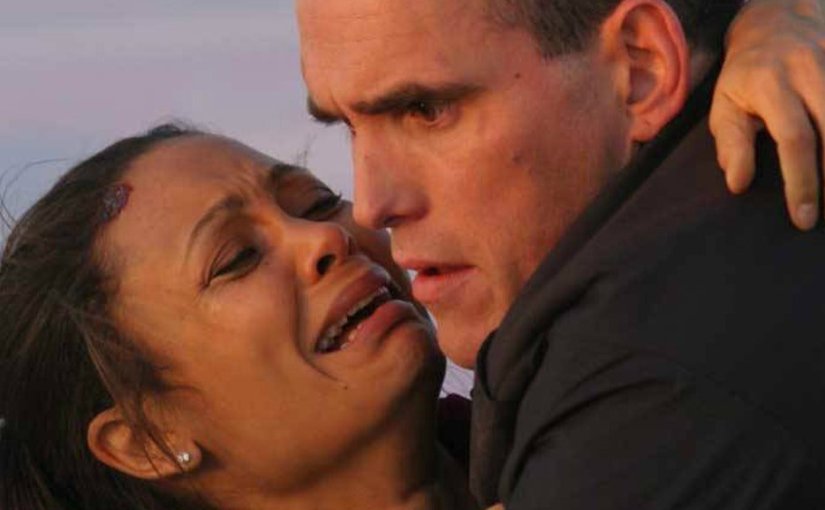
A racist cop (Matt Dillon) will pull over a well to do Muslim man (Terrence Howard) driving a high priced SUV and perform a sobriety test for no reason. Then the cop will deliberately frisk the man’s wife (Thandie Newton) with digital penetration. The next day, it’ll just happen to be that this woman will have no choice but to be rescued from a burning car by this same racist cop. Now I’m supposed to believe that the racist cop is not so bad, and the woman learns to become more tolerant. Well gee, thank heavens for coincidences!

The Muslim man (a television show director) gets car jacked the following day, and in a tense pull over moment he’s mistaken as the criminal. Fortunately, the partner of the racist cop (Ryan Phillipe) is there to subdue the situation. I’m sorry, but life doesn’t work out to be this tidy. Call me cynical, but more often than not we are not given a second chance at first impressions.

One of the real car jackers (Chris “Ludacris” Bridges) gets a moment of clarity and suddenly he’s generously giving out his last forty dollars to a group of Asian people being held in a van for human trafficking. Forgive me. If I want to begin respecting this car jacker who has held multiple people at gun point and even runs over a man, only to toss him out on the drive up to the Emergency Room, I’ll be more apt to do so if the criminal turns himself in.

I dunno. Maybe I’ve got a personal issue with Crash. It could not be more apparently preachy in how it patronizes me to simply understand the seething hate and criminal violations of its characters. I’m supposed to empathize with the racist cop because his ill father can’t get the health care he’s entitled to? I’m supposed to understand the prejudicial anger that the WASP wife (Sandra Bullock) of a District Attorney (Brendan Frasier) expresses because she no longer trusts her dedicated Hispanic housekeeper or the locksmith (Michael Pena) changing the locks on their house following a car jacking?

No. Paul Haggis didn’t earn that response from me in almost all of the short story scenarios his film offers. Maybe it’s because I tend to compartmentalize my episodes. I like to think that I don’t allow one experience with one kind of person cloud my judgement on the next person I encounter. A waiter can totally screw up my order and can even mouth off to me in a heated moment. Yet, I’ll return to the restaurant on another occasion because it’s likely I’ll run into a different waiter.

Haggis depicts people who appear to have a blanket opinion of other people with different backgrounds. These are all extremely prejudiced people with next to no understanding of where each of them stem from. An angry Persian man (Shaun Toub) puts blame on the locksmith after his convenience store is ransacked. The locksmith was only trying to explain that the back door needed to be replaced. The Persian refused to listen because his English is limited. So he just gets angry and curses the locksmith out. Haggis opts to insert a language barrier between the two men to serve up an eventual tense and dramatic moment in a neighborhood driveway with a loaded gun and a little girl. A loaded gun and a little girl! Yup, I think they teach these are the true ingredients for effective drama on the first day of screenwriting class. Again, it all comes about a little too forced.

The conveniences and ironies that bubble up at times are surprising. “Oh that guy is that guy’s brother! I see.” Things like that. However, I don’t think that is necessarily the strength of the picture.

In a film like Magnolia, we are treated to the vignettes of a handful of people too. However, not every single one of those people are sketched by means of their prejudiced natures. They are drawn by a variety of different elements whether it be a traumatic past or an inclination to do good. Then it’s kind of fun to uncover how each player is connected to one another.

In Crash, the players are only connected by the hate they carry within themselves, and Paul Haggis forces a redemption upon most of them with small gestures or a line of dialogue or the purity of a welcome snowfall to close out the film. Sorry, life is lot more messy and complicated than that. I guess I’m saying I may have learned a lot more about human nature from a downpour of frogs than a downpour of snow.