
By Marc S. Sanders
Bradley Cooper’s second directorial film suffers from the same ailments as his first film. Like his interpretation of A Star Is Born, Maestro is not as good as the sum of its parts.
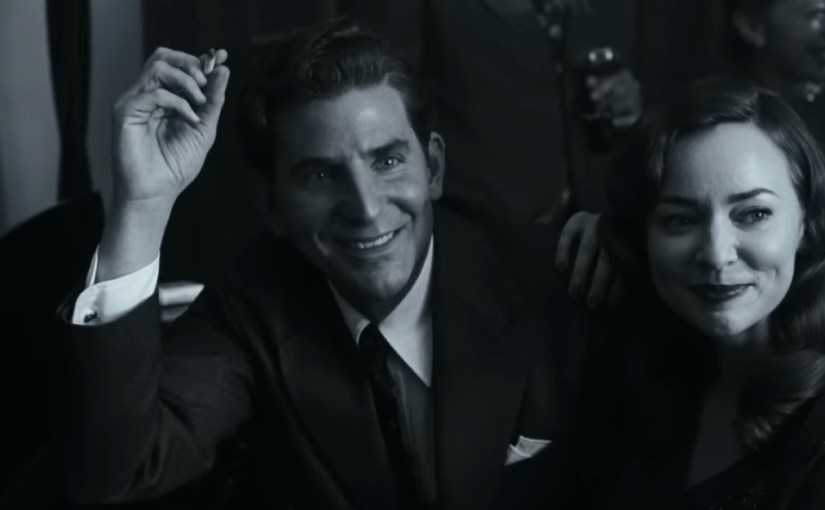
Constructively speaking Maestro is a gorgeous looking picture with a first half in a comfortable, historic black and white followed by its second half in vibrant colors. The acting from Cooper, as Maestro Leonard Bernstein is well performed. Carey Mulligan is sensational at no matter what age she is portraying actress Felicia Montealegre, the conductor’s wife. Within the scenes they share together there is a beautiful rhythmic exchange of dialogue, written by Bradley Cooper and Josh Singer. Cooper also looks powerful as he reenacts the conductor in front of his choruses and orchestras. There are also inspiring shots that start out vague and unclear only to come into a full blossom as Cooper’s camera maintains an unbroken focus on an image.
All that being said, none of it matters because the script from Cooper and Singer is muddied. While Mulligan and the actor/director are in the midst of marital argument on Thanksgiving day, much is hard to understand as they naturally speak over one another, and what can be made out seems to mean nothing as they fight over people and issues that I do not believe are ever touched upon in the picture. A scene like this looks like an actor’s dream piece, but it is hollow of substance.
Like A Star Is Born, there are characters that enter Maestro for long winded scenes and then are never heard from again. Either Bradley Cooper does not feel the weight of their importance, or he mistakenly presumes the audience will catch on. An outdoor brunch with Felicia, Leonard, another couple and I believe a mentor or agent of Leonard’s seems well written, but I have no idea who those people are or what kind of influence they carry. I was hoping to realize later, but those three amount to nothing. Was the other couple supposed to be Leonard’s parents, and perhaps they were meeting Felicia for the first time? I’m just not sure.
Bradley Cooper is a master with his camera. An important moment in Bernstein’s life is when he gets the call to perform at Carnegie Hall when the other conductor calls in sick. With its black and white imagery, a young and enthusiastic Leonard answers a phone call while a black square, with light from behind, occupies three quarters of the screen. I was wondering if that was a stage curtain that needs to be lifted. I was half right. It’s a window curtain to the apartment Leonard shares with his gay lover. The film moves into high energy as the would-be composer slaps his lover’s bottom and leaps down the stairs with a quick edit into the theater. Mike Nichols would be proud.
Another moment that struck me was Cooper pointing his camera up into the tall reaches of his apartment building staircase. It’s quite dark. You may have trouble realizing what you are looking at but then his son drops a paper airplane “good luck” note down to his father on the bottom floor. These images blossom into something as alive as I would imagine the director/co-writer/actor regards Bernstein.
So, there is much to praise in Maestro. Unfortunately, the assembly of these shiny, inventive, and magnificent pieces of film do not mesh very well together. Bernstein led a homosexual lifestyle, even going so far as to welcome a lover into the home he shared with Felicia. Carey Mulligan is excellent with expressions of resentment towards this other life that her husband follows. However, the storyline never feels fully fleshed out. We never get an opportunity to see the value or the menace of the other relationships that Leonard holds on to. A so-so moment is accompanied by Bernstein’s saxophone opening to West Side Story. The piece is used as a subtle tool of deceit and ignorant cruelty by Leonard while escorting his apprentice/lover in the home he shares with an angered Felicia in the foreground. We presume the threat that Felicia likely feels, but it never comes to the surface.
Bernstein’s career is glossed over as well. Who pushed him to move on to bigger moments and acquire greater crescendos in his life? I’d like to think it was Felicia, but I’m not certain. Felicia has conversations with Leonard’s sister (Sarah Silverman) and other acquaintances, but what is she really alluding to or really talking about?
The most impressive moment in the film is when the Maestro conducts the London Symphony Orchestra at Ely Cathedral. (I’ll own up and say I looked up what this scene was on IMDb.) Bradley Cooper does a masterful reenactment of Berstein, dripping in shaggy grey hair sweat, dressed in a three-piece tuxedo with baton in hand. This is a major multi talent working in films today. Cooper studied film footage of the scene over a six-year period to get this six-and-a-half-minute unbroken moment caught on film. It’s positively mesmerizing and I could watch this over and over again. I’m waiting for the side-by-side comparison to appear on You Tube soon. It is reminiscent of what Rami Malek did as Freddy Mercury at the Live Aid concert at Wembley Stadium in the film Bohemian Rhapsody.
Still, this scene much like a lot of the footage in Maestro seems to just be wedged in there. There’s a balletic flow to some moments in Cooper’s film and then there are times that come out of nowhere and I’m left to wonder how exactly we arrived and what was truly going on in Bernstein’s life when he conducted at this historic moment time. I’m watching a blazingly fine impersonation of Bradley Cooper doing Leonard Bernstein but I’m lacking the sub conscious dimension a biographical film should have at this point in a historical figure’s life.
Carey Mulligan is laying everything out to portray Felicia and her best moments come in the last third of the picture when the poor woman is struck with breast cancer that has spread to most of her body. We witness how she lives with the illness along with her separated husband by her side. I’ve seen ill women before in films. I know I sound crude by saying it’s nothing new. I’m still allowed to be impressed though. It’s a huge feat to bring a performance to this kind of level.
The makeup work is marvelous too. Raw footage of the real Leonard Bernstein is shown before the end credits, and I’m impressed with how much Cooper looks in comparison. The aging of him and Mulligan over the decades since the late 1930’s all the way through the mid 1980’s is perfectly captured. At one moment, Carey Mulligan looks just like my mother. I choked up a little bit when Felicia gazes upon Leonard at the Ely Cathedral. Same hairstyle. Same eyes. Same expression. Mom would have even worn a soft blue evening gown like that in the mid-1970s.
I wanted to like Maestro more than I did. I almost feel guilty for not liking it as much. There is magnificent camera work, sensational acting, wonderous music and perfect impressions on display, but the puzzle just did not have all of its pieces assembled together properly. Sadly, Maestro lacks the focus it needs, either for the famed conductor’s amazing career or for his relationship with Felicia with his not so concealed homosexual lifestyle on the side. Bradley Cooper put together a million magnificent moments, but it caused him to overlook the enduring structure of his subject.
 2 UNPAID MOVIE CRITICS!!!!