
NORTH BY NORTHWEST

By Marc S. Sanders

A story of mistaken identity becomes one of the grandest adventures on film with Alfred Hitchcock’s North By Northwest. The movie plays at such a fast pace, moving from one locale to the next and it all feels convincingly possible.

Before James Bond, there was the dashing Cary Grant in his sharp, fitted light grey suit (the best suit to ever be shown on film) portraying advertising executive Roger Thornhill who simply raises his hand in the air while meeting some colleagues at The Plaza Hotel in New York and is suddenly mistaken for a man named George Kaplan. Soon he’s forced into a car by two men and driven to an estate property belonging to someone named Townsend (James Mason) who implores “Mr. Kaplan” to cooperate or else. Suddenly, Thornhill who continues to insist he’s not Kaplan is on a cross country journey while escaping the authorities who want him for murder while he tries to prove his true identity and exonerate himself.

Cary Grant is dashingly fun with Hitchcock’s camera. It’s refreshing for a change to watch an innocent protagonist not lay on the heavy drama and panic so much. Hitchcock with Grant were going for a sweeping story of cat and mouse play.

What Alfred Hitchcock does best is put the viewer right in position of Thornhill. For the most part (definitely through the first forty minutes) the viewer only knows what Thornhill knows. We know he’s been mistaken for someone else and we are only given the opportunity to put a few names with faces and get a hold of a crumpled photograph. That’s all we and Thornhill have to go on.

Later on, it’s only fortunate that Thornhill comes upon one of Hitchcock’s celebrated blond actresses he was always reputed to cast. This time it is the incredibly striking Eva Marie Saint as Eve Kendall who becomes a willingly helpful train companion for Thornhill. Cary Grant and Eva Marie Saint make for a spectacular on screen couple. Their chemistry is so natural together.

Not much else should be said about the story of North By Northwest. The entertainment comes from what each new scene reveals. Hitchcock incorporates all the expected twists and makes sure to use a MacGuffin, of course. This time it involves a statue and microfilm. What’s on it? That does not so much matter really. It’s the need to pursue it that’s important. The pursuit is what drives the picture from New York City to the United Nations, all the way to a curious auction house for fine art and then on to the four famous faces of Mount Rushmore in South Dakota.

Naturally, Hitchcock is the master once again as he points his camera up close on Grant, Mason and Saint and then quickly will cut to one of their points of view to lengthen the suspense. Running after or away from something in the moment is where Hitchcock is very strong as a storyteller. It keeps you alert as a viewer. Very alert!!!

James Mason makes for a terrific villain as Townsend, or could he be someone else? He’s got that sneaky inflection in his voice and short build that makes for a great antagonist against Cary Grant’s tall stature. Mason’s sidekick, Leonard (a mysterious looking Martin Landau) is also a spooky guy to keep your distance from.

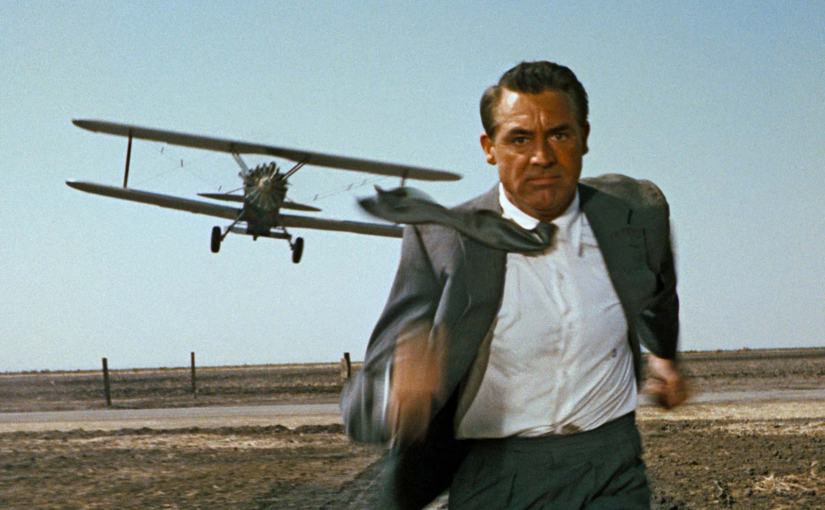
The most celebrated scene probably also contains one of the best captions caught in film. I speak of the very surprising crop duster chase. As Roger Thornhill finds himself in a quiet, Midwestern dirt road intersection, an airplane crop duster turns into a frightening menace. The best shot occurs as Grant runs quickly towards Hitchcock’s camera and the plane flies overhead rapidly getting closer in the upper left side of the screen. As Grant runs and runs, he fills more of the screen, but so does the crop duster. The editing alone is spectacular, as an oil rig eventually comes into play with Grant about to get run over. Story wise, I adore this scene as somehow the life of a man who routinely gets in taxicabs and hob nobs through New York City on a daily basis suddenly has found himself in a dusty field running for his life. What was never expected is suddenly all that matters to this ordinary man.

Hitchcock plays with what’s around to play with. Other than a quick gag in Superman II, l don’t recall many films incorporating Mount Rushmore as such an important element to its picture. Every crevice or ledge or finger hold is important to the edits of the climax in North By Northwest. When Eva Marie Saint is holding on for life, I truly believed she could actually fall. [SPOILER ALERT] Actually, Hitchcock wanted you to believe that as the very last scene doesn’t even truly reveal the solution to her predicament. I like his method of editing this way. Hitchcock seemingly offers no option for survival as Grant and Saint’s hands barely hold on to one another. The editing is just so damn good here.

I’d be remiss if I also didn’t recognize one of the greatest orchestral scores in film. Bernard Hermann’s stirring, fast paced rhythms keep the running man theme in play. The movie seems to play by the beats of Hermann’s conduction. Action films of the future seemed to adopt some measures from he did with this film.

North By Northwest will always remain as one Alfred Hitchcock’s best films. There is not one error in the picture. Every shot is done with deliberate intent to sustain the mystery of suspense. Humor is included even at times on a risqué and subtle measure. Alfred Hitchcock again invites the simplicity of storytelling to introduce the complexity of fear and mystery and outstanding suspense. Not many films compare to North By Northwest.
ROUNDERS

By Marc S. Sanders

Recently, I watched The Cincinnati Kid with Steve McQueen and it reminded me how much I enjoy a good poker movie, and I don’t even play cards.  Shortly thereafter, I took it upon myself to watch Rounders directed by John Dahl.  A few things occurred to me.  Poker movies do not acknowledge an organization called Gamblers Anonymous.  I guess to do so would be too much of a downer when the real suspense lies in the close ups of these talented players trying to read and outplay one another across the table.  Addictions become all too real and movies are not about reality but rather enhanced reality.

Rounders explores a seedy underground world of poker in modern day New York City.  Its community is made up of guys with names like Teddy KGB (aka The Mad Russian with ties to the mob), Joey “Knish,” and Worm.  There’s also a heavy who conveniently comes in to collect debts, and his affectionate name is Gramma.  These guys are portrayed by an outstanding cast of actors; respectively John Malkovich, John Turturro and Edward Norton.  Gramma is Michael Rispoli looking squat but all muscle under a derby hat while residing in his brothel of hookers who work for him.  All of these characters couldn’t be any more different.  The only thing they have in common is the game.  Gramma is the destiny that follows you after the game.  The other thing they have in common is the storytelling device of mentor, both good and bad. 

Knish maintains a conservative career approach to poker that allows him to pay his bills and alimony, and has groomed a baby faced “rounder” known as Mike McDermott.  He doesn’t look like he belongs with these shadowy figures but maybe that’s why he’s so good at the table.  KGB is the devil that’s not in disguise.  He’s the Oreo chomping Russian psycho with an appropriate, yet overly laid on Bolshevik accent. Worm is Mike’s pal who won’t let up to entice his childhood friend to keep the juice going because poker, honest or more importantly shady, is all that matters. 

Matt Damon is Mike in one of his most underappreciated roles.  Mike looks like a law student with a promising career.  I said he looks like that.  The film however shows that Mike is not a law student at all.  At least he shouldn’t be.  Early on in the film, Mike’s britches get too big for him and he loses everything such as his tuition money and rent and anything else he’d been saving up for.  Knish offers to help him get back in the game, but Mike swears off poker like someone who perhaps would swear off fatty foods.  I guess it’s not an addiction that is taking over his livelihood such as with his devoted law school student  girlfriend Jo, played by Gretchen Mol.  In Rounders, law school and love are the inconvenience.  Not poker.

Nine months go by and Mike picks up his childhood best friend, Worm, played with exceptional sleaze by Edward Norton.  Mike resists Worm’s advances to get back in the neighborhood games where they were masters at the hustle.  Worm is desperate and eager to play because it’s all he wants to do and he has an acknowledged drive to simply self-destruct in endless debt.  Mike’s devotion to Worm is tough for him to compromise and pretty soon his personal vouch for his friend gets them both into trouble where binge gaming is their only option.

The step-by-step play of the story is predictable here.  We know there’ll be one big game at the end with a monster win.  Mike will face set backs along the way.  He’ll have mentor moments and arguments with Jo.  But so what.  Look at the actors this film has to offer, and follow along with a great script of dialogue too. 

Rounders came out in 1998 when Matt Damon was surprising the world with his original script Good Will Hunting.  This movie is one of the first films where he got top billing and his name above the title.  He has so many good scenes because many of them play like duets.  Damon vs Malkovich.  Damon with Turturro.  Damon with, and sometimes against, Norton. 

My favorite pairings are the scenes he shares with Martin Landau who plays Mike’s law professor, Abe Petrovsky.  Landau personally touched me as the son of Jewish immigrants where each generation went on to Rabbinical school.  Petrovsky describes for his law student, Mike, that through his own personal experience that our destiny chooses us.  Often, we don’t choose what we have to become.  The Petrovsky character was raised in the Jewish orthodox community where I also had experience while attending Yeshiva for ten years.  I knew this man that Landau so accurately portrays.   Beyond my review, I have to share that this character spoke to me and reunited me with the Rabbis who taught me in elementary school. Personally, Petrovsky assured me that it was okay that I did not follow in the footsteps of my teachings at Yeshiva.  It wasn’t for me, much like law school is not for Mike.  Mike has a talent for something else.  Still, it’s a very risky talent.  Rounders would like to tell you that everything in life is worth taking risks.

I’m not sure I agree with the philosophy of Rounders.  Gambling can easily turn into a terrible addiction.  My father played all the games at the casinos on occasion, but he never stayed very long and he only went infrequently like when he was on a business trip.  He always told me that he would not be sure he’d be able to stop if he took up the game.  I knew exactly what he was talking about which is why I never even opted to learn.  I know my limitations.  Rounders doesn’t focus on limitations, though.  Limitations are for nerds, I guess.  Rounders is all about searching for strategy to improve your game.  It’s movie money.  So, there’s only pretend risk as Mike aspires to beat the best of the underground, come out alive from the violations of his pal and then move on to Vegas where he’ll give it a shot at the World Series of Poker.

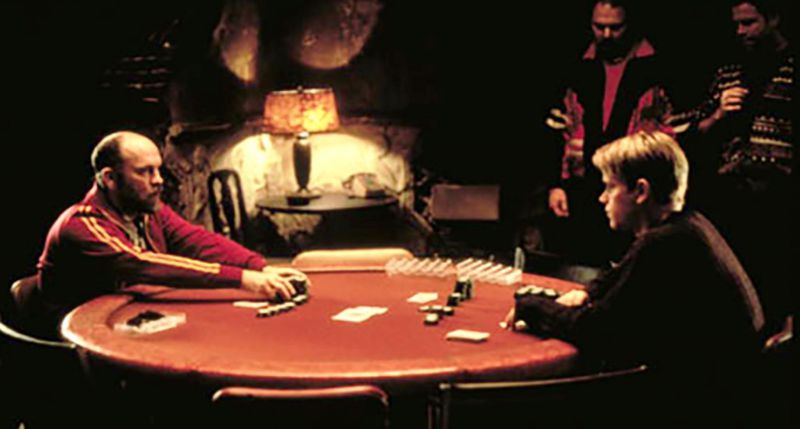
There’s one other aspect I admire about Dahl’s film.  I looked for it on this most recent viewing and I’m telling you I couldn’t see it anywhere.  Dahl never, ever shows you the full hands of the players.  Either you see only a part of the river of a Texas Hold ‘Em game or you see the pair of cards the players hold, but never both in any round of the various card playing.  Dahl’s approach like the Mike’s philosophy is not so much playing the cards as it is to show the players play against each other.  The ticks and expressions they give like how they smoke or drink or even how they eat Oreo cookies out of their poker chip rack.  It’s very effective compared to other poker scenes in films like The Sting or even Casino Royale.  With a fine tuned script by David Levien and Brian Koppelman, it is fair to say that anyone knows what hand beats a flush or two pair or whatever.  More importantly, what matters is what read is ultimately gonna win you the table.  Rounders is all about winning the table, not the hand.