
By Marc S. Sanders
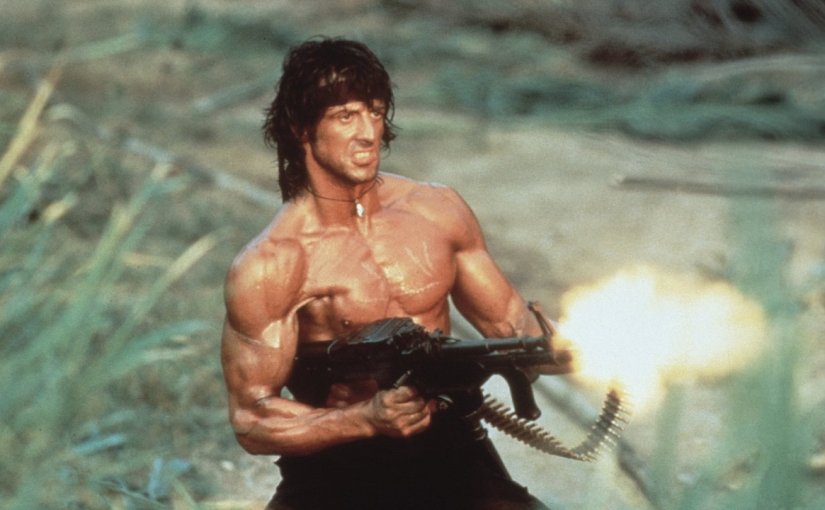
David Morrell’s literary character Rambo (no first name in the book, First Blood) cinematically survived his first post Vietnam adventure to spill buckets of bloodshed for many more follow ups. Sylvester Stallone hit box office gold when he signed up for Rambo: First Blood Part II. The Vietnam War was long over leaving an endless supply of storyline threads for Hollywood. Who better to go back there with a ripped upper torso, a bow and arrow, a bayonet knife that won’t carve your steak but will hack up the cow, and a lot of firepower?
Green Beret John Rambo is specially recruited by his former C.O., Colonel Trautman (Richard Crenna) for a solo mission into a Viet Cong camp where American POWs might be held captive. He’s got thirty-six hours to get in and out. There’s a catch though. A mercenary led operative named Murdock (Charles Napier), who hides behind a desk, a white collar and necktie specifically instructs Rambo to only survey the area and take photographs. Under no circumstances is he to engage the enemy or escort any prisoners back to his rendezvous point. Thing is that Rambo is not much of a photographer.
James Cameron is credited as one of the screenwriters and apparently Stallone modified the script from there. This bloody sequel is entertaining but I always found it a little mundane despite all the action.
Just as the movie is about to grow a brain and intelligently debate with itself about how so many American soldiers were disregarded following the war, it stops talking and only resorts to one action set up after another. Crenna and Napier potentially engage in a worthy debate focusing on government mistrust and moral servitude before the moment is cut short. Trautman is the easily assumed ally of Rambo. Murdock is the antagonist, but truly I have to ask why. What is the motivation not to side with Rambo’s efforts to literally rescue half a dozen abandoned soldiers? First Blood Part II cuts the argument short and never returns to settle the discord.
There is perhaps only 5 or 6 lines in the last forty-five minutes of the picture. There’s a melodramatic closing monologue from Stallone’s morose character. Otherwise, this movie would prefer not to think. Sadly, there is a lot to consider here, but the explosives and machine-gunning filibuster, insisting on holding the floor.
The action is categorized in a series of episodes. A five minute section offers a variety of ways Rambo covertly takes out Russian military soldiers who are maintaining a stronghold with the Viet Cong. It’s clever how one guy is taken by surprise when a mud caked Rambo guts him with his knife. For another stooge, he’s literally sucked away into the mouth of a cavern. You don’t even see Rambo. How does the hero get around with enough time to set up these sophisticated traps? This is all cool to look at but I would have liked to have learned more about how the Russian General (Steven Berkoff) formed an alliance with the Vietnamese.
Later, Rambo uses his endless supply of arrows to blow away acres and acres of marsh and tall grass. I buy one man army tropes in movies. Yet, I still question how a guy on two feet can set ablaze the equivalent of five football fields worth of territory. How does he always manage to get in range?
A war copter hovers over a river. The henchman riddles the surface with bullets, and Rambo LEAPS from the depths INTO the chopper. I mean he flies up like Superman. Another moment has him submerged and then he pops out of the water with perfect aim to mow down a mob of men. How did he know where to shoot?
I guess all of this is entertaining. I just don’t relish it like I’m expected to because I’m asking too many “how does he…” questions. My suspension of disbelief doesn’t have a high level of tolerance for what Rambo is apparently capable of. David Morrell’s character was somehow blessed with superpowers, practically!
With Rambo serving our country, how in the hell did we ever lose the Vietnam War? Seems damn near impossible.
First Blood embraced a common problem with veterans who were disregarded by the institutions they swore to defend and serve. It’s a terrible blemish on our country’s patriotism. An awareness was offered in that film amid all of the believably capable action scenes. Part II clearly shows a lack of concern. POWs get rescued but they are not even given an opportunity to reflect and speak. Their bearded and malnourished figures speak for them in close ups. I didn’t think enough was delivered for any semblance of a message that was asking to be heard. Instead, we get a Stallone showing off a bronze, ripped chest, red bandana and a slew sophisticated weaponry. Rambo looks sexy here, and that does not sit right with me.
I can rewatch Rambo: First Blood Part II. I just can’t feel for any of it. I think I was entitled though. Moreover, those that served in this awful conflict are deserving of a product that would better honor their sacrifices.
 2 UNPAID MOVIE CRITICS!!!!