
A CLOCKWORK ORANGE

By Marc S. Sanders

What is Stanley Kubrick attempting to demonstrate with A Clockwork Orange, arguably the most controversial and shocking film of his career?  The film is considered an almost precise adaptation of Anthony Burgess’ novel.  I never read the book, but the sources I found on Wikipedia and IMDb are consistent with their claims.  Kubick’s vision is never not odd or strange.  It’s almost always repulsive and I have to believe the director is proud of the finished accomplishments left in every caption and scene.  Yet even Kubrick was disgusted by some copycat attempts that spawned from what the story’s protagonist troublemaker executes within this context.  Regrettably, in 2025, it would be easier to ask what did you expect Mr. Kubrick?

In a dystopian future of England, young Alex (age 17, but 15 in the book) relishes on walking the streets each night, accompanied by his three droog companions, committing the worst atrocities imaginable.  They beat up a homeless beggar, engage in gang brawling, and brutalize and rape a wealthy couple in their own home to the celebrated tune of Singin’ In The Rain.  I’m curious how reminiscent A Clockwork Orange is to people who only wish to watch the cheerful and innocent fare of Gene Kelley.  Is their subconscious intruded by Malcolm McDowell as naughty boy Alex with the one eyelash, bowler hat, protective jock strap and erection mask?

Mayhem is the specialty of Alex and his degenerate friends.  However, Alex who is the leader of the pack is challenged to uphold his command on the gang of four, and once the others betray him, the poor boy is sentenced to a militaristic, concentrated prison where he must don an academy uniform while studying the gospel of the Bible.  

What happens though if the student sees himself more as the Roman with the harsh whip, and less as the savior willing to die for our sins?  Are people like Alex only inherently wicked, vile, and perverted?  Can nothing change their insatiable appetites for harm and evil doing?

I thought about One Flew Over The Cuckoo’s Nest while watching A Clockwork Orange.  McMurphy fakes an impression of insanity to be institutionalized. He operates under the presumption the circumstances will be more accommodating than a jail cell.  Alex campaigns to be a guinea pig for a new kind of therapy believed to eliminate all temptations of violence and cruel sexual escapades. This could be a means to free him from a forty-year prison sentence. I never believed he wanted to be liberated from his appetite of rape, torture and murder, though.

Following an abundance of sickening, visual exposition, Stanley Kubrick is ready to test some possible outcomes by forcefully prying open the subject’s eyes to witness footage of violence, extreme rape, harsh pornography, and Nazi propaganda.  Will this overexposure repulse Alex away from being the monster he used to be?

I’m not sure A Clockwork Orange provides any definitive answers but the weirdness of this off scale and ugly England is nothing but apparent.  Nothing is normal looking or relatable in this film.  Everything from the colors to the costume wear to the slang verbiage of the dialogue and even the furniture is completely twisted.  Kubrick would offer a similar approach in The Shining. No director is louder and more offensive with colors in a film. A green bedroom ceiling or a blue typewriter or even a glass of milk and stark white sexually posed mannequins used as furniture pieces in a hangout joint are so much more than discomforting.

Even the infamous rape scene is uncharacteristically done.  The Droogs happily sing while brutalizing this couple.  Before Alex commits his “push in, push out” he scissors the woman’s red jumpsuit around her individual breasts before cutting her out of the fabric to be entirely nude.  I’ve seen plenty of staged rape scenes but then there is what Kubrick envisions. Not to mention, how notoriously redundant he is with repetitively shooting his scenes over and over again. Kubrick is an auteur filmmaker but his desire for perfection in his shots are as twisted as many of his films.

A woman is brutally killed by being pummeled with a sculpture of a penis/taint/anus piece. (I don’t know what else you call this!) A typical baseball bat, stick or hammer is not the bludgeoning weapon of choice. Stanley Kubrick wants to ensure this perverted item of art owned by a wealthy woman is used to commit the crime. A mix of sinful natures ranging from sexual to violent.

Why go to all of these lengths to be so unusual?

A Clockwork Orange is deliberately shocking and thus everything on display is disorienting.  With all the movies and TV shows I’ve watched, on top of some of the most unusual fetishistic material I’ve witnessed, I imagine I’m like most viewers where I’ve grown accustomed to the violent and sexual debauchery on display.  I’ve seen so much I am practically desensitized to it all.  When I read about another school shooting in the news, regrettably and with sick sarcasm, I’ll think to myself, “Huh!  Must be a Tuesday.”  It feels so wrong but there is truth in this ongoing epidemic. Stanley Kubrick, back in the early 1970s, had to work that much harder to grab the attention of the viewer.  Nothing can prepare you for an initial viewing of A Clockwork Orange. Back in 1971, I’d argue no one was prepared for this film’s content. It’s a pioneering document of extreme violence and sexual perversion. Filmmakers, like Martin Scorsese, David Lynch, and Brian DePalma hereafter would push their own limits while bridging these activities with the natures of their challenged characters.

Is there a confidence to seeing if a heathen like Alex can be cured of his original nature? Can he be returned to a society where his once menacing threat is nonexistent?  Plus, can Alex live a peaceful and nurturing life?

Alex is not the only villain to this piece.  While we do not get to know his parents well enough, how sadistic are the individuals behind his therapy process? Alex’ “recovery” becomes politicized and treated like scientific doctrine at the expense of his own humiliation. He is used to prove a point by beating him up publicly and forcing him to lick the bottom of a man’s shoe and exposing him to a naked woman, as well. Those that he encounters again, like former victims and fellow Droogs, following his therapy are not perfectly complimented to this new Alex. Scenarios that re-introduce him to society imply that Alex’ conditioning process might have overlooked what was to come following his release. Were they truly “healing” their patient?

A Clockwork Orange is never a refreshing film.  It’s always alarming right down to its final frame.  The picture certainly does not endorse the merits of psychotherapy or psychological reform.  Maybe, that’s why I believe that anyone specializing in the field of mental health should watch the picture. See what works and what doesn’t. Kubrick is uncompromising with getting his cast to do what he wants, no matter how off putting the material is. If anything, I wonder if this movie is more relevant today. Can anyone who traps themselves in an impersonal and isolated environment of social media influence attain the capability to shed their destructive proclivities for a natural desire to live, care and cherish fellow human beings?

Like most of Kubrick’s films, A Clockwork Orange is not an easy watch.  I know a friend who describes the movie as a comedy.  I know what she’s talking about and why. Still, how can anyone allow themselves to guffaw at someone who is an agent of death, torture, destruction and chaos? 

I don’t know what else I can say about A Clockwork Orange.  I do not recall asking so many questions in one review as I demonstrate here. Watch the film on mute or with Alex’ voiceover against an assortment of classical music as Kubrick intends simply because Alex’ only friend, only ally, is “Ludwig.”  No matter how you observe the piece, it is likely your jaw will drop, and your eyes will wince.  You will cringe and you will unquestionably test your tolerance.  You may just turn the movie off.

Regardless of how you respond to the picture, be assured that Stanley Kubrick successfully completed what he set out to do.
TIME AFTER TIME (1979)

by Miguel E. Rodriguez

DIRECTOR: Nicholas Meyer
CAST: Malcolm McDowell, David Warner, Mary Steenburgen
MY RATING: 6/10
ROTTEN TOMATOMETER: 87%

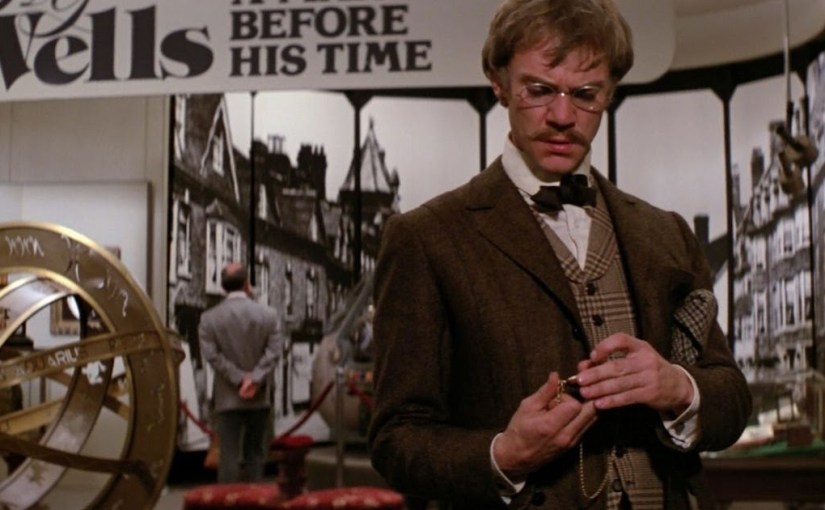
PLOT: Before he wrote any of his famous novels, H.G. Wells pursues Jack the Ripper to the 20th Century when the serial murderer uses the future writer’s time machine to escape his time period.


There are two scenes in Time After Time that are genuinely shocking from a story perspective.  One involves a newspaper headline.  The other involves a bloody crime scene.  The first I should have seen coming, but the second I never would have guessed in a million years, and I literally yelled at the TV when it happened.  That’s good plotting.

Those two scenes are the only things that prevent me from giving Time After Time a lower score.  That, and the fantastical, thought-provoking nature of the story itself.  Too bad both those scenes and the plot are buried under layers and layers of hackneyed dialogue and the kind of forced situational comedy that would be more at home in Three’s Company than in a sci-fi adventure.

First, the good stuff.  After a credits sequence that looks inspired by countless grade-Z movies before it, the story starts back in London, 1893, two years before H.G. Wells would write his first novel, The Time Machine.  A prostitute is murdered in a dark alley, victim of the infamous Jack the Ripper.  Later that night, Wells hosts a dinner party at his house for some friends and shows them something he’s been building in his basement: a fully functional time machine.  It doesn’t quite resemble the famous machine from the 1960 classic The Time Machine – it looks more like a ride vehicle from an amusement park than a chair with attachments – but the Victorian details are all there.  There’s some talk about a vital key needed to return to their present and a VERY important device that is discussed without being precisely explained, at least not to my satisfaction.  When it makes a reappearance late in the film, I was still mystified as to its actual purpose other than a convenient deus ex machina.

Suddenly, Scotland Yard appears.  Turns out they tracked Jack the Ripper to Wells’ doorstep.  Tricky Jack awaits his chance and uses the time machine to escape…though, without that handy key mentioned earlier, the machine returns to its point of origin on its own, leaving Jack stranded in a world 86 years in the future.  Wells feels duty-bound to bring Jack to justice, so he follows Jack, setting up the meat of the next few reels: a man from 1893 London struggling to adjust to daily life in 1979 San Francisco.

(It must be noted that the bulk of this film’s budget was clearly NOT devoted to the visual effects department.  The effects on display as Wells travels through time are cheesy at best.  I’d try to describe them here, but my words cannot possibly do them justice.  I couldn’t even find a decent still shot to embed here that would accurately convey just how low-rent they are.  I recently watched 1974’s execrable Zardoz, and I’m here to tell you, from a VFX perspective, Time After Time makes Zardoz look like Interstellar.)

H.G. Wells chasing Jack the Ripper through time?  This is a great plot from a sci-fi perspective, a thrilling “what-if” tale.  I had heard about this film for years but was never able to find a copy until recently.  The scores on IMDb and Rotten Tomatoes are decent.  Not stellar, but decent enough that I was pretty sure I would enjoy it.  The movie was directed and co-written by Nicholas Meyer, the mind behind The Day After, Star Trek II: The Wrath of Khan, and Star Trek VI: The Undiscovered Country.  That’s not a bad track record.

But, man oh man…for most of the film’s middle section after Wells arrives in 1979, the movie’s brain goes on sabbatical.  Example: he walks into a McDonald’s, takes careful note of how the customer in front of him orders a meal, then does his best to literally impersonate the customer.  He doesn’t just order what he orders…he gives an impersonation of the customer’s voice and accent.  Why?  He doesn’t do that at a pawn shop or a bank.  No, it’s just there because someone thought it would be a laugh to see Malcolm McDowell do a broad American accent.

I can’t deny that the potential is there for real humor.  I couldn’t find it.  I thought these scenes were completely at odds with the tone of the first third of the film.  Wells meets a bank teller, Amy, (a very young Mary Steenburgen) who inexplicably falls in love with him at first sight.  She’s so taken with him she impulsively asks him to lunch, an act that, in 1979, was directly at odds with 99.99% of all other screen romances, so kudos to that, I guess.  But why?  I’m not saying Malcolm McDowell is an affront to the concept of human beauty, but…really?  As Wells, he’s the 19th-century version of a science nerd.  Amy is not a character so much as a cardboard placeholder to be moved and manipulated according to the whims of the plot.

The dialogue is clunky, to say the least.  There is a foot-chase between Wells and Jack that is devoid of suspense.  The score by Hollywood legend Miklós Rózsa feels utterly out of place, as if someone simply lifted Rózsa’s score from some other film and plugged it in where necessary.  There is simply no romantic chemistry between McDowell and Steenburgen, as evidenced in a painfully unfunny scene when they sit on a couch and she declares: “Herbert, if you don’t take me into your arms, I’m going to scream.”

Another actual line of dialogue: “My mother was rather an atrocious woman in her own way, but her many failings did not include raising mentally deficient sons.”  That’s not a real person talking, that’s a writer trying to imitate George Bernard Shaw.

No doubt someone out there will tell me I missed the boat with this movie somehow.  Perhaps Rózsa’s score is intentionally “retro” to make the whole movie feel as temporally displaced as its characters.  Perhaps the intention was the same with the hopelessly amateurish visual effects.  Who knows.  It’s possible.  Maybe there’s a better movie here somewhere and I’m not equipped to find it.  I doubt it, but it’s a possibility.  In the meantime, I’m going to keep this movie in my collection as an example of how a great story can be derailed by poor execution.

And maybe I’ll bring it out if my fellow Cinemaniacs are in the mood for a “So-Bad-It’s-Good” movie day.

[P.S. Keep your eyes open for the screen debut of an 8-year-old Corey Feldman.]

THE ARTIST (2011, France)

by Miguel E. Rodriguez

Director: Michel Hazanavicius
Cast: Jean Dujardin, Bérénice Bejo, John Goodman, James Cromwell, Penelope Ann Miller, Missi Pyle, Malcolm McDowell
My Rating: 10/10
Rotten Tomatometer: 95% Certified Fresh

PLOT: A hugely popular silent film idol must adjust to culture shock when “talkies” suddenly invade the movie business.


Is there a movie more in love with the First Golden Age of Hollywood than The Artist?  I can’t think of one.  Sunset Blvd. comes close, but that was a caustic commentary on the heartless tendencies of studio executives to reject the Old and embrace the New.  The Artist covers the same ground, but in a much more comic fashion.

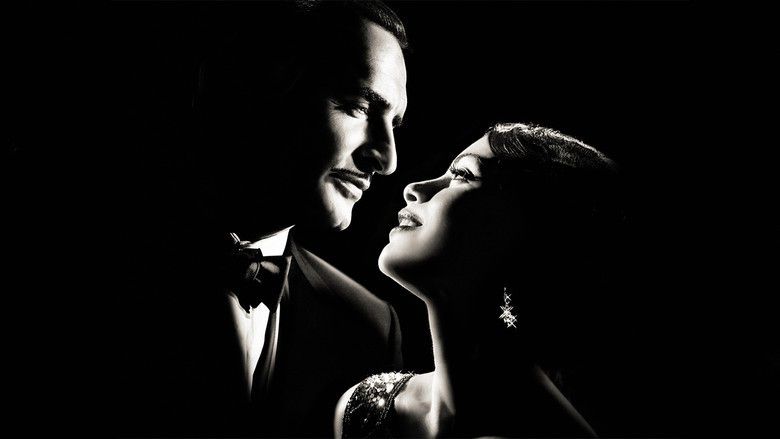
Not to say The Artist pulls its punches.  Not at all.  It tells the story of a silent film idol, George Valentin (Jean Dujardin), who has a meet-cute with a fan, Peppy (the stunning Bérénice Bejo), outside of a movie theatre.  Long story short, she becomes a bit player in numerous silent films and eventually becomes a superstar when the talkies take over Hollywood.  And George?  He struggles, as so many other silent actors did, to acclimate himself to a brave new world where faces and title cards aren’t enough anymore for an audience who is always looking for something new.

And, oh, yeah, did I mention The Artist is itself a silent film?  Shot in black and white?  Filmed in the old 1:33 aspect ratio?  Yeah.  It’s actually pretty cool.  It takes a little while to get used to seeing modern actors moving their mouths and not hearing their voices, but after a while, my brain acclimated itself to this “new” way of watching a movie.

As I was saying, The Artist doesn’t pull its punches in exposing Hollywood’s appetite for the New (in ways I don’t want to give away here), but it is still far more whimsical and audience-friendly than Sunset Blvd.  I’d compare it more to Singin’ in the Rain, if I had to compare it to anything at all.  But The Artist is a singular achievement, and well worth the Best Picture Academy Award for 2011.

There are two scenes in particular that elevate The Artist. In one, Peppy, who has always adored George from afar, finds herself alone in his dressing room.  She spots one of his jackets hanging on a coat rack and embraces it, imagining his arms inside it.  She then slips one of her own arms into the jacket, and voila!  She has a brief love scene where it really feels like she’s interacting with another person’s arm.  It’s a little hard to describe, but the effect is magical.

The second scene is one of my favorite scenes of all time.  George has just gone to see one of Peppy’s new films, a talkie.  The audience loves it, but he is still resistant to the idea.  He retreats to his dressing room, but something bizarre happens.  Remember, up until now, the movie has been completely silent (except for a musical score).  But this time, when he puts a glass down on a table…it clinks.  He stares.  What the heck was that???  He does it again.  Clink!  What’s going on???  He picks up a comb and drops it.  Thunk!  What the hey?!!  He opens his mouth to yell…but nothing comes out!

It’s a wonderfully comic moment, and a perfect way to demonstrate George’s anxiety at what this new technology will mean for him.

The more I think about The Artist, the more I’m realizing that the only way to properly discuss it is to go almost scene by scene, and I certainly don’t want to go down that road, especially for anyone who may not have seen it.  I mean, there’s the dog, George’s butler, the release date for one of his movies (October 24th, 1929, oh dear), the auction, the fire, and the deliriously happy ending, the kind of ending that tends to only exist in movies.

That’s really all The Artist is.  It’s an efficient engine designed to pull at our heartstrings and deliver a feel-good ending after teasing us with darker possibilities here and there.  The fact that it’s black-and-white and silent is a bonus, especially for film buffs.  It may not be realistic, but when it comes to Hollywood’s Golden Age…I mean, who really cared about realism back then?  (Back then, they didn’t need words, they had faces.)