JURASSIC WORLD: REBIRTH

By Marc S. Sanders

You’ve seen this movie before.  You likely saw it when you saw the trailer.  

The Jurassic films spawned from Michael Crichton’s ingenious best-selling novel, Jurassic Park (my favorite book of all time), stampede on and on, going on thirty-two years now.  Here is the seventh installment.  Once again, reinvigorated with a new cast and a bankable headliner/former Marvel Avenger.  

All year long, just like the last five films, I’m asking myself again why any of these people are going back to these islands.  Well Rebirth lends as good an answer as any.  Somehow the DNA from three different prehistoric mutated mega beasts will lead to a cure for heart disease.

Reader, from the outset I recognized the familiar pattern.  I knew precisely who was going to survive and who was going to perish before the closing credits arrived.  I got a perfect score, by the way.  Likely, you will too and thus the suspense is very watered down in Jurassic World: Rebirth. Seven times on the merry go round, you should know by now which direction this ride is moving.

Nevertheless, I was hoping against hope that the cure for heart disease will make it for the eventual consumption of human civilization.  The vials of Dino-DNA are collected and stored in an airtight briefcase.  So, while the scant cast of people screams, runs, tip-toes, swims, climbs and falls all over this tropical island, located close to the equator, my eyes were fixated on this medical breakthrough.  

Where are your priorities people? On the kid and her toddler dinosaur friend named Delores?  Come on!!!!! There’s much more at stake here than that or Scarlett Johansson and two-time Oscar winner Mahershala Ali. 

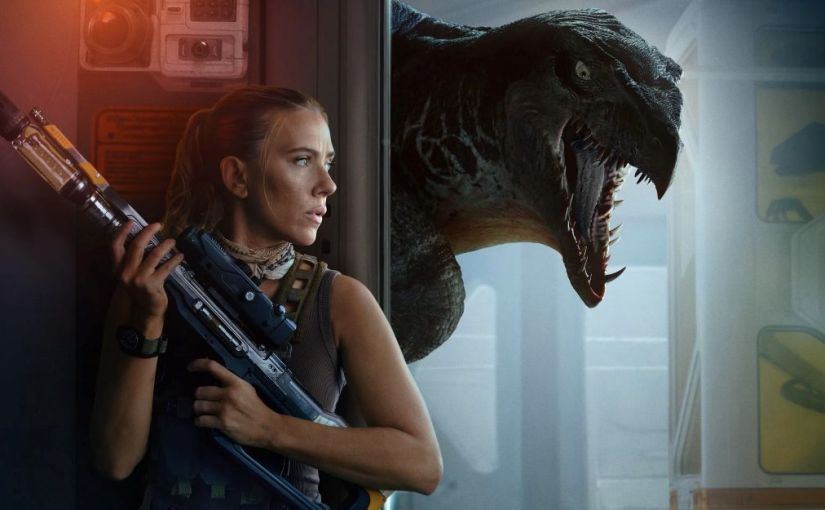
Gareth Edwards (Rogue One: A Star Wars Story) is new director in the franchise and I wouldn’t have it any other way.  The visuals of his dinosaur adventure are marvelous if not as impressive as they used to be.  Just like David Koepp’s script shamefully admits, the world no longer cares about dinosaurs as much.  Much of Jurassic World: Rebirth feels like a retread of the same old stuff.  At best, the only inventions left to tackle is to mold new monsters that are of a Frankenstein product.  The animals look fiercer and meaner and toothier and bigger…like way, way bigger.

Edwards and Koepp put the creatures in the ocean and in nestled caverns that have not been depicted as much before.  The sequences are done well but still I felt as if I had seen this movie before.

Not much can be said about Johansson or Ali’s performances.  She’s a high priced, skilled mercenary.  He’s the charter boat captain.  The rest of the cast is just the rest of the cast which includes some ready-to-sacrifice nameless folks gifted with screams to edit within and about five or six lines (one guy is privileged to share his French fluency), a pair of teenagers, an adorable kid and the resident greedy industrialist.  You know who I’m talking about, right?

I’m amused by those who rank the Jurassic movies.  How can you decide what is best or worst anymore?  The blueprints are so identical and the Dino gobbles and Dino chases and Dino roars all blend together for me by now.  If it was a Jeopardy category to identify which movie any scene was from, I’d lose big time and wager little on the Daily Double.

Beyond the first film from Spielberg none of these films are as special to me.  Like Chinese food, I fill up and I go back for more but that’s it.

Still…

Go to the movies.  Keep the cinema alive.  See the new Jurassic World movie and have fun with this new iteration of people going to the restricted island where dinosaurs romp and play.  I enjoyed it even if I never felt overwhelmingly stimulated.  At the very least I enjoyed watching my wife clap when she learned that one character survived.  

Me? 

…and 3…2…1… of course!

LEAVE THE WORLD BEHIND

By Marc S. Sanders

Anxiety and the unknown are the themes of Sam Esmail’s apocalyptic Leave the World Behind.  Actually, I can’t even be sure it’s apocalyptic or not until the end arrives.  Even then I wasn’t so sure.  

A family (Julia Roberts, Ethan Hawke as the parents, Farrah Mackenzie, Charlie Evans as the kids) make an impromptu getaway from New York City and rent a luxurious upstate air B & B for the next five days.  Upon arrival they are quickly relaxed amid all the amenities and beautiful outdoor pool.  A visit to the beach is refreshing until an oil tanker arrives from the deep ocean waters and drifts upon the shore with no warning.  Strange, but okay.  No need for that to ruin the vacation.

Then other unexpected occurrences happen.  A charming gentleman dressed handsomely in a tuxedo and his formally dressed daughter appear on the doorstep of the home in the middle of the night.  They are played very well by Mahershala Ali and Myha’la.  The man claims that he’s the owner of the house and while attending a concert in the city, they needed to make a quick exit and the best place to hold up was at this house.  Conveniently, he does not have any ID to prove his identity along with no specific personal items in this home he claims to own, not even the title ownership papers.  No photos of family tucked away anywhere.  He does have a key to the liquor cabinet, however.

Quickly, the scene is set where the internet goes down.  Federal blue screen warnings appear on every television channel.  Cell phones don’t work.  Deer, lots and lots of deer, appear in the backyard and then disappear.  Pink flamingos wade in the pool.  Elon Musk’s white Tesla cars have a stand out scene.  Roberts then recalls seeing a grizzled Kevin Bacon collecting an abundance of supplies when she made an earlier shopping trip in the local town.  

The paranoia starts to set in beginning with Julia Roberts’ character Amanda.  Amanda declares early on that she fucking hates people.  Hawke’s husband character, Clay, is not ready to hit any panic button and is happy to accommodate the strangers on the doorstep and just wait for the internet to be restored with a logical explanation.  Ali’s character, known as G.H., lends a welcome smile but it’s clear he’s not sharing all that he’s thinking or maybe what he knows.  

Sam Esmail’s film wants to provide a demonstration of how people respond when they don’t know all that’s going on, particularly when modern technology fails us.  A more relatable inconvenience is suggested as Mackenzie’s character Rose is frustrated that her streaming channel shut down just as she was starting to watch the final episode of the sitcom, Friends.  I felt her anguish immediately as my daughter consumes the trials and tribulations of Ross and Rachel on a repetitive cycle.  Ironically, streaming goes down and now the girl can’t watch Friends.  Netflix is the distributor of this film.  Yet, I think they just gave a ringing endorsement for a dying medium.  If only this girl collected the DVDs.  

My problem with Leave the World Behind is the slow pace of it all.  This is one of those movies where its triumphs hinge upon the final five minutes or so.  Either you applaud what sums up the last two and a half hours you invested, or you roll your eyes at where the picture drops you off with the urge to throw your popcorn at the screen.  

Watching Leave the World Behind brought back experiences of shows like Lost or The Walking Dead.  The set ups are brilliantly intriguing from one development to another.  The follow through on each new happening amounts to nothing or at least not anything where I can suspend my disbelief.  Questions are answered with questions.  It’s like calling an insurance company for information following a car accident.  You just want to slam the phone down.

When Ali’s character chooses to check on a neighbor, he sees a watch embedded in the sand nearby.  He picks it up only to get a fright that makes us jump.  The viewer sees nothing else and we are led to believe that Ali sees nothing else, until Esmail goes to a wide overhead shot showing the massive wreckage of a commercial airplane crash, complete with black smoke and flames and endless amounts of luggage and debris.  It’s hard for me to buy a scene like this.  G.H. doesn’t smell any burning fire nearby?  He doesn’t hear anything? He doesn’t see any other debris left mere inches away from the wristwatch only until Esmail’s direction goes from closeup to wide?  I cannot accept the character’s tunnel vision.  My eyes would go towards the crashed plane before I’d ever discover a wristwatch.  It’s just eerily quiet.  The director’s manipulation is a set up shock for me, the viewer, to grab my attention.  Yet, it backfires because it’s completely implausible.  There are many moments like this in the film.

Other than Marhershala Ali (who I still insist should be considered a viable candidate for the next James Bond or a 007 adversary), the rest of the cast is not dynamic enough.  Julia Roberts is working a little too hard.  Ethan Hawke is not working hard enough.  The dialogue is often boring arriving at no conclusions.  Thankfully, most scenes are enhanced by unusual camera angles from Esmail’s artistic freedoms with his lens.  It’s reminiscent of the deliberately weird structure that Stanley Kubrick often did with The Shining.  Nevertheless, it’s exhausting after a while.

Sam Esmail’s work is no doubt shown through long ponderous imagination.  I certainly felt Julia Roberts’ frustration on display, but still, I got the point.  I see no reason to repeat the same lines at higher volume.  I got the point of a lack of trust between the two parties being brought together.  However, I just got tired of the act.  The racial elephant in the room is even suggested.  Though I wish it wasn’t. People quickly forget that George Romero’s Night Of The Living Dead steered clear of any racial factor, and just look at the legacy of that film from the era of the Civil Rights Movement.

The ending that arrives seems inevitable.  Without revealing anything literal, it is doom and gloom.  However, I might have had more appreciation if suddenly the TV and internet got restored and these odd occurrences all just happened to be one big nothing.  At the very least, then I’d understand that this whole freaking planet would just go nuts without their You Tube, Instagram and Netflix.  

You might have had a conversation at one point in the last decade or so that began as “How did we ever manage to survive before the internet?”  The truth is we did just fine.  The adults in Leave the World Behind never stop to remember that though. 

SPIDER-MAN: INTO THE SPIDER-VERSE (2018)

By Miguel E. Rodriguez

Directors: Bob Persichetti, Peter Ramsey, Rodney Rothman
Cast: Shameik Moore, Jake Johnson, Hailee Steinfeld, Mahershala Ali, Lily Tomlin, Kathryn Hahn, Liev Schrieber
My Rating: 10/10
Rotten Tomatometer: 97% Certified Fresh

PLOT: In an alternate New York City, Miles Morales is bitten by a spider that has been strangely affected by scientific experiments being conducted by Kingpin. He soon meets other Spider-People from OTHER alternate realities who were dragged to Miles’ reality by those same experiments…


Right from the opening credits, an intense, fan-boy-level love of the Spider-Man characters (and comic books in general) radiates from the heart of Spider-Man: Into the Spider-Verse like those little squiggly lines of “spider-sense” that instinctively tells the various spider-people that they are in the presence of other spider-people.  It tells the other fan-boys, fan-girls, and fan-adults that here, at last, is a cartoon comic-book movie worthy of standing with the live-action giants of the MCU, both in terms of visual spectacle and in terms of an extremely solid, well-told story.

When I saw the first trailers for this film, I instantly dismissed it as yet another cinematic screening of a forgettable, straight-to-video animated feature.  The style looked like some kind of mish-mash of CG figures and hand-drawn faces, trying way too hard to be different without actually being effective.  The story was ultra-cheese, the kind of thing that even comic-book writers would find old-hat: a trans-dimensional rift allows Spider-People from different alternate universes to interact with each other at the same time.  And one of them is a literal cartoon pig called Spider-Ham.

Right.

So the movie gets released, and one day I take a peek at the ol’ Rotten Tomatometer, and it’s like at 95 or 96 percent.  And I’m STILL skeptical because the Tomatometer is only really accurate about 80% of the time.  But it continues to get buzz, and everyone on Facebook who sees it posts saying, “WOW, was that a good movie!”  It suddenly becomes the must-see movie of the holiday season.

So.  We saw it today, and just got home.  And WOW, was that a good movie!  It is fulfilling in just about every way a movie can be.  It had loads of humor; it was brilliantly original; it was visually stunning; it had real, EARNED dramatic moments; and it has the best credit-cookie since Ralph Breaks the Internet.

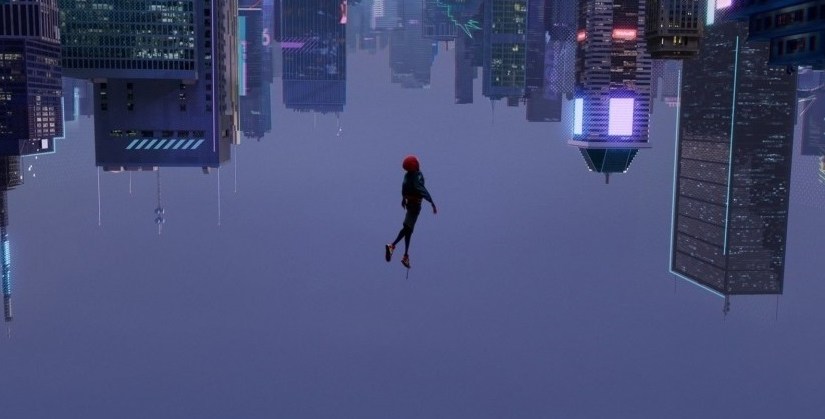
A lot of the film’s impact comes from that stunning visual style, which I initially dismissed.  As much as Sin City and Watchmen before it, Into the Spider-Verse takes great pains to recreate the look and feel of a comic book in as many ways as possible.  Speech panels appear occasionally.  Sound effects are manifested as words: “bap!” and “BOOM” and “bagel!”  (Yes, that is one of the sound effects.)  A lot of backgrounds are made to look as if they’re printed off-kilter, much like some comic books used to be printed back in the stone age.  This non-realistic style allows the filmmakers to create a crazy climax that would be virtually impossible with a live-action film; the CG would look too crazy to take seriously.

Aside from the visuals, there’s also the stunning originality with the screenplay.  For example, given the fact of many (infinite, really) alternate universes, the variations the screenwriters use are truly ingenious, particularly when it comes to the villains.  Kingpin makes an early, ENORMOUS appearance (he looks like the Hulk in a business suit), and he has a henchman that I really should have recognized earlier.  And the cleverness of Doc Ock’s arrival had me shaking my head in admiration.

The storytelling takes the time to let us get to know the inner workings of the main characters, a rarity in a non-Pixar film.  Miles Morales (the focal point of the story) is a high-school kid, loves his Latina mom and African-American dad, doesn’t love his new private school, loves bonding with his ne’er-do-well uncle…these connections are solidified in our minds so when the moment comes when a family member’s life is on the line, you feel it, man.  It’s not just drawings going through the motions.

It’s very hard for me to discuss the humor without giving away some of the best jokes.  You just have to trust me on this one, besides being one of the best comic-book movies of the year, it’s also one of the funniest.  (I LOVED the fake movie posters in Times Square.)

In closing, I can only apologize to the movie gods for completely dismissing this movie on the basis of the trailer.  Ever since that happened to me with Fight Club, I’ve tried to avoid making that kind of snap judgement.

SPIDER-MAN: INTO THE SPIDER VERSE

By Marc S. Sanders

Spider-Man: Into The Spider Verse is a spectacular new take on a beloved American tradition.

You know you are in for something good when Peter Parker’s Spider-Man introduces himself by reminding the audience how we know his story and the impact his alter ego has had including a cheesy street dance (Spider-Man 3) and an awful looking popsicle stick from the neighborhood ice cream truck. Then it swiftly jumps to a Brooklyn kid named Miles Morales, a good student who loves art and loves his mom and dad as well, even if he gets embarrassed to be seen stepping out of his dad’s patrol car.

Miles resides in one universe that we soon learn is separate from other universes that each have a spider version of their own. Look out though, because the universes are about to collide thanks to the dastardly Kingpin.

I’ll save the rest of the storyline for you to check out. There are some terrific surprises embedded in Miles’ journey to becoming a Spider-Man mixed with tragedy and surprising humor.

The animation took me a little to get used to but it was not a challenge. It’s a slick rainbow of different splashes of color. The action moves fast and I even got chills when a variation of Peter Parker encourages Miles to take a leap of faith, a moment that is inspiring for any young kid no matter if they are a boy, girl, White, Black, Hispanic or whatever.

Spider-Man: Into The Spider Verse reminds you that you can be whatever you want to be. Nothing and no one can stop you. Sure, its lesson sounds trite and done before but this film allows you to soar through inspiration. It’s difficult to describe the exhilaration, really. You have to see it for yourself to understand. Some might not accept this interpretation of the wall crawler. Some will embrace it. I never expected to love this film as much as I did. I was reluctant to see it and only opted to do so, once the incredibly positive reviews came out. This film is worthy of its praise.

Spider-Man: Into The Spider Verse might just be the best animated film of 2018.

GREEN BOOK

By Marc S. Sanders

The biggest surprise of Green Book is who its director is, the unlikely Peter Farrelly of The Farrelly Brothers, directors of Dumb & Dumber and There’s Something About Mary. Yet, when I reflect on the film it should not be a surprise. The Farrellys are known for raunchy humor, but often it stems from an honest source. When Viggo Mortensen’s character Tony folds an entire pizza pie in half and then scarfs it down whole, that’s a Farrelly touch but likely also what an Italian club bouncer raised in the Bronx would do without any consideration. He’d also win out in hot dog eating contest. Mortensen’s character is a far cry from his Russian Heyman in Eastern Promises or Stryder in The Lord Of the Rings. The pizza and hot dog scenes are great moments in a film weighted down by the Uncle Tom mentality of Deep South USA in 1962. Peter Farrelly needed to direct this film, and it just might be the best picture of the year.

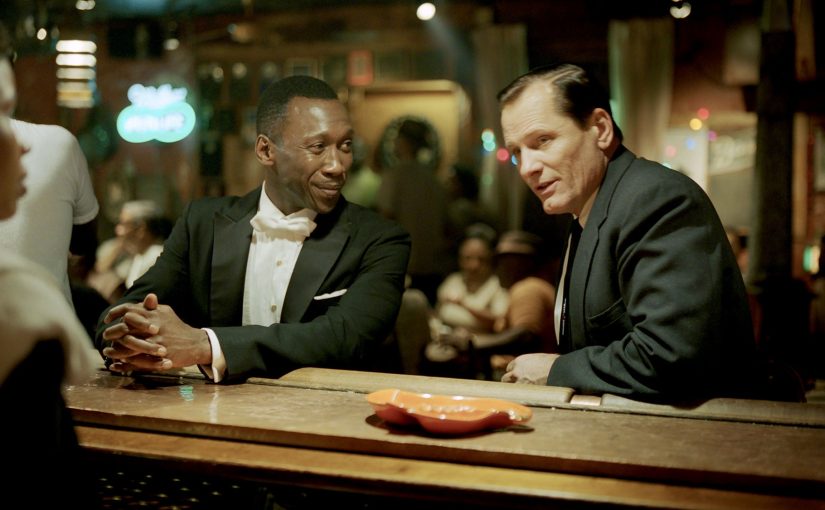
Tony (or “Tony Lip” as he’s known among his peers) is hired by Dr. Don Shirley played with such eloquence by Mahershala Ali. Dr. Shirley is an African American pianist, arguably the best in the world and ready to embark on a tour of the Midwest to Southeast of the country. It’s not that simple however as Dr. Shirley is all too aware of the racial prejudice that will befall him. Tony is hired to be Dr. Shirley’s driver as he has the toughness to look out for Shirley in the event that it is necessary. Sadly, the film shows that Tony is more than necessary.

There’s much comedy here between Ali, playing the well spoken “Felix” role, against Mortensen in the “Oscar” part. Tony and Don are worlds apart having virtually no understanding how the other half lives or what they are forced to compromise with on a daily basis. The hardships that Green Book offers focus more on Dr. Shirley as he is forced into humiliating circumstances where he is offered only an outhouse to use or denial of entry into a dining room. He could be wearing the sharpest of tuxedos, while Tony is a self aware “goombah” slob with no civility and Dr. Shirley remains the one to be overlooked. His value to Deep South America is to play his Steinway piano like meager jester.

There’s much to learn about our country’s mid 20th century history in Green Book. It’s a film I encourage families with pre-teen children to see. Not only will they learn of disillusioned hatred and treatment of black minority, but they will be entertained as well. References to Robert and John Kennedy are presented as well Aretha Franklin, and a Boston Celtics player (Name I cant recall).

The comedy that Farrelly brings keeps the audience engaged. The best dramas possess great comedy like Steel Magnolias, Terms Of Endearment, The Help, and even Kramer vs Kramer. If we can laugh along with our characters, then we will appreciate them that much more when harm and pain strikes. We want to ease their pain and be angry for them when those moments arrive. Their comedy of natural behaviors breeds affection for them. When they are compromised, we cry for them. Farrelly executes this format perfectly.

Mahershala Ali is a stand out here. He is snobbish at times towards the unmannered Tony but he is never deserving of his dismissiveness. He is a victim of the “colored mentality.” If not for the color of his skin, Dr. Shirley would have been regarded by all as a man of integrity; a hero to the American people. Sadly in 1962, many could not see past skin color. Thankfully, a great moment towards the end reminded me that it was in fact many…but not all. Watch the movie, and then tell me if you know what I’m referring to.

Remember, this is probably the best picture of 2018. Bring your children to see Green Book. Keep your children aware.