SILKWOOD

By Marc S. Sanders

As the 1980s were setting its stride, Silkwood might have been one of the earliest in a line of films to focus on the union worker who fights back at the billion-dollar corporation.  Some might unfairly regard the movie as The China Syndrome, Part II. Other well-known pictures of this mold are even more familiar to me like Michael Mann’s The Insider.  However, director Mike Nichols, working with a first screenwriting effort from Nora Ephron who partnered with Alice Arlen, showcases the aggravation on not just Karen Silkwood, the real life potential whistleblower, but also her friends and co-workers in a one factory town just outside of Oklahoma City.

Karen (Meryl Streep) lives with her boyfriend Drew (Kurt Russell) and her best friend Dolly (Cher) in a run-down house in the middle of nowhere.  They ride to work together at the local plutonium manufacturing plant where they dress in scrubs and gloves. Punch in, punch out kind of days, and often they are expected to work double shifts and weekends.  Karen works an assembly line where she places her hands in rubber gloves and assembles dangerous combinations of chemicals in an enclosed box.  It’s also routine that before you leave your station you wave your hands over a sensor to ensure you have not been exposed to radiation.  There’s even sensors you walk through as you enter and leave the plant.  When those sensors go off, a calm kind of film seemingly turns into a horror movie.  The last thing anyone could ever want is to get “cooked.”

Karen does not live a perfect life.  Her three kids reside with their uncompromising father in Texas.  Money is not ideal.  Dolly is a slob and has also invited her girlfriend to live with them.  Karen can manage with all of this, but when she observes some unconventional activities around the factory she gets up the nerve to head the union for better protection and working conditions.  However, the further she goes looking at files and photos, jotting down notes of what people say and do, plus taking trips to Washington DC, and getting phone calls from attorneys at night, she becomes more and more isolated from Dolly and Drew, along with the rest of her close-knit workers.  Karen is not just risking her job, but everyone else’s jobs and worse her own life.

The attorneys lay it out to the townsfolk and the union of the horrifying statistics that go along with radiation exposure.  The tiniest fraction of a miniscule of exposure to the smallest crumb of chemicals could increase a human’s bearable limit towards radiation and cancer.  The sad irony is that the more that is learned, the more the people of this area smoke and smoke some more.  Granted, this story takes place in the early 1970s, though.    

The company is primarily represented by an intimidating Bruce McGill.  He’s great in everything he does and is worthy of an Oscar nomination somewhere.  M Emmet Walsh has no lines but his presence is enough to shake you; the slimy guy you easily recognize from every other movie you have seen.  While the company’s overbearing intrusion is shown plenty, the script for Silkwood focuses more on how these working people get by.  They are treated unfairly and in dangerous working conditions, but they also know this is the only place that offers steady income in the area.  Without this factory, the whole town would be left in dire straits.  Karen is repeatedly told or implied to leave well enough alone.

Meryl Streep notches another harrowing performance on her resume and bears such a departure from more sophisticated characters found in Sophie’s Choice and Kramer Vs Kramer.  Karen Silkwood is not educated and she bears an unmistakable white trash dialect but she’s also not stupid and the more progress she makes at exposing the plant’s shortcomings the more unfairly she is treated with department transfers and workplace shake ups that she is indirectly blamed for.  Potential threats on her life begin to build, but she only upholds a bravery.  You really observe the strength of Meryl Streep.  She’s at the top of an elite class of actresses at this time that also included Sally Field, Jessica Lange and Glenn Close.

Cher plays Dolly in her first on screen role.  The variety act performer probably subjected herself to a bigger departure than Streep.  She was not a professionally trained actress at the time.  Mike Nichols insisted on no makeup along with her hair unkept and flat, while dressed in green chino pants and baggy sweatshirts.  The new actress carries herself so well without the usual glitz that accompanies her.  Her scenes with Streep are workshops in acting technique. 

Kurt Russell delivers another understated performance.  One of the best actors out there who has never been enough of a critical darling.  Drew is likable and Kurt Russell plays him as a settled in match for Streep’s portrayal of Karen.  Watch how they tangle up in each other’s arms in bed or when he snaps at her as she carries on her crusade while he’d rather things be left alone.  His timing is perfect for the script.

Mike Nichols keeps his film calm, except when the go by the numbers narrative must be disturbed.  A radiation cleanse with high pressure hoses will make you wince.  The factory alarms will terrify you.  Meryl Streep accepts the physical taxations necessary for this setting.  Nichols gets in close with his camera to show how cleansers dressed in scrubs and masks rub Streep down until her skin is a burning red.  I distinctly remember how her right ear appears in this scene, getting flushed by something just short of a fire hose, and the aftermath of her sitting in a chair is so discomforting while a company doctor assures her that there’s not much to worry about as long she brings in her urine samples daily.  In fact, soon all of the employees are tasked with delivering their urine samples.  What kind of place is this?

While Silkwood is based on a true story with a burning question left behind, I do not want to reveal too much.  Many have seen Silkwood since it was released over forty years ago, but as the third act begins, the fallout only becomes more disturbing and Mike Nichols directs a horrifying sequence built primarily on the pealing of old wallpaper.  That’s all I want to suggest. 

Karen Silkwood was a very unlikely crusader.  She probably never envisioned what she would become and what she would fight for.  Yet, she uncovered horrible truths that should not have been occurring under the eye of billion-dollar corporate America.  After watching Silkwood, I can only imagine what else was there to turn over.

NOTE: Another good reason to watch Silkwood is to discover early performances from some amazing character actors who were either just starting their careers or continuing to hide in the crowd. 

Scavenger hunt for Anthony Heald, James Rebhorn, David Strathairn, Ron Silver, Fred Ward, Diana Scarwid, Bill Cobbs, M Emmet Walsh, Craig T Nelson, Tess Harper, Will Patton, Richard Hamilton and Josef Sommer.

SLAP SHOT

By Marc S. Sanders

Slap Shot is to hockey what Caddyshack is to golf.  It is rude, crude and unapologetically harsh in its language, its temperament and with the memorable fraternal trio known as the Hanson brothers unforgiving with punches, slugs, checks and body slams.  The wardrobe looks dated (some of the ugliest plaids you have ever seen) and it was produced during a time when hockey players could opt not to wear helmets but it is still outrageously funny.  Best of all, Paul Newman, the guy from more upscale, sophisticated fare like Cat On A Hot Tin Roof, The Hustler, and Hud, leads the cast.  Some of the best actors are also the best comedians.  (Look at Robert DeNiro, Donald Sutherland and Clint Eastwood as well.)

The Charlestown Chiefs are the worst hockey team in the Federal League.  When the local Pennsylvania mill has announced that it is closing, it does not look good for the team as attendance will drop lower than what it already is.  The coach and oldest teammate, Reggie Dunlop (Newman), reaches for a few last-ditch efforts to elevate a demand and an appreciation for the Chiefs. 

First, he turns to reporter pal Dickie Dunn (M Emmet Walsh) and drops a made-up rumor that a Florida retirement community is interested in buying and relocating the team down south.  Then, it dawns upon him to antagonize opposing players which will lead into a series of goon fights.  His three newest recruits, the four eyed Hanson Brothers work best at bloodshed.  The enhanced violence lead to wins and suddenly the Chiefs have a new fan base that follows them on the road and sells out their home games.  Only one player, Ned Braden (Michael Ontkean) is against this new approach.  He’s college educated with a love for the game and refuses to stoop to Reggie’s level. A side story has Ned struggling with his marriage falling apart with his alcoholic wife (Lindsay Crouse).

In the meantime, as the rumor of the buyout stays alive, Reggie does his best to find who exactly owns the team.  He wants to convince that party to keep the organization running. 

Paul Newman owns this film despite a collection of fantastic characters that embody the team.  There’s the French-Canadian goalie who is not sharp at delivering proper English.  Killer Carlson (Jerry Houser) quickly develops a knack for being more of goon than a hockey guard. The team’s manager played by Strother Martin (a regular mainstay co-star in a series of Newman films) has to get the team to catwalk model the latest in fashionwear furs, and there’s Francine (Jennifer Warren).  She’s Reggie’s ex-wife, who still shares a thing with him but will not recommit while he continues to play hockey.

George Roy Hill (The Sting, Butch Cassidy And The Sundance Kid) is the unlikeliest of directors for a foul-mouthed film like this and just knowing that seems to make Slap Shot all the more rebellious and appealing for repeat views.  It’s as if Newman and Hill decided to lift their veil of innocence and join the ranks of the worst obscene.  These guys just said “Aw fuck it.  Let’s make the movie.”  I smile each time a sharp guy like Paul Newman delivers an F bomb.  It’s shocking, but it also works so perfectly.  Hockey is anything but delicate fare.

There are dozens of fight scenes in Slap Shot and normally I might claim exhaustion with its repetitiveness.  Thanks to Hill’s direction, every check or punch or wallop is caught differently.  No one is safe; the fans, the radio announcer, the referees, the organ player, the players.  All of them are in the line of fire of a puck or a punch.  While it should, none of what you see ever looks the same.  So, every contact in this contact sport brings one more laugh after another.  Absolutely hilarious!

The Hanson trio (played by real life hockey players – Jeff and Steve Carlson, David Hanson) became a pop culture sensation in cinema with the release of this film.  The image of these three goons, who look like nerds playing with racing car toys, is as uniquely identifiable as Arnold Schwarzenegger in his Terminator get up.  You can never forget the Hanson Brothers.

Screenwriter Nancy Dowd came up with the idea for Slap Shot after listening to her brother’s experiences of being on a minor league team.  Most of the characters she developed were based on actual players that Ned Dowd played with or against. 

I always like when a movie can teach me how an industry works.  With Slap Shot, as slapstick and raggedy as the material proudly is, there’s a mentality to witness and realize.  These guys are literally this brazen, crude and unrepentant, but like Newman’s character Reggie, they’re not stupid or unlikeable either. 

The conclusion of the picture is the championship game. It works because it performs against the grain of what the characters did to get to this point in the story.  The first period break in the locker room is hilarious with Strother Martin going off the rails while Paul Newman is muttering hilariously in the background.   What eventually sends this final game into the stratosphere is unexpected and hilarious. 

Slap Shot triumphs because it was never careful in its comedy.  It’s obscene, prejudiced by today’s standards and yet I do not believe most audience demographics would be offended because there’s an understanding in what it means to be a goon on a hockey team. 

Slap Shot may be a movie of its time from nearly fifty years ago, but it still holds up with big laughs and hilarious set ups. If I need to be more formal in my praise, it’s one hysterical fucking movie with a great fucking script.

Now cue the National Anthem because I’M LISTENING TO THE FUCKING SONG!!!!!

THE GAMBLER (1974)

By Marc S. Sanders

James Caan is Axel Freed, The Gambler, and when the film starts it shows the main character figuratively at the bottom of a very deep hole.  From this point on, he’s always looking at its great endless height above; a depth so low or a height so high, that there’s no crawling out of this trap.  No matter the opportunities that rescue Axel from a $44,000 debt to some bookies, he’ll never allow himself to be saved.

The autobiographical inspiration of James Toback’s first screenplay is hardly entertaining, but it held my attention all the way through.  Axel is a well-educated literature professor and an expert on Dostoyevsky but he’s entirely foolhardy.  A parallel inspiration comes from the author’s novella The Gambler.

I dunno.  Whether it’s 1974 or 2024, if I’m told I owe forty-four grand to someone who will otherwise break my legs and then who knows what else, I’d be terrified with fear.  Axel Freed seems to brush off his dilemma as he cruises through the city in his Mustang convertible.  To him, this is just the current setback of the week.  Nothing big.  He’s been in worse situations.  At least that’s what he tells himself. Axel swallows some pride and asks his mother (Jacqueline Brooks) for a loan, and she has to go through her own hoops to scrounge up the funds.  Look for an early appearance from James Woods as an unsympathetic banker.  Once mother’s monies are in hand though, Axel opts for a different route than to wipe his debt clean. Therein lies the anchoring burden of gambling addiction.

Toback’s script, directed by Karel Reisz, is not so much about a story as it is about living with overwhelming compulsion.  He writes good dialogue performed with apathy by Caan.  It’s not about winning.  It’s about the thrill of possibly losing the money he’s got in hand. 

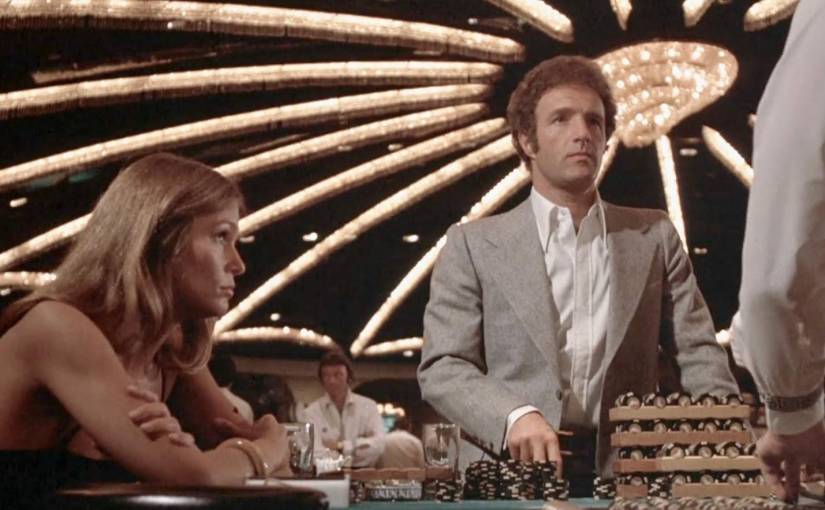
Once Axel obtains money, he ventures off to Vegas feeling sure that he will double what he’s got and still manage to pay off this huge debt.  The brilliance of the film is that it had me tricked as Axel marathons through victory at every table while also feeling confident on three college basketball games that seem to be moving in his favor.  I was not sure if I was looking at a hero or a despairing loser during this sequence.  Reisz convinces me that it can go either way for Axel with his girlfriend, Billie (Lauren Hutton) in tow.

As many films, books, and programs that I’ve encountered focusing on gambling and the addiction it musters, I feel confident I know the outcome of the piece.  What sets The Gambler apart though is the realistic nature of what this kind of craving does to a person.  It depicts the victim as in denial, rejoicing when he dodges bullets, thinking he’s invincible.  The film demonstrates how those close to Axel Freed respond to his mounting dilemmas, but also how they are affected.  It’s inclusive not only of his Billie, his mother, his self-made millionaire grandfather, or even his main bookie (Paul Sorvino), but an admiring student of his as well. 

There are scenes that I could see how they are going to play out as soon as they begin.  I’m sorry but when I see tough guy character actors like Burt Young and Vic Tayback enter a story like this, I know something, or someone, is about to endure some damage and walk away feeling terribly threatened.  Still, I’d be complaining if Toback excised moments like this from his screenplay.

The ending left me feeling a little perplexed as to if it really belongs here.  It’s not a happy ending but seemed to come out of nowhere and I questioned its relevance against everything else that was seen before. 

The strength of The Gambler lies in the honesty of James Toback’s script and the performance of James Caan.  The film belongs exclusively to Caan and his character, with the others entering the frame when they are called upon for a cause and effect of Axel’s actions and decisions.  There’s nothing to celebrate in a hard drama like this, but I applaud the film’s will to uphold a genuine truth of how gambling addiction leaves behind a crippling life for those caught in continuing temptation.

BLOOD SIMPLE.

By Marc S. Sanders

 “blood simple” is a term coined to describe the addled, fearful mindset people are in after a prolonged immersion in violent situations.

         IMDb – originally located in the book Red Harvest by Dashiell Hammett

The Coen Brothers’ first of several legendary and unique films is a seedy noir thriller called Blood Simple.  Joel Coen is the director.  Ethan Coen is the producer.  They wrote the script together and collected whatever pennies they could find door to door from anyone willing to invest in the picture.  You see how shoestring the budget was for this small film, but that’s exactly why it works so effectively.  The lowlifes of their script are not the sophisticated type like Hannibal Lecter or Harry Lyme.

This is a condensed piece, just over ninety minutes, with four principal players who inadvertently cause themselves to get tangled in a bloody web of gory crime.  The fun part is that none of the four know the whole picture of what’s occurring, or how, or why.  I’m satisfied the audience is in on the whole thing, though.

Without giving too much away, Dan Hedaya is Marty, the owner of a sleazy Texas saloon.  A private investigator provides evidence of Marty’s wife, Abby (Frances McDormand, in her debut performance), having an affair with one of his bartenders, Ray (John Getz).  Marty hires the P.I. to murder the two lovers.

Simple enough, right?  Wrong, because the Coen Brothers wisely have their players color outside the lines and soon there’s blood all over the floor, as well as in the back seat, and maybe something important was mistakenly left at a crime scene.  Perhaps someone who was thought to be dead is not, and maybe what you thought occurred is something else entirely.

Blood Simple. works because it operates beyond convention.  The characters are so unaware of what to do next or what precisely has happened that it introduces one layer of confusion and misunderstanding after another.  This is nowhere near a common episode of Three’s Company.  What’s even more appreciative is that once the end credits roll, those that survive this lurid tale will still never have a complete grasp of what’s happened or when or where the convolutedness began.  It’s satisfying that all of the answers are at my disposal. It gives me a sense of omnipotence.

M Emmet Walsh is the scuzzy private investigator.  You’ve seen this celebrated character actor countless times before.  It is this performance that might be the one where you would no longer recognize him as “What’s that guy from?” because now you’ll never forget his name. He’s a villain who pounces on a genius opportunity, covering all bases, until there’s one minor oversight.  The Coen Brothers inventively have this guy circling the waters of the whole film, and yet only one other character is aware of his existence.  Still, this guy is vital to the assorted conflicts uncovered in this sort of graphic novel pulp fiction.

Blood Simple. sets up scenes  that can be bridged together by what if scenarios. How can two windows mere inches away from each other lend to a painfully agonizing, thrillingly welcome moment of terror and suspense? When this scene arrives, does it make sense for how the characters play it out?  You bet it does.  

The film is strong due to its lack of dialogue too.  We watch what these characters do much more than we listen to anything they have to say.  Important props and locations seem to tell us more than any of the actors, and that’ll allow you to think like the character.  You read their minds rather than feeling a need to have everything explained to you.

Blood Simple. is an inspired nod to some of Hitchcock’s bewildering best like Dial M For Murder and Strangers On A Train.  It succeeds because of the twists it offers as nothing ever goes according to plan.  You’ll watch it once and then you’ll want to see it again to follow the breadcrumbs that trail off the path.

THE JERK

By Marc S. Sanders

As I close out this year, 2023, it’s funny that one of the last films I watched was The Jerk, directed by Carl Reiner with Steve Martin as dumb, lovable, idiotic, adorable, and moronic Navin – who was raised as “a poor black child.”  I find it funny because I have just come off the heels of directing a play I co-wrote with a best friend I just lost from ALS.  That friend was a part of my life for thirty years, and his name was Joe Pauly.  The play was a smack in the face, a head slammed against a door with an enormous amount of pratfalls to Charles Dickens’ holiday classic.  Joe and I called it A Christmas Carol Gets Decked

The play was an enormous box office hit for our theater, but the reaction to the show was mixed.  There were big laughs each night, but we also had some walkouts at intermission, and I wasn’t surprised.  Slapstick is not for everyone.  The cast was always brilliant though.

As I watched The Jerk, first I was sad that I never, ever talked about this movie with my pal Joe.  I bet he loved it.  Second, I found it fitting that my heroes Roger Ebert and Gene Siskel didn’t care for it.  Their review from 1979 can be found on YouTube.  Ebert simply said he didn’t like Steve Martin’s form of comedy.  He’s just not a fan.  Fair enough.  Siskel said the star’s brand of humor was Steve Martin doing Steve Martin, and it would have worked better as Steve Martin doing comedy as the character, Navin.  I do not think Gene Siskel is wrong.  I look at The Jerk, and I think Joe and I accomplished what Steve Martin was doing.  There is a collection of gags that I do not think are funny, but then there are at least an equal amount of jokes that are utterly hilarious and thankfully shocking.  Joe and I took a risk with comedy, just like Steve Martin; like anyone who is brave enough to enter through that dark valley alone where the act is always a test, night after night, performance after performance.

I love the plot of The Jerk, which is straight out of a Three Stooges short. Navin stands out from his family as the one with white skin and no rhythm amongst his large southern, black family.  I was so pleased to see Mabel King from What’s Happening!!! portraying Navin’s mother.  Following his birthday, Navin embarks on a journey to St. Louis to discover a life for himself.  He gets a job working for Jackie Mason at a gas station and falls into a fortune when he shares his invention for eyeglasses with a random customer (Bill Macy).  Along the way, he falls in love with Marie, a sweet Bernadette Peters, who looks like Alfalfa’s crush from The Little Rascals.  They get a mansion and live filthy rich, blah, blah, blah. SPOILER ALERT!!!!! The film’s famed director, Carl Reiner, reveals that Navin’s invention is defective and following a one, two, three class action lawsuit, Navin and Marie are flat broke.  I love the body of this plot.  Rags to riches to rags opens an invitation for one gag after another.

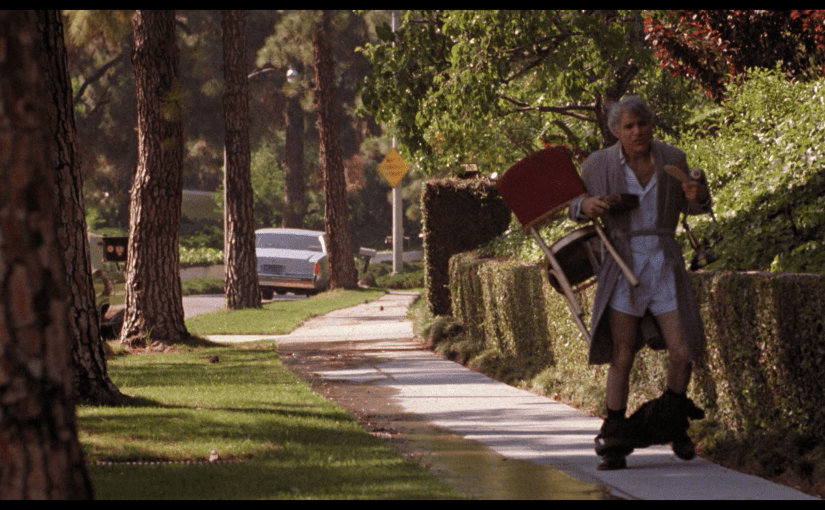
There’s his trusty dog named Shit Head.  Navin insists on no longer drinking the old wine.  Bring him the new stuff.  A crazed sniper (M Emmet Walsh) tries to kill Navin, misses and Navin reasonably concludes that it must be the oil cans that the killer has a grudge against, when the bullet holes spring leaks. Makes sense to me!  If you accidentally run outside naked to chase after the one you love, who is leaving you, then of course you will reach for the dogs nearby to cover up your bare behind and “your special purpose.”  Hilarious stuff.

There’s material that doesn’t work as well, but that’s just me.  Like the audiences that saw the play Joe and I wrote this year, what one person thinks is funny, another will not.  It’s a balancing act.  I’m not here to mandate what works and does not work for you.  I just want to celebrate Steve Martin’s inspired Three Stooges spawn that welcomed him to the big screen, long before the antics of Jim Carrey – who I rarely think is funny and simply comes off as an annoying child who won’t sit still.  That being said, I still prefer Martin’s  later work where he played the straight man victim to someone else’s annoyance such as in Planes, Trains and Automobiles (a favorite film of Joe and I, collectively) and Parenthood, not to mention the brilliant Only Murders In The Building, and his routines on Johnny Carson (a hilarious magician was my favorite) and Saturday Night Live.  The guy is an enormous talent far beyond The Jerk or The Man With Two Brains.

The Jerk had always eluded me, until now.  I think my parents wouldn’t let me watch it.  Dad thought the material was “filthy.”  He probably saw the one gag where the kid is running around with a t-shirt having the phrase “Bull Shit,” and thus opportunity passed me by.  Yet, he didn’t mind if I watched Dirty Harry or any of Bill Murray’s comedies.  Go figure.  That’s what the varying degrees of humor lend to you.  There are no straight answers in comedy.

Still, I’m glad I watched the movie.  2023 was melancholy for me.  There were some enormous ups, but losing my pal Joe, the Del Griffith to my Neal Page, was an expected but very hard moment to accept when he passed on December 4.  I’m still struggling with the loss.  In his last six months, he couldn’t speak with me on the phone, but at least I could text with him, and once the movie ended with Steve Martin happily dancing to banjo rhythms with his black family, I picked up my phone ready to write to him.  It couldn’t happen anymore.  At least not that way, from now on.  So, here I am on holiday break surfing Netflix, and there’s The Jerk with a warning that it was leaving the streaming service soon.  Joe must have been urging me to finally catch up with Navin, the poor black child.  Thanks Joe.

Chin up everyone.  We were all a name in a phone book. Happy New Year!!!!

CLEAN AND SOBER

By Marc S. Sanders

There’s nothing pretty about alcoholism and drug addiction.  Surprisingly enough, I can only think of a handful of films that really explore the struggle ahead of the main character admitting to a problem, then going through the rehabilitation process, and then trying to live without the chemical dependency, thereafter.  Each of these stages have been depicted plenty of times, in all kinds of mediums.  Yet, Clean And Sober, directed by Glenn Gordon Caron, with Michael Keaton in the lead role, covers all three quite effectively.

Keaton portrays Daryl Poynter, a successful real estate broker.  When he’s awakened by a phone call one morning, his incessant sniffing is interrupted by his insistence to the caller that he’ll check on a missing $92,000 from an escrow account on Monday morning.  He quickly hangs up the phone and turns towards the nude woman in his bed.  Then it dawns on him that something is not right with her.  Police determine she has overdosed, and Daryl better stay in town. 

Instead, Daryl opts to check in anonymously to a nearby rehabilitation center.  He’ll get free room and board, and no one will know to look for him while he’s hiding out from those looking for the escrow money or how he may be responsible for the drugged woman.  He’s just hiding out, though.  Daryl has no intention of following the program the center offers.  So, Daryl is a rule breaker where he sneaks in phone calls to his stockbroker, and his friend that he insists send him an overnight package of cocaine he kept stashed in his office desk.  Morgan Freeman is Craig, the leader of the recovery program and a recovering addict.  He easily sees through Daryl’s shenanigans and kicks him out.  Following a late night, out-of-control episode at his office, while looking for his drugs, Daryl returns to the center and gradually acknowledges his problem, while still living in fear of the consequences when he learns the woman he was with has died and her father has gone out looking for him.  His bosses are also questioning the whereabouts of that money.

Keaton turns in a chain smoking, red eyed performance.  His appearance and body language convincingly send the message of his harmful addictions more than his line deliveries.  Honestly, I found him to be a little over the top with his rantings and “fuck you” temper tantrums.  When I was observing his behaviors, only then was I buying his portrayal.  This role should serve as a significant accomplishment in the history of Keaton’s career.  Before this film, from 1988, the actor was more well known for comedies (Mr. Mom, Gung Ho, Johnny Dangerously) and his tours on the stand-up circuit.  I think he became a better dramatic actor later on. 

Freeman is once again so good as a subdued, in charge and street-smart mentor.  Another good mentor comes from the never showy character actor, M Emmet Walsh (I find him in so many of these now classic films; he really had a presence in Hollywood.)  Walsh is Richard, the unglamourous sponsor that Daryl was never expecting.  Daryl was holding out for an attractive woman to be his sponsor.  A great scene occurs between the two actors when Daryl meets Richard at a diner for lunch.  Richard has three desserts and a milkshake on the table in front of him.  Daryl makes a crack about it, and Richard reminds him that they are addicts.  It’s in their nature to be compulsive, even with food.  Good writing here, from Tod Carroll, who doesn’t take for granted how a recovering addict lives with himself, for the rest of his life, from one day to the next.

Carrol offers up other special scenes.  We’ve all seen the staged AA meetings where the character stands up, says his name and the others say hello back.  Tod Carroll goes a step further.  Morgan Freeman as Craig is a smart character who sees past the well to do appearance, and smiling face of one young female character and calls her out for being high right in front of the group.  He immediately asks her to leave, and rather than come off embarrassed, she exits the room.  The rest of the group, Daryl included, are shocked.  They are only beginning to learn how people like them function only on the dependency of the drug and drink.

Kathy Baker portrays another addict that Daryl becomes attached to.  She’s also very good in her role as the lonely woman with the boyfriend who treats her like dirt, yet she can’t imagine anyone better for her; not even Daryl as he’s moving on a positive path towards recovery, and wants to begin a life with her.

Caron and Carroll focus the script of Clean And Sober on a variety of ways that addiction affects different walks of life.  It’s fortunate that the film does not fall into the trap of melodrama.  Chemical dependency is an ugly ordeal that destroys so many lives, not just the abuser.  Relationships are tested.  The will to function is also tested.  As well, the endurance to remain clean and sober is tested. 

This film might be from the late 1980s, but I’d argue that its themes and messages remain prevalent today.  Alcohol and drug addiction still stand as leading killers within the country.  I believe violations of DUI are not taken seriously enough.  Alcohol and drugs are too easily accessible and affordable, thereby feeding the illness.  Ultimately, we can only be responsible for ourselves.  One way to hold fast to our committments is to observe and learn.  Clean And Sober will allow you to do just that.

BLADE RUNNER

By Marc S. Sanders

Ridley Scott’s Blade Runner is a technical and special effects masterpiece…however thin-very thin-its story may be. 

When the film was originally released in 1982, its period setting of November 2019 seemed unimaginable.  So, it was easy to accept that the dystopian future first conceived by author Phillip K. Dick (in his book Do Androids Dream Of Electric Sheep?) could actually happen.  With the Vietnam War behind us, and shopping malls becoming the happening place to be in our Members Only jackets and Jordache jeans with Swatch watches, the 1980s seemed like eternal bliss.  Middle class America felt prosperous and free and comfortable with a President on his way to eight years in office.  Bright pastel and neon colors took over.  A hopeless, dreary future was all but fantasy.  Therefore, just like Star Wars, a gritty, urban Los Angeles seemed like another possibility where science fiction had become as trendy as super hero movies are today.  It was cold and rainy and dirty, but we wanted to see that because that was nowhere near what we were living in, much less envisioning. 

Ridley Scott achieved greatness with visuals never thought possible.  George Lucas might have introduced moviegoers to desert and swamp planets and industrialist Death Stars, but Scott delivered an Earth where Coca-Cola, Pan Am, Atari and Cuisinart still existed amid a dark, rainy Chinatown section of Los Angeles with glowing umbrella handles, flying police cars and cabs, hovering electronic billboards, and exhaust flames that spewed out of the rooftops of cylindrical skyscrapers.  Ridley Scott might have supervised this palette of futuristic film-noir, but the real heroes of Blade Runner belong to its Oscar nominees Lawrence G. Paull, David L. Snyder, and Linda DeScenna for set decoration, as well as Douglas Trumbull (already a legend for 2001: A Space Odyssey), Richard Yuricich and David Dryer for visual effects.  All these years later, there’s much to explore within the appearance of Blade Runner, but the storyline still remains shallower than a puddle of water.

I’ve watched Blade Runner a number of times because fellow peers and colleagues carry such admiration for the film.  I cannot deny the first third of the film holds your attention as you acclimate yourself to this enveloping world.  Once your accustomed however, the story is what has to carry you through to the end, and the journey is as slow moving as a rickshaw on one wheel.  Harrison Ford is Rick Deckard, a blade runner and the best one there is.  Upon learning of an escape of four Replicants from an off-world slave site, Deckard is tasked with coming out of retirement to hunt down these Replicants and “retire” them.  Retire is the polite word for kill, exterminate, slaughter or execute.

A replicant is an android that looks completely human, bleeds like a human and talks like a human.  It’s near impossible to tell the difference on sight between a human and a replicant. As well, replicants are manufactured with four-year life spans and are not permitted on Earth.  They are intended for the sole purpose of slavery towards their human creators.  Yet, what makes them so exemplary or offensive?  What trait do they carry that threatens their human counterparts?  Racism often occurs because of fear derived from skin color or appearance.  Antisemitism will have you believe that Jews have horns growing out of their heads under their yarmulkas.  What is so terribly misconstrued or offensive or threatening about Replicants?  The film never makes clear, and that’s frustrating.  What makes a villain a villain?

M Emmet Walsh comes on early enough to tell us through dialogue that he needs the best of the blade runners back and that’s Deckard.  When I’m to understand that I’m watching the absolute best of something, whether it be a cop, lawyer, baker, student, doctor, painter or blade runner, I want to see what exactly makes them the best.  In Top Gun, I saw the aerial maneuvers that potentially justified why Maverick could be the best of the best fighter pilots.  The problem with Blade Runner and the script, written by Hampton Fancher and David Webb Peoples, is that I never see in its two-hour time span when or how Rick Deckard is such an exceptional blade runner.  How is a blade runner different from an ordinary cop or a simple person with a large gun?  No matter which of the various cuts of the film I’m watching, with or without Harrison Ford’s voiceover narration, I fail to see any outstanding fighting skills or clear thought-provoking intuition.  This guy is neither as good as Dirty Harry or Sherlock Holmes or even James Bond.  He’s not even as personable as Sam Spade, the original noir detective.  Rick Deckard just looks like Harrison Ford with a very large hand gun.  Furthermore, where does the term “Blade Runner” derive from?  Is it just there because it sounds cool?  The moniker wasn’t even created by Philip K. Dick.

The film’s eventual sequel, Blade Runner 2049, is a far superior film.  It’s longer, but it’s much more fleshed out in tone and character and understanding of its setting.  The original film stands on the heels of its cult like legendary status.  Some of the best filmmakers today cite Blade Runner as an influence in how they construct their own movies.  I buy that.  The assembly of whatever cut I’m watching is evident of how mind blowing its appearance is.  You can see some of the blue print visuals that carried over in to Christopher Nolan and Denis Villeneuve’s pictures. But I’m past all that.  Now I need to appreciate what it’s all there for, and who is playing in its yard. 

I cannot simply rely on IMDb trivia and endless social media sites that speculate on whether Deckard is a replicant himself, or why he dreams of a unicorn and why Ridley Scott opted not to include said dream in the original cut.  I cannot just tickle my curiosity with the picture’s eerie foreshadowing of the various product placements that suffered real life eventual downfalls after its release.  Beyond the visuals, what am I watching Blade Runner for?  This is not just a riddle in the Sunday paper.

The film boasts an eclectic cast that work well together.  I just wish they were provided with something much more insightful with background and personal experience.  Rutger Hauer became a familiar name following the release of this picture.  When he’s finally given the opportunity within the second hour of the film to come off as hideous and terrifying and strange, it’s worth looking at.  His famous “tears in the rain” closing dialogue is beautifully poetic, as it was personally written by him.  It’s as ambiguous as the film.  Yet, Shakespeare can be vague too.  I might not understand what anyone is talking about, but the performance can keep my attention.  Regrettably, he does not do much else in the film beyond his closing fight scene with Ford.  Ridley Scott insisted on casting Sean Young as Rachel, as her appearance was reminiscent of Vivian Leigh.  She’s intentionally mysterious as a likely replicant and/or niece of the wealthy creator of the replicants, Dr. Tyrell.  It works, but again, if the viewer is going to be questioned on the mystery of this major character early on, then why doesn’t the film follow further into that enigma?  You don’t have to say for sure, but at least give me evidence to argue one way or the other.  The same goes for the speculation on Deckard.  Had it not been for outside references, I’d never question who or what Deckard really is.  Daryl Hannah, Brion James and Joanna Cassidy round out the rest of the cast/replicants within the film.  Edward James Olmos is here too with a curious and odd habit of making origami.  They all have their unique way or look about them.  In science fiction, every character should stand apart.  Yet, again, it’s all about appearance.  What is the motivation here?  What is the motivation to live on earth or off earth?  What is the motivation to kill a human?  What is the motivation to kill a replicant?

I’ve beaten my head enough over this film.  Blade Runner has always been frustrating to me.  Maybe I’m not being fair to myself, as I try to find something else or some underlying layer each time I watch it.  Why do people love this movie so much?  Why does it consistently appear on “greatest of all time” tabulations?  Ultimately, I’ve come to the conclusion that I’m just pounding sand, or maybe as Rutger Hauer’s Roy Batty suggests, I’m impossibly looking for tears in rain.

BOUND FOR GLORY

By Marc S. Sanders

David Carradine plays Woody Guthrie in Bound For Glory, directed by Hal Ashby.  It’s a magnificent performance in a well-constructed film especially by the standards available in 1976, and still today in 2022.  Yet, am I capable of showering the film with additional accolades?

My first viewing of the Oscar nominated picture occurred with my Cinephile pals (Thomas Pahl, Anthony Jason and Miguel Rodriguez).  More or less, we all had the same reaction.  The film is as slow moving as much as the slow-moving trek that Guthrie embarks on from his dustbowl home town of Pampa, Texas all the way to California.  Guthrie is a musician, especially when he’s strumming a guitar and he’s altogether attractive to anyone within earshot as he seemingly makes up the lyrics to his Depression-era Americana songs on the fly.  Anyone reading this has certainly heard of “This Land Is Your Land.”

Woody is married to Mary (Melinda Dillon) with two children, and as the film opens in 1936, his hometown is flat broke.  There are no jobs anywhere.  Families are abandoning their homes that they can’t afford to maintain.  Literally, no one has two nickels to rub together.  It also doesn’t help that the town and outlying areas are plagued with monstrous dust storms.  Ashby with legendary cinematographer Haskell Wexler offer up a caption of one such storm towering over the town like a terrible tsunami.  Even on Blu Ray, this is eye opening.  It’s a magnificent visual effect that took me completely by surprise. 

Shortly thereafter, Woody ups and leaves his family with just a note saying he’ll send for them once he settles down in California.  I can only guess he’s looking for a better life, and I can only presume California is the promised land of wealth and well…glory!  I don’t recall a prior conversation that praises the state as the land of milk and honey.

Wexler spoils the viewer with countless moments of scenic design as the film moves on.  We follow Guthrie as he walks the endless roads towards the west with nothing to hold in his hands.  He hops on cars that pass by.  He also hitches rides upon locomotives heading in the western direction.  Ashby reminds us that the sojourn is not easy. Seems like everyone has the same idea in mind as Woody; looking for a better way of life. Fights for sitting space on train cars break out.  Authorities try to shoot stowaways off the trains, and the best place to hide is maybe on the roof of the train, or simply hanging on to a ladder with your elbow painfully folded over, as the train moves on.

Whenever I watch a film, I try to make a habit not to look at the time.  If I do, I feel like I’ve broken the wall of the environment I should be immersed in.  I kept to my rule on this film, but Guthrie’s journey takes so long, that I truly thought once he reached California, that would be the end of the picture.  Not so.  There was at least another hour to go.  Wow, did this thing move at a snail’s pace.  Woody arrives and gets into episodes of infidelity, and more importantly he bonds with another strummer named Ozark Blue (Ronny Cox), who travels the state singing in support of a union for the poor and destitute working odd jobs on farms and railroads earning only pennies by the day.  Woody eagerly takes up the cause even as he is becoming a pop sensation on the radio.  The fight for the rights of the poor becomes so passionate for him that he butts heads with the radio big wigs who insist on knowing what he’s going to sing about on air, to ensure the wealthy sponsors remain happy. 

I read briefly afterwards that much of what is depicted in Bound For Glory is actually not true to Woody Guthrie’s story.  My buddies felt a little betrayed knowing that.  I still don’t know what is and isn’t accurate.  I dismissed all of that, though.  What fascinated me was the technical work of the film.  When David Carradine is leaping on to a moving train or jumping off of it, that’s really him.  We also uncovered that along with Rocky, also released in 1976, Ashby’s picture was one of the first to use a Steadicam and the output is marvelous.  Ashby with Wexell’s lens is unbelievably impressive.  They capture Carradine walk through an ocean of extras while strumming the guitar and singing in the moment; his voice never cracking and all happening in one take.  Carradine is seen standing in between train cars and lying on top of them with the rising or dawning sun in the foreground.  The film delivers a literal moving picture to Woody Guthrie’s most famous song “This Land Is Your Land.”  For a film made in the mid-1970s I certainly believed what was captured was genuine to the mid-1930s. 

Ashby also seemed to be inspired by the The Grapes Of Wrath.  Numerous cars of the time are disproportionally stacked with furniture like dressers, kitchen chairs and tables, along with knapsacks and sleeping bags, while the raggedly clothed children hang out the window or sit on top.  A nipple bottle top is attached to a glass Coke bottle for a baby to drink from.  If you are looking for reference material of what it was like to live in the times of the Depression, look no further than Bound For Glory.

I can’t say I will rush back to watch this film again.  The story never grasped me.  I was waiting for that special turnaround moment to come that would perk up my interest.  It just never arrived.  There’s no question, however, that the merits of the piece stem from the set design and camera work at play.  It is absolutely jaw dropping.  Woody Guthrie’s story, though, not so much.  He had faults. We learn he is not a devoted family man (something we’ve seen many times over in countless stories), and his drive to fight for the rights of the working man doesn’t appear to stretch very far.  After nearly 2 hours and twenty minutes, Guthrie up and decides to resume his countrywide walkabout on trains to sing in devotion for the working class across the country, but beyond a favorite camp fire song, what else did he truly accomplish?  There’s never a time when he sways the authority to see it his way, and there’s never an announcement that a union is established in direct response to Woody’s movement.  At best, we are offered Randy Quaid in a small role as a one of the poor family men who reminds Woody to keep doing what he’s doing.  However, that’s a staple of any biography film really, and in pictures like Malcolm X or The Last Emperor, it seemed that much more effective. 

Maybe there was more to Woody Guthrie.  I just didn’t feel that Bound For Glory illustrated much beyond the song we all know and love.  So, was that enough?