THE EXORCIST (1973)

By Marc S. Sanders

Perhaps it is my Jewish upbringing or the fact that I’m not a spiritual person anymore, but what many consider to be the scariest movie of all time really does not alarm me that much.  William Friedkin’s The Exorcist is a superb demonstration in horror though.  Disturbing? Yes.  Unsettling? That’s an understatement.  Scary? A little bit. 

It’s not so much the threat of a random demon or the possibility of Satan on earth that chills me.  It’s this poor, sweet girl who has been unfairly taken advantage of that makes me shudder. 

William Peter Blatty adapted his best-selling novel into his Oscar winning screenplay and it succeeds so well because amidst all of the terror, there’s an education to be had.  Do any of us truly know or have witnessed someone who has been demonically possessed by an entity of pure evil?  I’ll be the first to come clean and say no.  Therefore, I’m intrigued as Friedkin’s film proceeds to observe how the decision to exorcise a demon from the shell of a pre-teen girl arrives.  Nevertheless, to me it is all fantasy.  I might just hold more faith in the Jedi practice of the Force than I do in the ideas of holy water, devilish idols or even what can befall you by flippantly using the name of Christ in vain.

Famous film star Chris MacNeil (Ellen Burstyn) is on location in Georgetown shooting her latest picture.  She resides in a furnished home with her twelve-year-old daughter Regan (Linda Blair), along with an assistant and a butler servant.  Regan is a fun-loving kid and adored by her mom.  Strange behaviors begin happening and all too quickly, the daughter is beyond control with patterns of activity that are anything but recognizable.  I can’t even describe most of the imagery.  I could never do it justice.

Doctors are quick to attribute Regan’s afflictions to a lesion resting on the cerebellum of her brain.  Yet, extreme procedures and x-rays show no medical disruption or disturbances.  I recall Friedkin’s director cut from 2000 inserted the questionable practice of dosing the girl with Prozac.  Before the supernatural is ever considered, the merits of science and medicine must be explored.  

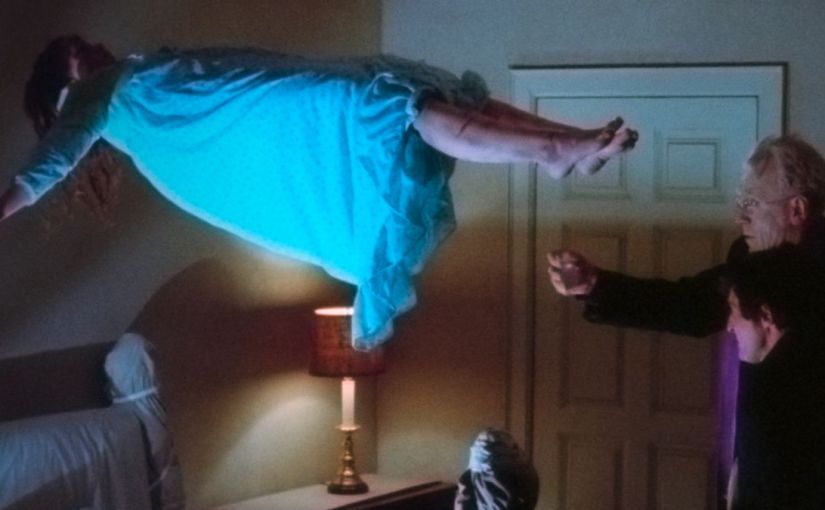
Nevertheless, it is unbelievably bold how this personification puppeteers young Regan with vile actions of vomiting, uttering the ugliest vocabulary and committing terrible bodily harm and atrocities with a crucifix.  Blatty could have drawn the line with the slaps and punches Regan delivers to the doctors and her own mother.  The point would have been clear.  Yet only something that has to be tangibly real with no question of a joke or side humor, has to go this far.  It’s often sickening and demoralizing to the worst degree, but reality never compromises.  The drivers of this fiction wish to move this as far away from what’s not valid. It’s evident how convincing all the footage is within the film.

Following the mysterious death of Chris’ film director, along with an unheard-of recommendation from a physician, the idea of committing an exorcism to release whatever’s possessing the girl is suggested.  The problem is there is no expert on the subject of exorcism.  It seems absurd, and the Catholic Church is never quick to endorse the procession.  

During the first hour of the picture, a second story covers the personal conflict of Father Karras (Jason Miller).  One of his first scenes shows him arriving home to his ailing mother and removing his collar.  It’s a visual sign that the minister is questioning his own faith as he undoes his garb.  Karras may be a priest, but he also specializes in the study of psychology for his parishioners.  As he encounters Regan in her bedroom, he’s gradually assured that he is speaking with the demon who knows too much about himself.

A third story, which actually opens Friedkin’s film, occurs in Iraq where Father Merrin (Max von Sydow) is excavating through an archeological dig.  He doesn’t have much to say but his stoic expression tells us that his discovery of a medallion buried in the rubble, along with particular statue, spell dread.  It’s no accident that Friedkin places this scene often against the backdrop of a sun sparked, blood red sky.  

Eventually, all three stories intersect within the coven of Regan’s upstairs bedroom, where this demon taunts, cackles, teases and defies the power of the Bible and the Catholic faith.  This third act is impossible to take your eyes off.  Every second of imagery builds upon the power of the supernatural from moving furniture that charges forward like monsters on the attack, to ceilings and doors that split open.  The bed rumbles.  Demonic imagery appears out of the cold darkness.  It’s such a well-crafted sequence of events that is completely atmospheric.  

On what I believe is only my second viewing of the film, there are few things I noticed.  Chris is not a religious character.  So, when she evokes frustration, first at her ex-husband over the phone, and then at doctors and priests who lack explanations, she’s apt to shout “For Christ’s sake,” or “Jesus Christ.”  Variations of the word fuck is also adjacent to this dialogue.  Chris’ language could be a close second to the abhorrent verbiage coming from her monstrous daughter.  Blatty and Friedkin seem to imply how the son of God and the potential of Satan are so easily taken for granted.  Chris may be corrupted, but it is the innocent, young Regan who is trifled with.  There is nary a thing more disturbing in film than watching a child in peril.

Friedkin’s direction with Father Karras is consistently interesting as well.  Often, he positions his camera on a ground floor or at least pointed up to a level above to witness Karras’ ascents.  His faith is clearly shaken.  So, all he can do is rise and rise again, closer to a heaven that may still be welcoming.  Karras climbs flights of stairs or walks up sidewalk hills, to approach a vile intruder seeking to disrupt the purity of angelic youth.  

Only after I watched the film did I read that Linda Blair’s unforgettable performance was not the only contributing factor to Regan’s demonic possession.  Oscar winner Mercedes McCambridge who originally was not credited, supplied the scratchy, tormented and taunting voice of the demon.  It’s an unbelievable embodiment of a powerful villain.  Linda Blair was Oscar nominated for this role, but because she did not entirely own the performance, she likely lost to another child actor, Tatum O’Neil (Paper Moon).  The craft of Blair’s makeup all the way to her changes in eyes is a gut punch to the psyche.  Regardless, this is one of the most uncompromising and effective child performances I’ve ever seen in a film.

Max von Sydow donned aging makeup on his youthful forty-four-year-old complexion, and he looks straight out of another famous role from later in his career (Minority Report).  Richard Pryor and Saturday Night Live did a hilarious spoof on The Exorcist and for this nonbeliever I related to Pryor’s antics.  Yet, Max von Sydow takes what could have looked like utter silliness and convinces me that the ritual of exorcism is incredibly trying and exhaustively repetitive accompanied with the robes he dons to the holy scripture he reads from.  Merrin specifically instructs Karras not to directly respond to the demon.  Don’t even talk to it.  Merrin sticks to that practice.  Karras, the younger and less experienced sidekick, is drawn into the monster’s personal jibes.

Despite my position on religion and faith, I do not frown on what others value.  People find solace in their perceptions of God, the biblical stories, and the figures who teach. Religion often bestows a fulfilling life cycle.  Religion offers comforts through pain, loss, love and hope.  That’s okay. Everyone must follow their own path towards salvation. I tend to turn towards my personal psyche which I speak to daily.  

I watched The Exorcist off of a 4K streaming print found on HBO MAX, and the picture is positively striking.  Aside from dated fashions and cars of the early 1970s, the picture looks incredibly modern.  The themes of the film remain strong.  Hardly anything has ever matched the horror of The Exorcist.

I value everything in The Exorcist that Father Karras and Father Merrin heed to.  I believe in this story wholeheartedly.  Friedkin and Blatty, plus the cast enhance the authentication of demonic possession and how it operates.  This work of fiction, which Blatty claims to have been inspired by from an account of possession of a young boy during the 1940s, is a thousand percent genuine.  Within the moment and inside the confines of this picture this demon lives by overtaking young Regan.

How much did I believe it? Before bed last night, I made sure my little night light was on and I never walked into a dark room.   Every single light in the whole house was practically turned on.  

It’s not about the fear of God or the Devil.  It’s the fear I had for young Regan.

ON THE WATERFRONT

By Marc S. Sanders

Terry Malloy innocently calls up to his friend Joe’s window and tells him to go to the roof of his apartment building to check on the pigeons.  Only what happens to Joe when he gets there is not what Terry expected setting off a complex dilemma of morality and preservation of life.

In one of Marlon Brando’s most famous roles, Terry Malloy is an ex-prize fighter who now carries out menial tasks for the New Jersey mob bosses that have a foothold over the longshoremen and their union contracts.  Terry listens to what his mobster brother Charley (Rod Steiger) tells him to do.  As long as he keeps his mouth shut, he’ll be selected each day on the dock for work and he’ll never have to lift a finger.  Just let things be and keep quiet.

Charley’s boss is Johnny Friendly (Lee J Cobb), who is ruthless with his control over the area. The guys have to surrender to the demands of Johnny and his toughies because it is no secret what really happened to Joe and who was responsible.  The cops can investigate and ask questions, but they’ll get nowhere.  It’s up to Father Barry (Karl Malden) to talk some sense into the fellas, and considering Terry was one of the last guys to see Joe alive, he’s the best option to overthrow Johnny’s reign.  If Terry shows up for a subpoena, it could put Johnny and his goons out of business.

Another conflict of interest for Terry is that he has taken to Joe’s sister Edie (Eva Marie Saint) who also knows of Johnny’s corruption.  She just has not realized that Terry might have been indirectly responsible.

Marlon Brando looks everything like a movie star should.  His slicked back hair and dark eyes shadowed by his thin eyebrows and the way he carries himself in a plaid winter coat is held in a permanent memory just as James Dean and later pop culture figures like Fonzie, or Tom Cruise and Brad Pitt evolved.  It sounds silly but there’s a reason Madonna lends recognition to the classic actor in her club song Vogue, and this is one of many films in his early career to reference for the honor. 

Eva Marie Saint is wonderful as the young woman in pain and confusion following the death of her brother.  Edie is as least as conflicted as Terry due to her immediate attraction to the tough guy’s charms while still bent on discovering who had her kind brother killed and why.  Brando and Saint have a magnificent scene together when the truth comes out and Leonard Bernstein’s music comes to a halt of silence.

On The Waterfront has an irony of life imitating art.  Mind you, I’m not here to provide a history lesson and wallow in political divisions.  I find it interesting that Terry Malloy’s dilemma is whistle blowing the corruption that occurs, while also being intimidated to keep quiet.  Patterned similarly is what director Elia Kazan infamously became known for when he testified during the Joseph McCarthy hearings against people in Hollywood suspected of having communist ties.  A Union community is designed to protect its members, but sometimes the dynamics lead to just one who is singled out to expose what is not cooperating legally and accordingly.  (Some of the actors were against working on this film because of what Kazan committed but they were bound by studio contracts.)

I am aware of how much On The Waterfront is hailed as a perennial classic.  The cast is an outstanding collection of actors beginning of course with Brando, Malden, Steiger and Cobb.  Following television appearances, this was Eva Marie Saint’s first film, and there are other uncredited actors who had not made their mark yet including Martin Balsam, Michael V Gazzo, and Fred Gwynne.  The film boasts Oscar nominations for five actors (two wins, for Brando and Saint respectively) as well as wins for Best Picture, Director and Screenplay.  All that being said and yet I cannot say I felt invested in the film. 

The characters’ plights and pains simply did not connect with me.  Actually, while I believe I’m expected to yearn for Terry Malloy’s pain and regret where he declares he “…coulda been a contender…,” I felt sorrier for his brother Charley. 

In that well-known scene between the two brothers in the back of the cab, it is Charley who is really torn.  Charley is tied to his mob boss, Johnny Friendly, but he has to convince his brother to do what is best to protect the mob he’s committed to, or it could get both of them killed.  That famous scene is owned more by Steiger than Brando.  An interesting fact is that Rod Steiger had to perform most of that scene without Marlon Brando there.  The lead actor would leave the set at 4pm sharp each day, leaving Steiger to do his half of the scene with a stand in reading Brando’s lines.  It caused a bitter rift between the two actors.  Yet, the next time you catch the film, have a look at who is really doing the heavy lifting.

I might have gotten trapped trying to understand the way the union operates and how the mob manipulates everything to their advantage.  I’m lost in some of the early dialogue and how people go about doing what they do.  Maybe what I should have done is relax my train of thought and take in how the protagonist is pulled in many different ways, none of which seem like a winning solution. 

Out of context there is a selection of great scenes on display.  Karl Malden is magnificent when he urges the longshoremen to stand up to the brutality and intimidation they are under.  His concentration is amazing as he is pelted with trash while holding his composure.  This scene won him his Oscar nomination.

Lee J Cobb is a memorable antagonist. The concluding scene between his Johnny Friendly and Terry stands as a final battle between hero and villain and the residual effects of what was shot of that bout have been honorably repeated in many films thereafter. 

There’s an obvious influence that stemmed from On The Waterfront.  Clearly, much of the material had an enormous influence on future filmmakers like Lumet, Scorsese and Coppola.  Perhaps that’s the reason it did not grab me.  Those future directors turned the motifs that Kazan provided into flashier segments of color and trick camera work.  Even the inclusion of harsh language in those grittier, later films left me with a more convincing authenticity.  Then again, I was shocked to see Terry Malloy tell Father Barry to go to hell.  Pretty bold for 1954, and still somewhat shocking within the context of the piece.

On The Waterfront is actually based on fact from happenings at the docks off of Hoboken, NJ where most of the film was shot.  To watch it today is to look back at what high stakes dramatization and dilemmas of ethics surrounded by death and crime must have looked like.  It does feel outdated to me, showing a period that is long past, but it paints its truth very, very well. 

12 ANGRY MEN

By Marc S. Sanders

This film lives up to its reputation.

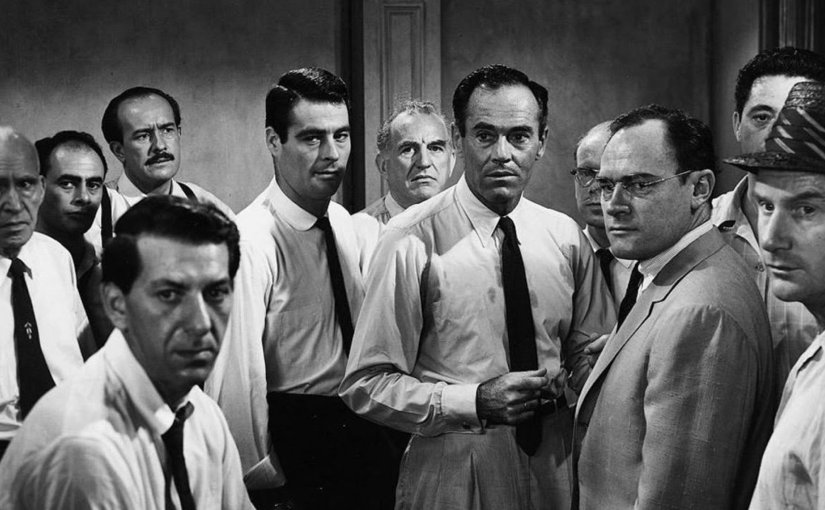
This was the great Sidney Lumet’s first theatrical film, and for a project limited mostly to only a claustrophobic and hot room, it boasts a lot of talent; Henry Fonda, Martin Balsam, Lee J Cobb, Jack Klugman, Jack Warden, EG Marshall.

For a black and white picture Lumet and his crew are effective at showing tiny details like sweat on brows and shirt stains, a broken ceiling fan, and the mental exhaustion of limited breathing space as twelve citizens debate over the guilt or innocence of a young man on trial for killing his father by stabbing. Lumet’s camera (just like when I watched The Verdict) is constantly traveling, even if it’s in a tiny confined space. He zooms in when he needs to and he changes angles to get the most of 12 different perspectives. Lumet keeps it interesting by changing up his use of lens. As the afternoon proceeds into early evening, the camera navigates more closely to the table they sit at. The men are uncomfortable, frustrated with each other, more impatient and more concerned with their consciences about sending a man to death. The actors do well with translating these factors, but Lumet sends the message home.

What I found most interesting is the different variations of how each juror eventually comes to changing his mind. Almost all of them arrive at that point in a new or different way. Credit goes to screenwriter Reginald Rose for that. Additional credit for the different variations of how the jurors repeatedly cast a vote; raising hands, notes, anonymously, not anonymously and so on. Rose changes it up each time to keep the viewers’ attention.

Rose’s script will only tell you so much. The attorneys don’t appear in the film, deliberations are done, we only get a close up of the defendant but there’s not enough material for a viewer to cast judgment. The film opens with the judge giving a boring routine instruction as to how the jury should proceed. He might as well be telling them how to complete an SAT exam.

Yet what we are treated to are the faults and overcomings of the human spirit. Ed Begley is a juror who gives a brilliant monologue that stereotypes the defendant’s ethnic background, though we never know what race or ethnicity he is. As he continues to rant, every other juror steps away from the table. Begley seems to get more ashamed of his thought process as he carries on, but he doesn’t stop until he’s ordered to by another juror. Amazing!!! In 1957, when Jim Crow and McCarthyism were on the horizon or rampant, this film was not having it. It’s the best scene in the film.

Henry Fonda is great as the one who only asks for sensibility. He adds weight to the case they are deliberating over that the others are sadly failing to recognize. A man’s life is in their hands.

I’d argue that the facts of the case and evidence presented carry very little complexity to what a real murder trial might offer. I’d also argue that what serves as a fulcrum to sway each vote is maybe a little too convenient (presuming the time it takes for one witness to walk or whether a witness wore glasses), but that doesn’t matter. What’s most important is whether each of these men can live up to the demand of recognizing reasonable doubt; the necessary requirement for a trial by jury. In that sense, 12 Angry Men succeeds.