REBECCA

By Marc S. Sanders

“The suspense is killing me!  I hope it’ll last!”

                                      – Willy Wonka

Even if the outcome does not amount to much, the journey into mystery is often all that is needed for an effective film.  Mood and eeriness, plus unsettling foreboding are reliable tools for engaging storytelling.

The one film in Alfred Hitchcock’s career to win Best Picture is 1940’s Rebecca, and if you’re a fan of the director, you’ll quickly fall in love with his deliberate shots of shadow and the panning explorations his camera gravitates towards.  Close ups of his actors have an unsettling haunt, and large hand-crafted doors are intimidating to an aristocrat’s new wife who carefully enters one room after another.  Other than a few pertinent differences, Hitchcock, with David O Selznick as producer, remain faithful to the eerie themes of Daphne de Maurier’s novel.  

Joan Fontaine works as an attentive helper to a wealthy and brutish snob (Florence Bates) who is on holiday in Monte Carlo.  There, she encounters a dashing aristocrat by the name of Maxim de Winter (Laurence Olivier).  The helper is shy and reserved but somehow Maxim allows her into his world even though she first encounters him as he seems to be stepping off into the rocky ocean depths below, looking like he’s about to end his own life.  Every day she sneaks away to be with Maxim and all too quickly, just as she is about to head off back to the States, he proposes allowing her to be relieved of her obligation to the haughty dowager she’s been serving.

Once married, Maxim brings the new Mrs. de Winter to his regal European estate famously known as Manderley.  It is here that Fontaine’s character will learn details about the mansion and Maxim’s enigmatic and deceased first wife, Rebecca, who drowned during a sailing accident a year earlier.  

Rebecca’s monogrammed R is embroidered in handkerchiefs and bed sheets throughout the house.  Her address book in her drawing room remains at the desk where she ritually wrote her letters. The cornered off west wing of the house is supposedly preserved with Rebecca’s furnishings.  Most disturbing is Manderley’s housekeeper, Mrs. Danvers (Judith Anderson), who is far from comforting or welcome to the new Mrs. de Winter.

Rebecca is quickly engaging because of Hitchcock’s haunting exposition that persists until the final act of the film.  Following the opening credits, he shoots his camera through a distant wooded drive that eventually arrives at the decrepit ruins of Manderley, with Fontaine’s voiceover guiding the viewers towards flashback.  Then we see Olivier, performing rather cold and isolated, apart from his sudden interest in Fontaine’s shyness. After the nuptials, the bulk of the film turns Manderley into a off putting locale, not ready for Maxim to have a new wife living within its confines.

Most effective is Mrs. Danvers.  Judith Anderson lends a spectral presence to a creepy individual dressed in black with a most evident paler complexion, even under the black and white photography.  Reading about the making of the film, Hitchcock wanted to make sure Mrs. Danvers hardly ever entered a scene walking into a room.  He’d cut away to a close up of Anderson simply being there, as if Mrs. di Winter or the viewer never knew she existed in the frame.  It lends to that haunted house kind of tension.  

Mrs. di Winter never feels like she belongs.  That signature letter R is a constant reminder of Rebecca occupying this home’s past.  Her wardrobe, personal bedroom and belongings remain behind too.  Maxim travels out of town often leaving his new wife alone with no family or companionship of her own.  A charming but odd cousin of Rebecca’s named Favel (George Sanders) appears outside the window of the reading room to remind the new Mrs. di Winter that Maxim is not especially fond of him.  Hitchcock left me wondering why Mr. Favel didn’t arrive by the front door.  It’s deliberately odd; certainly strange.  There’s a miser who roams around a small cottage near a beach path that Maxim insists his new wife stay away from.  These are elements to uphold Hitchcock’s penchant for unnerving his protagonist’s senses.  Delirium works to the director’s advantage time and again.

In addition to full sets tall staircases and vast, castle size rooms, a miniature model of Manderley was constructed for the film.  The background of this setting is so dense that every piece of artwork or window curtain or book seems to have a history for Mrs. di Winter to uncover in this cold and unwelcome house.  The gigantic doors to new rooms against Fontaine’s petite figure are disconcerting.  Maxim’s staff of servants may cater to his new wife’s needs, but it is Mrs. Danvers who appears to desaturate any joy or ease from this home’s new guest, and it is reasonable to consider that the housekeeper seeks to disrupt the wife’s adjustment at Manderley.

Joan Fontaine’s mousy, insecure performance works especially well next to the confident and cool tempered strength expected from Laurence Olivier.  Fontaine is also an exact opposite to Judith Anderson’s eerie persona.  How can she ask for anything of this housekeeper who maintains a fierce loyalty for Rebecca, the first Mrs. di Winter?  George Sanders also has a sense of self confidence but with his wide smile and that distinct English dialect, how can anyone feel like they can trust him? I guess it doesn’t help that he’s a car salesman, no less.

I actually thought back to Ari Aster’s Midsommer. In that film, Florence Pugh’s character no longer has a family and the only companionship she is left with is a boyfriend and two friends who she travels with to a mysterious, but intriguing destination.  Like Fontaine’s character, Pugh’s character is alone feeling helpless to turn to anyone for aid.  How can someone in a scenario like this ever feel secure or eventually rescued?  The loneliness for these women in these two broadly different films is what gives me shivers.  It leaves me shaken and terrified.  Is there anyone who would even notice they are missing or unaccounted for?  Just give them someone to trust and talk to!!!! PLEASE??????  ANYBODY????

Answers behind the puzzles found in Rebecca eventually arrive, and while the explanations add up, I did not believe they were especially sensational.  There are some twists.  The story veers off in different directions and Olivier and Fontaine drive the script quite well to a conclusion.  Though the ending is not the greatest strength of Rebecca, it is the journey that’s appealing, especially when you are seeing the film for the first time and have no knowledge of where the story is going.  Hitchcock’s trajectory is the real thrill.  

I pointed out to Thomas and Anthony, two of my Cinemaniac comrades, that in this whole expansive house we never once see a photograph of Rebecca, the first Mrs. di Winter, and then with their input I realize that’s the intended point.  Each viewer has their own design of what the mysterious Rebecca must have looked like based on what’s left behind with her husband, her devoted housekeeper, her cousin, her wardrobes and belongings, and her enormous, hidden dwelling known as Manderley.  Like Steven Spielberg committed to with concealing the driver of his terror truck in Duel or his great white shark in Jaws, Hitchcock applied to a phantom of a past, and her name was Rebecca.  

With a film like Rebecca, Alfred Hitchcock didn’t really need a knife or a gun to rattle your senses.  It’s his approach with mood that will keep you alert and unsettled.  You want to know more and see more and uncover more and more and more.  

Yet, that housekeeper suddenly appears, and those giant double doors are most unwelcoming.
A BRIDGE TOO FAR (1977)

by Miguel E. Rodriguez

DIRECTOR: Richard Attenborough
CAST: Sean Connery, Ryan O’Neal, Gene Hackman, Michael Caine, Anthony Hopkins, James Caan, Maximilian Schell, Elliott Gould, Denholm Elliott, Laurence Olivier, Robert Redford, and MANY others
MY RATING: 7/10
ROTTEN TOMATOMETER: 63% Fresh
Everyone’s a Critic Category: “A Movie Set During an Historic War”

PLOT: A detailed account of an overly ambitious Allied forces operation intended to end the war by Christmas of 1944.


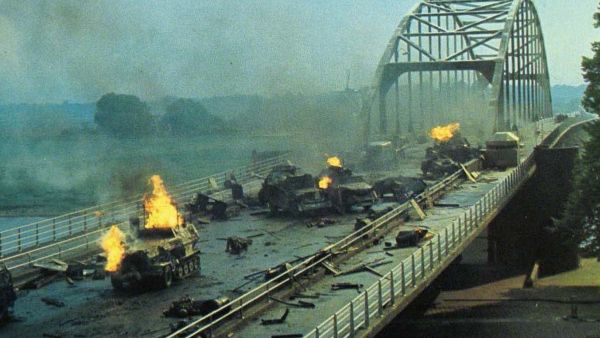
In September of 1944, in an attempt to land a finishing blow to Germany following D-Day, Allied forces launched Operation Market Garden, a bold offensive that would drop over 30,000 soldiers behind enemy lines.  The objective was to capture and hold three strategic bridges in the Netherlands, over which a massive column of British tanks would then roll straight into the Ruhr, the heart of Germany’s industrial complex.  Neutralize the Ruhr, and taking Berlin would be inevitable.  However, as with so many other simple plans in history, multiple factors led to the operation getting bogged down at the third bridge, and after massive Allied casualties, the offensive was abandoned.

Based on a bestselling novel by Cornelius Ryan (who also wrote the novel The Longest Day), the movie of A Bridge Too Far resembles the actual Operation Market Garden, not just in appearances, but also in its ambition, scope, and ultimate failure to achieve its goal.  However, as a pure combat movie, I give it credit where it’s due.

First off, look at this cast.  There had not been an assemblage of so many of Hollywood’s leading men since 1962’s The Longest Day (“42 International Stars”, that movie’s posters proclaimed).  Naturally, most of the actors are pitch perfect in their roles, with one glaring exception.  Whoever thought Gene Hackman was just the right guy to play a Polish general was either desperate or foolhardy, or both.  Hackman is a talented actor, without question, but his attempt at a Polish accent is a MAJOR distraction from whatever he’s saying.  Every once in a while, it even pulls a disappearing act, not that it matters.

ANYHOO.  The all-star cast.  To offset the lengthy running time, the story is told in semi-episodic fashion, which makes me wonder if someone hasn’t thought about rebooting this movie as a Netflix/HBO/streaming miniseries.  I’d watch it.  Within each of these episodes, it helps if we remember right away that Michael Caine is the leader of the tank column, Sean Connery is heading up one of the ground units, Anthony Hopkins is holding the bridge at Arnhem, and Elliot Gould is the cigar-chewing American trying to get a temporary bridge put together, and so on.  It’s a rather brilliant way of using visual shorthand to keep the audience oriented during its nearly three-hour running time (including an intermission at some screenings).

There is one “episode” featuring James Caan that has literally – LITERALLY – nothing to do with the plot.  He plays an Army grunt who has promised his young captain not to let him die.  After a grueling ground battle, Caan finds his captain’s lifeless body and, after improbably running a German blockade, holds an Army medic at gunpoint, forcing him to examine his dead captain for signs of life.  I read that, unlikely thought it may seem, this incident really did happen as presented in the film (more or less).  All well and good.  But what does it have to do with capturing bridges?  I’m sure the story is in the novel, but the movie takes a good 10-to-15-minute detour from the plot to follow this bizarre story.  Did director Richard Attenborough think we needed comic relief or something?  I remember liking that story as a kid, but watching it now…is it necessary?  Discuss amongst yourselves, I’ll expect a summary of your answer at tomorrow’s class.

I want to mention the combat scenes in A Bridge Too Far.  First off, I never served in the armed forces.  Well, never in combat.  I was in the Air Force for about a week.  (Well, Air Force boot camp in Oklahoma for about a week…LONG story.)  So, my observations of the combat scenes are less about historical accuracy and more about how they compare to other films.  While some of the combat portrayed is rightfully horrific in its own way – the river crossing in those ridiculous canvas boats, the slaughter of the paratroopers, the seemingly endless holdout at Arnhem – a lot of the combat, particularly the tank shelling and the skirmishes at Arnhem, is…I have to say, it’s kind of fun to watch.  There’s something, I don’t know, charming about it all.  It reminded me of how I used to play with my army men and Star Wars figures, or how I used to run around with neighborhood friends wearing plastic helmets and pretending we were “good-guys-and-bad-guys” while throwing dirt clods at each other and making fake explosion noises.  It was movies like A Bridge Too Far that shaped my young impressions of what wartime combat was like, and whether it was realistic or not was irrelevant.

Anyway, enough nostalgia.  Here’s the sad truth: A Bridge Too Far, despite its thrilling combat and all-star cast, falls short of delivering a truly meaningful war film.  There are half-hearted attempts to drum up some dramatic impact with scenes in a makeshift field hospital and a speech in Dutch from Liv Ullman wearing her best “isn’t-war-awful” expression, but for some reason those scenes fall flat.  (I did like the “war-is-futile” scene with that one soldier who runs out to retrieve the air-dropped canister, only to discover…well, I won’t spoil it, but it’s a good scene.)

After writing almost 1,000 words, I’m no closer to explaining why A Bridge Too Far falls short.  It’s still an entertaining watch, but I’ve really got to be in the mood for it.  It’s rather like reading a historical novel that isn’t particularly thrilling like a Crichton or a Clancy, but it does deliver some eyebrow-raising information.  It doesn’t hit me in the heart, but it does feed my brain.  Maybe that’s not such a bad thing in the long run, but if movies are about stirring emotions, I must say: A Bridge Too Far is no Saving Private Ryan.

(Sure, I probably could have just said that instead of writing this long-ass review, but where’s the fun in that?)


QUESTIONS FROM EVERYONE’S A CRITIC

Best line or memorable quote:
“Remember what the general said: we’re the cavalry. It would be bad form to arrive in advance of schedule. In the nick of time would do nicely.”

Would you recommend this film?  Why or why not?
Ultimately, I would recommend it to film buffs who have not yet seen it.  If nothing else, it’s an interesting time capsule movie.  This would be the last time for a VERY long time that anyone would attempt to make an epic film with a truly all-star cast.  …come to think of it, I can’t think of a major, epic drama since A Bridge Too Far with an actual A-list cast.  Can you?

WUTHERING HEIGHTS

By Marc S. Sanders

1939 is a pioneering year for film with timeless classics like Gone With The Wind, Stagecoach, and The Wizard Of Oz making their debuts on the silver screen. Arguably, it is one of best years ever for cinema. Finally, I was able to see another sampling from this period, William Wyler’s adaptation of Emily Brontë’s novel, Wuthering Heights.

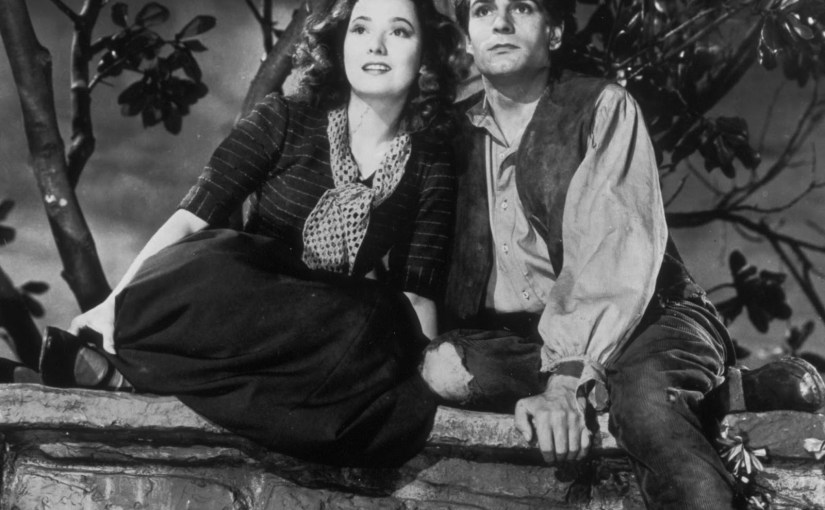
Laurence Olivier portrays Heathcliff, a wandering “gypsy boy” welcomed into the home where the story derives its title from. Over time, he develops animosity from Henry, the son of the landowner, while building a an affectionate relationship with the daughter, Cathy (Merle Oberon). Heathcliff and Cathy fantasize of royal, romanticized adventures along the neighboring rock side. Following a sneak away moment to observe a social gathering dance on a nearby estate, Cathy is tended to and welcomed by Edgar (David Niven), and eventually marrying him, much to Heathcliff’s dismay. From there, moments of melodrama, that likely served as a precursor for modern day soap operas, occurs.

Wuthering Heights caught my attention from the moment it began because I thought I was about to journey through a servant’s ghost story retelling of what became of the lovers never meant to end up together. A stranger wanders on to the property in the midst of a fierce snowstorm and swears he heard a woman’s voice outside and witnessed two shadows. Was this written by Brontë or Poe? Then the tale plays out.

Olivier is the most impressive of the cast, naturally. He’s very striking and handsome. While watching with friends, we all agreed that he might have made a good James Bond or Bond villain. Whether he’s the poor, oppressed Heathcliff or the later, wealthier property owner, Olivier offers a commanding presence that you can’t ignore.

The story doesn’t wow me as much as the the set design and camera work for 1939. Edgar’s grand ball room and foyer are a sight in wide measure with gorgeous, prominence ranging from large bookshelves and furnishings to a functioning fireplace. Was this a real home that Wyler’s camera moved through, or just a Hollywood set?

It was good to catch up with a classic. I’ll likely not watch on repeat, but Wuthering Heights is a treasured story in literature and film. I’m appreciative of the experience.

MARATHON MAN

By Marc S. Sanders

John Schlesinger contributed to the long line of political paranoid thrillers that came out in the 1970s with Marathon Man, with a screenplay by William Goldman based upon his own novel.  Most films are not constructed this way any longer.  Here is a picture that, albeit may have large plot holes, leaves you curious as to what it all means while you are watching it for the first time.  Don’t belabor yourself with watching it again as a way to piece it altogether with logic and sense.  You’ll only be keeping yourself up at night.

Marathon Man begins with several different incidents occurring at different parts of globe.  A man is tirelessly running through Central Park.  In Manhattan, two elderly men get into a heated road rage argument that leaves them dead in a massive explosion.  A box of band aids is taken out of a safe deposit box and later smuggled beneath a box of chocolates.  In Paris, an explosion occurs after a sharp dressed man gets into a car.  A little later, that man is violently attacked in his hotel room, leaving a very bloody mess.  A couple is mugged, only the hoodlums are dressed in business suits.  Another man is found with his throat slashed in the balcony of an opera house.  A white haired man hiding out in South America starts to shave his head.  What does it all mean?  How are all of these occurrences connected?

As long as vague moments like these don’t carry on too long, I’m likely to be hooked because I consider myself a curious fellow.  Thankfully, Goldman’s script pieces the characters together with a few hair raising twists that I didn’t see coming.

Without giving too much away, Dustin Hoffman plays a marathon runner/Columbia University history major with a bleak family background.  Beyond his comprehension, he is connected or will find himself connected to each one of these early moments in the film.  Once a person very close to him turns up dead in his apartment, the hysteria sets in.  Hoffman plays this quite well as he is always trying to catch his breath while soaked in sweat and remaining the lightest of sleepers.  Schlesinger creates a terrifying moment with a bathroom door that Hoffman is trying to hide behind.  It reminded me of Kubrick’s use of an axe with a bathroom door that would come out four years after this picture, with The Shining.

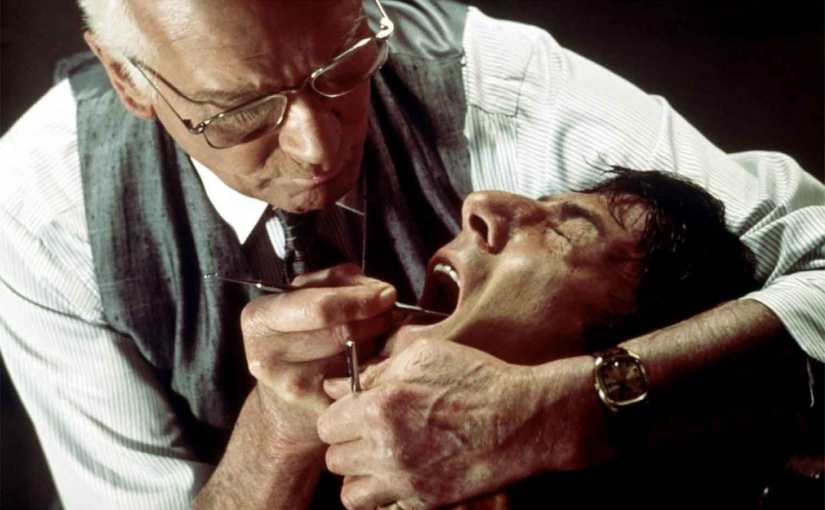
Laurence Olivier is a mysterious elderly man who has arrived in New York, eventually coming face to face with Hoffman. Thus, leading to one of the most uncomfortable torture scenes in film history.  Cancel any upcoming dental appointments that are scheduled soon after watching Marathon Man.  You’ll thank me for it.

The set up and players are eventually explained, albeit at breakneck speed when the tension is very high.  Put it this way. It’s a challenge to sum up exposition when it’s being dictated in a high-speed car chase.  So, on the first viewing, you might miss a few details here and there.  Nevertheless, I knew who the good guys were, I knew who the bad guys were and simply hearing the word “Nazi” in any given line of dialogue is enough for me to know how sinister this all is.

I can’t deny the ending feels a little hokey as it takes place in a Central Park reservoir system with platform stairwells and waterfalls all around.  Yet the tension remains as a young Dustin Hoffman (a hot commodity of 1970s actors) pairs up with the legendary performer, Laurence Olivier.  As I came to understand, Olivier was suffering from a terrible cancer diagnosis while making this picture.  Unbelievably, he never shows his illness, as his performance is electric with a well-deserved Oscar nomination.  Hoffman was striving for method by exhausting himself personally.  I know about the legendary story where Olivier suggested he simply “try acting.”  Hoffman later clarified that conversation and explained it had more to do with a personal divorce he was going through and late night drinking at Studio 54.  Whatever!!!  The ailments these great actors were experiencing at the time lends perfectly to the paranoia. 

I try to avoid movie trailers these days.  They give away much too much.  I had not seen one trailer or commercial for Marathon Man, prior to experiencing it for myself.  All I was aware of was the infamous dental torture scene with the famous line “Is it safe?”  Out of context, I found it to give me goosebumps.  Within the framework of the film, it’s utterly disturbing and it only heightens the suspense that Schlesinger and Goldman were striving for.