NEVER SAY NEVER AGAIN

By Marc S. Sanders

If it walks like James Bond, if it talks like James Bond, it is…STOP RIGHT THERE! 

Sean Connery in Never Say Never Again is not James Bond…at least not the James Bond that I know.

Why was this movie even made?

I know.  You don’t have to tell me. 

For the most part it was a legal blessing for a gentleman named Kevin McClory, a contributing writer to the film Thunderball.  McClory sued the Ian Fleming estate for the rights to such named properties as the villainous “Ernst Stavro Blofeld” and the organization he heralds known as “SPECTRE.”  Eventually, it came to be that none of the films could use these copyrighted terms going forward.  (Hence, why Roger Moore never uttered these names in any of his films.  He just dropped a wheelchair bound bald man down a smokestack.)  Anyway, the courts allowed McClory a second chance at his Thunderball creation by granting him the blessing to remake the film with certain moments and developments that upheld the structure of the story.  So, in 1983 a competing studio to United Artists called Warner Brothers greenlit the release of this new film and banked on Sean Connery’s return to the famed secret agent.

Frankly, the backstory is a much more tantalizing adventure than this misfire.

Never Say Never Again always eluded me.  I never had a desire to see it.  I regarded it like a generic brand.  I turn to the EON productions for my James Bond fix the same way I turn to Heinz ketchup, never, ever Hunts.  What I’d heard of this film and the scant moments I saw of Connery in the picture over the years made me question how necessary this movie ever was.  It’s like that Gus Van Sant shot for shot remake of Psycho.  Why do it?  Because you can?  Is that all you need?

So, Connery opted to return for a large salary and for the only time in history two James Bond films were released in the same year, 1983, when Moore’s Octopussy also made it to the big screen.  Connery’s picture is a direct remake of Thunderball. One of SPECTRE’s top agents Maximillian Largo (Klaus Maria Brandauer) catches possession of two United States nuclear missiles and hides them in the Bahamas.   Bond is older now, reflective of Connery’s age at the time, and practically retired as he loses a bit of his step in a training simulation.  Soon, however, he is on the case and contends with a female henchman by the name of Fatima Blush (Barbara Carrera) while also womanizing Largo’s main squeeze Domino (Kim Basinger, in a very early role).  His primary gadget is an exploding fountain pen.

Other than Carera who was Golden Globe nominated for her role, I can’t say anyone is doing anything terribly wrong here.  It is simply that this reiteration seems altogether flat.  This film is certainly missing the exhilarating pace of director Irvin Kershner’s The Empire Strikes Back.  Here, James Bond the hero just seems to walk and sit and stand in and out of frame.  A lifeless tango occurs midway between Connery and Basinger as an opportunity to share some confidential information.  I don’t care if 007 is adorned in his tuxedo next to a 1980s hair sprayed Kim Basinger, the tango is boring to watch.  It is a dance that goes nowhere or builds to anything. 

Games are updated as well.  We are not in the casino watching baccarat or poker anymore.  James Bond plays video games against Largo and the only threat is a shock on the joystick when a parlay is struck.  I can’t feel the zap that is supposed to happen, and Sean Connery is hardly displaying any anguish as Klaus Maria Brandauer smirks in triumph.  So, where’s the suspense here?  Sound effects from an Atari 2600 while the hero and villain sit at a table with joysticks doesn’t send this scene into astonishment. In 1983, in the movie theatre next door, Roger Moore is undoing a cheating Louis Jordan in backgammon while the muscle headed henchman crushes the dice into dust.  That’s much more frightening. 

A midway motorcycle moment with smoke and missile gadget tricks is fun but still not as escapist as most other Bond pursuits. Maybe it’s because 007 wears a dark helmet and thus hiding his charm.  It’s a lot more fun to see Connery or Moore give a wink and nod as the chase continues.  Here there is no reaction and no response to the environment of the Bahamas.  Couldn’t a banana tree topple over or something?  Maybe some coconuts?  Could a yacht or boat capsize?

I always remember the infamous shark scene in Thunderball as Bond gets trapped in a swimming pool with a couple of great whites.  That scene is now changed to an ocean floor shipwreck setting.  For the most part this works as Bond circumvents through the wreckage trapping one shark after another.  This is one of the film’s few improvements.

The big regret is that Klaus Maria Brandauer as the main villain Largo was not served a better product. He is gleefully good.  He’s at least trying as hard as he can. He has the evil grin and short fused temper, but he’s also sophisticated among his wealth. 

He’s certainly working much harder than Sean Connery who seems to just be going through the motions and hardly exerting himself.  The actor is much too relaxed in his role here.  It looks like he memorizes his few lines minutes before the camera starts shooting.  Then he says what needs to be said.  You can subconsciously visualize Connery walking back to his trailer take after take.  There are some decent one liners, but none of his delivery soars anymore.  I think Connery was out of the role far too long since his last turn in 1971 and he just didn’t pick up where he left off.  He’s never applying himself.  His wardrobe, from the tux to a camouflage uniform, or even his swimsuits do not seem to rest well on him.  The tailoring looks off.  He’s not wearing anything as well as he used to.  Not even his hair piece, which is far too thin and uncooperatively resting on his scalp, sits well.

Kim Basinger is the blond.  Nothing more needs to be said.  Rowan Atkinson debuted on the screen with some silly escapist humor but either he’s not on long enough or he’s there too much.  The part should have just been cut altogether.

You don’t forget Barbara Carrera but that’s not necessarily a compliment.  She’s working like a dastardly cartoon from the Adam West Batman TV show and Connery is hardly responding to her screaming or antics.  Funnily enough, the screenwriter is Lorenzo Semple Jr, writer of the Batman show and Flash Gordon, from 1980.  So, while the tongue is trying to touch the cheek it’s only reaching the roof of the mouth this time.  Carrera is a headache. She acts like a misbehaved child.  Somebody loved her though for that Golden Globe nomination.  How? Why?

Another bit of buyer’s remorse is the casting of Max Von Sydow as Blofeld.  Inspired casting.  Yet, why is he given nothing to do?  This is Max Von Sydow!!!!!  He’s been hired to watch a Sony monitor with his white cat tucked into his lap, but that’s it.  Between Brandauer and Sydow, these are some heavy hitters.  Plus, Connery, and a built-in storyline.  It should have all worked but it doesn’t.

The theme song is a painful earworm.  It is performed by Lani Hall, doing a Holiday Inn barfly lounge act that will never leave your consciousness.  You can practically see that wet, shiny lipstick slobber all over the microphone while she’s wearing a blingy sparkle dress and a red, leafy boa around her neck.

Never Say Never Again is a lifeless, uninteresting, tedious and sleep-inducing picture that no one but a Mr. Kevin McClory wanted. 

Like Jeff Goldblum would say ten years later, just because you could doesn’t mean you should.
MEPHISTO (Hungary, 1981)

by Miguel E. Rodriguez

DIRECTOR: István Szabó
CAST: Klaus Maria Brandauer, Rolf Hoppe, György Cserhalmi, Karin Boyd
MY RATING: 9/10
ROTTEN TOMATOMETER: 80% Fresh

PLOT: In early-1930s Germany, a passionate, prominent stage actor must choose between an alliance with the emerging Nazi party or a life of obscurity in exile.

[Author’s note: this is another in a series of movies I’ve watched lately whose subject matters have intimidated me.  There are topics at play in Mephisto that are beyond my ability to analyze in coherent prose.  I must advise you, this is a BRILLIANT film, even if my review below does not convey that fact…]


Watching Mephisto reminded me of the early days of Covid-19.  As the infection spread and restaurants and other businesses voluntarily closed their doors, I was still naively hopeful that it would all just go away.  A friend asked me, “When will you take this seriously?”  I blithely said, “When all the McDonald’s restaurants close, that’s when I’ll know there’s a problem.”  Not long afterwards, that’s exactly what happened.  Then I was indefinitely “furloughed” from my job, and soon after that, the government shutdown occurred.  In hindsight, I was foolish.  The signs were all there.  Had I paid more attention, I might have been better prepared for the stressful days that followed.

This situation is echoed in director István Szabó’s Mephisto, the first Hungarian film to win the Academy Award for Best Foreign Film.  Mephisto tells the story of a popular actor in 1930s Germany, shortly before and after Hitler rose to power.  Hendrik Höfgen (Klaus Maria Brandauer) is a hot-headed, passionate stage actor who throws himself into his performances with abandon.  We watch him evolve from an actor/director to the leading force behind a “revolutionary” theater company that exhorts its audience to acknowledge the plight of the everyman in their society.  He marries (for money more than anything else), but keeps a mistress on the side, a black German woman named Juliette Martens (Karin Boyd) who doubles as his private dance instructor.  He rails at his wife for riding horses before breakfast – the ultimate in bourgeois behavior – but engages in frantic frolicking with his mistress between dance lessons.

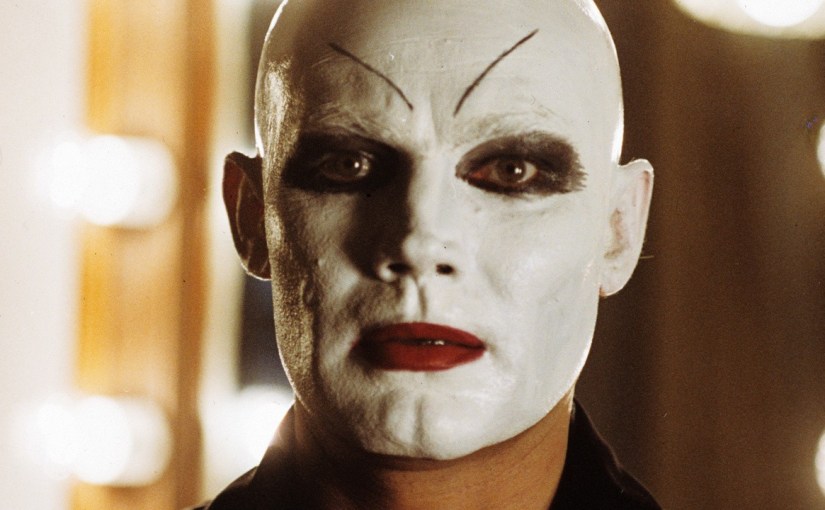
Brandauer plays Hendrik as a man who only feels like himself when he’s pretending to be someone else.  Onstage or when directing his cast, he’s filled with boundless energy, dancing with the chorus line or leaping across the stage with abandon.  Offstage, he is quiet and self-effacing, unless he’s socializing with other cast members.  Mention is made several times of his “limp” handshake, a direct contradiction to the strong characters he portrays, especially his most famous role: Mephistopheles in Faust, a role that brings him even more fame and prominence within the theater community.  The imagery of Hendrik is striking: He covers his face in white makeup like a kabuki player with sharply angled black eyebrows and red lips, the ultimate in being able to disappear inside a character.

But something is happening in the background that Hendrik is reluctant to acknowledge.  A fellow cast member almost gets into a fistfight with him when he criticizes another actress because of her associations with a member of the Nazi party.  His wife warns him about the dangers presented by this man who was just elected Chancellor.  [Interestingly, the name of Adolf Hitler is never once mentioned onscreen.]  She tells Hendrik that many of his friends are leaving Germany, fearing for their livelihoods, if not their lives.  But Hendrik refuses to panic:

“There is still the opposition, no?  They’ll make sure he doesn’t get too big for his boots.  And even if the Nazis stay in power, why should it concern me? … On top of that, I’m an actor, no?  I go to the theater, play my parts, then go back home.  That’s all. … I’m an actor.  You can design sets anywhere or buy antiques.  But I need the German language!  I need the motherland, don’t you see?”

Hendrik is so wrapped up in his profession that he simply cannot accept the fact that his freedoms are about to come crashing down around him.  He would rather formulate a far-fetched scenario based on nothing but hope so he can just stay where he is and keep performing.

(I have to be honest: when we took our first steps out of the Covid lockdown, I felt the same way.  Local theaters announced auditions for shows again, and I assured myself and my girlfriend that I would take the utmost precautions and wear masks at rehearsals and disinfect and wash my hands and I wouldn’t get sick.  And, of course, I eventually got sick.  I recovered, but you can probably imagine my disbelief when I tested positive that first time.  “ME?  But I was so careful!”)

Hendrik stays in Germany.  His wife moves to Paris.  Fellow actors either disappear outright or are arrested by the Gestapo in full view.  Hendrik accepts an offer to direct the official state theater, despite his past affiliations with liberal/Bolshevik causes, because of his prestige in the theater world.  A character known only as the General (probably intended to be Hermann Göring) gives him his marching orders as theater director.  He witnesses several Nazis beating a man on the street and walks in the other direction…best not to get involved.

So, what we have here is an actor willing to trade away his soul and his conscience in exchange for the opportunity to remain in the limelight, performing as Mephisto or Hamlet.  The metaphor is not exactly subtle, but director Szabó manages to land the message in such a way that it never feels like preaching.  It’s a masterpiece of storytelling that lands somewhere between satire and Kafka.

An especially telling scene has Hendrik explaining to an attentive crowd of Nazi journalists that his production of Hamlet will portray the lead character as “a hard man…an energetic, resolute hero”, rather than as a neurotic, “pathetic” revolutionary.  Hendrik tells them exactly what they want to hear so he can stay in the limelight.  He’s made his own deal with the devil.  I will not reveal whether Hendrik’s bill comes due during the film, but I will say the finale evokes the landmark documentaries of Leni Riefenstahl.  I’ll leave it at that.

As I said, watching the film reminded me of the Covid lockdown…but it also made me think about all those many, many times in the past that actors and other celebrities have been criticized for voicing their political opinions in public.  “Shut up and play/act!” is the usual cry.  Many people would prefer their favorite actors to behave more like Hendrik: just keep your head down and let everything blow over, don’t make waves, it’s not your place, etcetera, etcetera.  Mephisto argues that keeping silent in the face of injustice or tyranny is not an option, especially not for people in the spotlight.  Those who do so risk suffering Faust’s fate.  Or Hendrik’s, whose last words in the film are brilliantly contradictory.

OUT OF AFRICA

By Marc S. Sanders

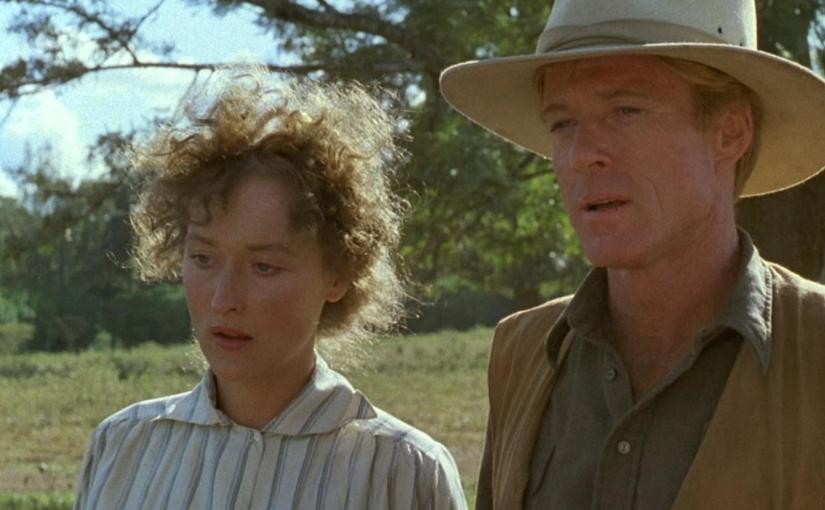
Sydney Pollack’s Out Of Africa might seem like a whirlwind romance if you’re only looking at the top billed names of the cast, Robert Redford and Meryl Streep, but it’s much more than that. It’s an education of the African continent beginning in 1913 when World War I was on the brink, and the British monarchy appeared to become territorial of its lands.

Karen Blixen (Streep) is a Danish Baroness who marries a Swedish nobleman, Baron Bror Blixen (Klaus Maria Brandauer) out of simple convenience. She plans to begin a cattle farm outside of Kenya to manage with Bror. To her unfortunate surprise, Bror has invested her monies in harvesting coffee on the land, which is much more difficult to produce at the altitude where they settle. Bror is also not so concerned with growing to love Karen and would much rather hunt on safari and be a womanizer, while welching off of Karen’s enterprise.

Karen grows to love Africa with its wildlife, as well as the local people whom she does not object to them squatting on her property. She provides medical aid and schooling for the children, too.

Karen also encounters the dashing adventurer, Denys Finch Hatton (Redford). Denys comes in and out of her life where he welcomes her on expeditions that are up close with lions and rhinos. He also takes her in his biplane to get God’s perspective of the lush scenery, a major centerpiece of the film. Denys, however, is not concerned with offering the full commitment Karen seeks. He’s happy to carry on with his safari treks only to return on occasion.

Clocking in at nearly three hours, Pollack’s film gives plenty of time and footage to absorb gorgeous landscape views of Africa from above and across the plains. The cinematography is on par with some of the best I’ve ever seen in a motion picture, compliments of David Watkin. The colors of sky with green, brown and yellow landscapes are breathtaking. Sunsets are spectacular with Redford’s silhouette in the foreground. Herds of cattle consisting of oxen, gazelles and lion feel so up close and personal. The production design of Karen’s home and coffee farm are also noticeably authentic. The home feels comfortable.

Out Of Africa is based on the stories told from Isek Denisen, Karen’s pseudonym. Like many of these sweeping epics, I find that I need to get accustomed to the nature of the film first. Dialects, when done authentically like Streep always strives for, are challenging for me to understand initially. The African people are hard to understand at times. As well, this is a period picture in a territory that I’m mostly unfamiliar with. So, I find that I have to adjust to the habitat and culture of the characters. Frankly, the first half hour or so was a little tough for me to stay with the picture. Once I got my footing with the film, though, I could not get enough. I felt terrible for Karen when she contracts syphilis. I was truly annoyed with how the Baron treats Karen with such disdain. It’s also heartbreaking when Karen and Denys are in disagreement with one another, simply because I loved the chemistry between Redford and Streep. Later setbacks feel tragic, especially as you feel like you’ve traveled through the progress and impactful differences that Karen affectionately made for Africa and its people.

Out Of Africa is an outstanding piece of filmmaking. It’s another example of a film where the setting is as much a character as the leads who carry the story. Sydney Pollack and his crew, which includes grand horn and string chords from Oscar winning composer John Barry present a captivating story that also feels rich in a documentarian point of view. A restored copy of the film on a large flat screen TV is a must see.