YOUNG GUNS

By Marc S. Sanders

In the late 1980s a novel idea hit the screens.  An MTV interpretation of the Old West with a rock anthem soundtrack of electric guitars and drums. A far separation from Ennio Morricone’s unbeatable spaghetti western approach.  

The film was Young Guns, featuring handsome stars like Emilio Estevez, Kiefer Sutherland, and Lou Diamond Phillips.  They were each different kind of gunslingers in their own right while delivering stand out personalities.  The film has some problems in editing, and some sequences do not work.  Yet, it remains stylish with impressive set designs, props, costume wear, and an especially appealing array of performances from the whole cast.  

Billy The Kid aka William H Bonney is one of the most notorious outlaws in American history.  Emilio Estevez brilliantly turns the gunslinger into a quick draw joker with an addictive cackle and an adorable smile.  William is taken in by the mentoring John Tunstall (Terence Stamp) who already oversees a collection of orphaned young men.  He’s teaching them to bear responsibility on his farm while they learn proper manners at the dinner table and how to read.

A neighboring industrial enemy, L.G. Murphy (Jack Palance) commissions his men to gun down Tunstall.  Billy and the rest of the gang are then deputized by the local Sheriff to issue warrants for the arrest of the killers.  However, Billy repeatedly exercises his own form of justice by killing one guy after another with his pair of six shooters.  Soon after, the boys are on the run by horseback while creating a whole bunch of mayhem.

I never considered Young Guns to be a perfect film, but I like it a whole heck of a lot.

There are moments that serve no purpose, like when the men get high on peyote, introduced by the Navajo, Chavez Y Chavez (Lou Diamond Phillips).  It’s not amusing.  It’s not quotable and the scene runs too long as we watch the cast walk and talk while in daze.  Frankly, most movie scenes of just watching people get high are boring.  Often, they go nowhere and I’m not sure how to respond. It’s like I’m the designated driver fiddling with my car keys at a drunken binge fest. This is no different.

As well, there seem to be gaps within the body of the story. I know it is inspired by the Lincoln County War, but it’s never entirely clear why Tunstall and Murphy are at odds with each other.  We just have to accept that the two elderly men of equal proportions are against one another.  Still, Palance versus Stamp is a very inviting conflict to look at. (Supposedly, the real John Tunstall was only in his mid-20s.)

Young Guns has a very cool polish.  These cowboys are downright attractive, sexy like Hollywood movies tend to offer, and I love how they handle each other, their horses and their pistols.  Every time a six shooter whips out of a holster and clicks, the movie becomes more alive.  The guys look well-worn within this environment, close to the Mexican border of the 1870s.  The image is just as effective as Clint Eastwood appears in his various assortment of westerns.  

Billy The Kid, over this film and its sequel, is Emilio Estevez’ best role of his career.  The actor has such a cocky, nervy way about him and his over-the-top laugh is impossible to forget.  A favorite scene in all of movies emerges when Billy toys with a bounty hunter in a saloon.  Estevez delivers much fun before gunning the guy down. I never tire of watching that moment.

Kiefer Sutherland is second in line with a graceful sensitivity as the educated and poetically romantic Doc Scurlock.  You worry about him and his courting affair with a young Chinese concubine that is owned by Murphy.  Lou Diamond Phillips specializes in knife throwing as Chavez, the token Navajo.  His presence belongs here as an unpredictable sidekick.  

The best surprise is delivered by Casey Siemaszko as the virginal, boyish illiterate Charlie.  Some gunslingers were afraid to ever become outlaws.  Charlie is ugly and dirty, bumbling and sweet, reminiscent of Fredo in The Godfather films.  Siemaszko never became as established as the others in the cast, but he’s a good performer who delivers panicked fear and brings the glamour of Young Guns down to a semblance of reality.  

Young Guns is a style over substance product.  It has potential for a stronger storyline, but the dialogue works and the cast is stellar, which also includes Dermot Mulroney, Terry O’Quinn and Charlie Sheen.  The sequel is actually better as it commits closer to the intrigue of Billy The Kid.  

Not perfect, but this is a fun escapist western experience.

JUROR #2

By Marc S. Sanders

Since Unforgiven, director Clint Eastwood has sought out projects that have an intrinsic message or a question of morality.  That film seemed to channel the second half of his career that has spanned over a half a century.  Before, many of his films sensationalized the quiet killer or the silent tough guy with the six shooter gunplay and cracking fists. After the movie won Best Picture in 1992, movies like A Perfect World, Letters From Iwo Jima and Mystic River were not developed for simply the sake of escapist entertainment.  There was something to ponder after the stories wrapped up. 

Eastwood’s latest film, and supposedly his last, is Juror #2 and to the best of my recollection, I believe it is the first time the actor/director brings his experience to a courtroom.  Some of his more recent efforts have been questionable and not up to his best standards (Cry Macho), but Juror #2 is one of the best films he’s directed, and perhaps the best picture I’ve seen this year so far. 

Nicholas Hoult plays Justin Kemp, an expectant father with his wife Allison (Zoey Deutch).  He has just been selected for jury duty in a Savannah, Georgia courthouse.  Justin is Juror #2.  The case centers on trying a man for the murder of his girlfriend who was found bloodied and bruised in a rocky, wooded canal beneath a bridge.  Earlier that night, the couple were witnessed at a local watering hole having a drunken argument.  She walked off in the dead of night in the pouring rain.  The man was seen going after her.

Coincidentally, Justin was at this same bar.  He drove off in his car around the same time, but he accidentally hit what he thought was a deer.  The incident was hardly considered again until the opening statements were heard in court a year later.  Suddenly, the young man is putting two and two together and questioning if in fact he hit a deer.  Now Juror #2 embarks on a test of morality while sometimes adopting a Twelve Angry Men narrative.  Justin might appear as noble as Henry Fonda, but is he the culpable one?

Juror #2 assembles a good cast of characters.  Toni Collette is the prosecuting attorney, Faith Killebrew, who is also campaigning for an important election.  Collette has that deep southern twang, but the earth tone suits she wears along with her firm body language exude a tough exterior.  You believe Collete’s character is compartmentalizing this trial away from her chances of election.  The opposing attorney, Eric Resnick (Chris Messina, who I’d like to see in more films), is apt to imply the true motive behind Faith’s pursuit of trying his client.  Is it for personal gain, because Eric truly believes his client is innocent.  The evidence and facts add up to reasonable doubt.

Eastwood, with a script by Jonathan A Abrams, places his film in a variety of on set locations around Savannah.  Personally, it was fun recognizing certain areas following a recent weekend getaway my wife and I took to the storied town.  There are flashback pieces to the night in question at the bar and the crime scene.  Beautiful locales within the historic squares of Savannah are also covered in addition to the river boats near the docks.  Much of the picture occurs in the jury room where the group of twelve deliberate.  Leslie Bibb is charming as the Jury Foreperson.  However, Justin tries to find ways to allow his peers to consider other possibilities.  The only one on his side is a well-cast J.K. Simmons.  Simmons has the deep crackling voice that absorbs you into what he’s believes versus everyone else in the room.  Against him are jurors played by Cedric Yarbough and Chikako Fukuyama, also well cast.  What seems like an easy wrap up case of declaring a guilty verdict turns into a dead heat of 10 to 2, and eventually even Faith the prosecutor is personally questioning what occurred.

Juror #2 is very well cast film.  None of the actors are stand out marquee names, which works as an advantage.  They all appear common.  They don’t look like movie stars and thus it is easier to buy them in their roles.  After seeing the film at the 2024 AFI Film Festival, the gentleman sitting next to me had to surrender to a friendly debate we had.  He tried to point out plot holes in the film but I had an answer for each element he questioned.  Juror #2 is solid in its storytelling.  The motives that characters like Justin and Faith and even the respective jurors stand by all have a validity to their lines of thinking.  Therefore, Abrams’ script works well at arguing two sides of the same coin and the picture concludes with an opportunity to think about it long after it’s over.  Hanging threads to solid conundrums are a favorite factor of mine.

A story currently circulating in the trade papers is that Juror #2 is only being released in fifty theatres nationwide.  This is Warner Brothers’ decision and it’s a terrible shame.  When the debate of streaming versus exclusive theatrical releases is continuously being put into question, this is a sure sign of movie theatres eventually becoming obsolete. What a pleasure it was to watch Clint Eastwood’s film among crowd at the famed Grauman’s Chinese Theater (aka TCL Theatre) in Hollywood, California.  The audience was completely engaged, applauding as names appeared in the credits and laughing at the intended cues provided by the director and screenwriter.  To see a film, any film in a theatre, is a unique experience when it can be embraced among a crowd of movie lovers. 

If Robert Zemeckis’ Here can be released nationwide in thousands of venues, there is no reason why a well-made Clint Eastwood picture can not have the same treatment.  Movie houses were never designed to offer only the latest Marvel or Transformers film.

My hope is that the ongoing, widespread positive reception that Eastwood’s final film is receiving is noticed thereby building some traction for Warner Brothers to consider going wider with exposure.  At the very least, the famed studio owes it to arguably its most prized filmmaker and actor.  Time after time, the WB logo appears just ahead of Eastwood’s own Malpaso studio credit.  There is no Warner Brothers without Clint Eastwood and to close out his legendary career commands a bigger recognition. 

At the very least, Warner Brothers needs to recollect what occurred with a film like The Shawshank Redemption.  No one saw it in theatres and it had a terrible initial box office.  Some argue it was the title that turned people off.  Maybe.  Yet, think about the admiration that movie continues to garner thirty years later.  Warner Brothers needs to pay more attention to the quality they possess in their library.

At any rate, my hat off to Mr. Clint Eastwood – a pioneer filmmaker and one of the last survivors of a filmmaking yesteryear.  He began directing in 1971 with the thriller Play Misty For Me, and at age 94, he has only enhanced his meticulous dedication to drawing a crowd in while directing sensational casts.  Along with Harrison Ford and Steven Spielberg, I have followed Clint Eastwood’s career all my life.  Beginning with seeing Dirty Harry at age 8, I grew up on his imposing stature and his reliance on silent performances.  The first R rated film I saw in theatres was Sudden Impact.  Beyond being a Producer, Director and Actor, he is also a film composer.  Clint Eastwood is one of the few multi-talented people within the history of Hollywood, but no one compares to him.  You’re likely never to hear someone say that guy reminds me of Clint Eastwood, because there is only one Clint Eastwood. 

I am only blessed because I still have yet to see every one of his films.  If Juror #2 is his last effort, it’s a noble and solid ending to his run.  Yet, I’m glad I know I still have more to uncover in Clint Eastwood’s celebrated career.

NOTE: The murder victim is portrayed by Francesca Eastwood, Clint’s daughter.  As well, look for a blink and miss it moment where the director makes his way down a staircase while JK Simmons and Toni Collette share a scene together.  Eastwood is full bearded but there is no doubt that’s the guy.

PERSONAL NOTE: On the closing night of the 2024 AFI Film Festival, I had the pleasure to meet actors Cedric Yarbaugh, Amy Aquino and Zele Avradopoulos following the film and it was such a treat to hear how much they appreciated Mr. Eastwood as a director. All three were consistent in their admiration for the filmmaker describing him as patient, quiet, and a master of his craft who continuously worked with the same crew on one film after another. It was a real treat to chat with them. I also saw Nicholas Hoult walk by me three times and because I simply didn’t recognize him, I regret not asking him for a quick chat and photo as well. Yet, he and Toni Collette introduced the film which included a quick impersonation of Clint on the phone offering the role to him. Everyone was positively charming. This was such a memorable moviegoing experience. I’ll treasure the memory always.

MAX DUGAN RETURNS

By Marc S. Sanders

Max Dugan Returns is one of those delightful films where the smile never leaves your face.  It’s a cozy, rainy Saturday afternoon with your favorite pillow and throw blanket.  The characters are whimsical, and they simply feel like good, good friends you would love to have in your life.

Nora McPhee (Marsha Mason) is an overworked, underpaid high school English teacher who is drowning in debt with a broken refrigerator and a car that is as ugly as it sounds on the road.  Her fifteen-year-old son Michael (Matthew Broderick, in a sensational on-screen debut performance) is a good kid, but she’s worried he’s getting too involved with the drug dealers that roam his school.

After her jalopy of a car gets stolen, the only positive that comes upon her is in the form of Donald Sutherland as a cop named Brian.  After he lends her his motorcycle to get around, there’s an immediate attraction, but it could not happen at a worse time.

Nora’s father, Max Dugan (Jason Robards), who abandoned her at age 9 arrives on her doorstep in the middle of a rainy night with a business proposition.  Now that his doctors have informed him he has six months to live, he would like to provide Nora and Michael with the six hundred thousand dollars he’s towed with him in an attaché case.  In exchange, he only wants to spend time with his grandson.  Beyond the animosity she’s held for Max, what alarms Nora is that her father stole this money from a Vegas casino.  He claims the mob stole the money from him first.  She doesn’t want the money; not with Brian the police officer in her life and she does not want to be affiliated with Max’ criminal past or associations.  Not to mention there would no way to explain this sudden windfall based on her minimal teacher’s salary.  Max won’t go away so easily, though.

Thus, the theme of Max Dugan Returns is one scene after another where a hoard of luxurious items arrive on the McPhee’s doorstep.  New appliances, new jewelry, new furnishings, fresh groceries, electronics for Michael, a Mercedes, and a thoroughbred dog named Pluto – I’m sorry.  Plato!

It’s impossible not to love this movie.  It is one of the few films that Neil Simon wrote directly for the screen.  It is so much fun though, that I think it would work marvelously as a stage play.  The story may not be grounded in reality, but Simon’s dialogue is so quick and sharp and a better cast could not be found to deliver Neil Simon’s wit.

Mason, Robards, Broderick and Sutherland have pitch perfect chemistry with one another.  These actors are so absorbed in their characters, and it makes sense.  Matthew Broderick was personally selected by Neil Simon to do his biographical play, Brighton Beach Memoirs.  Marsha Mason did five of Simon’s adapted films while she was married to him.  (They divorced shortly after the release of this picture in 1983.)  Jason Robards has an affectionate gravel to his voice – one of the best voices in film next to James Earl Jones. Robards is just so appealing as he playfully conflicts with Mason on screen while connecting with Broderick’s character under a different identity.  It’s important Max maintains a low profile.  Donald Sutherland is the straightest character in the picture.  He has a relaxed manner to him that’s found often in Neil Simon’s scripts (unless you’re a Nora McPhee or a Felix Unger).  In another actor’s hands, this would be just a walk on role, but with Sutherland on screen, you are satisfied to watch another winning performance from this actor with a relaxed stature and a genteel way about him, as his detective suits and ties hang loose on his shoulders.

Max Dugan Returns is an enchanting fantasy without the overt fantasy.  It never needed unicorns or lovable elves to deliver its magic and whimsy.  I did notice a collection of rainbows –  easter eggs hiding in plain sight, however.  Are pots of gold to be uncovered? The film asks what would happen if your long-lost father showed up on your doorstep with a suitcase full of money and a treasure trove of gifts to bestow upon you. 

Hey, it could only happen in the movies.

THE SENTINEL

By Marc S. Sanders

You know those movies where in the first twenty minutes you learn that there is a mole in the department?  The department could be the police or the FBI or the Starship Enterprise.  In the Presidential assassination thriller, The Sentinel, the mole is someone within the Secret Service.  Having read several John Grisham and Brad Meltzer novels in my day, I have a weakness for assassination plotlines within the hallowed halls of the White House or on-board Air Force One.  However, if the object is to uncover who is framing the hero, in this case that’s Michael Douglas, and more importantly to reveal the mole, then at least give me more than one possibility. 

Director Clark Johnson works adequately with the sunglasses, dark suits and ties adorned by Douglas and his antagonist former colleague and friend played by Kiefer Sutherland.  Douglas portrays Pete Garrison, an elder agent who has commendations for heading off the Reagan assassination.  Amazing that President Reagen was even shot because on top of Michael Douglas, I believe Clint Eastwood and Kevin Costner were also there on that fateful day.  Sutherland is Dave Breckinridge. He wasn’t there because he was just a teenager in 1981.

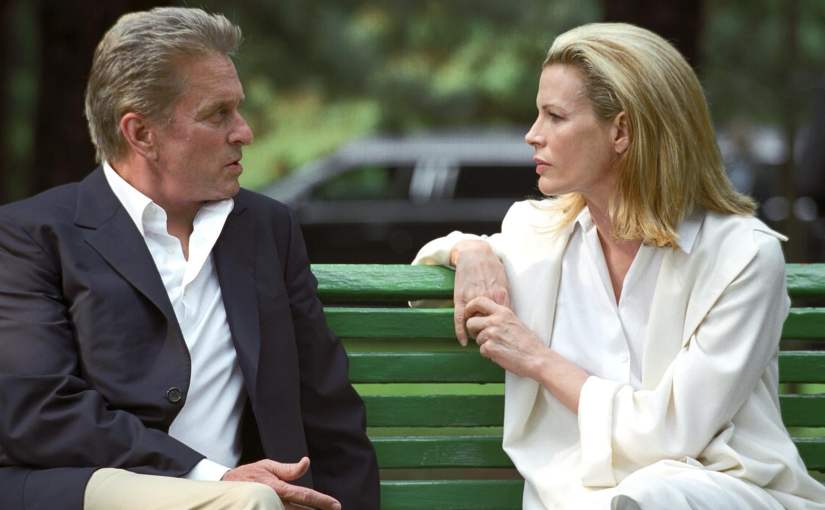
There’s troubling bubbling up in this Presidential cabinet, particularly because black and white photographs have mysteriously landed on Garrison’s desk depicting his clandestine tryst with the First Lady, played by Kim Basinger.  An agent partner of Garrison’s is shot dead on his front porch.  Then Marine One is taken out by a missile.  Obviously, someone has the President (David Rasche) in their sights.  Therefore, it must be a mole.  Who’s the likely traitor?  Pete Garrison is suspect numero uno, and so Michael Douglas is in the spotlight doing a subpar Jason Bourne treatment of resourcefulness to prove his innocence and uncover who framed him.

The Sentinel is not a terrible movie by any means.  It’s just this flavor of film has been done countless times before it came out in 2006, and thereafter.  Eva Longoria plays a former student of Garrison and now partner to Breckinridge and together with Sutherland they do the staple run with guns drawn down the streets of D.C. and the black sedan daytime drives while trying to stay hot on Garrison’s trail.  For some extra spice, Pete and Dave had a falling out some time ago and when we discover what that’s about it’s not very savory.

What keeps Johnson’s film from entering the lexicon of other grade A thrillers is that the true bad guy is completely apparent long before the plot unravels itself.  You know who’s spiking the voodoo doll within the first five minutes of the picture.  Why did Clark Johnson have to give this character the most oblivious close up?  That’s a failure on the director’s part, I’m afraid.  The Sentinel is short of plausible red herrings.  Someone told me recently that the best part of a magic trick is when you forget you are watching a magic trick.  Well in this movie, you know how the rabbit pops out of the hat.

There are obligatory shootouts. There’s also the big speech the President gives at the end when the bad guy is about to make a deadly move at the podium. As well, naturally there’s another typical Michael Douglas affair in a long line of on-screen Michael Douglas affairs.  Kim Basinger, I’d like to introduce you to Sharon Stone, Demi Moore, and Glenn Close.

Michael Douglas and Kiefer Sutherland (more or less doing his Jack Bauer schtick) have a magnetism on screen that’s upheld their long careers.  However, The Sentinel is not evidence of their worthiness.  Watch this film after you’ve exhausted all the other movies belonging in this category, and you just need to see who Michael Douglas is sleeping with this time, while the President gets saved one more time.   

AT CLOSE RANGE

By Marc S. Sanders

Sean Penn has been a gifted actor from the very beginning of his career.  Whoever thought the kid who played surfer dude Jeff Spicoli in Fast Times At Ridgemont High would go on to evoke such intensity in future roles afterwards?  Other actors who did that kind of sophomoric material went on to be in Police Academy movies.  Penn would never shake that surfer image, but he would at least equally receive accolades for his dramatic turns. In James Foley’s At Close Range the high stakes drama could not be more apparent. 

Penn portrays Brad Whitefore, Jr. in this film based on a true story taking place in a small, rural Pennsylvania town in 1978.  Brad Jr.  is going nowhere and that’s fine with him.  He’d rather be an intimidating, fearless kid who will defy his step father so he and his brother (Chris Penn, Sean’s real-life sibling) can get drunk and high.  When Brad opts to go live at his father’s, Brad Sr., house, he hopes that he will learn the ropes of becoming a career criminal like his dad.  Brad Sr. (Christopher Walken) specializes in ripping off tractors, farm equipment, cars, wealthy property owners, and safes carrying large amounts of cash.  He happily welcomes his son into his home with his misfit gang and his new young wife.  Dad will also express love to his son by giving him a car and support, while also welcoming in Jr’s new girlfriend Terry (Mary Stuart Masterson). 

There is a code among these criminals however, and it stretches to flesh and blood as well.  No one is to talk about what they do or how they do it.  Shortly after dad allows his son join in on a job, Brad Jr. learns of the consequences if anyone talks about their handiwork, especially if you are seen chatting with local law enforcement.

At Close Range came out in 1986.  Even by then, I don’t think it would be challenging to forecast where the story is heading.  What’s most interesting about the film are the cast performances from Penn, Walken, and Masterson.  James Foley sets up good scenes where loving trust works at one point, but when that is shattered, what is the detritus left over afterwards?  Christopher Walken plays a guy with no limits to upholding his code, and as I reflect on that motivation, I can’t help but think how relevant Madonna’s eerie ballad Live To Tell (from her True Blue album) is so very important to the picture.  The song should have received an Oscar nomination based on its significance alone.  I’ve only now just seen the movie for the first time.  Yet, I’ve been familiar with the song for nearly forty years.  It carries much more meaning now.

James Foley’s film could’ve been better, however.  The first hour is incredibly slow moving and doesn’t seem to offer much direction or exposition for what the film is truly going to be about.  At some points it is a boy meets girl storyline with Penn and Masterson.  They have good scenes together, but were they all necessary?  Couldn’t some of this material ended up on the cutting room floor?  Then in other areas it is a father/son coming of age piece where pals from both of their respective backgrounds get drunk together on any given night.  Brad Sr. is emulated for his leadership, the gun he carries, the money he flashes and the high-end muscle cars he steals, even gifting one to his son.  Brad Jr. is looked upon as the cool rebel (maybe a more aggressive modern James Dean) for not surrendering to intimidation from anybody. 

The movie also ends kind of abruptly.  It’s clearly understood what’s going to come of the father and son’s relationship.  Sean Penn and Christopher Walken stage a nail biting, very intense showdown in the kitchen.  However, what happens to them individually?  The final scene actually ends right in the middle of what could have been some good dramatic work, but it all goes to black.  Had I been in a movie theatre, I might have thought the projector broke down.  Business must have interfered behind the scenes.  A producer must have stepped in and pulled the plug.  It’s the best excuse I can think of, because the end credits intruded way too soon.  If the film was being edited for length, then there was much material to chop out of the first hour.  The filmmakers basically cut off the wrong leg.

At Close Range is not a steady trajectory of a movie.  It moves in too many sideways directions to stay focused on what it wants to be considered.  Is it a more genuine Rebel Without A Cause?  Is it a rural, backwoods interpretation with inspiration from Mean Streets?  Thankfully, what saved me from turning it off or falling asleep are the assembled cast performances.  At the very least, it got me interested to read up on the real story the film is based on.

A FEW GOOD MEN

By Marc S. Sanders

A Few Good Men really does hold up.

Anyone with even minimal movie going experience can predict how it is going to end almost as soon as it starts, but that doesn’t take away from Aaron Sorkin’s first screenplay based on his original stage play.

It is well cast. For the film, no one else could ever play the intimidating and terrifying Colonel Nathan R Jessup other than Jack Nicholson. It’s not that it is just him in the role. It’s really Nicholson’s whole career legacy against the arguably still ripening careers of Demi Moore, Kiefer Sutherland, Kevin Bacon, Kevin Pollack and Tom Cruise. Nicholson’s timed grandstanding is necessary for the role to work.

Cruise on the other hand left me feeling a little too overplayed. The role calls for cockiness, yes, but is Cruise too cocky? Some of the gags he does work. Some don’t, like impersonating Nicholson momentarily (leave that for the guys on SNL, Tom), or when he’s poking fun at Moore’s character to his own delight. It’s a little too much. Still, his courtroom scenes are like watching the best in live theatre. Those scenes play like great sport, notably thanks to Tom Cruise.

Major props go to JT Walsh as a conflicted witness. When I say conflicted, I mean he authenticates a seriously valid and personal dilemma beautifully. Had it not been for Jack Nicholson, Walsh might have had an Oscar nomination. A shame he didn’t come close to such recognition while he was alive. He was such a great character actor.

Recognition also goes out to Kevin Bacon as a well versed prosecutor/Marine. His timing exudes the experience his character has, despite his youthful appearance.

Demi Moore might be caught trying too hard, I think. Kevin Pollack is the wise mentor sitting quietly waiting for his great moments. Kiefer Sutherland is great in almost anything he does. He doesn’t ever steal the spotlight like Cruise, Nicholson or Moore but he makes a great presence; conniving and bold.

The direction is nothing special really. Rob Reiner does fine but honestly Sorkin’s script sells itself.

Yeah, yeah. “You can’t handle the truth.” Great line, but I got news for you. I’d argue there’s even better lines in this 1992 film. It’s worth revisiting.

STAND BY ME

By Marc S. Sanders

I’m not embarrassed to say it.  I’ve experienced a mid-life crisis.  Last night, I watched Rob Reiner’s Stand By Me, and I absolutely broke down in tears when it finished.  As I approach age 50 later this year, the most recent viewing of this film alerted me that my childhood memories are further away than I ever realized before. 

Reiner lifts this coming-of-age story from Stephen King’s novella entitled The Body. Four boys spend the long and hot dog days of summer in Castle Rock, Oregon (it was Maine in King’s story) in their tree house smoking cigarettes and discussing important topics like Annette Funnicello’s breast size on The Mickey Mouse Club and the recent disappearance of a twelve-year-old kid.  Yackety Yak and Lollipop play on their transistor radio in the background.  The wimpiest one of the pack, Vern (Jerry O’Connell), overhears the location of the kid’s body is off the side of the railroad tracks, about twenty miles away.  Teddy (Corey Feldman), along with best friends Chris (River Phoenix) and Gordon (Wil Wheaton) decide to embark on the search for the body and get their picture in the paper, labeled as heroes.  It’ll take them the Labor Day weekend to carry out their quest.

During their long journey across the railroad tracks into the woods, the four boys will discover what concerns them, like figuring out if Goofy is a dog and who could win in a fight; Superman or Mighty Mouse.  As well, they’ll uncover what gives them anxiety ahead of their entry into adulthood.  Gordon lives with being unloved by his parents both before and following the accidental death of his older brother (John Cusack).  Chris lives with being unfairly labeled as a young hoodlum.  Teddy endures the aftermath of an abusive military father currently living in the looney bin.  Vern suffers from a hesitancy to live for adventure and risk due to ongoing fear. These boys had a future that awaited, but for some it seemed like there was no escaping the destiny the locals of their small town had already mapped out for them. 

In the last few years, I reconnected with a childhood friend by means of social media.  Visiting New York City annually over a three-year period, I got to see Scott in person and recollect on our times together.  It had been over thirty years since we had seen or spoken with one another.  We reminisced about tormenting the substitute teachers, and our first crushes.  We reflected on favorite movie scenes that we acted out in between classes.  We are different now, though.  Nowhere near the same as we were at age 12.  We have families and careers and responsibilities.  Yet, our memories of trading comic books, talking dirty, going to movies, and acting out cops and robbers shoot outs in the backyard all remain. 

When Stand By Me opens, a present day adult (Richard Dreyfuss) is shown reflecting in the distance following reading an article about a lawyer who was killed in a restaurant.  This narrator then flashes us back to the year 1959 when this adventure between him and his three friends occurred.  One of those friends was the lawyer who was killed.  A piece of his history has ceased to live and continue on.  That terrifies me personally.  Friends, and family, and people I’ve encountered over my half century will leave my presence, never to be seen or spoken to again.  I’ll never get the opportunity to reflect with them again, much less make new memories.  I’m now living in an age where Facebook comments seem to weekly consist of saying “very sorry for your loss.”  Friends are losing their parents.  Some are passing away themselves.

Stand By Me might not be altogether realistic.  The boys are getting overpowered by a sinister Kiefer Sutherland, who’s not afraid to use a switch blade and cut one of the kids’ throats.  King’s story also feels like an elevated Hardy Boys or Tom Sawyer kind of adventure.  I don’t know of anyone who went looking for a mutilated corpse during my summer days living in Wyckoff, New Jersey.  The adventure conceived by Stephen King serves as a thrill that you imagine as you read it off of the page.  My upbringing consisted of play dates and sleepovers with Scott, Star Wars toys and Saturday morning cartoons.  Yet, the connections that thread the main story together are what’s to treasure in Rob Reiner’s film.  The friends we make in grade school before becoming interested in high school, alcohol, sex, and career planning, are the most important people we know and first encounter in our lifetimes.  It’s impossible to forget them or the impact they had on our lives.  Scott certainly had an impact on my life.  I credit my sense of humor to him, and his carefree attitude to the ugliness of this world.  Sometimes that’s all we have to survive.

King and Reiner use the body that is being sought as a device to drive the characters.  What’s going to bring these boys together with no outside influence?  How can young Gordon deliver his revered sense of imagination as the writer he’s to become?  The best way is to put the boys around a camp fire.  Gordon can then entertain his pals with the story of an incredibly fat kid who got his revenge on the locals during a pie eating contest that results in a massive “Barforama.”  It’s silly and sophomoric and childish fun, but for 12-year-olds, it’s the best thing imaginable.  Teddy dreams of being an army hero storming the beaches of Normandy like his father was rumored to have done.  His sleeping bag is his machine gun mowing down an oncoming train.  Vern’s favorite food?  Watch the movie to find out.  Chris might be regarded as the outlaw, but he’s also the most mature, and perhaps the mentor to Gordon who suffers from the loss of the brother he loved, as much as he suffers from the neglect of his mother and father.  At age 12, in 1959, Chris was all that Gordon had.  I may have had more than Gordon at that age, but whenever I was with Scott, he’s all that I had.

Ultimately, Stand By Me is not an adventure or a silly comedy about boys being boys.  It’s a character study of kids just outside of their formative years.  It’s a film that captures a single moment before friendships inevitably expire.  It’s a reminder to embrace those you’ve treasured over your lifetime, because we cannot be twelve years old forever.