
By Marc S. Sanders
I read that Reagan completed shooting in 2021 during the height of Covid. It was not released until three years later because it had trouble finding a distributor. Everything happens for a reason, because it is more fitting that the cinematic biography of America’s fortieth President be released during an important election year. I do not believe it matters what political party you lean towards, this telling of Ronald Reagan’s life demonstrates a man of principals with an adoring sense of humor, even when death’s door might be knocking.
Reagan is one of the best films of 2024.
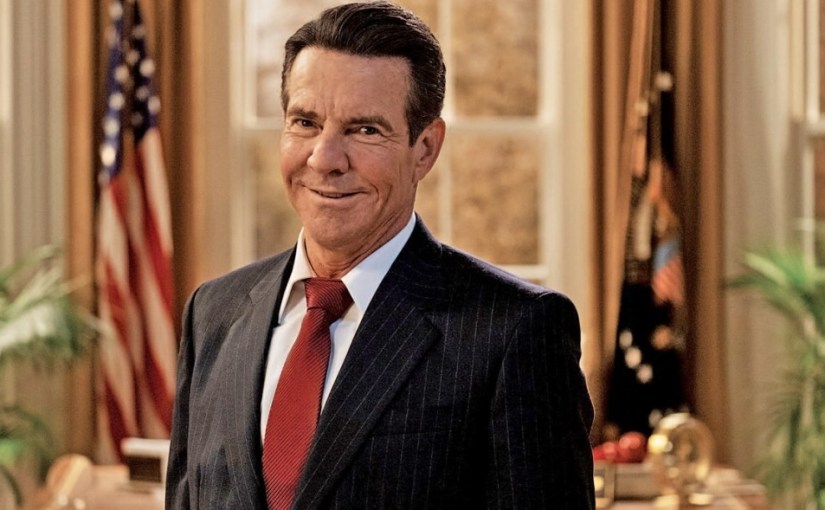
Dennis Quaid is an early Oscar contender for Best Actor as the title character. It’s easy to fall into the trap of a Saturday Night Live impression or what Johnny Carson famously did on his show. Quaid, with the assistance of some flawless makeup, finds Ronald Reagan’s crooked grin that shows a welcoming and open-minded figure, but also makes use of a slight scowl when the President emulated a need for tough policy, particularly with a bullying Soviet Empire and their possession of over thirty-five thousand nuclear missiles against America’s twenty-two thousand. Like most of this cast, you absolutely believe that Dennis Quaid is Ronald Reagan, in a performance that quickly attracts a likability for the man, laughter when the film calls for it and earned sorrow when the figurehead is facing death or illness. I cannot say I’m a big admirer of Dennis Quaid’s long career. None of his films ever stood out to me, until now.
The film directed by Sean McNamara follows a pattern like another celebrated biography, Amadeus. An outside observer narrates a person’s life to someone else. This time it is a retired KGB spy named Viktor Petrovich portrayed delicately by Jon Voight. Viktor claims that in the early 1940s he was assigned to penetrate the ranks of American activities to allow the Russians a leg up during pre-Cold War. He thought a good route was through Hollywood as there were some connections between that industry and politics. Viktor zeroed in on the eventual president of the Screen Actors Guild, a young Ronald Reagan, whose espouses of policy against Communist doctrine seemed to be overshadowing his budding acting career. At the same time, he was frustrating his first wife, actress Jane Wyman (Mena Suvari). Viktor could never anticipate this man would ever go from movie star to a life mired in divorce and bankruptcy, but then on to Governor of California and eventually a two term President of the United States.
It’s hard to find a way to get a biography off its feet and hit the ground running. Where do you begin and how do you start the story? Fortunately, McNamara is working with a script by Howard Klausner and Paul Kegnor who find the most unexpected storyteller and Jon Voight is perfect in the role, perhaps a supporting actor nomination should be considered for his Russian interpretation that is utterly convincing.
After the film hops around in time for a bit, beginning with the day of Reagan’s assassination attempt (March 30, 1981) to young actor to early childhood when he was addressed with the nickname “Dutch,” does the story move on a straighter path. The months, years and decades move in a chronological pattern. I’m grateful for it because I can easily connect the dots.
McNamara and Quaid show developments that lead to the next big moments, including time for Ronald to meet Nancy. Penelope Ann Miller plays the First Lady and I’ve been missing her on the big screen. She’s also perfectly cast and the picture allows her character to become fully developed so that a solid marriage of affection, love and image seems complete.
Two stories I had heard before are included in Reagan. Nancy enters the hospital just after the President has been shot and Ron tells his wife “Nancy, I forgot to duck.” Years later, ahead of the very important Geneva Convention with Mikhail Gorbachev, Nancy insists that her husband not appear with a winter coat on when he goes to meet with the Soviet Prime Minister. Ronald will be able to handle the cold air while Mikhail, the Russian, cannot. It was an image of a strong, defiant leader standing in front of the world.
In less than two and a half hours so much is covered in Reagan, but like any biography it cannot cover everything. That is okay here. A lot of details are explored and you do not need to be familiar with the history that was made during this man’s life. Sean McNamara’s film never makes it overly complex. News articles flash in front of you depicting some challenges that John F Kennedy faced which compounded on what Reagan would contend with nearly twenty years later. Much of it has to be blink and miss it moments to allow other details and events to be presented. You get an idea, but you do not need to reference an encyclopedia to understand the film.
Reagan is primarily a favorable depiction of the famous President. He’s almost always faced in a positive light. I’d argue it is fair actually. In his second election, he beat Walter Mondale by a landslide of forty-nine states to Mondale’s one. Ronald Reagan remains a celebrated statesman among both sides of the aisle. He was a bi-partisan man. Room is allowed for Ron to have a friendship with the Democratic Speaker Of The House Tip O’Neill (Dan Lauria) despite their disagreements in ideals.
I try to avoid getting too passionate and political as I write this article, and I know it is just a movie, but Reagan serves as a reminder when a political system was not hinged on the extremism that is demonstrated today. The politicians did not seem to be running for themselves ahead of the party they supposedly represented on a ballot. My family and I leaned Republican during the time of Ronald Reagan and Bush after him. My ideals have had no choice but to change however, because as Reagan demonstrates, the Republican party of today is not what it stood for thirty and forty years ago.
This film glosses over Ronald Reagan’s faults and shortcomings, particularly the scrutiny that came with the Iran-Contra Hearings and his possible negotiation with terrorists to rescue hostages. However, while Reagan may have contradicted his line in the sand of no negotiations with terrorists, his intent steadfastly never remained with a personal self-interest. Whatever he opted to do, he acted on behalf of the greater good of the nation he was elected to oversee. That mentality is not easy to find today. Presently, ego and self-entitlement drive many of the candidates to run for office, and at least I believe that is a very unhealthy mantra.
Sean McNamara’s film is a sensational biography with a superb cast. Many faces are familiar and only appear for minutes on screen to portray important members of Reagan’s cabinet or other political leaders. Time of course is given to Gorbachev (Olek Krupa) as well as the Iron Lady, Margaret Thatcher (Lesley Anne-Down). There’s also George Schultz (Xander Berkeley) and a California hippie named Dana (Derek Richardson in a scene stealing performance) who apparently was Reagan’s go to speech writer and created the line “Mr. Gorbachev, tear down this wall!!!” Never heard of Dana, and he seems like a far cry from who would exist significantly within the President’s career. However, McNamara and the writers allow for some entertainment in the picture.
You see jars of Reagan’s jellybeans on tables everywhere and you cannot help but grin. A door-to-door campaign for Ron and Nancy has a hilarious outcome with a housewife. As President, Ron is tasked with feeding a goldfish belonging to the daughter of the Swedish Prime Minister. The Secret Service even has the challenge of finding an agent to ride horseback alongside the President. These are issues that people face and live with, and the attention that McNamara lends to Ronald Reagan shape the kind of person he was.
The most memorable sequence is circumstantial when it is quickly depicted how three Russian Prime Ministers in a row suddenly die ahead of Gorbachev taking the spot. Jon Voight is especially funny here amid his subtle expressions. McNamara is working in the same mindset that Robert Zemeckis did with Forrest Gump’s fictional history. Ronald Reagan even has a zinger of a line in response to this series of unexpected deaths. Trust me. If you watch this film with a crowd, you’ll be laughing among the masses. It’s so unbelievable that it could only be true.
It makes no difference where you stand politically to appreciate Reagan. It’s another biography to take advantage of and quickly gather a lesson in history. The film is favorable and not overly judgmental of the figure it depicts. That’s okay.
The United States of America and its leaders were never entirely great. No President ever satisfied an entire nation of people. Reagan was not favored among the young adults of his time in an MTV age faced with the adversity of an unfamiliar AIDS crisis. He faced challenges from his opposing party and he could have been the President that led the world into a World War Three of nuclear destruction. All of these considerations are touched upon in a two- and half-hour movie and any world leader must be scrutinized in the same way they can be celebrated. Yet, for a movie, this is about all we can ask for. If you want to dive deeper, then I encourage you to do your research, find a podium or a college class or forum and declare your passions. Use a website like I do. You absolutely have that right. A movie does not have that luxury of time to go that far into the entirety of a man’s near ninety years on Earth.
I reiterate just how accomplished Reagan is. Sean McNamara is a director to lookout for. If he does not receive award recognition for this picture, and frankly I doubt he will (though I want to be wrong), his time will come. This is a guy who only recently was directing silly Nickelodeon and Disney TV shows. Yet, this director has a great vision for film assembly and a telling insight. Ahead of the movie, I saw a preview for a Holocaust picture that he recently completed called Bau: Artist Of War. Because of McNamara’s work here, that film is on my radar.
The cast of Reagan is also outstanding, worthy of Oscar nominations for Dennis Quaid, Jon Voight and Penelope Ann Miller. As well, a host of character actors really embrace their short time on screen such as Dan Lauria, Lesley-Anne Down and Xander Berkeley (always a celebrated character actor), plus this bearded hippie guy Derek Richardson. At the very least, the SAG awards should recognize this cast with a nomination for Best Ensemble.
Reagan is a very important film to see regardless of whatever generation you stem from. At the very least, no one can argue that Ronald Reagen lived his life touting his own name and his own special interests. Like the greatest of Presidents, he willingly served, only to serve the best interests of a country. Watch the film that explores the life of one of American history’s greatest servants.
For our country’s own future and prosperity, Ronald Reagan needs to be remembered.
 2 UNPAID MOVIE CRITICS!!!!