DAS BOOT (GERMANY)

By Marc S. Sanders

Wolfgang Peterson demonstrated how much suspense he can squeeze out of the tightest of movies when he embarked on filming one of the most realistic and famous submarine movies of all time, Das Boot (translated as The Boat).

During World War II, a German U-Boat is assigned to carry out missions of war within the deep Atlantic.  The purpose is simply for attack and never to question motivations or reasons.  Because these Nazi sailors have no concept of the politics or the totalitarianism behind the Führer, it is not hard to empathize with their plights at sea.  Life on a submarine is no party.

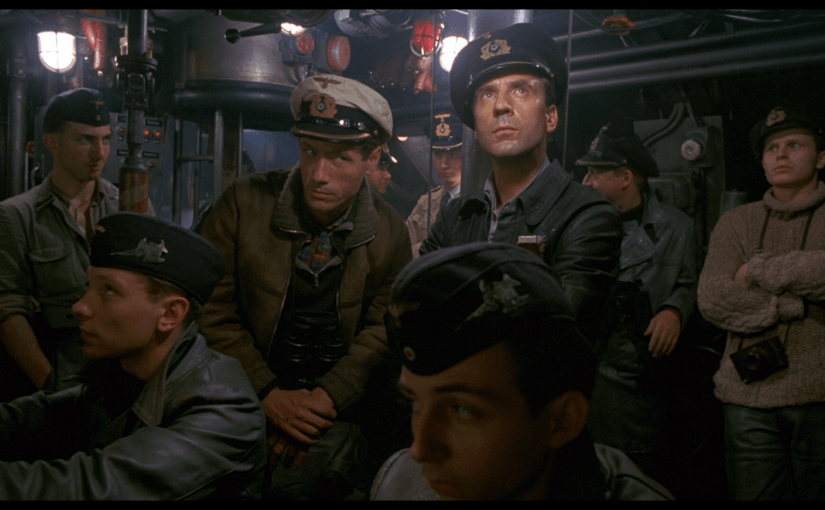
The Captain of the vessel is played by Jürgen Prochnow, the only recognizable actor in the whole cast.  However, all of these men are working just to get by one more day within the very narrow confines of the sub.  In fact, the main character is the submarine.  Rarely has a setting been so evident.  I was told that Peterson used miniature cameras, rare for use in the late 1970s when the film was shot.  He would tightly hold the projector and pursue his cast of shipmates down one galley way after another.  He’d put the camera right up against their face and profiles.  The concentration of these actors to ignore the filming is astounding.  Wolfgang Peterson provides a very clear documentary style to the piece.  Herbert Grönemeyer portrays a war correspondent, easily used within the context of the story to accept Peterson’s approach of simply witnessing the activities and claustrophobia aboard a boat that is primarily under hundreds of feet of ocean water.

To my knowledge, Das Boot is a fictional story loosely based off of accounts from an actual military journalist who was aboard a similar cruiser during the war.  I suppose the film could have been told from an Allies perspective rather than the Axis German superpower.  However, the film works and as a viewer, as you become more engrossed in the picture, you become blinded to the fact that these men served Adolph Hitler.  There’s hardly a swastika in the film.  So, I’m seeing men like any other cadets and officers serving a military branch, working to survive while completing the assignments bestowed upon them.

The torment comes in all forms.  The controls are old and clunky.  It gets very dark at times.  The vessel does not move at a comfortably smooth pace.  They have no choice but to eat rotten food.  It is so bad that the bread turns blue or green.  The men are unbathed and you can practically smell the stench of their body odor and the raw sewage that remains behind.  Sleeping quarters are cramped and are never efficient.

There is such miniscule space available for these people to carry on. The top officers get their exclusive table, but they must get up and move out of the way during dinner, while seamen pass them by on their way to different stations.  Luxury is not afforded for anyone.  The beards of the men become longer.  Wolfgang Peterson shot the film in sequence to accurately show the progression of their beards.  It maintained proper continuity as their sojourn of the boat carried on. 

Most agonizing is when the submarine attacks back at the crew.  A long sequence of suspense occurs following a surprise attack from the air.  The boat has dive into the depths of the ocean, but their controls are malfunctioning and they just continue to sink and sink.  Nuts and bolts pop out of nowhere like ricocheting bullets as the water pressure gets heavier.  My car or my smart phone is more technologically developed and capable than this sub, and I question how this clunker can even withstand the compression.  To maintain balance and direction, the men have to race to the front or back of the ship applying their body weight to work like a scale. 

Imagine the boat coming to a rest on a rocky perch hundreds of feet deep underwater.  There is no propulsion or engine power.  No communications either and the crew has less than a few hours left to survive among the carbon monoxide flooding the ship.  It’s a helpless scenario and at multiple points during the movie, I was convinced this is how it will all end.  Often, I was prepared not to be surprised how this all wrapped up at any given period of time.  Das Boot is a long film. The special edition is over three and a half hours. So, you get a vibe of how stretched out this crew has been away, cramped in these quarters.  Because Peterson stages these challenging scenarios to be extensive, you easily relate to the stress of these men. 

War is hell, even for the Nazis.  The Captain agonizes over a successful attack he’s accomplished when he takes out an American naval destroyer.  He’s done his job well, but he’s angered as he witnesses the aftermath through his binoculars.  Crewmen are set ablaze as they fall off the ship and into water below, and he wonders where the rest of their convoy has gone.  Shouldn’t they be rescuing their men?  This Captain is not a Nazi.  He’s a pawn on a chess board, not assigned to think of the fallen, but rather to do what he is told, absent of questions or emotions.

I do not want to spoil the ending but I cannot recall feeling so much anguish for a collection of Nazi officers before.  Another submarine movie was bold enough to say that the only true enemy in war is war itself and having watched Das Boot, I can clearly see the meaning behind that perspective.  This is not a war picture where one side torments and personally tortures individuals before brutally killing them with gunshots to the head.  In a submarine, the crew is somewhat blind to what they must attack. They are only aware of the environment that troubles them. The men of Das Boot don’t curse the Americans or the British, or the Jews.  They show no prejudice.  That’s not their mentality.

When I see them overcome one daunting challenge after another, I’m relieved for these Germans.  They survived.  They made it. 

However, after watching for over three and a half hours, the final sequence and frame send me a cold, all to real reminder of what occurred during that terrible world war less than eighty years ago and it the film’s ending is the only way this picture could have ended.

Das Boot is a masterpiece of filmmaking.

AIR FORCE ONE

By Marc S. Sanders

On the day I write this article, July 12, 2024, the new trailer for Captain America: New World Order premiered and Harrison Ford (whose birthday is tomorrow; Happy Tiding Dr. Kimble, Dr. Jones, Captain Solo, Mr. President, Dr. Ryan) is back in the Oval Office playing the President of the United States.  Don’t know what kind of Commander In Chief he’ll be this time around.  He might be as heroic as James Marshall from Air Force One. Then again he could be a challenge of hulk like proportions.  However, let’s at least fantasize that we have Mr. Marshall running for the top job this year against both the criminal buffoonery and geriatric disqualifications we are left to choose from.  Just look at James Marshall’s qualifications. 

Following an American Special Ops capture of a Russian radical, Marshall is bestowed an honor from the Soviet government. His acceptance speech insists his administration will never negotiate with terrorists.  Now that the line has been drawn, away he goes with his staff, his wife (Wendy Crewson) and pre-teen daughter aboard the most protected and safest plane in the world, Air Force One.  Yet, an element of careful process does not go according to plan and Gary Oldman’s team of Russian radicals hijack the plane with demands to free their leader from captivity.  Oldman’s screaming hysterical character, Ivan Korshunov, won’t have it so easy though because his team of men failed to capture the President.  As well, it requires the Vice President (Glenn Close) and Secretary of Defense (Dean Stockwell) who are on the ground to coordinate with Russia to free the prisoner.  Oldman’s response is to kill a hostage every half hour and if that does not work, then just blow up the plane.

This is not good.  BUT WAIT!!!!!  Is that…?  Could it be???  Is the President alive, sneaking around the bowels of the plane while taking out one terrorist at a time?  Raise your fist for Harrison Ford!!!!

‘Murica!!!!!!

There are two narratives going on with Air Force One.  One is the standard Die Hard formula action onboard the plane.  Then there is the endless debates of authority between the Vice President, the Secretary of Defense and the military leaders about if the President is in a proper state of mind to lead and act upon his aggression with a high level of threat to the country at stake, and more personally his wife and daughter in harm’s way?   None of this is nothing new.  It’s all familiar from the likes of many late 80’s and 90’s action pictures.  The politics are much more simplified than what you’d find in a Tom Clancy novel.  There’s even time for a which color wire to cut scene.  Yet, the movie is entertaining.

Director Wolfgang Peterson is best at showing the real star of the picture and that is Air Force One itself.  He’s got long shots down endless corridors and aisles. Within the underbelly, as well as the hollowed-out cockpit, there’s more for us to explore amidst the gunfire.  We see where the weapons are stored as well as the luggage and food supply.  We get to watch the football game in the President’s office too.  Heck, before the terrorists reveal themselves they are given a tour of the massive plane as their guide boasts that it is even impervious to a nuclear blast.  Color me impressed in Patriotic Red, White and Blue.

I think some of the acting is a little overdone at times. Not by Ford, but by almost everyone else.  Watching the debates within the government conference room, I’m seeing a little too much melodrama around the table.  A little too much hand clasping, pacing around the room, whispering,  and deep sighing.  On the plane, Oldman goes over the top but he’s one of our best character actors and its expected from him.  He’s the evil villain after all.  On the ground though, Dean Stockwell has done better work elsewhere, with much more complicated material. 

I like the idea of including political debates and a response to an unfathomable crisis like this, but a lot of the dialogue from guys like Stockwell, Phillip Baker Hall and Bill Smitrovitch comes off as textbook boring.  Same goes for Close, but she fits the role perfectly.  Let her be Ford’s running mate and they got my vote.  The only thing that upholds these scenes are due to Peterson’s hyper Steadicam.  So, when one more person in a suit makes a mad dash into the room, the director sweeps his camera right over there to get the latest news. 

Harrison Ford is doing his standard everyman/tough guy routine, always knowing how to stay one step ahead of the bad guys. President Marshall is much more capable than his entire trained Secret Service Squad and it’s fortunate that he gets the convenient shard of broken glass to cut the tape that binds his hands.  How often do we see that in movies?  The film definitely belongs to Ford, but it’s also nice to see some familiar faces participating like Xander Berkley, William H Macy and Paul Guilfoyle. 

The most unforgiving moment of the film occurs in the final minutes.  I don’t spoil everything by saying the plane nosedives into the sea, but this crash has to land at the top of some of the worst CGI ever assembled.  Yes, I know this was back in 1997, two years before what George Lucas accomplished with, at the time, pioneering effects on his return to Star Wars.  However, the final climax to Air Force One looks so obscurely animated and unfinished, it begs for the screenplay to find another way to wrap up its simplistic story.  It is downright terrible.  I recall it looking terrible on the big screen.  It looks just as bad on a 65” flat screen.  A toy plane crashing into a bathtub would look more convincing.

Air Force One is solid action.  Nothing more.  It’s not a thinking picture or one needing deep concentration and analysis. It does make you yearn for Harrison Ford to at least consider a run for the Oval Office, though.  He’d still be better than what will be on the ballot this year.

BEVERLY HILLS COP II

By Marc S. Sanders

I know. I know. I SHOULDN’T like this movie, but I do.

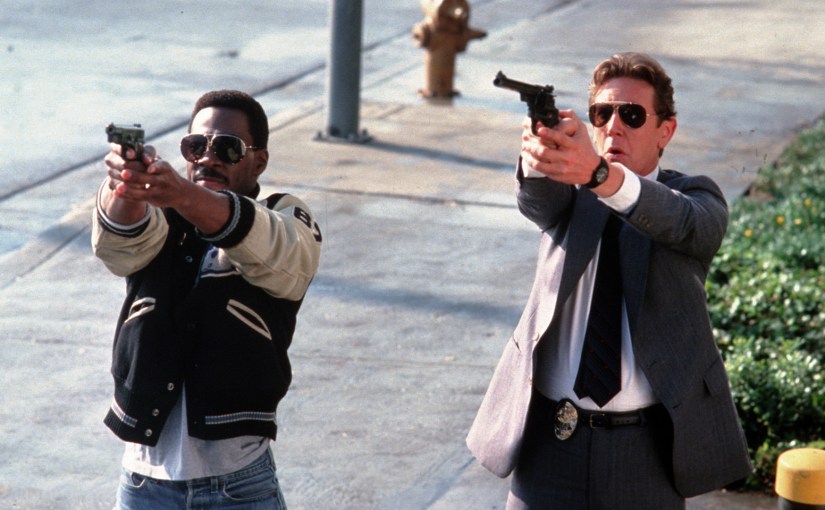
Beverly Hills Cop II is a sequel that is really an opportunity to see a wide variety of close ups of an Eddie Murphy who was well in his ‘80s prime, releasing one #1 movie after another. Here the viewer is treated to Murphy’s Axel Foley blowing a kiss to himself in the mirror, laughing to himself, tucking his crotch in his tailor made suit, flipping sunglasses on and off, driving a Ferrari, and shamelessly plugging the Detroit Lions all while trying to stop an “Alphabet Bandit” criminal in Beverly Hills, CA.

So there’s really not much here when all the vanity is on Murphy. Well, then what’s to like?

Considering I’m a fan of director Tony Scott, who uses great cinematography in all of his films with quick, tension filled editing, it’s hard to resist.  Most especially here Scott’s film is accompanied with an exceedingly cool and dangerous soundtrack from Harold Faltermeyer. Just the opening scene alone (without Murphy in it) belongs in a better movie. A robbery at a City Deposit bank and then later at a horse track are so well edited that you might tuck your knees into your chest and chew on your thumbnail. Great stuff from Tony Scott that would eventually carry over in films like Crimson Tide, Enemy Of The State, and one of my very favorites True Romance.

There are other good moments in Beverly Hills Cop II, especially a great scene with Gilbert Gottfried, and a few with Paul Reiser as well as a smirk inducing scene with Hugh Hefner.

I shouldn’t like this movie but sue me. It’s a guilty pleasure for me. However, watch the far superior first installment over this one any day of the week.