
A HAUNTING IN VENICE

By Marc S. Sanders

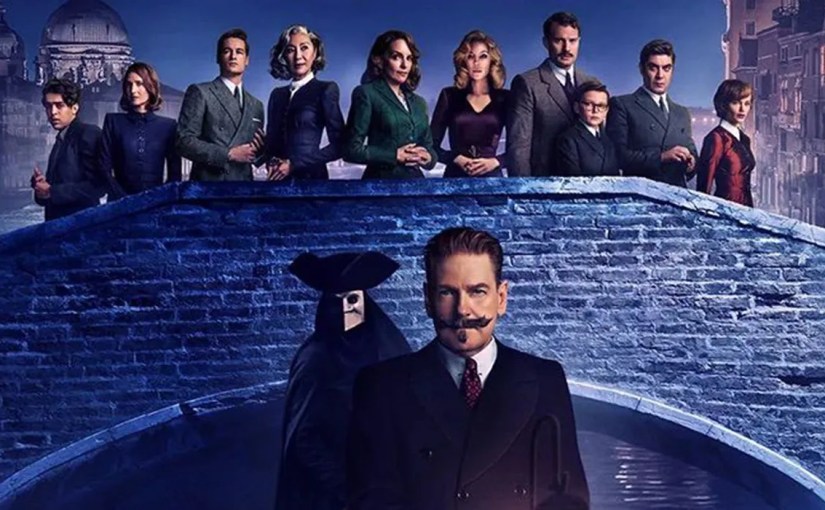
There’s A Haunting In Venice and Hercule Poirot is on the case.  

Kenneth Branagh returns for a third time as Agatha Christie’s famed literary detective.  He also serves in the director’s chair again, and this is his best installment in the updated franchise.

The man with the exaggerated mustache is living in Venice, Italy, with the assurance of a bodyguard (Fernando Piloni) to fend off any pestering folk needing their own personal conundrums resolved.  Poirot is not interested to assist.  

On All Hallow’s Eve, he is invited to be a tag along with his American mystery novelist friend Ariadne Oliver (Tina Fey) at Rowena Drake’s home. A celebrity Medium known as Mrs. Reynolds is to appear and perform a seance. My first impression of Fey’s character is a loose interpretation of Dame Agatha come to life to partner up with Hercule.  She’s sort of a wink and nod to the author’s fan base.  What if Agatha and Hercule actually worked together?  This is as close as you’ll get.  Branagh and Fey work so well together.

Poirot reluctantly agrees to accept Ariadne’s invitation.  Upon arrival at the affair, the best feature of the film is introduced.  Rowena’s home is a foreboding dwelling alongside the Venetian River, and this Hallowe’en evening is turning into a dark and stormy night.  A children’s costume party is wrapping up complete with creepy puppetry, ghost story telling and apple bobbing.  Then it is time to welcome the arrival of a figure dressed in black wearing a pearl white Kabuki mask.  The children have left, and the eventual suspects of a murder mystery are all that remain in the house when the seance begins.  Mrs. Reynolds will use her talent to communicate with Rowena’s daughter who passed away a year earlier following a fall off the rooftop and into the murky river below.  

Poirot is the most skeptical of the guests as he staunchly believes only in logic, not the supernatural.  Ariadne insists that he will be amazed at the unexplainable talent at play. A well timed falling chandelier and a typewriter that seems to answer the Medium’s questions are not convincing enough for him.  

Eventually, a gruesome and shocking murder occurs.  Like most formula mysteries, everyone appears to have an alibi.  Yet, Poirot refuses to believe this crime took place by means of a supernatural element.  Even if there are unexplained noises within the home and the appearance of Rowena’s daughter turn up, there must be a more logical resolution.  

A Haunting In Venice works especially well thanks to the atmosphere of its setting.  The multi-floored and darkened home lend to the eeriness necessary for a spooky story focusing on death.  The faucet of a sink doesn’t work.  The innocence of apples takes on a nervous feeling.  Lanterns allow shadows to float within the darkness while the lightning flashes and the thunder pounds outside with choppy waters in the river. This haunted place where a young girl recently died is not somewhere I want to stay overnight.  

One suspect that especially stands out is Leopold (Jude Hill), a preteen boy with a fondness for the macabre works of Edgar Allen Poe.  Poirot suggests he turn towards Dickens.  Leopold seems much wiser than his years, as he tends to and speaks on behalf of his unwell father, Dr. Leslie Ferrier (Jamie Dornan).  

Michelle Yeoh turns in another memorable performance permitting the strangeness of her Medium character, Mrs. Reynolds, to elevate suspense.  Poirot can choose to be doubtful.  Nevertheless, I’m convinced Mrs. Reynolds can speak to the actual dead.  

A Haunting In Venice has murder on its mind and the sudden death of one of the characters is horrifying.  I dare not spoil how it transpires.  Thankfully, this tale returns to an approach that so many classic films adopted.  You don’t need pools of blood and guts to get the hairs on the back of your neck to stand up.  It’s clear that with the approval from Agatha Christie’s estate, Branagh is well researched in what the author wanted to accomplish.  

The screenplay from Michael Green lends wonderful color to the characters, as Poirot interviews each person.  All of the performers are engaging.  This collection of actors especially works because unlike the other two Branagh films, this installment does not rely so much on stunt casting with recognizable marquee names.  For me, the who done it resolution was more challenging to solve because the actors portraying the assortment of suspects were deliberately vague, airing a sense of distrust in any one of them.  

This is a fireplace story to curl up with under a blanket and a cup of hot cider on a brisk Autumn night. The best compliment I can give A Haunting In Venice is that it’s a never-ending page turner.

BELFAST

By Marc S. Sanders

Within the first three minutes of Kenneth Branagh’s Belfast, there is impactful transition that goes reverse in time.  Van Morrison supplies the music to the film and it opens in bright color capturing glimpses of the thriving city.  There are well paved highways with ongoing traffic.  Fresh painted construction cranes stand in front of a blue sky with a warm sun.  Buildings have beautiful architecture.  There are pieces of eye-popping art within the city.  It looks like the most gorgeous vacation destination.  Even the opening credits are stenciled in nice gold font.  Then Branagh’s camera lifts up over a wall and the screen reverses back in time to August, 1969 where it’s depicted in black and white.  A sweet blond-haired boy named Buddy (Jude Hill) is holding a stick and a trash can lid as he slays an imaginary dragon, but then reality dawns upon him and violent riots erupt on the street he lives on. Cars are set on fire, windows are smashed, bricks are thrown, and Molotov cocktails burst into flames.  What we see as prosperity now, had a history at one time, and history is not always something to embrace.  Belfast reminds us that it was ugly before it got better.

Belfast, Ireland in the late 60s/early 70s is shown through the eyes of Buddy.  Branagh never has Buddy be forced to grow up so fast, despite the inflamed conflicts between Protestants and Catholics living in Ireland.  He plays in the park.  He watches Star Trek on TV.  He does his math homework with his Pop (Ciaran Hinds). He’s a little bit of a troublemaker as he pockets chocolate from the local candy store.  He also escorts his grandmother (Judi Dench) to the movies and live theater.  He’s a happy little kid, but he’s also wise to the new world thrust upon his doorstep.  It’s hard not to see the make shift barrier walls of junk at the end of the block and the sometimes-questioning policemen.

His Pa (Jamie Dornan) leaves for two-week trips for work, but when he’s home, Buddy eyes upon his Pa’s childhood friend intimidating him to join the cause to rid the area of Catholicism.  His Pa is put into an “either you’re for us or you’re against us” dilemma.  Pa does not sway so easily. 

His Ma (Catriona Balfe) tries to keep things as normal as possible.  A surprising moment occurs when Buddy gets swept up in looting a grocery store with the rioters.  He runs home with a box of laundry detergent.  Ma will not stand for that and escorts him back to the store to return the item.  Ma gets a full account at this moment of what’s become of their hometown when all she wants to do is properly discipline and raise her child.

As tensions rise over the coming months, Ma debates with Pa about whether to leave Belfast for a new life in the United Kingdom.  I think this becomes more traumatic for Buddy than the random violence he periodically witnesses.  He’d have to leave his grandparents and his school and his friends.  As well, he’s been working so hard to keep his grades up so that he can sit at the front of class, next to the young girl he pines for.  They are working on a science project that recounts the historic first trip to the moon.

Belfast is a rather short film, but Branagh’s script offers much.  It focuses on a piece of mid-twentieth century European history that I was never familiar with.  The film gives you the minimum details through conversations and sound bites from news broadcasts.  That’s fine, but my attention span was waning at times.  It’s not fair for me to criticize the picture this way.  I just couldn’t relate to the culture of the community, and so I just was not engaged on this one and only viewing.

It’s clearly well-made, and Branagh presents a convincing depiction primarily of this one residential block that this family lives on.  While Buddy’s exploits are endearing and there are especially good performances all around, the riot violence is scary with harsh sound editing of screams and shattering window panes.  The cinematography is strong, especially when it contrasts with color.  The choice is made to depict a live performance of A Christmas Carol in color while the seated audience with Buddy and his grandmother stays in black and white.  Branagh does a cool effect by having bright orange stage lights reflect in Dench’s eye glasses which remain in monochrome.  When the family goes to see Chitty Chitty Bang Bang, the movie screen is in color like the film they are watching.  The characters of Belfast remain in black and white, though.  This family and others like them, remember these tumultuous times in a dull, gray perspective.  It was a non-celebratory and often harsh way to live.  The escapism they partake will always be preserved in promising and welcome colors, however.  This is a fantastic storytelling device.

As Kenneth Branagh wrote and directed the piece, it’s clear that he strove for his exact vision and he has a personal achievement he should be proud of.  There doesn’t appear to be any compromise to his picture.  It’s very well directed with its cast performances, the town extras and the technical choices made.  Yet, the film never grabbed me emotionally.  Belfast exists to simply to show how this family survived day to day with turmoil surrounding them.  If anything, at least I learned something new within the confines of Ireland from fifty years ago.