MEGALOPOLIS

By Marc S. Sanders

Francis Ford Coppola’s Megalopolis is undeniably the director’s most ambitious project of his long career.  Like other films, Coppola put up the entire $120 million to finally make the picture, including selling his well-known vineyard to make it happen.  Every penny he invested is well spent.  Especially seeing it on IMAX, this is an absolutely gorgeous motion picture, like James Cameron’s Avatar films.  I mean…wow do the colors pop and shine.  

However, as beautiful as the visuals are in Coppola’s self-described “Fable” (it literally says that in the title card), it is mostly devoid of substance beyond the paint by numbers debates that cause conflict among these very strange characters.

In New Rome City, an alternative reality to the Big Apple (the Statue of Liberty holds the torch in her left hand), Caesar Catalina (Adam Driver) is a “designer” who recently invented Megalon, a substance that he believes is the answer to a utopian future.  It’s indestructible and it can be molded to serve practically any purpose.  For example, you don’t even have to walk to where you’re going.  Step on the Megalon puddle and it will move you there.  Not much of a departure from the flat movable floors you find in nationwide airports.  This is one of Megalon’s major innovations, designed to impress me?

Megalon can also be used for healing, and it has the ability of transparency.  It is more durable than wood, steel or concrete.  It’s truly the next greatest wonder of resources.  Frankly, I was more dazzled by the Vibranium found in Wakanda.

As Caesar the artist pushes his agenda for absolute Utopia, the hardened Mayor Franklyn Cicero (Giancarlo Esposito) is the opposing side of the argument declaring Utopia to be an impossibility.  Caught in between the two figures is Julia (Nathalie Emmanuel), daughter of Cicero and in love with Caesar.  Gotta have a soap opera element to this piece so the stubborn divide between these two men remains firmly in place.

Just as in typical political rings, the Mayor works to smear Caesar the idealist who is solely focused on his end goal design.

Outside the boundaries of their public quarrel are other overly colorful and garish looking characters such as the banker Hamilton Cressus III (Jon Voight), his wife, the gossip reporter Wow Platinum (Aubrey Plaza), Constance Cassius Catalina who is Caesar’s mother (Talia Shire), a lone, crazed revolutionist and nephew to the Mayor called Clodio Pulcher (Shia LeBeouf) and Nush “The Fixer” Berman (Dustin Hoffman).

These names are exhausting.  Coppola’s film is even more tiresome.  The filmmaker truly must believe he is the second comings of both Nostradamus and William Shakespeare.  The ego of this picture could not be more apparent.  The director’s head must be THAT BIG to believe he has the nerve to tell this story of such biblical proportions.

Much of those character names, and the actors who play them, are here for show and tell.  Their value to this piece is nowhere near as prized as anyone living in Harry Potter’s world, though. Megalopolis only takes time to calm itself down when the three principal players have scenes isolated to themselves or when they only occupy the screen together.  Otherwise, this movie serves as vehicles for much of the cast to be adorned with updated and trendy Roman costume wear, from fig leaf crowns to golden armored chest plates.  At times, LeBeouf is so unrecognizable in hair, makeup and clothes you don’t even realize you’re looking at him.  

The performances are all over the place.  I never once believed that whatever Dustin Hoffman was talking about that he knew what he was even saying or representing.  Shia LeBeouf mostly runs with the privilege of getting to say “Fuck Caesar!” while finding motivation only in whatever weird appearance he’s dressed in.  Adam Driver can lead a picture for sure, but here he looks like he showed up for filming with a bewitching overnight hangover.  

This is a film that cannot be ignored for its technical achievements at Oscar time.  For no reason other than aesthetics, Driver and Emmanuel will share a scene while balancing themselves on swinging steel construction beams high above the city. The view is spectacular.  All undeniably eye opening.  You also cannot look away from the costumes or scenic art direction.  The sound mixing in an IMAX theater totally envelops you in this weird world.  It’s a digital film’s dream just like James Cameron banks on.  

Still, maybe none of these efforts will be recognized because frankly much of the visuals, audio and physical construction make zero sense or relevance to the central storyline that Coppola is striving for.  Namely, the possibility for Utopia versus the practicality of simply living through life with the necessity for economics, technology, healthcare, fuel and on and on and on.

Of all films I thought about while watching Megalopolis, my mind went to William Shatner’s Star Trek V: The Final Frontier.  Shatner had the idea to have the Enterprise crew meet face to face with the almighty God.  Well, if you’re going to deliver God to a movie house, without George Burns or Morgan Freeman in the role, you’re setting yourself up to disappoint at least half or maybe even one hundred percent of your audience.  When you factor in the tremendous assortments of beliefs and religions, I’d argue no two people who believe in God, see the ethereal, omnipotent entity in the same way.  The same goes for Utopia.  How can Francis Ford Coppola be so audacious as to believe audiences will accept Caesar’s vision of a perfect land?  

Reader, he can’t!

My Utopia is different than your Utopia.  This is practically an untouchable subject and Francis Ford Coppola is far from the fabled prophet that the world needs or will draw their attention to.

Still, I remained as open minded as I could with Megalopolis all the way towards the ending that finally arrived.  The Utopia shown on this giant IMAX screen was told by the film’s narrator (Laurence Fishburne, also paying Caesar’s chauffeur) that the world was showered in gold dust.  A far cry from the Bible’s claim of arriving upon a land of milk and honey.  Why should I ever need the nourishment of milk and honey when I can have gold dust?

Think about that for a second.  Gold Dust.  I know.  The narrator is being allegorical.  Still, couldn’t that be interpreted as a little too materialistic for the Utopia we yearn for?  Gold is only a precious metal the same way a diamond is only a precious stone, or the Atari 2600 is now an expired precious commodity among former twelve year old kids in the 1980s.  

I have little shame.  I’m an admitted materialistic kind of guy.  My Mustang and my flat screen TV and my Star Wars collectibles mandate that I am. Yet, none of these possessions have ever delivered me into a paradise of perfection.  The Mustang needs precious fuel to operate.  Try as I might, I can’t collect everything.  My flat screen TV is still on the fritz.  (DAMN YOU BEST BUY GEEK SQUAD!!!)

Coppola contradicts himself with the conclusion of his fantasy opus.  He pans over the extras who occupy this film with big toothy grins of enormous gratitude while the very well dressed and bejeweled surviving characters of his story seem to be shot from an elevated stage above me, the viewer, and all who occupy a brightly lit Times Square located within the heart of New Rome City.  I am meant to look up to these giants!!! 

THIS IS UTOPIA???  

No!  I could never accept this interpretation of grand decadence as the enigmatic paradise we have all envisioned in dreams and discussion and literature.  Shouldn’t Utopia consist of a life where stress is absent, and pain is a foreign unfamiliar word and feeling? I’m not even giving Utopia its fair due.  It’s practically impossible to describe, but I’m at least certain that the rich shades of gold and black glamours within a Times Square shopping district is not the way to go.  Yet, Francis Ford Coppola is suggesting this is all that it is.  A Times Square showered in gold dust.

Frankly, I normally would give much more credit to the man who pioneered the stellar Godfather films along with the bombastic Apocalypse Now and the intimate The Conversation.  He’s never been more short sighted though, than when he finally made his “fable,” Megalopolis.

The greatest flaw and tragedy of Megalopolis is the very broad contradiction that Francis Ford Coppola declares within his fictional, fantasy-like prophecy.  Once the “fable” is all over, I feel like I paid an enormous amount of money for a cult like weekend seminar meant to brainwash me into broadening heights of positivity and awareness, showered in gold dust of course.  

Where’s The High-Level Minister Coppola?  

I’d like my money back because this preach is no more believable than an L Ron Hubbard doctrine.  Battlefield Earth just might be a little more convincing Megalopolis.
REAGAN

By Marc S. Sanders

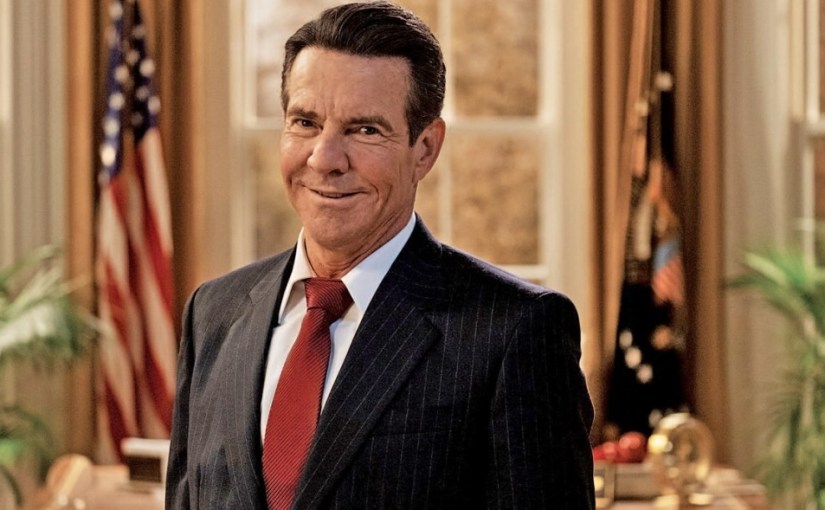
I read that Reagan completed shooting in 2021 during the height of Covid.  It was not released until three years later because it had trouble finding a distributor.  Everything happens for a reason, because it is more fitting that the cinematic biography of America’s fortieth President be released during an important election year.  I do not believe it matters what political party you lean towards, this telling of Ronald Reagan’s life demonstrates a man of principals with an adoring sense of humor, even when death’s door might be knocking. 

Reagan is one of the best films of 2024.

Dennis Quaid is an early Oscar contender for Best Actor as the title character.  It’s easy to fall into the trap of a Saturday Night Live impression or what Johnny Carson famously did on his show.  Quaid, with the assistance of some flawless makeup, finds Ronald Reagan’s crooked grin that shows a welcoming and open-minded figure, but also makes use of a slight scowl when the President emulated a need for tough policy, particularly with a bullying Soviet Empire and their possession of over thirty-five thousand nuclear missiles against America’s twenty-two thousand.  Like most of this cast, you absolutely believe that Dennis Quaid is Ronald Reagan, in a performance that quickly attracts a likability for the man, laughter when the film calls for it and earned sorrow when the figurehead is facing death or illness.  I cannot say I’m a big admirer of Dennis Quaid’s long career.  None of his films ever stood out to me, until now.

The film directed by Sean McNamara follows a pattern like another celebrated biography, Amadeus.  An outside observer narrates a person’s life to someone else.  This time it is a retired KGB spy named Viktor Petrovich portrayed delicately by Jon Voight.  Viktor claims that in the early 1940s he was assigned to penetrate the ranks of American activities to allow the Russians a leg up during pre-Cold War.  He thought a good route was through Hollywood as there were some connections between that industry and politics.  Viktor zeroed in on the eventual president of the Screen Actors Guild, a young Ronald Reagan, whose espouses of policy against Communist doctrine seemed to be overshadowing his budding acting career.  At the same time, he was frustrating his first wife, actress Jane Wyman (Mena Suvari).  Viktor could never anticipate this man would ever go from movie star to a life mired in divorce and bankruptcy, but then on to Governor of California and eventually a two term President of the United States.

It’s hard to find a way to get a biography off its feet and hit the ground running.  Where do you begin and how do you start the story? Fortunately, McNamara is working with a script by Howard Klausner and Paul Kegnor who find the most unexpected storyteller and Jon Voight is perfect in the role, perhaps a supporting actor nomination should be considered for his Russian interpretation that is utterly convincing.

After the film hops around in time for a bit, beginning with the day of Reagan’s assassination attempt (March 30, 1981) to young actor to early childhood when he was addressed with the nickname “Dutch,” does the story move on a straighter path.  The months, years and decades move in a chronological pattern.  I’m grateful for it because I can easily connect the dots.  

McNamara and Quaid show developments that lead to the next big moments, including time for Ronald to meet Nancy.  Penelope Ann Miller plays the First Lady and I’ve been missing her on the big screen.  She’s also perfectly cast and the picture allows her character to become fully developed so that a solid marriage of affection, love and image seems complete. 

Two stories I had heard before are included in Reagan.  Nancy enters the hospital just after the President has been shot and Ron tells his wife “Nancy, I forgot to duck.”  Years later, ahead of the very important Geneva Convention with Mikhail Gorbachev, Nancy insists that her husband not appear with a winter coat on when he goes to meet with the Soviet Prime Minister.  Ronald will be able to handle the cold air while Mikhail, the Russian, cannot.  It was an image of a strong, defiant leader standing in front of the world. 

In less than two and a half hours so much is covered in Reagan, but like any biography it cannot cover everything.  That is okay here.  A lot of details are explored and you do not need to be familiar with the history that was made during this man’s life.  Sean McNamara’s film never makes it overly complex.  News articles flash in front of you depicting some challenges that John F Kennedy faced which compounded on what Reagan would contend with nearly twenty years later.  Much of it has to be blink and miss it moments to allow other details and events to be presented.  You get an idea, but you do not need to reference an encyclopedia to understand the film. 

Reagan is primarily a favorable depiction of the famous President.  He’s almost always faced in a positive light.  I’d argue it is fair actually.  In his second election, he beat Walter Mondale by a landslide of forty-nine states to Mondale’s one.   Ronald Reagan remains a celebrated statesman among both sides of the aisle.  He was a bi-partisan man.  Room is allowed for Ron to have a friendship with the Democratic Speaker Of The House Tip O’Neill (Dan Lauria) despite their disagreements in ideals. 

I try to avoid getting too passionate and political as I write this article, and I know it is just a movie, but Reagan serves as a reminder when a political system was not hinged on the extremism that is demonstrated today.  The politicians did not seem to be running for themselves ahead of the party they supposedly represented on a ballot.  My family and I leaned Republican during the time of Ronald Reagan and Bush after him.  My ideals have had no choice but to change however, because as Reagan demonstrates, the Republican party of today is not what it stood for thirty and forty years ago. 

This film glosses over Ronald Reagan’s faults and shortcomings, particularly the scrutiny that came with the Iran-Contra Hearings and his possible negotiation with terrorists to rescue hostages.  However, while Reagan may have contradicted his line in the sand of no negotiations with terrorists, his intent steadfastly never remained with a personal self-interest.  Whatever he opted to do, he acted on behalf of the greater good of the nation he was elected to oversee.  That mentality is not easy to find today.  Presently, ego and self-entitlement drive many of the candidates to run for office, and at least I believe that is a very unhealthy mantra. 

Sean McNamara’s film is a sensational biography with a superb cast.  Many faces are familiar and only appear for minutes on screen to portray important members of Reagan’s cabinet or other political leaders.  Time of course is given to Gorbachev (Olek Krupa) as well as the Iron Lady, Margaret Thatcher (Lesley Anne-Down).  There’s also George Schultz (Xander Berkeley) and a California hippie named Dana (Derek Richardson in a scene stealing performance) who apparently was Reagan’s go to speech writer and created the line “Mr. Gorbachev, tear down this wall!!!” Never heard of Dana, and he seems like a far cry from who would exist significantly within the President’s career.  However, McNamara and the writers allow for some entertainment in the picture.

You see jars of Reagan’s jellybeans on tables everywhere and you cannot help but grin.  A door-to-door campaign for Ron and Nancy has a hilarious outcome with a housewife.  As President, Ron is tasked with feeding a goldfish belonging to the daughter of the Swedish Prime Minister.  The Secret Service even has the challenge of finding an agent to ride horseback alongside the President. These are issues that people face and live with, and the attention that McNamara lends to Ronald Reagan shape the kind of person he was.

The most memorable sequence is circumstantial when it is quickly depicted how three Russian Prime Ministers in a row suddenly die ahead of Gorbachev taking the spot.  Jon Voight is especially funny here amid his subtle expressions.  McNamara is working in the same mindset that Robert Zemeckis did with Forrest Gump’s fictional history.  Ronald Reagan even has a zinger of a line in response to this series of unexpected deaths.  Trust me.  If you watch this film with a crowd, you’ll be laughing among the masses.  It’s so unbelievable that it could only be true.

It makes no difference where you stand politically to appreciate Reagan.  It’s another biography to take advantage of and quickly gather a lesson in history.  The film is favorable and not overly judgmental of the figure it depicts.  That’s okay. 

The United States of America and its leaders were never entirely great.  No President ever satisfied an entire nation of people.  Reagan was not favored among the young adults of his time in an MTV age faced with the adversity of an unfamiliar AIDS crisis.  He faced challenges from his opposing party and he could have been the President that led the world into a World War Three of nuclear destruction.  All of these considerations are touched upon in a two- and half-hour movie and any world leader must be scrutinized in the same way they can be celebrated.  Yet, for a movie, this is about all we can ask for.  If you want to dive deeper, then I encourage you to do your research, find a podium or a college class or forum and declare your passions. Use a website like I do.  You absolutely have that right.  A movie does not have that luxury of time to go that far into the entirety of a man’s near ninety years on Earth.

I reiterate just how accomplished Reagan is.  Sean McNamara is a director to lookout for.  If he does not receive award recognition for this picture, and frankly I doubt he will (though I want to be wrong), his time will come.  This is a guy who only recently was directing silly Nickelodeon and Disney TV shows.  Yet, this director has a great vision for film assembly and a telling insight.  Ahead of the movie, I saw a preview for a Holocaust picture that he recently completed called Bau: Artist Of War. Because of McNamara’s work here, that film is on my radar. 

The cast of Reagan is also outstanding, worthy of Oscar nominations for Dennis Quaid, Jon Voight and Penelope Ann Miller.  As well, a host of character actors really embrace their short time on screen such as Dan Lauria, Lesley-Anne Down and Xander Berkeley (always a celebrated character actor), plus this bearded hippie guy Derek Richardson.  At the very least, the SAG awards should recognize this cast with a nomination for Best Ensemble.

Reagan is a very important film to see regardless of whatever generation you stem from.  At the very least, no one can argue that Ronald Reagen lived his life touting his own name and his own special interests.  Like the greatest of Presidents, he willingly served, only to serve the best interests of a country.  Watch the film that explores the life of one of American history’s greatest servants. 

For our country’s own future and prosperity, Ronald Reagan needs to be remembered.

MIDNIGHT COWBOY

By Marc S. Sanders

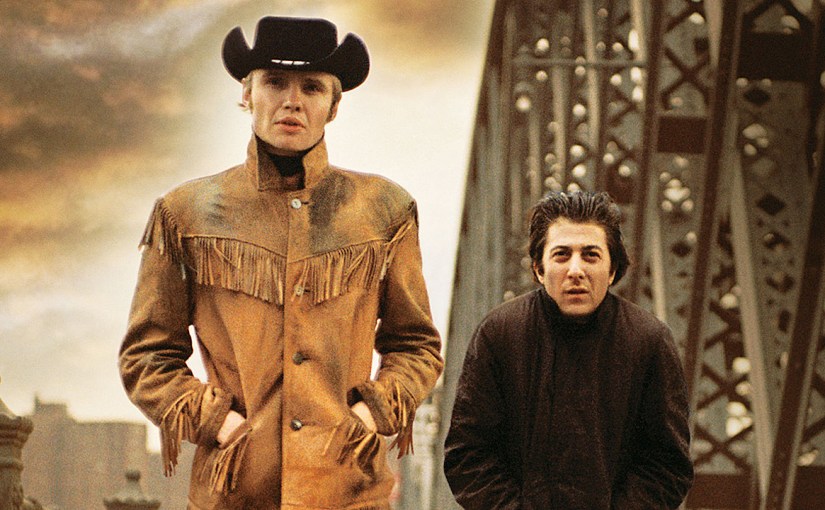
There’s an irony to John Schlesinger’s Midnight Cowboy.  At first, the film centers on a Texas bumpkin eager to relocate to New York City and succeed as a hustler.  Upon his arrival though, he could not appear any more virginal.  The cowboy’s name is Joe Buck, portrayed by Jon Voight in his Oscar nominated breakthrough role.

The first act of the film follows Joe on his long cross country bus ride.  He’s dressed in his finest country western shirt, stitched with floral patterns.  He’s got his black leather cowboy boots and of course the cowboy hat.  His origin bred Texas twang completes his image.  He meets a variety of comers and goers on the bus and then finally he reaches his destination. 

Schlesinger’s camera follows Voight as he treks through the city.  A man is passed out (heck, maybe he’s dead) on the street in broad daylight.  My Cinemaniac pals that I watched the film with noted how it’s funny that the streetwalkers don’t take one look at the poor fellow.  Rather they’re looking at Joe’s get up as he clearly stands out among the masses. Joe is the only one looking at the guy on the street.

Interspersed within Joe’s travels and entry into the city are quick flashbacks to where he stemmed from.  It does not look like a favorable upbringing spent with his grandmother.  There are flashes of Joe being victimized by possible sodomy.  There also appears to be a gang rape that he might have participated in.  None of it is made completely clear.  Though, it is evident that Joe has been trying to escape that environment for good. 

Eventually Joe encounters a sleazy, squat fellow who calls himself Rico Rizzo (Dustin Hoffman), addressed by others as Ratso.  Joe is so naïve that he’ll trust Ratso to get him some action where he can earn some money.  In exchange, Joe is completely willing to surrender the cash in his wallet.  He’ll learn from that mistake once he’s drained of everything but a few coins, locked out of his hotel room he can’t pay for and denied of his cow skinned suitcase that contains his possessions.  Eventually, he has no choice but to live in a condemned tenement building with Ratso. Joe Buck is about to lose a second virginity as he experiences how hard it is to live within the city.  He’ll also realize the value of friendship as he sees no choice but to take care of Ratso who is very sick.  Hoffman’s appearance shockingly changes as Ratso’s health submits to a harsh, unknown illness.  The sweat all over his face is palpable.  The chilling, sickly feeling he exudes is clearly felt.

Waldo Salt’s award-winning script, based upon a novel by James Leo Herlihy, explores the good nature found within two different walks of life despite the dodgy pasts that follow them. Ratso and Joe are one of the oddest couples in cinematic history.  There’s no way these two would want to be together unless one was trying to take advantage of the other or one was left with his guard down, open to being taken for and deceived.   Jon Voight has a tall youthful stature, a handsome man.  Dustin Hoffman is scrawny and significantly shorter with greasy hair, an uneasy limp and a weird squawk to his voice.  The often-times method actor seems to make himself increasingly hideous. 

Perhaps I needed to see Midnight Cowboy at the time of its release.  It surprises me the film merited the prestigious accolades it collected, including Oscars for Best Picture, Director, and Screenplay.  The two actors also received Oscar nominations.  It remains an honest film of its time in the year 1969.  Yet, it is disturbing and ugly too as it captures the seedy side of New York with experimental drug use and Joe’s victimization for sex.  He gets ripped off by who he thought was a kind woman (Sylvia Miles) looking for an intimate evening with his hustler capabilities.  Later, he’ll surrender himself to a man looking for oral pleasure in a movie theatre.  It’s not the typical glamourous epic of a Hollywood yesteryear.  In fact, for a time it was the only film to be recognized for winning Best Picture with an X rating.

The celebration of Midnight Cowboy’s achievements falls upon the relationship between Joe and Ratso.  Had Joe not been so naïve to how lowlifes operate and had Ratso not become so ill, yet welcoming to Joe when he needed a place to stay, then a friendship would not have gradually developed. 

The ending to Schlesinger’s film is touching, though sad.  As the story began, it also ends on a bus heading towards a new destination – another new way of life, different from what Joe experienced in small town Texas or New York City.  The two characters sit together in the back seat and the other passengers eventually observe them like they had on Joe’s first journey.  Either individually or together Ratso and Joe are simply strange to any sort of environment.  Yet, they’ll learn from each other and that’s where Midnight Cowboy triumphs.

FOUR CHRISTMASES

By Marc S. Sanders

I love Christmas cookies.  Those Santa, snowman and tree shaped sugar cookies with the frosting and sprinkles.  They are my weakness come every December.  Cookie cutter, however, is not necessarily a compliment when talking about a movie.  Four Christmases is as cookie cutter as they come.

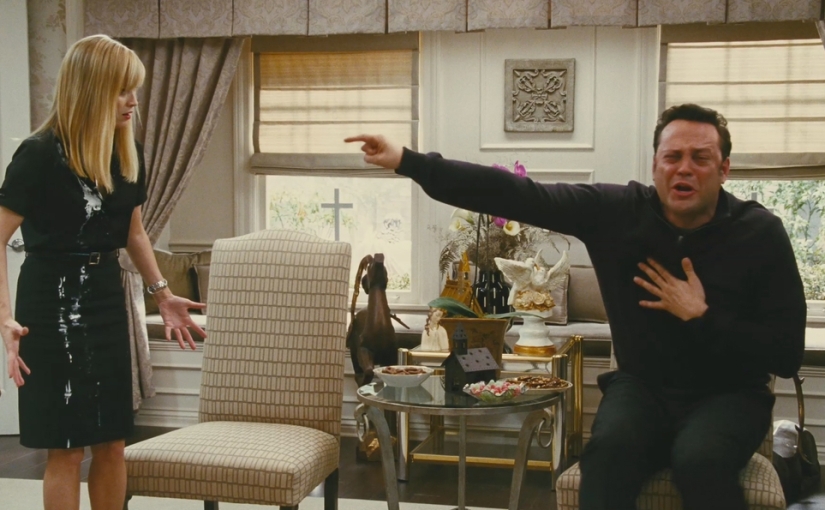
Reese Witherspoon and Vince Vaughn are Kate and Brad, an unmarried couple happily going on three years and ready to celebrate the holidays alone in Fiji while lying to their divorced parents, on both sides, about doing charitable service within poorly developed countries.  However, when they arrive at the airport and learn that their flight is cancelled, wouldn’t you know it?!?!  A news reporter is there to capture them on live television revealing their ruse.  Now Brad and Kate have no choice but to visit each parent’s home on Christmas.  With less than an hour and a half running time, let’s chop this up evenly, shall we?  Figure there will be about 15-20 minutes devoted to each parent.  Hence the title… (say it with me now) …Four Christmases.

Let’s go see Brad’s dad first, Robert Duvall, who lives with Brad’s aspiring MMA fighting brothers played by Jon Favreau and Tim McGraw.  They live a simple life with a Zenith television set and Christmas presents that are purchased with a ten dollar or less limit. A gift of a satellite dish is not gonna go over well, and will likely mean a fall off the roof.  Side note: doesn’t falling off a roof seem to happen a lot in Christmas movies?  Also, if the bros are into MMA fighting, well you know that Brad is going to have to endure body slams galore while Kate simply gasps in shock at her boyfriend’s demise.

Transition time in this film happens in the car while going to the next Christmas celebration.  Brad and Kate take these opportunities to question the purpose of their relationship.  They think they have relationship troubles licked by NOT getting married and not devoting themselves to time with family, but are they kidding themselves? 

Next stop is at Mary Steenburgen’s house, Kate’s mom.  Kate’s older sister played by Kristin Chenoweth is here too.  Kate’s agonizing childhood is brought up for laughs like attending a fat camp and reminiscing about her being the one with the cooties and fearful of bounce houses.  Oh, look what’s in the backyard!  A bounce house!  How ironic!  Know where this is going?  A visit to the church of an overzealous evangelist (Dwight Yoakum), where Kate and Brad are quickly recruited to participate in the Nativity play, happens. 

This is about midway through the film and I gotta say I can’t blame Brad and Kate for always lying about going somewhere else for the holidays.  Who wants to live with this kind of torment?  There’s some truth to the adage “You can pick your friends but you can’t pick your family.”  The movie wants me to recognize the oversight of Brad and Kate and their disregard for family time, but I don’t see it.  These are cruel people that they are confronted with.

Next up, let’s go see Sissy Spacek, Brad’s mom, who is sharing coitus with Brad’s high school best friend.  Enough said there. 

There’s more transitional driving to happen where the question of if Brad wants to get more serious about their relationship is discussed following Kate’s reveal that she took a pregnancy test.  Often in films, it’s the baby factor that tests the relationships.  I wish Hollywood would think outside that box a little.  Having children is not the end all be all, all the time, in building a loving relationship.  Components involving work, religion, and money also come into play.  Mustn’t forget about love too.  Just once, I’d like to see something else.  So many couples live happily without children.  We are even reminded how it’s rude and intrusive to ask “when are you going to have a baby?”  In fact, it is rude to ask that question because it’s too standard and presumptuous.  Hollywood should account for that.  I digress though.

The fourth and final Christmas visit occurs at Jon Voight’s house, Kate’s dad.  Not much wrong here, as we are in the final act of the movie where it’s more about a will they or won’t they conundrum for Brad and Kate.  So, cue the insightful commentary from Voight dressed in a comfy blue sweater.

Look, I can’t deny it.  I laughed at several moments in Four Christmases.  Favreau is hilarious in his tattooed, buzz cut, intimidating presence.  The Nativity play with Brad dressed as Joseph and getting caught up in the hallelujah enthusiasm is funny too.  Duvall is doing his old man redneck routine like he does in Days Of Thunder, and well…c’mon it’s ROBERT DUVALL!!!!

I just wish I didn’t know what was coming from one scene to the next.  In a film this structured, you don’t even have to try to predict what will happen.  You have an involuntary instinct to just know. 

As well, I don’t get a kick out of seeing how uncomfortable characters are made out to be when they are doing nothing but paying a visit.  Poor Brad gets outnumbered by his fighting brothers and suffers the Home Alone slapstick body blows.  Later, a baby spits up all over Kate’s dress, and Brad starts to dry heave at the sight of the mess. That’s not funny.  That’s a shame.  In life that happens.  Babies spit up, but we should feel awful for the victim.  How uncomfortable that must be.  Kate is not Joe Pesci trying to rob a house and getting a deserving paint can to the face.  Kate isn’t laughing at her misfortune.  She’s in shock.  Steenburgen and Chenoworth cackle hysterically, though.  I can’t bring myself to do that.    I feel bad for these two, and all I’m thinking is that it really sucks that they couldn’t make it to Fiji.  I wish they made it to Fiji.  What a shame they never got to Fiji.

Like Home Alone or Planes, Trains and Automobiles, Four Christmases wants to deliver the message that there is nothing better than to spend the holidays with the family, or get married and start a family of your own.  Yet the campaign seems to defeat itself in its demonstration.  I love my family and I love being married, but if I saw this film ahead of what I have now in life, twenty years going strong, I might have thought otherwise. 

Quick reminder: THEIR FAMILIES ARE FRACTURED IN DIVORCE ALREADY!!!!  So, all that Four Christmases tells me is TO HELL WITH FAMILY.  I JUST WANNA GO TO FIJI!!!!!

MISSION: IMPOSSIBLE

By Marc S. Sanders

Brian DePalma directed the first installment of Tom Cruise’s film adaptation of the Mission: Impossible series. It’s good, but not necessarily the best of the bunch.

DePalma’s approach with a script by screenwriter Robert Towne (Chinatown) & David Koepp opens with last ditch effort at a Cold War setting. (By 1996, Pierce Brosnan’s James Bond had already abandoned that point in history.)

Cobblestone streets in Prague glisten under wet street lamps as a team of spies, led by Jim Phelps (the “Captain Kirk” of the original series) with Cruise’s Ethan Hunt as point man. They are attempting to prevent a buy/sell exchange of a disc containing identities of undercover agents spread across the globe. There are shadows. People walking covertly and other people watching people through cameras on eyeglasses and computer monitors. Everything is going according to plan, until as we expect, nothing goes according to plan, and Tom Cruise seems to be the only one surprised by it all. Now he’s accused of being a traitor having gotten his whole team murdered and he must go rogue (he does this a few times in the M:I films). DePalma’s opening is straight out of a John LeCarre novel. All good stuff.

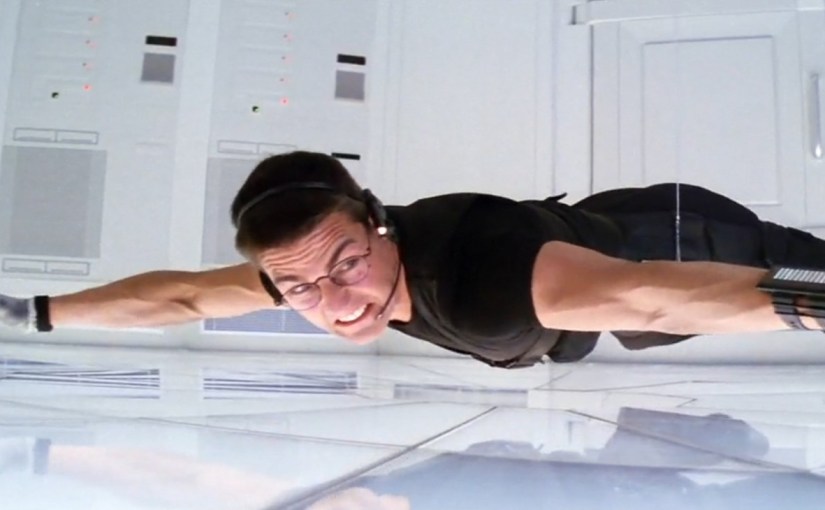
More good stuff appears in act 2 when Ethan Hunt has to infiltrate CIA headquarters to retrieve another disc and allow himself to cable down into the most high tech secure room in the…well lets just say the world, that is conveniently run by the most incompetent dweeb in the…well let’s just say the world…again. The primarily silent sneak is as beautifully choreographed as a Russian ballet. It’s spectacular.

Even more good stuff occurs in act 3 in a high speed super train crossing through the Chunnel in Europe. There’s a helicopter and Tom Cruise on the roof of the train and even some exploding chewing gum. Act 3 is where DePalma, Towne & Koepp opt to leave the Cold War behind because let’s face it, no spy can remain covert when a helicopter gets tethered to a high speed train in a tunnel.

So yeah, there’s lots of goodies in Mission: Impossible, but it falls terribly short because Tom Cruise produced the film with his ego in the way. For example, he sets up a team of four, all with different specialties. They get properly introduced and then they are given not much to do except watch Tom Cruise “Ethan Hunt” his way out of one dangerous situation after another. Ving Rhames seems like an especially interesting character but all he’s reserved to is typing on a keyboard. Vanessa Redgrave puts on a charming mystery about herself for one short scene as an arms dealer only to do nothing else but sit on the train later on.

Lots of talent was assembled for this film including Jon Voight, Emilio Estevez, Jean Reno and Kristen Scott Thomas but they’re only here to be a live studio audience for Cruise’s heroics.

Compare this film to Eddie Murphy’s Beverly Hills Cop. Murphy is no doubt the centerpiece, but he does not own every scene. Big moments come from the supporting cast as well. There’s more variety to that picture, which Murphy produced, than Cruise’s production.

A well utilized cast can be the difference between a good picture and a great picture.

FANTASTIC BEASTS AND WHERE TO FIND THEM

By Marc. S. Sanders

I really do like the Wizarding World of J.K. Rowling.   The attention to detail is marvelous.  The landscapes she has painted over eight best-selling books that follow the adventures of a boy wizard, are limitless.  A new kind of fun vocabulary was invented thanks to her colorful imagination.  Still, she needs an editor!  Even if it is not a novel, her recent screenplays that follow the escapades of another magical protagonist, Newt Scamander, and his small, distressed suitcase drift off into so many side stories, it is difficult to focus on a central plot at play.  While some might appreciate the assortment of distractions, for me it grows a little frustrating.

Fantastic Beasts And Where To Find Them (great title) is the first of what will become five new films that focus on an earlier time before the famous boy who lived was ever born.  Rowling takes the magic to New York City for the odd, but adorably likable Newt (Eddie Redmayne) to accompany his suitcase that carries the most unusual creatures that any other fantasy has likely ever introduced.  There’s a platypus duck thing that has a penchant for stealing jewelry and coin; perfect for stuffed animal merchandising at Universal Studios.  There’s a purplish-blue mosquito that twittles around.  There’s a dragon and an elephant/rhino combo thing.  There are bright green grasshoppers that hide in Newt’s jacket pocket.  It’s an encyclopedia of Rowling wildlife.

Newt arrives in Depression era New York and some of the creatures flip the buckles on the suitcase open, and before you know it, he’s chasing them through the streets.  Soon after, he gets his bag mixed up with another one belonging to a lovable baker “No Maj” (American term for “Muggle” or non-magic person) named Stanley Kowalski (Dan Fogler).  From there, a partnership is forged, and the men are pursuing the missing animals through the city bank, the zoo, tenement buildings and jewelry shops.  Romantic angles serve the men by way of magical sisters, Tina and Queenie (Katherine Waterston and Alison Sudol).

Parallel to all of this are concerns of a magic criminal known as Grindlewald who is making headlines for his various worldwide offenses.  The North American magic congress is disturbed by these events and rely on a man named Graves (Colin Farrell) to investigate.  As well, there is a No Maj woman (Samantha Morton) leading a chorus of city folk and politicians (including Jon Voight) in the hunt for what are believed to be witches and those that are committing crimes of witchcraft.  This woman serves also as a foster mother to numerous children, two of which are known as Credence and Modesty (Ezra Miller and Faith Wood-Blagrove).  These two in particular are curiously quiet with a dark way about them. 

So, yeah!  There’s a lot going on here.  There are a lot of stories to explore and a lot of characters to meet. As well, there are a lot of animals to learn about.

David Yates has become the go to director for the Harry Potter franchise and he takes up the mantle here as well.  This first film in the new series is gorgeous to look at with its period piece art design and the CGI special effects blend nicely with the human actors. 

However, the film loses itself over and over again with the different avenues it takes.  One moment we are supposed to feel the tension of Grindlewald on the loose. Then we are getting into madcap mischief with two other characters chasing down silly creatures seemingly inspired by a Jumanji theme.  We are also treated to an opportunity to literally step down into the suitcase for a whole other world of different settings where these animals are meant to be housed.  It’s wonderous for sure and Yates simply allows time for observation and nothing else.  Intermittently within the film, we also end up following these two dark children who are altogether disturbing, and we wonder why.  How and when do they come into play?  Rowling’s script is more concerned with painting broad strokes of new environments, rather than staying focused on one trajectory.  At times, I’m asking myself, where did we leave off with this storyline or that storyline.

Eddie Redmayne is adorably quirky, but maybe a little too much.  He has the “Willy Wonka” palette to his wrangler occupation. Though, his dialogue gets swallowed in his modified English accent and it is difficult to comprehend what he is saying.  He’s deliberately mumbling his words to build upon the oddities that come with Rowling’s character.  Newt has a name for each creature in the film, but there’s no way I could understand what he calls them.  I don’t even think his acting partner, Dan Fogler, understands everything being said to him.  On this latest viewing with my wife, we opted to turn the subtitles on our 4K player.

The characters are suitably atmospheric for the dark and unusual that stems from Rowling’s imagination.  Colin Farrell always plays well as the handsome, yet brooding man of mystery.  Ezra Miller seems to come from the cloth of a Tim Burton iteration.  Fogler’s character is the best though.  His expressions of stare at the amazements he’s witnessing for the first time represent the audience.  He’s not the bumbling fool that other storytellers might depict him to be.  He truly can’t believe his eyes at first, but eventually builds an affinity for the fantasy in front of him.

The ending somehow brings all of these characters together. It is engaging for sure with an action-packed encounter with a black cloud blob within the underground subway tracks. Then it is concluded with a celebrity cameo that teases of what’s to come. 

Fantastic Beasts And Where To Find Them is not unwatchable, but it requires extra attention so that you can recall where one story leaves off and then later resumes itself.  Often, I found myself asking how did I get here, and then my mind would wander and I’d get distracted from the continuing narrative. 

There’s no doubt of the kind of power and influence J.K. Rowling has.  If only someone would be brave enough to offer her a little constructive criticism, though.  The Fantastic Beasts series was originally meant to be a trilogy of films.  Then her contract with Warner Bros expanded to five films.  You know what?  With all that Rowling has to share with us, I think she might need ten or twelve films.

THE RAINMAKER

By Marc S. Sanders

Francis Ford Coppola didn’t just call his film The Rainmaker. He called it John Grisham’s The Rainmaker. I understand the significance as a large portion of the film relies on voiceover narration from its main character, Rudy Baylor (played very well by Matt Damon).

The film focuses on much of the underpinnings of the legal system within the state of Tennessee. Rudy gives insight into his position of ethical practice – he’s fresh out of law school but doesn’t have a license yet – versus the large giant sell out attorneys (a towering, sharp dressed and slick Jon Voight) that represent goliath parties like big time insurance companies. Grisham’s novel, along with Coppola’s screenplay, also leave room in the beginning of the film for the sleaze of the law practice with Rudy’s first employer who goes by the moniker “Bruiser,” played by an oily Mickey Rourke.

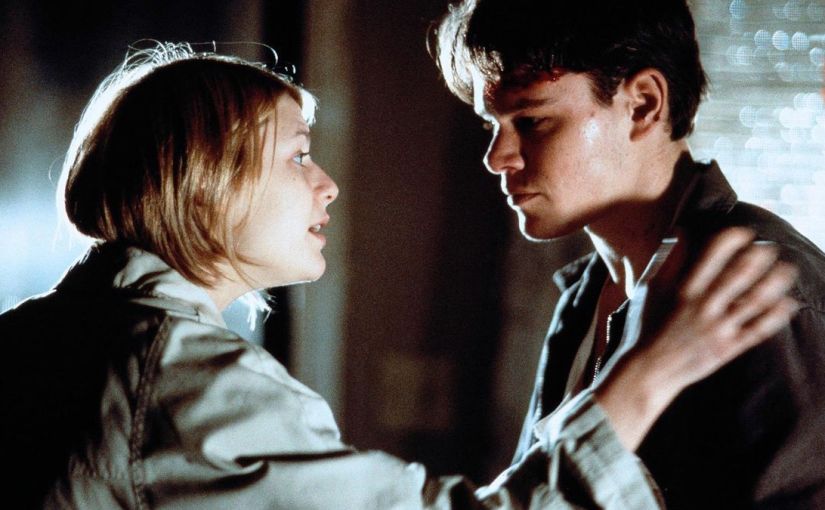
Rudy has not even passed the bar exam at the start of the film but he’s already got three cases in progress. He has agreed to completing a will for a kind old lady (Teresa Wright) who is adamant about leaving her estate to a television evangelist. He also volunteers himself to protecting a young woman named Kelly (Claire Danes) from an abusive husband. His biggest case is going after a million dollar insurance company for wrongfully denying a claim filed by one of it’s ill insured. Rudy knows the insured is justified to sue and it could be a huge and necessary windfall for him and his unlicensed, corner cutting partner (Danny DeVito), but it’s only him against a grand army of legal gods lead by the great Leo F. Drummond, Esq. (Voight).

Grisham and Coppola wanted to depict a drive for doing right by the law and the people it’s meant to protect. Damon’s portrayal of Rudy represents that ideal. His father hated lawyers and he grew up in a home life that never responded favorably to the merits of officers of the court. Rudy defies what his father frowned upon. Despite his inexperience in a courtroom and his ability to respond with objections and cited legal rules, he knows he’ll be a good lawyer simply because he can distinguish between right and wrong. He doesn’t need to sink as low as Drummond’s cronies by bugging the opposition’s office. Will Rudy’s righteousness be enough though? He’s so dang honorable in his profession that it might just be the ultimate means of his defeat.

Same can be said for Rudy’s will to protect Kelly, the young, abused wife. Precedents of law keep her husband on the streets no matter how bruised and bloody she gets time and again. This man is a monster, but no higher power is looking upon this victimized wife to legally protect her, and this man will continue to beat her until one day she’s dead. Rudy wears his heart on his sleeve for this woman and again can only serve as an honorable servant of the court. When he steps out of that line a little by risking his life to save this woman, he’s testing his own sworn code that he’s respected while others have dismissed it.

John Grisham’s The Rainmaker is one of those under the radar films not celebrated enough. I recall it being shown in limited theatre capacity, and it hardly did well at the box office, but it’s really a remarkable piece as it shows an unconventional and honorable attorney, reminiscent of Harper Lee’s Atticus Finch but set in modern day. Nearly everyone around Rudy, from his own father, that he describes to the students he attended law school with, to even the even the fool of a judge (Dean Stockwell) who swears him in as well as his own partner (DeVito in a hilarious, quick solving, underhanded role), are beyond any moral compass and yet Damon ensures Rudy Baylor sticks to his convictions.

Coppola’s film is not a legal thriller. It’s an observation of how the established perceive the law and the one fish who treads water above the bottom feeders, allegorically shown in Bruiser’s fish tank, seek out big rewards. For Rudy, the client matters. For everyone else, only the money matters.

HEAT (1995)

By Marc S. Sanders

My all time favorite crime drama, as well another one of my most favorite films, is Michael Mann’s Heat which is widely recognized for the much-anticipated moment where Al Pacino and Robert DeNiro finally share the screen together for the first time. The Godfather Part II never counted as their characters performed in different time periods. Still, Heat has so much more going for it, beyond just its headliners.

Michael Mann wrote the screenplay he directed. It deeply involves both the thief, Neil McCauly (DeNiro), and the homicide detective who pursues him, Vincent Hanna (Pacino), with inspiration from two real life characters. Therefore, this film drives with more authenticity than a standard Lethal Weapon picture. Much more is at stake than a standard kill shot, arrest or the score to take down. The women and children and partners these guys become associated with carry a weight and sense of value. Even the hoods who betray them hold significance. How they matter and are part of the story is just as pertinent.

The story focuses on DeNiro, with Val Kilmer and Tom Sizemore taking down high stakes scores, not petty liquor store hold ups. An early armored truck hold up goes well until a new partner executes the three security guards in broad daylight on the street, at point blank range. Pacino takes the case along with his brilliant squad of detectives that includes great supporting performances from Mykelti Williamson, Ted Levine and Wes Studi. Then it becomes a cat and mouse tale where two equals match one another in wits, skill, and experience. To believe the equal match up though required casting Pacino and DeNiro. The film would not work with any other pair. Through their respective careers, their various performances came off different than one another. Yet, it has been often easy to imagine either one of them playing their classic roles instead. I could envision DeNiro as Michael Corleone or Serpico. I can also envision Pacino as Rupert Pupkin or Travis Bickle. The range of these actors is unlimited.

Diane Venora and Ashley Judd are two actresses not used enough in films. As the wife to Pacino’s round the clock detective, Mann provides time for Venora to show the pain of a woman in love with a man who can hardly ever be home because he’s always on the prowl of DeNiro’s professional thief and his crew. Venora is a likable woman in the role, only the circumstances of her marriage and the difficulties of dealing with a troubled pre teen (a fantastic Natalie Portman who will break your heart with just three scenes) are gradually making her cold. She has a great monologue midway through the film that is terribly dark, as she surmises Pacino’s cunning detective.

Ashley Judd is a different kind of cold as the wife of Val Kilmer’s gambling addicted sharpshooter. She’s a beautiful housewife and mother to a toddler that is trying to maintain a happy home. However, the balance of living with a career criminal is near impossible to maintain.

Michael Mann put so much thought into characters like this. Other directors and writers would keep the story on the streets and in the hideouts and city precincts. Mann goes not just for the low level criminal hoods who provide information in a night club at 2 AM. Mann allows his crime drama to spill over into the home.

He even allows a side story to occur with an ex con (Dennis Haysbert) out on parole trying to get his life back in order. What does this guy with his loving girlfriend have to do with anything else? Eventually, the bridge is connected, and it comes down to an emotional and heartbreaking conclusion.

Heat deliberately takes its time to flesh out a lot of great characters. The large cast are all given moments to stand apart from the rest. It is primarily a quiet, talking picture of careful planning and investigation. However, when the legwork is complete, Mann arrives at two scenes right in the middle of the film. The first is the now famous coffee shop sit down confrontation between Neil and Vincent. Mann did a masterful job of capturing the two actors doing some of their finest work with nothing tangible to aid them; no props or grand music or effects. Just a table in the middle of a crowded coffee shop. The professionals allow their history to show only so much but the cop and thief know this is not going to be easy from here on out. Mann did numerous takes, but with at least two cameras showing at each go round. So, if Pacino is talking, we see DeNiro’s facial reactions and vice versa. Pacino’s take #11 is also DeNiro’s take #11. It is one of the all-time great scenes in film history. Beautifully written. Beautifully constructed. Beautifully performed.

The next centerpiece is the bank robbery that occurs at midday in downtown Los Angeles. Neil and crew are almost scott free when Vincent and squad intercept them in the middle of the street. What sets this massive shootout (based on a real incident) above all others is that I actually get choked up and emotional over the moment. Characters that I have become acquainted with for the last 90 minutes are swept up in huge risks and danger of massive gunfire and ambushes. I even become terrified for the extras that Mann includes in this scene. I’ve watched this scene a hundred times and I can’t help but actually get tearful over it. Mann has the power to make me have an affection for these characters. As well, how will the spouses, who become aware of this matter, be going forward? That accounts for much of the latter half of the film.

Neil holds true to a philosophy he learned while doing time. If you spot the heat around the corner, allow nothing to interfere that you cannot walk away from immediately to avoid getting apprehended. He is put to the test of that motto when he falls in love with an introverted graphic designer played with quiet reserve by Amy Brenneman. This storyline will sum up the ending. Again, Mann shows the characters on the outside of these guys with their guns, working in an underworld environment. How do the risks of these guys play out on others?

Technically, Heat succeeds as well with brilliant blues, blacks and whites in cinematography. Major accolades for Dante Spinotti. Everything from the well-lit coffee shop to Neil’s unfurnished, ocean view apartment and even a blue Camaro that Neil drives away in through an underground tunnel are brilliant. Spinotti paid careful attention to the evolution of the characters. As Neil drives into that tunnel, the car turns white hot. He is on his way to escape with an unsure Brenneman by his side. Often in moments like this, the film tells more than any piece of dialogue could ever sum up.

Heat is a must watch film for genuine portraits of characters few of us will ever cross paths with. We should understand, though, they have more than just a drive to steal or to get an arrest. These guys exist for more than just the score. Few crime dramas ever approach that angle, and that is why Heat is such a special film.