
BLACK MASS

By Marc S. Sanders

Black Mass tells the story of an FBI agent, and his two childhood friends who are brothers.  One brother is Billy Bulger, a Massachusetts state senator.  The other is notorious Boston gangster James “Whitey” Bulger.  The script has a lot of elements to make for a great crime drama, but I wonder what Johnny Depp is doing here made up to perform like a crazed ghoul.

The FBI agent is John Connolly (Joel Edgerton) who turns to Whitey (Depp), a fearful leader of the Irish mob in South Boston during the nineteen seventies through eighties to work as an informant, providing intel on the competing Italian Mafia.  It’s no secret about Whitey Bulger’s dealings or what territory he covers.  Agent Connolly does his best to protect his friend, so long as he collects pertinent information that leads to arrests.  However, what’s the limit to Bulger’s activities, and how does this reflect on a public figure like Whitey’s politician brother, Billy (Benedict Cumberbatch)?

Much of Black Mass reenacts recorded testimonies after everything has shaken out.  Guys who survived Whitey’s violent crew (Jesse Plemmons, Rory Cochrane) offer information on the gangster’s activities and what he compelled his captains to carry out.  Mixed in with these voiceovers are how Connolly responds to the progress of his operations.  Time and again, his superiors (first played by Kevin Bacon and later by Corey Stoll) question Connolly about how beneficial Bulger can be if the crook always has his finger on the trigger, killing those that might rat him out.  Black Mass is told from an assortment of different perspectives and sometimes that muddies the water.

The most interesting storyline is how Connolly uses and protects his criminal friend, while also stepping away from getting blood on his hands.  Joel Edgerton gives the best performance of the film as an FBI guy who turns a blind eye to Whitey’s crimes. Connolly thinks he can continue his own corruption while Whitey cooperates and leads him to big, heroic indictments of the Italian mob.  As long as the arrangement upholds, the corrupt agent will always have an answer for his actions and stay ahead of the ethical lines he knows he’s crossing.  More importantly, even if his wife protests, Connolly is getting prestigious promotions and collecting substantial paychecks for his progress.  Scott Cooper directs Edgerton with conflicts of overwhelming complications.

One problem is that Whitey Bulger is a loose cannon who is never intimidated, not even by the Feds, especially not by his childhood friend.  His brother Billy looks away to maintain a clean political image.  Therefore, it is quite easy for Whitey to gun down a rat associate in broad daylight in the middle of a wide-open parking lot, shotgun and all.  The killer doesn’t even need to run away from the scene of the crime.  This is Whitey Bulger.

Johnny Depp is great in the role, but does his portrayal belong in this film?  Depp’s career is widely celebrated for the quirky, makeup clad parts he plays such as Jack Sparrow and Edward Scissorhands.  Even Ed Wood is delightfully weird.  In Black Mass, the actor dons steel grey eye contacts, white slicked back hair making him appear almost bald, and skeletal teeth beneath a near albino complexion.  He looks like Skeletor without the hood.  Throw in a brooding, deep Bostonian accent and you have the ghoul I referred to earlier.  Is this Whitey Bulger?  Online photos of the real guy do not seem consistent with the film’s appearance.  Depp’s delivery of dialogue and even his wicked Freddy Krueger laugh seem too far beyond the realm of this crime drama.  The actor is working on another plane than everyone else in the cast who wear hairpieces, three-piece cotton suits and cheesy off-the-rack polyesters and denims to populate this time period from forty years ago. 

A scene showing Bulger dining on steaks with Connolly and his FBI partner (David Harbor) was famously used in preview showings ahead of the film’s release.  Take this scene out of context like the trailer did and Depp looks scary good as he terrifies Harbor for doing something as simple as revealing a long-time secret family recipe.  Afterwards, Whitey goes upstairs to harass Connolly’s wife (Julianne Nicholson) at the bedroom door.  The dinner scene sold me on getting a ticket for the movie as soon as it was released.  However, put it back into the framework of the script and I feel like Black Mass is diverting itself from a complex crime drama to a vampire in a Member’s Only jacket.  As good as Depp is with his makeup and his vocal inflections and pace, it just doesn’t seem to belong in this particular film.  Marlon Brando as Don Corleone with the shoe polish in the hair and the cotton in the mouth? That works.  Johnny Depp as Count Dracula in Sergio Valente skinny jeans is not as effective.

Because the script changes hands from one perspective to another and then another, I found the reenactments of Connolly and Bulger’s reign of crimes to be a little inconsistent.  I found much potential for Benedict Cumberbatch’s purpose as Whitey’s brother, but there is too much diverted away from that character because the picture is trafficked with what everyone else is doing and seeing on top of giving Johnny Depp a lot of scenery to chew.

Black Mass pursued the potential for a very interesting gangster picture like Goodfellas or Donnie Brasco, but it wants to capitalize too much on the latest Johnny Depp routine.  I think James “Whitey” Bulger is an interesting twentieth century bad guy with a violently daring and checkered background.  He had associates within his family and gang to color in a movie that’ll grab you.  The tainted lawmen who were involved are also intriguing.  Scott Cooper and the screenwriters knew this, but often they opt to go in different directions.  

Now that a loose interpretation of Bulger has been played by Jack Nicholson in Martin Scorsese’s Oscar winning The Departed and again here, it’s time to tell the cold-blooded killer’s story once more.  Just go simpler without all the clownish theatrics.
PLATOON

By Marc S. Sanders

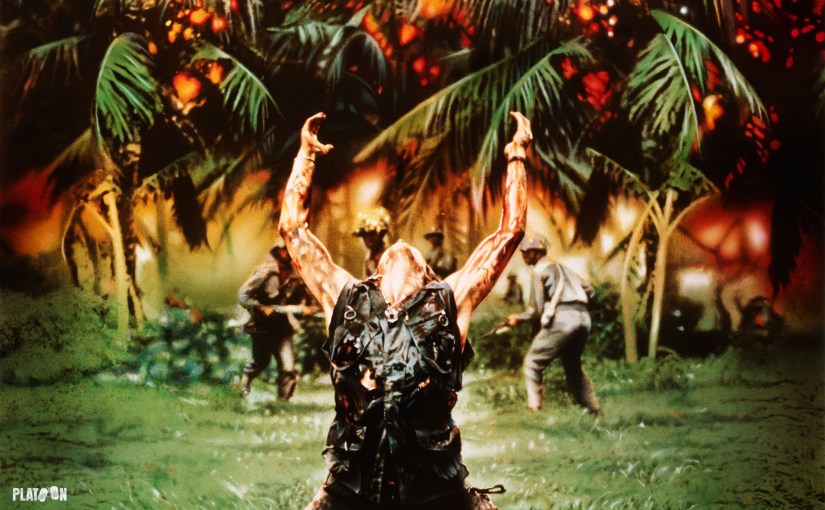
Oliver Stone’s Oscar winning Platoon takes place in the late 1960s, somewhere on the Cambodian border during the Vietnam War.  Many of the chaotic happenings the film presents are based on Stone’s own experiences after he voluntarily enlisted to fight.  However, while there is an unwinnable war occurring for the American troops, there is just as horrifying a battle going on within the ranks of the platoon the film focuses on.

Charlie Sheen echoes a lot of his father’s, Martin Sheen, voiceover narration, and performance in Francis Ford Coppola’s Apocalypse Now.  He portrays Chris Taylor, a college dropout who voluntarily enlisted for a one-year tour of duty to serve.  After only one week within the harsh, humid, and wet jungles, he’s writing his grandmother a letter asking what the hell was he thinking.  Chris is quite virginal to the harshness of war and that won’t work to his advantage when needing mentoring and support from his fellow soldiers.  The newest enlistees are the ones at the front point.  They haven’t devoted enough time to sit in the back and because of their lack of experience with war, they are not as valuable for the ongoing campaign in battle.  Platoon is not the heroics depicted in John Wayne movies.  This was one reason that Oliver Stone wanted to make this picture.  Platoon is a bitter retort to Wayne’s celebrated movie, The Green Berets.

There is an angel and devil flanking Chris in the form of Elias (Willem Dafoe) and Barnes (Tom Berenger).  Berenger is the cruel side of the conflict with his battle-scarred face.  He gives his underlings the impression that because he’s seen so much fighting and endured being shot seven times, that he must be invincible.  Elias is a fighting soldier, but he adheres to the rules of war and when it is time for rest, he joins his fellow troops in a unified vigil of drug-induced relaxation.  Chris warms up to Elias easily despite his initial fears of being a soldier with no experience or knowledge of how to survive, much less fight alongside his fellow men.

What drives the conflict between Barnes and Elias occurs following the first act of the movie.  The infantrymen come upon a Vietnamese village.  Some men, including Chris, get wildly abusive with the unarmed people, burning and pillaging their huts.  Only after Chris gets control of himself does he realize the wrongs he’s capable of by serving in this war.  He prevents a group of men from gang raping a child.  Furthermore, he witnesses Barnes commit the illegal murder of a defenseless village woman, shot at point blank range.  Elias has his bearings though and will file the proper reports when the opportunity permits.  Nothing in Platoon is easy though.  This war rages on and the possibility of an investigation and court martial is held off while the fighting continues. 

An interesting take on Oliver Stone’s direction is that he never really shows any close ups or lends any dialogue to the Viet Cong.  I believe Stone is confident that people know who our battalions were supposed to engage with.  However, as another favorite picture of mine stated (Crimson Tide), the true enemy of war is war itself.  The enemies of Elias, Chris, and Barnes as well as the rest of the platoon permeate within and among themselves and it lends to the chaos of the brutal combat scenes depicted in the film. Stone doesn’t offer much opportunity to see who any of the soldiers are shooting at or who is shooting at them.   There is much screaming and hollering but who are any of the characters shouting at and can they even be heard or understand what is being said amid the gunfire?  Platoon demonstrates that a Vietnam war picture is not one of heroics with grandstanding trumpets and a towering John Wayne who takes a hill.  War is disorganized, messy, and terribly bloody. 

This may be Charlie Sheen’s best film of his career.  As he represents the fictional account of Oliver Stone’s personal experiences, we see the trajectory of his change.  He is supposed to be there for 365 days, and he, along with his buddies, count down to when their tour will be complete.  However, this one short year will be the longest he ever encounters, and it will change him permanently, assuming he survives.  Chris is always tested of his tolerance.  He’s always subject to respond to how Barnes commands or how Elias mentors and leads. 

Oliver Stone is so convincing in his often-documentary approach to Platoon that it is at least understandable to see how the men in this picture behave and carry themselves.  Why do they refer to the Vietnamese as “gooks.”  Why do they bully with intent to commit rape.  Why do they quickly pounce to kill when for even a moment there is no threat.  Moreover, why they are willing to turn on each other.

They were never the decision makers for this conflict.  These soldiers are depleted of sleep and rest.  They are the pawns of a higher power, and they have been left to their own devices in a dense environment infested with bugs, snakes, unbearable humidity, and bodies that infest the waters and land while armed men appear out of nowhere ready to ambush.  Some ensnarements might occur within their own regimen.  None of these men are justified in their actions.  Yet, it is not hard to understand where their motivations stem from.  They are not programmed for heroics.  Keith David portrays a likable soldier who tells Chris that his mission is just to survive until he’s summoned home.  Survive among those you march and sleep with.  Outlast this hellish environment and overcome those that are trying to mow you down in machine gun fire.  Everything else around here is “just gravy.”  When you are an infantryman, you are not making a statement any longer.  You are not fighting for a cause anymore.  You are only trying to stay alive.

Platoon is such a shocking film of unconventional madness and turmoil.  Oliver Stone is relentless in the set ups he stages.  This picture came out in 1986, long before the strategic methods of the modern “shaky camera” approach.  It’s beneficial to watch the film as Stone must be positioning his camera on a track as the platoon hikes through the forest, parallel to his moving lens.  We are walking alongside them.   Early morning overhead shots depict the carnage of battles that occurred in the dark of night. Flares and sparks come from nowhere.  I think you could watch this movie ten times and still not know when to expect gunfire to intersect with the story or when the bombs to go off.  It’s hectic hysteria like I can only imagine these young men experienced before they spilled their blood on the battleground and either died right there or returned home physically and mentally crippled for life.

Platoon is one of the best and most frightening war pictures ever made.

FANTASTIC BEASTS: THE CRIMES OF GRINDELWALD (2018)

By Miguel E. Rodriguez

Director: David Yates
Cast: Eddie Redmayne, Katherine Waterston, Jude Law, Johnny Depp
My Rating: 7/10
Rotten Tomatometer: 40%

PLOT: Magizoologist Newt Scamander (Redmayne) searches Europe for a young man harboring a powerful talent, but must contend with dark forces led by the notorious dark wizard, Gellert Grindelwald (Depp).


[SPOILER ALERTS!!!]

In a nutshell, Fantastic Beasts: The Crimes of Grindelwald is more exposition than spectacle, delivering chunk after chunk of background information on new and existing characters, culminating in a filial revelation that, frankly, I found more than a bit unbelievable.  (But then, I originally thought Vader was lying to Luke Skywalker, so there you go.)  The movie also has a weird habit of introducing characters and then forgetting about them, either altogether or for long stretches of time.  (Wasn’t Bunty interesting?  Two scenes, then nothing.)

But, I have to say, I loved the creatures again, just as I did in the first installment.  The obscurial, for example, is a deceptively hard creature to bring to life, and it’s just as imposing and fearsome this time around.  I loved seeing the niffler again, and who wouldn’t?  The Chinese dragon creature, the Zouwu, was the highlight of all the creatures for me, if for no other reason than the charming method used to calm it down.

I did have a problem following the action during the film’s opening sequence, Grindelwald’s escape.  In all the worst ways, it resembled one of the main fight scenes from Ang Lee’s “Hulk.”  It takes place at night, in driving rain, and a lot of the action happens too fast for the eye to follow.  I might as well have been watching an abstract screen saver.

Being a middle chapter, there were also a lot of threads left hanging, no doubt to whet our appetites for the third chapter, but frustrating nevertheless.  I felt some key information was left out in Yusuf Kama’s story.  The French witch in charge of the archives in the French Ministry of Magic seemed to know more than she was letting on…did she know immediately that she was being hoodwinked?  It was nice to see Nicolas Flamel…but who was he talking to in that big book of his?  A prophecy is mentioned repeatedly…but no one is ever able to finish it without being interrupted.  The woman who fatally pulls a wand on an auror at the big gathering in the finale was glimpsed earlier in the film.  Why?  Was she meant to be important?

I haven’t read the negative reviews of the film, but I would imagine these questions and the density of the screenplay are key points in their arguments.  I have no counterargument.  The screenplay is indeed very dense.  But the visuals are a treat, however rare they were.  It was extremely cool, on a Potterhead level, to see Hogwarts again.  (An audience member applauded when it appeared on screen.)  The creatures are, naturally, fantastic.

I can only hope that these great gobs of backstory pay off in future installments of the franchise.

FANTASTIC BEASTS: THE CRIMES OF GRINDELWALD

By Marc S. Sanders

The Wizarding World franchise of Harry Potter and Fantastic Beasts has suffered its first absolute failure, and much of it is owed to staple director David Yates, and more importantly JK Rowling.

I’ve been saying it for years. The wealthiest woman in the world possesses an incredible imagination, but it serves as an Achilles Heel because ALL of that creativity is thrown into her works along with the kitchen sink, the kitchen and 30 or 40 bedrooms. It’s much too much.

The Crimes Of Grindelwald is mired in overly long confusion. A week ago, I more or less praised the prior installment but I noted that it seemed as if 5 different stories were going on at once and none of them had anything to do with the other. The new film doesn’t just suffer from the ailment. Rather, it is slaughtered by it. It seemed like there were 50 stories going at once. None of them were very interesting. Everything seemed bland, and all of it was near indecipherable.

The lead is once again played by a charismatic, yet innocent looking Eddie Redmayne as beast caretaker Newt Scamander. Redmayne has the mannerisms down. He fits comfortably in the early 20th century England, the costume works well on him, but he speaks in gibberish it seems. As well, Rowling has written his role so as not to reveal everything he knows. He feels incomplete. In this film, he also feels irrelevant to anything that is going on. I couldn’t figure out his purpose. His random pet beasts’ appearances offer nothing to progress anything or anyone. They are helpless creatures. He is assigned early on in tracking down prison escapee Grindlewald, played with disappointing reservations by Johnny Depp and yet I don’t recall a showdown between them or an acknowledgement of each other.

Grindlewald is a disappointing character. He’s bent on making the magical world full of pure blood magic folk. That’s all we know ahead of his albino threatening appearance. Sure he’s got a past with a young Dumbledore (a well cast Jude Law), but hardly anything is written for Depp to play with. He’s flat. He doesn’t amp up the evil. This is Johnny Depp, formerly Jack Sparrow and a half dozen Tim Burton characters before???? He has few lines in a very long picture. He does not declare his cause really. His motivations are only explained in long drawn out scenes by some boring magic politicians. All talk in these scenes, no magic and thus very dull.

There’s an early prison escape for Grindelwald but thanks to David Yates and his team, it is very hard to follow who is disappearing and reappearing and how it’s all happening. Like the whole film, the cinematography is very dark (and this wasn’t even 3D). Everything is so dim in this film. It’s as if Yates was not confident in his spookiness he demanded all camera lamps be turned off while the dry ice machine is turned on. This is including in the daylight scenes. The editing of this opening scene is choppy at best. Visual effects are masked with dark blurs and loud sounds and music to heighten danger that just doesn’t feel very urgent.

The cast is way too large. My favorite character from the prior film, Stanley Kowalski (Dan Fogler) is given nothing to do and considering his memory of magic had been erased, his purpose for returning is poorly explained. This time, there’s nothing cute or charming written about Kowalski. You’d have the same film whether he was here or not. He serves no point and when he’s given material to fawn over Queenie (Alison Sudol) his love interest, and also pointless, it amounts to nothing. Katherine Waterston as Tina, Newt’s love interest American partner, as well serves no meaning. She’s there because she must be paired up with Newt.

So Rowling as before on other occasions brings back the four main characters from the first film and just gives them nothing to do. Rowling is notorious for side stories in her Harry Potter novels. Fans really love that it paints an ongoing landscape of this world. Here however, her original screenplay oversteps.

The Crimes Of Grindelwald is not funny or whimsical. Nothing is jaw dropping or fun for the whole family. (This is a franchise spawned from young adult novels??????) It all feels like edited junk from all the other films thrown into this one. There’s nothing new here in tricks or treats. Grindelwald ignites beautiful glowing blue fire at the end. So? We’d seen that already.

The film is obese on characters and side tracks. It is poorly filmed in foggy settings and gloomy skies, and the editing is a patchwork moldy blanket of irrelevance.

As you try to find the stitching between all the stories, you realize that you are working too damn hard. What I’d give for a little magic right now!