BLOW OUT

By Marc S. Sanders

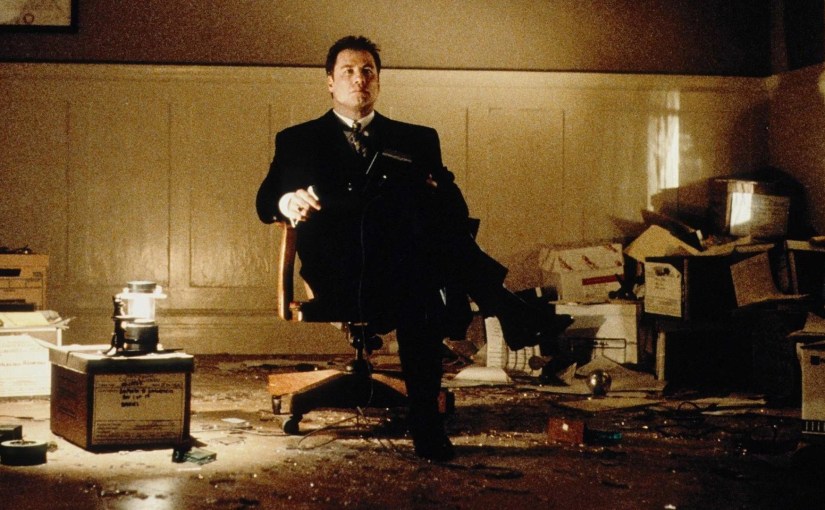
Brian DePalma’s Blow Out is an inventive approach to the political conspiracy thriller.  In 1981, following a mask of innocence the United States lost with the assassination of President Kennedy, later his brother Bobby, plus the drunken, liable carelessness of their brother Ted, and then finally the Watergate scandal, DePalma capitalized on newsworthy incidents to make a paranoid thriller of present day while incorporating what he likely knows much about which is sound effects editing.  Despite the cheesy music soundtrack that is highly intrusive and poorly composed, Blow Out is a good blend of hysteria and suspense.

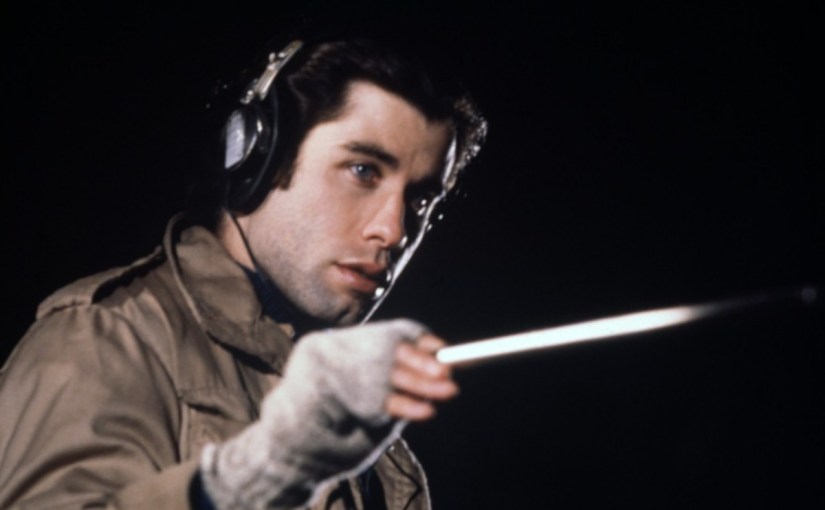
John Travolta plays Jack Terry, a Philadelphia sound effects recording artist for b-grade schlock horror movies.  One night, while out in a park trying to pick up sounds of outdoor nature, he witnesses a car suffer a blown-out tire and crash into a nearby river.  Jack is able to rescue a woman named Sally (Nancy Allen) but cannot save the Pennsylvania governor who was driving the car.

As he is about to leave the hospital, he is specifically instructed to never speak to Sally nor acknowledge to anyone about any of his own involvement in this incident.  However, Jack cannot help but recount the sequence of events in his head and as new details come to light, he knows that there is a cover up at play.

Blow Up operates like a how-to kind of picture.  The expertise of a sound effects recording artist is demonstrated as Jack replays every sound that his equipment picked up. Later he’s able to manufacture his own film by assembling a series of published photographs that also captured the crash.  Sync up the sounds with the sights and a new theory surfaces.  Other mysteries change the course of the riddle through dialogue.  This character has to work by himself using the skills he’s acquired to learn the truth.  He hardly has anyone to commiserate with.

John Travolta is convincing within this occupation that’s not as common as a cop or a private eye.  I like how I can pick up how he uses his recording equipment and even the minute details like labeling what he has preserved within his inventory.

It took a little bit of patience to get used to Nancy Allen’s damsel in distress who plays it up like Judy Holliday or Jean Hagen with the squeaky, dingbat voice.  When we first meet her, she is in an intoxicated stupor that goes on a little too long. Nevertheless, I came around because the tension of the film builds quite well.

John Lithgow is the sadistic adversary – a serial killer and assassin rolled into one.  He’s got the weird, unwelcome appearance like any bad guy in a Hitchcock film.

DePalma is known for his split screen cuts that he offered in Carrie and later in Mission: Impossible.  More well known is his reliance on bringing a character in zoom close up, while in the same frame, another object will be zoomed out at a distance.   During an outdoor evening in the park, an owl hoots and stares us down while John Travolta is far in the background standing on a bridge. Within this same moment, DePalma does it again with a toad ribbiting up close with the actor again positioned out. It’s a disorienting approach that works well at maintaining the perplexity of his story.

I think the final act of Blow Out falls apart a bit.  Travolta is on the heels of rescuing Sally by rampaging his jeep through a crowded parade.  The scene is shot so aggressively that it was hard for me to believe he would survive much less not run down a cop, spectator, or the entire marching band.  DePalma could have tightened this up a bit.

Blow Out ends on a bleak irony that’s quite surprising and definitely against formula.  There’s a running gag for Jack and a film director as they edit a silly problematic issue for a new slasher flick.  I guessed early on how this was going to resolve itself.  Though I was right, I didn’t expect how the conclusion arrived at my predication.  

As well, there are some notable questions left unanswered.  I had to roll back and see if I missed something.  I didn’t.  DePalma’s script neglects some key points with unfinished resolutions. So, I was not entirely satisfied. Still, the how-to procedures along with the pursuit of the truth, while also evading demise, are very engaging.

When I conduct workshops on playwriting, I always recommend keeping up with the news.  An unending wealth of ideas are there to be discovered.  As a sincere compliment to Brian DePalma, it could not be more apparent where his creativity took off with this film.  As a skilled and educated filmmaker, he also writes what he knows.  

Blow Out is very close to being a smart nail biter that echoes the sad truths of political rule breaking by means of savage crime. I wish modern films would be as risky today.  There are so few of these kinds of thrillers being made anymore.
SATURDAY NIGHT FEVER

By Marc S. Sanders

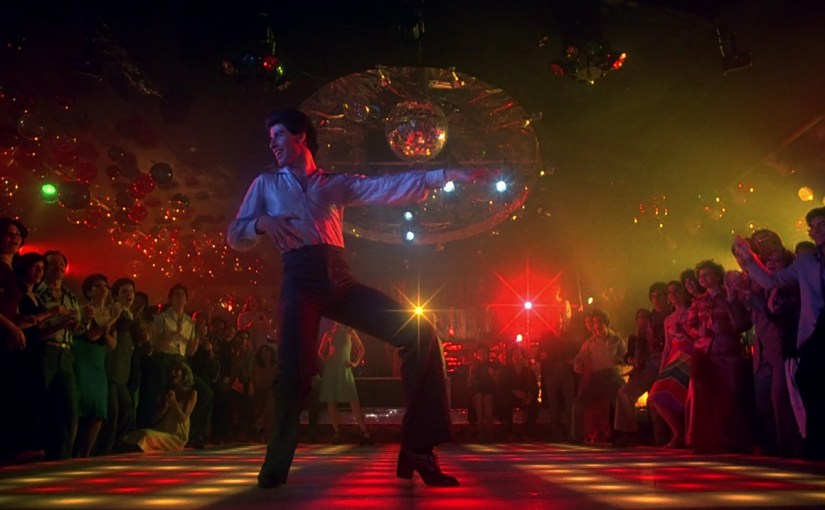
One of the biggest cinematic cultural touchstones announced itself just as the fad was withering away.  John Travolta blew up movie screens in 1977 when he strutted down the streets of Brooklyn with a paint can in one hand while wearing his wide collared red shirt under his black leather jacket.  The song that that got audiences grooving in their seats with the immediate superstar? Staying Alive by The Bee Gees.  The movie?  Saturday Night Fever which offered one of the most memorable character introductions in film history.

Disco might be dead and only designed for themed costume parties nowadays, but Saturday Night Fever remains very much alive.  No one forgets the moves Travolta did on the dance floor in his polyester shirts and suits.  John Badham’s film continues to be saluted with spoofs ranging from Airplane! to Saturday Night Live to Family Guy and one commercial after another.  The soundtrack is an unforgettable mix played for every generation that comes along at weddings, proms and bar mitzvahs.  The film was also adapted into a successful Broadway and touring musical.  I loved the live stage performance by the way.

Still, there’s a sensational dramatic story to Saturday Night Fever and Tony Monero, the nineteen-year-old kid who is only a Brooklyn celebrity on the streets and especially at the local dance club 2001: Oddyssey (the extra d is included).  Tony has unwanted ladies dying to sidle up to him, especially his contest dance partner Annette (Donna Pescow) who will eagerly surrender her virginity to Tony without protection.  His buddies idolize him as well, as they cruise the streets at night drinking in their beat-up Ford sedan on the way to and from the club, before finishing off the evening with some risky tomfoolery on the edge of the Verrazano bridge.  His boss at the paint shop even loves the kid.  Tony doesn’t ask for it, but he gets a raise and by the end of the conversation, the boss has nearly doubled his first offer. 

None of this is enough for Tony though. He doesn’t want to be tied down to working at the paint store for the rest his life.  He’s afraid he’s losing his beautifully well coifed hair and maybe his dancing skills will not survive as the years pass him by.  He also gets no love from his father.  Every dinner erupts into a family argument.  His mother has preferred adorations for Father Frank, Tony’s older brother who entered the priesthood.  Ma calls her son Father Frank, because, after all, he’s a Father of the Catholic Church.  Tony is also envious of Frank, first for their parents’ adoration.  Later, it is because Frank decides to leave the seminary to be free of the parents’ expectations.  

Tony also sees the talents and beauty of a dancer named Stephanie (Karen Lynn Gorney) who has no interest in his immaturity but is willing to be his partner for 2001’s upcoming dance contest.  Try as he might, Tony cannot keep up with Stephanie beyond the dance floor.  He’s not educated or cultured like her, and she is relocating across the bridge to Staten Island for a better life.  On the other hand, Tony remains stationary and therefore he is a frustrated man about to put his teenage years behind him with no aspirations and the weight of those who he spends time with holding him down.

I’d argue many are familiar with the colorful dance sequences accompanied by The Bee Gees’ memorable numbers (How Deep Is Your Love, Night Fever, More Than A Woman) as well as KC and the Sunshine Band (Get Down Tonight) and The Tramps (Disco Inferno).  Yet, Saturday Night Fever demonstrates a tough coming of age struggle for its protagonist.  John Travolta is at least just as memorable as James Dean was in Rebel Without A Cause.  Life goes on, but how can it when all you have to show for yourself is being the best at disco dancing?  There’s a whole other world beyond Brooklyn.

Sex is even frustrating for Tony.  He gives in to Annette’s desires to make love to him in the back seat, but then tosses her aside when she does not bring a condom.  All of this is too easy for Tony; so easy that it’s not even pleasurable and thus he’s continuously cruel and dismissive of her.  When Annette gives in to group sex with the guys, one after the other, Tony can do nothing but chastise her for allowing herself to be subjected that way.

Bobby C (Barry Miller) is the fearful, untalented, uncool and insecure buddy who is lost with what to do when he thinks he might have gotten a girl pregnant.  Tony is the greatest guy he knows, but he has no interest in helping.  Bobby even tries the next best thing by approaching Frank…formerly Father Frank.  Everyone wants to be with Tony and stay in his social circle, yet Tony is the one who wants out.

Norman Wexler’s screenplay is tremendously insightful but never so apparent.  As loud as the clothes, the disco music and the dance is, this is a script of subtly in Travolta’s performance.  It’s likely why he got the film’s sole Oscar nomination for Best Actor.  Despite Tony’s continued outbursts, there’s nothing so blatant in Saturday Night Fever like you would find in other coming of age films like James Dean’s, for example, or any of John Hughes’ films.  Director John Badham accustoms you to Tony Manero’s anxiety. 

It’s ironic, normally a protagonist will grow into self-assurance.  In this film, Badham wisely shows the confident swagger of Tony Manero in the film’s unforgettable opening only to see him diminish as the character arc proceeds over the film’s next two hours.  Badham includes small hints in this opening.  Tony might walk with a strut, but the first attractive woman he passes on the street does not give him the gumption to approach her, and the second woman tries avoiding him being in her way.  Later, Tony is outright rejected by Stephanie for anything beyond friendship and dance practice.  Tony wears the local celebrity façade, but in reality he is just a nobody.

John Travolta is so effective at showing on screen how Tony internally speaks to himself as he vocalizes his frustrations at those around him.  Whatever is angering Tony only looks like it’s Annette’s fault, or Stephanie’s or the guys, or Mom and Pop.  There must be something better for him than just being a small time, well dressed disco dancer, and a valued worker in a paint store.  He’s also outgrowing the street brawling with his buddies.  All he knows is he had better find a way out of this life with no promise of a future. Otherwise, he’s destined for a destructive ending.

Saturday Night Fever has a staying power.  Years after anyone has seen this film, all that might be remembered is John Travolta in the white suit on the lighted disco floor while Staying Alive is blaring through the speakers.  However, it’s a deeper film than just glitzy aesthetics that arrive with the final cut.  This is a coming-of-age story that does not hide the struggles nor romanticizes a path towards a better person or future. 

The film’s ending is even deliberately ambiguous. It’s more realistic than you might realize because the future remains uncertain for all of us, especially when we believe we don’t have much beyond what we are envied for to send us forward.  I know of the film Staying Alive directed by Sylvester Stallone which brought Travolta back into the legendary role.  It is the follow up film to Saturday Night Fever; notoriously considered one of the worst sequels ever made as it attempts to bring Tony Manero into the early 1980s cheesy zeitgeist world of Cats on Broadway or a poor impersonation of Prince pop music.  Norman Wexler demanded his story credit be stricken from that film. 

Choosing to ignore what came with that awful sequel, Wexler’s script for Saturday Night Fever wisely offers no promises for its protagonist, because unlike what we often see in the movies, life never guarantees a new day, and that’s what truly scares Tony Manero more than anything else.  It’s fair to say an uncertain future terrifies all of us.  That is why Saturday Night Fever remains completely genuine.  We are never meant to see what comes of Tony Manero because Tony Manero struggles with the unknown of what’s to come.  Some endings are meant to have those hanging threads from a time gone by.

A CIVIL ACTION

By Marc S. Sanders

In A Civil Action, writer/director Steve Zaillian allows John Travolta to demonstrate the workings of a remorseless ambulance chasing lawyer with a pride for the finest in men’s wear and the title of one of the most eligible bachelors in Boston, Massachusetts.  Then, all of that crumbles apart when a self-effacing acknowledgment breaks through. 

Travolta portrays real-life attorney Jan Schlictmann, who heads a small personal injury law practice with three partners (Tony Shalhoub, William H Macy and Zeljko Ivanec).  They go after the cases that promise large settlements from hospitals, insurance companies and multi-million-dollar corporations.  The best cases are where the mid-30’s breadwinning male of the household has suffered irreparable damages.  The victim is not deceased, but permanently handicapped, unable to work and provide for his family.  A dead victim is not as theatrically attractive.   Better to put the poor soul in the wheelchair on stage for the winning cash settlement. 

When Jan is boxed into a corner to meet with the residents of a small New England town, he dismisses their case as an unwinnable nuisance.  The townsfolk believe that their children have taken ill, with some not surviving, due to locally contaminated drinking water.  Kathleen Quinlan is one mother who wants an apology and explanation from whoever is responsible.  An apology holds no tangible value for Jan though, until he observes who the primary suspects are likely to be; two large corporations that own well known brands like Peter Pan Peanut Butter, Tropicana Orange Juice, and Samonsite Luggage.  Now the pockets to collect from could go on forever, and Jan does not realize until it’s too late how much of a personal gamble he is undertaking with himself and his partners in tow.

A Civil Action has always left me thinking on so many different levels since I first saw it in theaters.  The value of a life, especially a child’s life, is not very significant when corporate America profits on dollar bills.  The priority of environmental protection and its most precious resource, water, is just as minimal, maybe more.  Zaillian uncovered a fantastic character arc from a very frighteningly sad and true story.   Jan Schlictmann proudly dons an appearance of false care for victims of botched surgeries and car accidents to advance his ego and materialistic nature.  However, then he found a conscience, as he realized that money doesn’t win cases for his clients.  Instead, the acceptance of responsibility triumphs.  That surrendering admittance, though, is not expected to come from these companies.  Not when the burden of proof only comes from a measly platoon of four small town attorneys, who could never bear the expenses of proving such gross negligence and wrong doing.  This is a David & Goliath confrontation. 

Beyond a cast of recognizable faces, there are scenes in this film that just stay with you.  Most especially for me is the unforgiving nature of Quinlan’s suffering maternal character.  She no longer has any care in the world for whatever sacrifices are made by the lawyers to reveal the truth of what happened.  I didn’t think that was fair of her, frankly.  Zaillian demonstrates what these four guys endure as the case prolongs itself.  However, people are unfair.  Sometimes they are unreasonable because they have been pushed down to a bottom they’ll never climb up from.  This movie and the circumstances at play are not here to please me and make me feel good with a tidy ending wrapped in a bow, however.  The script is brutally honest in its characterizations.

What’s also disturbing about this case is simply water.  Countless times, Steve Zaillian gets close up shots of glasses and pitchers of clear, crisp water.  Children are drinking water.  Water is spilled on tables.  Jan’s enemies in trial will indulge in a refreshing gulp from a glass as they finish a scene with him.  The movie reminds you time and again that water is the silent killer.

Robert Duvall is the shining talent on the other side of the aisle from Travolta as an attorney in a fifty-dollar suit with a beat up fifty-dollar briefcase representing one of the large companies that is being sued.  Duvall makes his shark of an attorney appear effortless.  He falls asleep in court.  He tucks away in a corner to listen to the Red Sox play on his transistor radio.  Yet, he’s wise enough to know how to derail an opposing counsel’s case with just his quiet, unspoken presence at the table.  He isn’t even so much a villain or an antagonist as he allows the hero of the film ample opportunity to settle rather than charge on.  His urgencies don’t work however because Jan has changed.  Where he once saw money, he now sees something much more valuable that is beyond any variance of negotiation.  The scenes shared between the handsome, fit and well-dressed John Travolta against the older, short, hunched yet astute Robert Duvall play beautifully here.  There is top notch stage performance work happening here.

It amazes me that A Civil Action is not available on Blu Ray or 4K.  Look at this cast and its direction.  It’s magnificent.  Zaillian’s film moves with a fast pace of easy-to-follow courtroom theatrics.  Additional performances from Sydney Pollack, James Gandolfini, Dan Hedaya, and John Lithgow are so engrossing.  William H Macy is very good too, as the desperate man trying to keep Jan’s cause afloat.  Why is this film not being granted the accessibility it deserves?  I actually had to pay for a streaming rental watch.  No matter, it was worth it.  For like Jan Schlictmann, money is not the most important commodity known to man.  Morality and decency will stretch further than money that’s been spent, never to be replenished.  A noble and most human thing you can do is to experience Steve Zaillian’s film, A Civil Action. Then you will understand what an unjust world any one of us could fall victim to.  Then maybe you will understand the loss a loving mother endures far outweighs any financial liability from a grocery food company.

PULP FICTION

By Marc S. Sanders

No one can deny that Quentin Tarantino’s classic film, 1994’s Pulp Fiction is one of the greatest screen accomplishments of the latter half of the 20th century. It’s strange, lurid, scary, unforgivingly funny and altogether different from practically anything that came before it. How did the Weinstein brothers with Miramax films prophesize the energy it would surge in mainstream audiences?

When I first saw the film I was apprehensively going with two college friends who insisted I see what they experienced from a prior viewing. Suddenly, I realized that alternate surf 70s rock, black suits, and a kinetic visit to the restaurant known as Jack Rabbit Slims could entertain and make me look further than just a facial close up.

Tarantino entertains the lens of his camera by making his audience the camera. A drug dealer scrambles to find a medical book to awaken a boss’ wife who is dying from a potent heroin overdose, and the camera stands in place only frantically swinging left and right. The camera doesn’t move while everyone in the scene remains in a panic, frightened of administering an adrenaline shot. The camera stands still to allow the audience to stand in the room as well. It’s very unusually funny, but unnerving and suddenly we are amid the clutter of crime and drugs frightened of a terrible fate.

Another scene follows two gangsters down the hall as they debate whether a foot massage equates to fellatio on a woman. They look serious as they earlier regretted bringing shotguns to their destination but here they are having a debate likely reserved for men’s locker room talk. Is a foot massage really worthy of dropping a guy out of a four story window into a glass enclosed garden below? I mean, apparently the poor guy developed a speech impediment.

Tarantino used Pulp Fiction as an excuse to show how criminals inadvertently lead their lives to the unexpected, beyond a cliché cop bust. Two guys might be settling a personal vendetta, but somehow get interrupted by a redneck gang rapist and his chained up “gimp.” Two other guys might be trying to deliver a briefcase and yet somebody’s brains splatter all over the inside of a car. Another guy might have left behind a family heirloom gold watch as he and his girlfriend run for their lives, or they might suddenly acknowledge a moment of clarity when death seemingly walks out of a bathroom door.

Some might not agree but I always consider Tarantino’s colorful film characters to be rather two dimensional. What you see is all you see. There are no hints at an underlying motivation or a background to anyone you meet in Pulp Fiction, or any of his other films. Normally, that’s a negative in my book but with Quentin Tarantino it is what’s expected. He’s a masterful script writer of the situation. A well known fan of kung fu and lurid crime movies of the B variety, gangsters like Vincent Vega, Jules Whitfield, Marsellius Wallace, Butch Coolidge and Winston Wolf (even the names are entertaining) get caught up in just a random moment in time. Beyond the incident nothing else matters, and just to make it fun Tarantino uses his favorite editor, Sally Menke, to scramble everything out of order. I like to think the script was assembled this way to demonstrate that what happens in one instance doesn’t reflect what happens in another. Every brief moment is bookended. Again, two dimensional characters who don’t reach an intended karma. It doesn’t matter what’s been done before or what will be done next. It only matters in the moment.

The cast is great. Likely, you know who all the players are by now. The best compliment is that they obviously listened closely to the director’s vision. They spoke his language which had yet to be very mainstream before this film’s release. They are a pioneering cast of great talent and many owe quite a bit to Tarantino for jump starting and reviving their careers.

Pulp Fiction is a rousing expedition in sin and surf music symphony with endless quotable and un-PC dialogue that revolutionized filmmaking and brought about risk taking movie makers. It’s just exciting and fun and wild and it especially became a favorite upon seeing one of my favorite kinds of scenes-a dance sequence. If you incorporate dancing into a non musical film, you’ll likely win me over.

Spoiler alert: Vincent & Mia win the dance contest, and right they should. Chuck Berry’s “You Never Can Tell” became that other popular film song once Pulp Fiction hit the scene.

Thank you Quentin Tarantino.

THE TAKING OF PELHAM 1 2 3 (2009)

By Marc S. Sanders

While the remake of The Taking Of Pelham 123 is not the best of the Tony Scott directed/Denzel Washington headlining thrillers, it’s still a good time. I’m a sucker actually for most of their films, though as of this writing I’ve yet to see Man On Fire. Washington and Scott made several action pictures together. You depend on Scott to work in all the fast cuts to wake up your pulse and allow Washington to form a variety of characters. Denzel Washington didn’t have to appear like the macho tough guy with the ripped muscles. In Pelham, it could not be more evident.

Washington plays Walter Garber (first name salute to Walter Matthau of the original film), a dispatch operator for the New York City subway line with years of experience in all facets of operation and management. However, he’s been demoted due to an ongoing investigation that he has accepted bribes. Now let me say that I like this angle. He’s not a typical alcoholic or drug addict that we might have seen a Bruce Willis guy do one too many times. This is something different and unexpected. Washington also appears with a pot belly, glasses and no fashion sense. He’s not a decorated war veteran. This is not an action hero. Screenwriter Brian Helgeland got it just right, with this character at least.

John Travolta is your bad guy known as Ryder, and I’m afraid he’s cut from similar cloths of his other career bad guys. He screams in the same way. He has the psycho meltdown attempts at hilarity. So he’s more of the same really.

Ryder and his crew hijack one car off the subway line that comes out of Pelham Bay, NY. Garber answers the call from Ryder with his demands for money within the hour or a hostage will get killed minute by minute after the deadline.

Now Helgeland and Scott are very aware of the absurdity going on here. When the apathetic Mayor (a welcome James Gandolfini) agrees to pay the cash, it has to be transported all the way from the bank reserve in Brooklyn. This requires Scott’s signature moves of racing police cars and bikes through congested New York City to get it to Ryder before the deadline. Only midway through this long sequence which gobbles up tons of the film’s running time, does someone ask why they just didn’t use the helicopter. Cue my colleague Miguel E Rodriguez: “Then there wouldn’t be a movie!!!!”

As much as I like the action shots, because I’m a guilty pleasure sucker for that stuff, I have to insist that there still could’ve been a movie; a better movie. Helgeland’s script wasn’t imaginative enough, or the producers insisted on more car crashes and things blowing up real good. The original with Walter Matthau and Robert Shaw maintained tension for its two hour running time. This remake could have learned a little more from its ancestor. Two great actors are at your disposal, and you might have gotten some good dialogue like that of Clarice & Hannibal, perhaps.

Still, the conversations between Washington and Travolta are serviceable on at least one side with most credit going to Washington. Surprises into the Garber character keep the film interesting. Travolta? Well, I saw this guy in Face/Off and Broken Arrow and Swordfish and on and on.

The Taking Of Pelham 123 always had my attention. Yet, I wish it showed me even more new things than just its unlikely hero. Denzel Washington shouldn’t have to be the only one putting in overtime.