IN THE LINE OF FIRE

By Marc S. Sanders

While watching Wolfgang Petersen’s In The Line Of Fire for about the umpteenth time, it occurred to me that good, solid action pictures work so well when there is at least one or two characters who suffer from a past trauma.  Recently, I wrote about John Rambo in First Blood where what haunts the character sets the story in motion.  In Petersen’s film, both the villain and the hero attack one another’s personal sufferings to stay ahead of a game that could result in the assassination of the President Of The United States.

Clint Eastwood is aging Secret Service agent Frank Horrigan.  He served on the team the day Kennedy was killed in Dallas.  A deranged lunatic who initially goes by the name of Booth (John Malkovich), a salute to Lincoln’s assassin, forces Frank to play hand after hand through disturbing phone calls he makes to Frank where he discusses his eventual rendezvous with death when he will finally kill the President.  Booth tests Frank mettle though.  Does Frank have the guts to take a bullet for the subject he is supposed to protect? 

In The Line Of Fire is a very effective thriller because of its lead performances from Eastwood and Malkovich – two actors of different ranges with very different personalities.  Eastwood is famous for being the quiet kind of hero in films like Dirty Harry and Unforgiven.  Malkovich is a character actor who hides within his roles, which is especially demanding of the character in this film.  It is hard to find two roles in his career that seem similar. 

Booth is a master of disguise.  Wolfgang Petersen takes more the one opportunity to show the endless possibilities of what Malkovich as Booth could do to alter his appearance.  The morphing of the digital composites-bald, hairy, thin, plump, glasses or no glasses-is a welcome disturbance.  Interestingly, the basic John Malkovich that audiences are familiar with does not even make an appearance until at least a third into the movie.  Prior to that he’s disguised as a hippie or Petersen has him concealed in dark corners where all that you are seeing are his eyes hiding behind a pair of binoculars. 

What holds your attention in a script from Jeff Maguire is that you learn more and more about the man called Booth as the story moves on, all the way to final act.  What would motivate someone to assassinate the most powerful leader of the free world?  The odds of accomplishing the act are enormous against the security and protection devoted to one person. 

You also witness the defeat that Horrigan endures as Booth stays ahead of him and torments him over his past transgressions. At first Frank is forced to recollect his past failures by what Booth brings up in one phone call after another.  Later, Frank gets the upper hand as his investigation uncovers more.  A later scene in the movie brings about a sensational exchange of dialogue between the two actors.  The agent also has to contend with a difficult supervisor (Gary Cole) and a Chief Of Staff (Fred Thompson) who carry no faith in Frank’s efforts and are more concerned with the President’s image versus saving his life. 

Clint Eastwood and John Malkovich are a terrific protagonist and antagonist. There are a few scenes the two actors share together but they arrive later.  Before those moments, much material depends on the phone calls they have.  So, they work well off each other without even being in the same room.  The characters come at one another with the demons they dig up and the responses from Eastwood and Malkovich appear very convincing.  Very effective work with script, direction, and performance.

The supporting cast is terrific too.  There’s a romantic angle that could have been filler, but thanks to a good matchup between Eastwood and Rene Russo, as another Secret Service agent, there are some humorous moments as well as tender scenes for the heroic agent who is approaching a dinosaur period.  Clint Eastwood is great to watch as a piano player in this film.  Watch as he plays As Time Goes By when Russo rejects his advances and wanders off for the elevator.   Shortly after, she succumbs and there’s a hilarious moment that pokes fun at what it takes to be an active agent.

Dylan McDermot is Frank’s younger partner.  He’s quite good, representing the fear that goes with being a man willing to take a bullet for someone else.  An opening scene presents a frightening moment for the character.  On a Clint Eastwood level, it works with the signature charm that most are familiar with, but from McDermott’s perspective it is something else entirely, helping to shape his character for the rest of the film.

The characters in In The Line Of Fire are not tough guys beyond dares.  They are conflicted.  They experience fear and hesitation.  They have pasts that haunt them as well, and the opponents use psychological warfare to weaken their enemy.

Because Maguire’s characters are so fleshed out, the suspense works nicely with Petersen’s direction and a recognizable Ennio Morricone soundtrack.  The ending is great, not just for the action and editing, but the tension is quite palpable as well.

In The Line Of Fire has magnificent performances. You get a clear picture of what is necessary to be in the Secret Service, all the way down from the department’s appearance while jogging next to a Presidential limousine while wearing a suit, to the process of preparations, and what heights Presidential protection strives for to stay ahead of endless threats that come their way.

Wolfgang Petersen’s film is thirty years old, and the technology and procedures within the governmental departments have assuredly been updated since its release, but this picture does not appear dated or out of touch.  This thriller still works.
EMPIRE OF THE SUN

By Marc S. Sanders

Empire Of The Sun is a marvelous film.  Finally, I got to see it, and now I consider it to be Steven Spielberg’s transition film within his storied career. It’s also one of his best cinematic achievements.

Other than The Color Purple, the majority of his directorial work up to this point in 1987, consisted of adventure and escapism found in cliffhangers and children with the innocent curiosities to uncover what is underneath.  Empire Of The Sun contains all of these elements, but as the film progresses, it matures and grows up right before your eyes. 

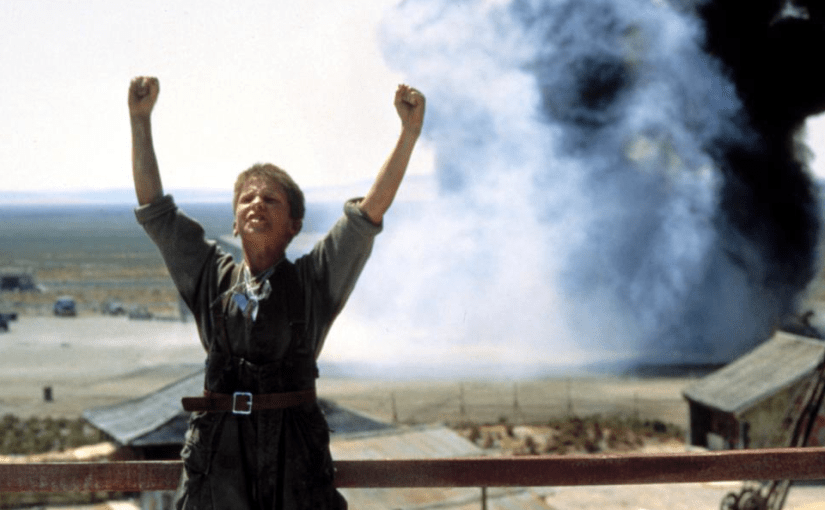
Christian Bale makes his introductory role a performance to remember as young Jamey Graham.  He is a British child of unlimited privilege living in Shanghai with his parents, naïve and sheltered from the gradual Japanese occupation taking place in 1941 when China and Japan were in conflict with each other.  Jamey happily plays and gets into adventures with his model airplanes and his imagination of heroics.  One day, while at a costume party, he discovers a crashed war plane and then envisions his fantastical heroism.  Shortly thereafter, the fantasy becomes real when he comes upon a Japanese battalion, just yards away.  With his parents, they make a desperate escape from the city they and their ancestors have called home.  However, Jamey becomes separated from them amid the chaos within the surmounting crowds.  Now, this young child with no sense of self reliance has no choice but to become resourceful if he is to survive and reunite with his mom and dad.

Eventually, Jamey meets up with two Americans named Basie (an outstanding John Malkovich) and his sidekick Frank (Joe Pantoliano).  The three are sent to a Japanese Internment Camp forced to live and survive on bare necessities as the second World War rages on with the Americans joining the fight.

Spielberg treats his protagonist the same as he did with the Elliot character in E.T. The Extra-Terrestrial.  Jamey happily lives in his own imagination until it is disrupted by an intrusion.  For films like Close Encounters Of The Third Kind and E.T., an alien of fantasy interrupts the protagonist’s lifestyle.  For Jamey, however, the reality of war harshly takes over.  It fascinated me how Empire Of The Sun, with a screenplay adaptation by Tom Stoppard of J.G. Ballard’s biographical account, seems to follow a familiar formula to Spielberg’s other pictures, and yet it reinvents itself with reality as opposed to fantasy.

Furthermore, Steven Spielberg does not abandon one of my favorite tropes of his as he makes the unseen the antagonist of the film.  When the veil is lifted, you can’t help but gasp.  Everyone knows he followed this approach in Jaws.  I also like to think he did this effectively with the German tank in Saving Private Ryan.  Here, he caught me completely off guard.  Young Jamey is dressed like Sinbad for Christmas jubilation at a costume party.  He’s happily tossing around one of his model planes and then when it flies out of sight over a grassy ridge, he runs over to the edge and finds something shocking beyond his treasured toy.  It’s a moment that happens early in the film and immediately tells me that this story will be bigger and more frighteningly real than meeting a cute, strange friend from another planet willing to eat my Halloween candy.

Spielberg’s production value is eye opening with thousands of extras within the scenes of mass exodus from Shanghai or within the internment camp.  Especially impressive is how he directs his extras to seem so overwhelming against young Christian Bale.  The child actor really followed direction, but more importantly it’s easy to see how method Bale might have been even at this young age.  He gets pushed and pulled and tugged on like I can only imagine an unforgiving circumstance of war would present itself.  Cinematics often praise Whoopi Goldberg’s debut in The Color Purple as one of the greatest introductions ever.  I have to put Bale’s performance up there as well.  The character arc that young Jamey experiences is well drawn out within Stoppard’s script, but Bale really performs the gradual change of a spoiled brat forced to become resourceful for not only himself but his comrades within the camp.  A director can tell a child actor where to walk or to sit or to stand.  A director can discuss the motivations of a particular scene.  With Christian Bale though, his performance throughout the film seems to remember where his character left off earlier in the story, where it has currently arrived and where it hopes to end up.  This young actor is so in tune with his character’s story. 

You may say John Malkovich serves as the staple mentor that every child protagonist has in so many other stories.  Basie is not that simple though.  A child will be quick to trust anyone he comes in contact with.  Spielberg and Stoppard know it’s not that easy though.  Malkovich is that dynamic actor who never seems forthright with his portrayals.  There’s something he always seems to hide from the audience.  Is he a snake ready to strike?  Is he a gentle pup ready for an embrace?  I never trusted how Basie would end up with Jamey by the film’s conclusion.  Malkovich delivers unpredictability so well.

Miranda Richardson is credited as a once wealthy friend to Jamey’s parents.  She’s not given much dialogue or scene work, but with the times she appears on screen Spielberg gradually breaks her down.  At first, she is well dressed in her finest linens insisting that her husband explain who they are to the Japanese forces.  Later and later in the film, the strength of her proud stature slowly crumbles.  It’s nice work and it’s crushing to watch.

Notable “tough guy” Joe Pantoliano goes through a similar transition.  A capture of him with Spielberg’s camera eventually focuses on a weeping and weak man.  Like much of the film, it is so unexpected.

There are epic overhead shots of panic and riots within the streets of Shanghai.  There are amazing moments where aerial attacks coming from nowhere with Jamey depicted running in a parallel line along the trajectory of a bi-plane.  It’s such a sweeping, personal story but the visual effects and camera work are so impressive as well.  The photography is striking in bright sunlight amid fireball missile strikes.  It is dazzling to watch.

As I noted earlier, Empire Of The Sun is Steven Spielberg’s transitional film.  Once again, he focuses on the innocent, young and unaware hero who is forced to become wise and most especially sensitive to a change in setting and circumstance.  With Empire Of The Sun, Steven Spielberg demonstrated that he could mature himself away from fantasy and embrace reality. 

I think Empire Of The Sun is an absolute masterpiece.

ROUNDERS

By Marc S. Sanders

Recently, I watched The Cincinnati Kid with Steve McQueen and it reminded me how much I enjoy a good poker movie, and I don’t even play cards.  Shortly thereafter, I took it upon myself to watch Rounders directed by John Dahl.  A few things occurred to me.  Poker movies do not acknowledge an organization called Gamblers Anonymous.  I guess to do so would be too much of a downer when the real suspense lies in the close ups of these talented players trying to read and outplay one another across the table.  Addictions become all too real and movies are not about reality but rather enhanced reality.

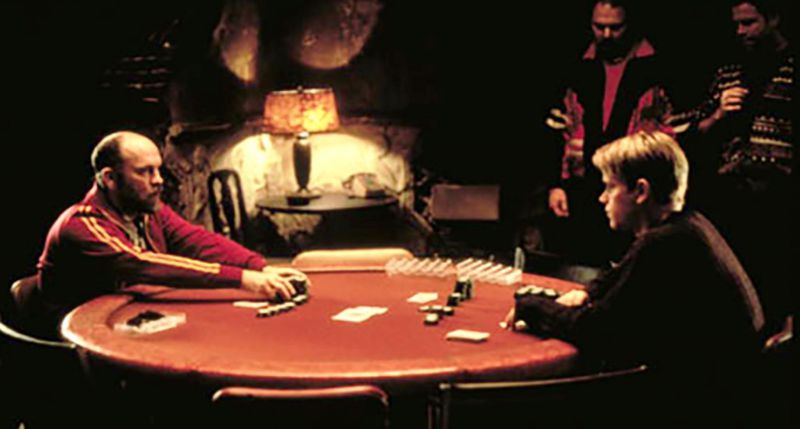
Rounders explores a seedy underground world of poker in modern day New York City.  Its community is made up of guys with names like Teddy KGB (aka The Mad Russian with ties to the mob), Joey “Knish,” and Worm.  There’s also a heavy who conveniently comes in to collect debts, and his affectionate name is Gramma.  These guys are portrayed by an outstanding cast of actors; respectively John Malkovich, John Turturro and Edward Norton.  Gramma is Michael Rispoli looking squat but all muscle under a derby hat while residing in his brothel of hookers who work for him.  All of these characters couldn’t be any more different.  The only thing they have in common is the game.  Gramma is the destiny that follows you after the game.  The other thing they have in common is the storytelling device of mentor, both good and bad. 

Knish maintains a conservative career approach to poker that allows him to pay his bills and alimony, and has groomed a baby faced “rounder” known as Mike McDermott.  He doesn’t look like he belongs with these shadowy figures but maybe that’s why he’s so good at the table.  KGB is the devil that’s not in disguise.  He’s the Oreo chomping Russian psycho with an appropriate, yet overly laid on Bolshevik accent. Worm is Mike’s pal who won’t let up to entice his childhood friend to keep the juice going because poker, honest or more importantly shady, is all that matters. 

Matt Damon is Mike in one of his most underappreciated roles.  Mike looks like a law student with a promising career.  I said he looks like that.  The film however shows that Mike is not a law student at all.  At least he shouldn’t be.  Early on in the film, Mike’s britches get too big for him and he loses everything such as his tuition money and rent and anything else he’d been saving up for.  Knish offers to help him get back in the game, but Mike swears off poker like someone who perhaps would swear off fatty foods.  I guess it’s not an addiction that is taking over his livelihood such as with his devoted law school student  girlfriend Jo, played by Gretchen Mol.  In Rounders, law school and love are the inconvenience.  Not poker.

Nine months go by and Mike picks up his childhood best friend, Worm, played with exceptional sleaze by Edward Norton.  Mike resists Worm’s advances to get back in the neighborhood games where they were masters at the hustle.  Worm is desperate and eager to play because it’s all he wants to do and he has an acknowledged drive to simply self-destruct in endless debt.  Mike’s devotion to Worm is tough for him to compromise and pretty soon his personal vouch for his friend gets them both into trouble where binge gaming is their only option.

The step-by-step play of the story is predictable here.  We know there’ll be one big game at the end with a monster win.  Mike will face set backs along the way.  He’ll have mentor moments and arguments with Jo.  But so what.  Look at the actors this film has to offer, and follow along with a great script of dialogue too. 

Rounders came out in 1998 when Matt Damon was surprising the world with his original script Good Will Hunting.  This movie is one of the first films where he got top billing and his name above the title.  He has so many good scenes because many of them play like duets.  Damon vs Malkovich.  Damon with Turturro.  Damon with, and sometimes against, Norton. 

My favorite pairings are the scenes he shares with Martin Landau who plays Mike’s law professor, Abe Petrovsky.  Landau personally touched me as the son of Jewish immigrants where each generation went on to Rabbinical school.  Petrovsky describes for his law student, Mike, that through his own personal experience that our destiny chooses us.  Often, we don’t choose what we have to become.  The Petrovsky character was raised in the Jewish orthodox community where I also had experience while attending Yeshiva for ten years.  I knew this man that Landau so accurately portrays.   Beyond my review, I have to share that this character spoke to me and reunited me with the Rabbis who taught me in elementary school. Personally, Petrovsky assured me that it was okay that I did not follow in the footsteps of my teachings at Yeshiva.  It wasn’t for me, much like law school is not for Mike.  Mike has a talent for something else.  Still, it’s a very risky talent.  Rounders would like to tell you that everything in life is worth taking risks.

I’m not sure I agree with the philosophy of Rounders.  Gambling can easily turn into a terrible addiction.  My father played all the games at the casinos on occasion, but he never stayed very long and he only went infrequently like when he was on a business trip.  He always told me that he would not be sure he’d be able to stop if he took up the game.  I knew exactly what he was talking about which is why I never even opted to learn.  I know my limitations.  Rounders doesn’t focus on limitations, though.  Limitations are for nerds, I guess.  Rounders is all about searching for strategy to improve your game.  It’s movie money.  So, there’s only pretend risk as Mike aspires to beat the best of the underground, come out alive from the violations of his pal and then move on to Vegas where he’ll give it a shot at the World Series of Poker.

There’s one other aspect I admire about Dahl’s film.  I looked for it on this most recent viewing and I’m telling you I couldn’t see it anywhere.  Dahl never, ever shows you the full hands of the players.  Either you see only a part of the river of a Texas Hold ‘Em game or you see the pair of cards the players hold, but never both in any round of the various card playing.  Dahl’s approach like the Mike’s philosophy is not so much playing the cards as it is to show the players play against each other.  The ticks and expressions they give like how they smoke or drink or even how they eat Oreo cookies out of their poker chip rack.  It’s very effective compared to other poker scenes in films like The Sting or even Casino Royale.  With a fine tuned script by David Levien and Brian Koppelman, it is fair to say that anyone knows what hand beats a flush or two pair or whatever.  More importantly, what matters is what read is ultimately gonna win you the table.  Rounders is all about winning the table, not the hand.