
IN THE LINE OF FIRE

By Marc S. Sanders

While watching Wolfgang Petersen’s In The Line Of Fire for about the umpteenth time, it occurred to me that good, solid action pictures work so well when there is at least one or two characters who suffer from a past trauma.  Recently, I wrote about John Rambo in First Blood where what haunts the character sets the story in motion.  In Petersen’s film, both the villain and the hero attack one another’s personal sufferings to stay ahead of a game that could result in the assassination of the President Of The United States.

Clint Eastwood is aging Secret Service agent Frank Horrigan.  He served on the team the day Kennedy was killed in Dallas.  A deranged lunatic who initially goes by the name of Booth (John Malkovich), a salute to Lincoln’s assassin, forces Frank to play hand after hand through disturbing phone calls he makes to Frank where he discusses his eventual rendezvous with death when he will finally kill the President.  Booth tests Frank mettle though.  Does Frank have the guts to take a bullet for the subject he is supposed to protect? 

In The Line Of Fire is a very effective thriller because of its lead performances from Eastwood and Malkovich – two actors of different ranges with very different personalities.  Eastwood is famous for being the quiet kind of hero in films like Dirty Harry and Unforgiven.  Malkovich is a character actor who hides within his roles, which is especially demanding of the character in this film.  It is hard to find two roles in his career that seem similar. 

Booth is a master of disguise.  Wolfgang Petersen takes more the one opportunity to show the endless possibilities of what Malkovich as Booth could do to alter his appearance.  The morphing of the digital composites-bald, hairy, thin, plump, glasses or no glasses-is a welcome disturbance.  Interestingly, the basic John Malkovich that audiences are familiar with does not even make an appearance until at least a third into the movie.  Prior to that he’s disguised as a hippie or Petersen has him concealed in dark corners where all that you are seeing are his eyes hiding behind a pair of binoculars. 

What holds your attention in a script from Jeff Maguire is that you learn more and more about the man called Booth as the story moves on, all the way to final act.  What would motivate someone to assassinate the most powerful leader of the free world?  The odds of accomplishing the act are enormous against the security and protection devoted to one person. 

You also witness the defeat that Horrigan endures as Booth stays ahead of him and torments him over his past transgressions. At first Frank is forced to recollect his past failures by what Booth brings up in one phone call after another.  Later, Frank gets the upper hand as his investigation uncovers more.  A later scene in the movie brings about a sensational exchange of dialogue between the two actors.  The agent also has to contend with a difficult supervisor (Gary Cole) and a Chief Of Staff (Fred Thompson) who carry no faith in Frank’s efforts and are more concerned with the President’s image versus saving his life. 

Clint Eastwood and John Malkovich are a terrific protagonist and antagonist. There are a few scenes the two actors share together but they arrive later.  Before those moments, much material depends on the phone calls they have.  So, they work well off each other without even being in the same room.  The characters come at one another with the demons they dig up and the responses from Eastwood and Malkovich appear very convincing.  Very effective work with script, direction, and performance.

The supporting cast is terrific too.  There’s a romantic angle that could have been filler, but thanks to a good matchup between Eastwood and Rene Russo, as another Secret Service agent, there are some humorous moments as well as tender scenes for the heroic agent who is approaching a dinosaur period.  Clint Eastwood is great to watch as a piano player in this film.  Watch as he plays As Time Goes By when Russo rejects his advances and wanders off for the elevator.   Shortly after, she succumbs and there’s a hilarious moment that pokes fun at what it takes to be an active agent.

Dylan McDermot is Frank’s younger partner.  He’s quite good, representing the fear that goes with being a man willing to take a bullet for someone else.  An opening scene presents a frightening moment for the character.  On a Clint Eastwood level, it works with the signature charm that most are familiar with, but from McDermott’s perspective it is something else entirely, helping to shape his character for the rest of the film.

The characters in In The Line Of Fire are not tough guys beyond dares.  They are conflicted.  They experience fear and hesitation.  They have pasts that haunt them as well, and the opponents use psychological warfare to weaken their enemy.

Because Maguire’s characters are so fleshed out, the suspense works nicely with Petersen’s direction and a recognizable Ennio Morricone soundtrack.  The ending is great, not just for the action and editing, but the tension is quite palpable as well.

In The Line Of Fire has magnificent performances. You get a clear picture of what is necessary to be in the Secret Service, all the way down from the department’s appearance while jogging next to a Presidential limousine while wearing a suit, to the process of preparations, and what heights Presidential protection strives for to stay ahead of endless threats that come their way.

Wolfgang Petersen’s film is thirty years old, and the technology and procedures within the governmental departments have assuredly been updated since its release, but this picture does not appear dated or out of touch.  This thriller still works.
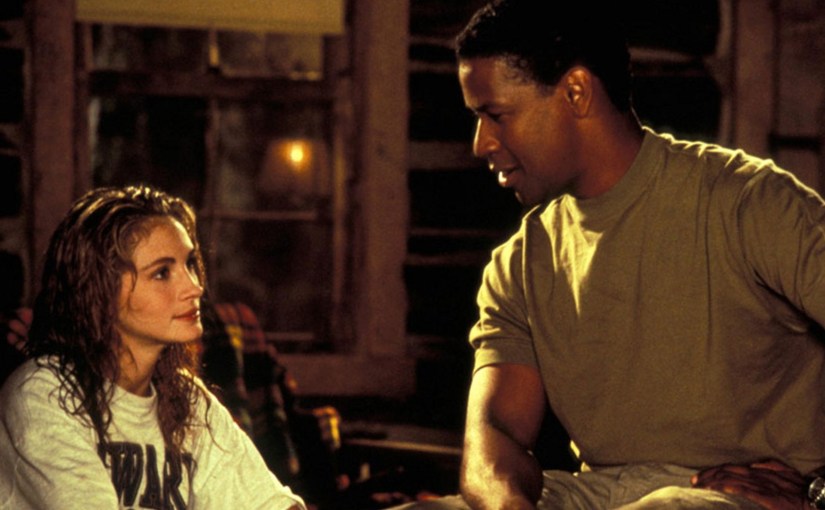
THE PELICAN BRIEF

By Marc S. Sanders

Tulane Law Student Darby Shaw (Julia Roberts) is unbelievably lucky. She can find herself being pursued by one white guy in a suit after another over the course of a two hour movie and will be fortunate enough to escape every threat by sheer chance. It’s only to her benefit when she is being chased by two assassins in a creepy downtown parking garage that someone left an angry doberman in a car to startle the killers. As well, it’s really a blessing that Darby has caught on that if an engine sputters when turning the ignition it can only mean one thing – car bomb! GET OUT!!!!!

Darby is the main protagonist of The Pelican Brief directed by Alan J Pakula, adapted from John Grisham’s best-selling novel. When the eldest and the youngest Supreme Court justices are murdered, Darby conceives of an outrageous conspiracy stretching all the way to the President and documents the whole rundown in the so-called Pelican Brief. She shares the document with her law professor who shares it with his government friend who shares with the CIA who shares it with…and so on and so on.

Pakula is an under celebrated director when you consider his better thrillers like Presumed Innocent, Klute, and especially All The Presidents Men. Here though, I think he got a little lazy with his screenplay and direction. The Pelican Brief is a little too paint by numbers.

Sure, the film has suspense. I think Grisham’s story has some convincing weight to it where wealth and government won’t stand for the platforms of environmental causes and therefore people have to die. Still, while the meat of that story eventually surfaces, we are left with A LOT of buildup before Darby gets involved. Just a lot of white guys in different office buildings walking down hallways, entering doorways and talking on the phone. Every so often we come across a DC crack reporter, Grey Grantham (Denzel Washington) who gets a phone call from a potential informant. When that guy gets scared and hangs up, thank goodness Darby just happens to call two seconds later regarding the same story. Good on you Grey for being by that telephone.

That’s my problem here. Pakula just works in the lucky conveniences to keep Grey and Darby on the trail. Neither of them ever truly escape a bind on their own. Neither of them ever truly dig the hole any deeper without something COMING UPON THEM to help them along at just the right moment.

We learn a safe deposit box belonging to a dead character exists. Darby just strolls into the bank and posing as the widow, who is not a signer on the box, is just asked for her address and phone number. No proper identification necessary. Why didn’t anyone ever tell me it’s that easy? Folks, hide your valuables because I’m gonna be robbing you blind.

Pakula will even set up a good scenario where Darby thinks she’ll be meeting someone who can help but it’s an assassin ready to kill, only suddenly the assassin is killed while holding Darby’s hand in a crowded courtyard. Wow!!! Lucky again, Darby. I’m still fuzzy on who actually killed the guy. That didn’t concern Pakula though. It’s explained in a quick throwaway line before the credits roll. Pakula only had to get Darby out of danger again. So let’s see he’s got the barking doberman for something else, the engine sputter will be used later on. Hmmmm??? Meh!!! we’ll just have someone randomly kill this guy. Now run, Darby. RUN!!!

Notice I haven’t talked about performances. Well, there’s not much to them. The Pelican Brief boasts an impressive cast of character actors like Sam Shepherd, Anthony Heald, John Lithgow, Stanley Tucci, Robert Culp and John Heard. Yet, these guys, along with Roberts and Washington are flat. Just reciting their lines when the cues call for them. There’s nothing very exciting to any of them really. Very monotone. Roberts is beautiful yet depressing even before she gets caught up in the mystery. Washington, while handsome, does not seem to have the gusto that Pakula’s reporters did when he directed Hoffman & Redford. Grey is too neat, physically fit and tailored for an always on the job, aggressive reporter looking for a scent.

There was a better movie to be made here, thanks to some convincing motivations that were started with Grisham’s novel. Unfortunately, Pakula just didn’t devote enough respect to the original author’s imagination.

AWAKENINGS

By Marc S. Sanders

The title of Penny Marshall’s film Awakenings has at least two meanings.  The most obvious focuses on Robert DeNiro’s character, Leonard Lowe, who comes out of a near thirty-year catatonic state one day.  As well, Robin Williams plays Dr. Malcolm Sayer, the doctor who uncovers the experimental drug that awakens Leonard, along with other patients who reside in the caretaker ward located in the Bronx.  Many of the patients share the same abnormality as Leonard, due to all suffering from a wave of encephalitis that swept through the area in the 1920s. 

DeNiro and Williams are a top of their game pair together.  Both of them go against type that many audiences were accustomed to by the time this film released in 1990; DeNiro – the tough, short tempered, unhinged guy; Williams – the manic, fast talking, quick on his feet comic.  Both actors bring it down many notches to bring this story to light that was inspired by the documented experiences of Dr. Oliver Sacks.

Still, Penny Marshall has a way a bringing gentleness with touches of comedy to this film just like she did with Big and A League Of Their Own.  Okay, maybe those films were more energetic at first and then quieted down, thereafter.  Awakenings performs in the opposite direction, but Marshall’s recipe of drama mixed with humor is so appreciated.

Dr. Sayer is a shy individual with limited social skills.  He relates more to plant life than actual humans.  When he’s recruited by the hospital administration, led by the intentionally obnoxious and objectionable John Heard, to oversee the patients at the ward, he does so without any intent to make a difference.  The hospital staff is just fine with that.  Soon though, Dr. Sayer is recognizing a behavior in some of the patients.  They seem to be staring into space, open mouthed with no emotion or change in expression, but they respond to a variety of unusual stimuli.  A woman will walk across the social hall on the black squares of a checkered floor.  Leonard, and a few other patients, will catch and toss a tennis ball around.  Yet, they won’t blink or wince or smile.  Through further research, Dr. Sayer takes a pharmaceutical risk and increases the dosage of an untested prescription over time.  One night, his patient zero, Leonard, is sitting up in bed and awake.  Shortly thereafter, he’s speaking, walking, and functioning like a regular forty something man.  Thereafter, the drug is administered to the other patients who demonstrate the same outcome. 

The challenge comes first from the hospital, though.  They are not prepared to take Dr. Sayer’s methods or assessments seriously and they are stubborn to recognize some exceptional progress.  Like any standard drama, this leads to conflicted debate.  The debates Dr. Sayer has with the hospital board never took me out of the picture, but I do question if the antagonism needed to be so close minded.  After all, should such unexpected and miraculous development be so dismissed?  The challenge seems so forced at times that a scene is offered where the doctor’s support from nursing and janitorial staff gladly gives up their hard-earned paychecks to help alleviate the expense of the experimental drugs.  It puts a lump in your throat for sure, but would this really happen? 

A hint at a romantic angle presents itself when the lovely Penelope Ann Miller arrives at the ward to tend to her ill father.  Leonard becomes smitten with her.  He is not free to go about as he pleases.  Miller’s character can.  Eventually, Leonard becomes rebellious of his “incarceration” within the ward while the hospital exercises its mandated caution.  While this is occurring, Leonard’s condition is deteriorating. 

Robert DeNiro received an Oscar nomination for this role and its easy to see why.  His physical performance comes so naturally, at first in the catatonic state, later as a man witnessing daily life in the hippie of age of the 1960s and then again as his body dwindles into uncontrollable spasms, when the drugs’ positive effective doesn’t hold.  His enunciation falters, his body violently twitches and he can’t even grasp anything.  It’s a sorrowful and marvelous performance to see.

Awakenings is a picture that performs with real heart and tenderness.  Marshall’s film offers a glimpse into a short period of time when adults who hadn’t gotten the opportunity to live active lives were suddenly offered an opening.  Leonard gets to see a jet liner fly overhead and take a walk in the ocean.  He can taste ice cream for the first time in years and get a glimpse of young hippie’s derriere.  The other patients get a chance to go to dance at a swing club.  As well, Dr. Sayer’s guarded exterior gradually sheds as he persists to act beyond the administrators’ objections and also consider a little romance for himself with a nursing assistant.  (Point of fact: Oliver Sacks was actually gay in real life.  So, some liberties are taken with the film.)

It’s important to point out a forgotten performance from Ruth Nelson as Leonard’s elderly mother.  She visits Leonard every day by reading to him, dressing him, and changing his diapers like any loving mother would.  Yet, as Leonard gets more independent, Nelson is terrific as the kindly elderly woman who has to become a different kind of mother to her son.  She is an quickly awakened from being the mother of a helpless child to the elderly mother who is not as capable of controlling her son’s choices.  Mrs. Lowe is rightly uncomfortable with Leonard’s affection for Miller’s character.  She’s just not used to this dynamic that’s come about so quickly.  What an amazing character arc and Nelson pulls off the portrayal beautifully.

Tear jerking films work best when they operate like Awakenings.  You’re given many opportunities to laugh and enjoy the pleasures and quirkiness of the characters.  Later, it becomes a welcome and satisfactory cry fest when what was once celebrated is at a risk of loss.  Penny Marshall worked best with this formula on these kinds of pictures.  It’s why a simple, seemingly silly story like Big worked.  It’s also why a female baseball movie worked as well beyond the diamond.  There was more dimension than just the basic summary.  Marshall always delved deeper and she allowed her actors to go that far as well.

Awakenings is a terrific film, blessed with a gamut of emotions.