MY COUSIN VINNY

By Marc S. Sanders

The American Bar Association’s publication, The ABA Journal, ranked My Cousin Vinny #3 on its list of the “25 Greatest Legal Movies.”  Surprised?  You really shouldn’t be.  

This “fish out of water” film follows a goodfella who did not pass the bar exam until his sixth try.  Now he’s defending his cousin and another UCLA college kid in an Alabama courtroom.  It’s Vinny’s first murder trial.  So he’s gotta learn the ropes of how to dress properly for court all the way up to discrediting material witnesses and demonstrating reasonable doubt to get his clients exonerated.  It’s a great courtroom picture because within the dense slapstick comedy there are authentic lessons to learn about being a member of the Bar and having confidence in yourself.

Bill and Stan (Ralph Macchio, Mitchell Whitfield) are roadtripping through southern America, en route to UCLA, when they get pulled over and framed for the murder of a convenience store clerk.  With no money or hope of retaining a reliable public defender, the young men turn to Bill’s cousin Vinny.  

Straight out of the five boroughs of New York wearing a black leather jacket, black boots and a slick pompadour, Vinny Mancini arrives in small town Alabama.  You know something?  If I didn’t know any better I’d say he looks and acts a lot like Joe Pesci.  With him is his long time fiancée, Mona Lisa Vito (Marisa Tomei, in her very well remembered Oscar winning role). Mona Lisa Vito!  I love when there’s some thought put into a character’s name.

The future looks grim for the accused as Vinny doesn’t know where to begin.  The iron horse Judge Chamberlain Haller (Fred Gwynne) habitually holds the guy in contempt because Vinny can’t shed his New York ways either in wardrobe or proper decorum. The prosecutor played by Lane Smith really doesn’t have to try hard at all.  Though he deliberately gets all Southern showy each time he faces the jury, made up of friendly locals.  In an unexpected and tender moment, the tough guy, Vinny, admits to Lisa that he’s “a-scared.”

I never cared for My Cousin Vinny since I had seen it in theaters.  However, there’s much I appreciated on only my second viewing of this film directed by Jonathan Lynn, an actual law scholar.  Lynn is always striving for an authenticity within the courtroom.  His protagonist might not know anything about being a litigator, but the director ensures that a genuine regiment of customary courtroom behavior, procedure, and theatrics will be upheld even if this is only a silly, little comedy flick.  

Outside the courtroom, there’s primarily an updated George and Gracie situational comedy at play.  Marisa Tomei is of cinema’s great scene stealers.  Mona Lisa Vito might look like an overly familiar character, but the actress’ performance is entirely unique.  She never plays Lisa as a dumb side character to her boyfriend who will not commit to marriage.  Lisa comes off generous, always offering to assist Vinny despite his rejections.  She’s also positively smart as a whip with her extensive knowledge of automotive repairs, and she’s a quick study of Alabama law.  When she gets put on the witness stand it hardly matters what she’s saying.  Marisa Tomei owns the expertise and defiance of Lisa.  Turn the scene on mute to watch her doing some of her best work would be equally effective.

Go look at Silver Linings Playbook when Jennifer Lawrence rhythmically dictates numeric football statistics at Robert DeNiro.  Both actresses won Oscars for these respective roles.  These performances stand apart from so many other second, third and fourth billed actresses because they are written with immense intelligence.  That’s what Tomei and Lawrence normally embrace first, ahead of costume and makeup.  The confidence from these actors is uncanny.  More women need to be cast in roles like these.  

Joe Pesci is doing his reliable, familiar schtick from Goodfellas, Raging Bull and Easy Money.  He’s in a what if scenario though.  What if there’s a movie with Jersey Boy Joe Pesci, but he’s put in Alabama country with roosters crowing and trains chugging into town at five in the morning? There can even be a communication gap between the Judge and Vinny for some padded laughs.  “What is a yoot?”

I was bored with this movie the first time I saw it.  I just didn’t think the humor was funny even if I recognized the attempts.  Over thirty years later, what I appreciate is the heart that feels much more apparent.  The hero feels weak and at a loss.  Only when he is given strength and support from a wisecracking, sexually frustrated girlfriend does he get the drive to behave like a lawyer he’s licensed to become.  I like Vinny.  I like Lisa.  Therefore, now I can laugh at their unfortunate dilemmas as they work towards an end goal – getting him to do his best at becoming a courtroom lawyer and hopefully reaching a not guilty verdict. 

I gotta give a shout out to the supporting cast.  Bruce McGill plays a familiar sheriff that we’ve seen before, but so what.  It’s the way he carries himself that I’m always welcome to see him in a movie.  Same goes for Lane Smith.  These guys are sophisticated Dukes Of Hazzard.  Fred Gwynne, most famously known as Herman Munster, was always a brilliant character actor.  He has the ability to be goofy and intimidating all in the same scene.  To place his towering stature against little Joe Pesci? Who needs dialogue? Watch Fred Gwynne’s moments in My Cousin Vinny.  He could’ve been Oscar nominated, and I would not have complained.  While Ralph Macchio is doing his typical routines (same things we saw in The Karate Kid, The Outsiders and so on), it’s Mitchell Whitfield playing his buddy who really stands out.  This is a nothing role but it’s as if this guy fell out of a Woody Allen or Neil Simon picture to claim his own territory among an outstanding cast.

My Cousin Vinny is one of those comfort films to put on when the stress is becoming too much in real life.  Everyone is so likable here.  There isn’t a villain to dual against.  Instead, it’s a conflict of cultures who must work together to uncover truths within a murder trial while also learning about what any one of us is actually capable of accomplishing. 

Vinny from da Bronx is a lawya???? 

FUGGETABOUTIT!!!!!
JFK – DIRECTOR’S CUT

By Marc S. Sanders

Oliver Stone’s JFK is told through perspective, not necessarily history.  It’s not a biography and I do not believe Stone would ever claim it to be so.  It’s a thinking person’s picture that gives viewers entitlement to question what occurred, how it occurred and why it occurred.  It might guide you not to trust what anyone says, sees or hears, but let’s face it.  Probably the day Kennedy was shot, November 22, 1963, could we ever completely trust anyone ever again? 

(Forgive my cynicism.  I must backtrack a little.  I still trust my wife and daughter.)

Oliver Stone works through the eyes of New Orleans Prosecutor Jim Garrison (Kevin Costner, in what may have been his most challenging role to date at the time).  Garrison sees a little too easily that there are circumstances out of place, or maybe too neatly in place to satisfy the ultimate resolution that a known American defector to the Soviet Union, like Lee Harvey Oswald (Gary Oldman), acted alone in the assassination of the President.  Stone wrote the script for JFK with Jim Marrs and used Garrison’s input from his own novel. Nearly every scene builds into another possibility of how that fateful day came to be.  Stone even questions if a famous photo of Oswald on the cover of Life Magazine is real.   Too many cover ups with a building list of body count witnesses and too many coincidences keep Garrison up at night.  So, he assembles a crack team of investigators and fellow attorneys to reopen the case and question the official Earl Warren Commission.

Firstly, JFK is magnificent entertainment with a hair raising and unusual original score from famed film composer John Williams.  His notes on percussion with dings and harpsichord strings cue in at just the right moments when Stone introduces another one of many scenes that point out what seems cagy and suspect. The music of JFK works as a narrator.  This narrative keeps you alert.  Maybe you should look in each corner of the screen at times for some subtle clues.

It was also wise of Stone to go with a well-known cast of actors.  The Oscar winning editing from Joe Hutshing and Pietro Scalia moves at a breakneck pace.  Yet, because I recognize fine performers like Ed Asner, Jack Lemmon, Kevin Bacon, Tommy Lee Jones, Brian Doyle-Murray (Bill’s brother), John Candy and Joe Pesci it is easy to piece together who is playing who and what significance they lend to the many theories Garrison and Stone question next.  

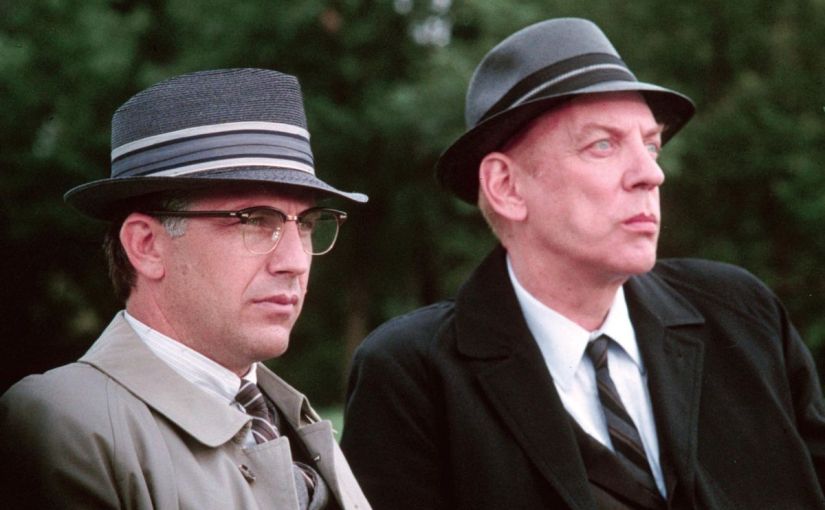
My admiration for the casting continues with the Garrison team that performs with Costner – Michael Rooker, Laurie Metcalf (especially impressive), Wayne Knight, and Jay O. Sanders.  There’s also a clandestine trench coat guy named X portrayed by Donald Sutherland.  Who even knows if this guy ever existed?  He’s more secretive than Deep Throat, but Mr. X has a hell of a lot of information to justify Jim Garrison’s suspicions.  That is an especially marvelous sequence between two men strolling through Washington D.C., eventually concluding a disturbing realization on a park bench.

Sissy Spacek brings out another dimension to the Jim Garrison character.  She’s his wife and the mother of five who suffers the loss of her husband’s attention which is entirely focused on this compounding investigation.  I like Costner’s take on the Garrison character.  Early on he politely asks one of his associates to stop cursing.  He does not like that kind of talk.  Later, it is Garrison who is dropping a number of eff bombs in front of his wife and young children.  This conundrum of a case, a very puzzling detective story, is unraveling the investigator. 

JFK was instrumental for further Congressional consideration following its release.  Files were reopened.  Additional research was executed, and soon many of those secret documents pertaining to the assassination will be revealed in 2029.  Back in 1991, of course that appeared to be a lifetime away.  It’s time we know everything, though.  Arguably, most of who were involved in this incident are dead by now.  Let us know our history.  Still, Garrison was bold enough to point skepticism at not just the adversarial relationship Kennedy may have had with Castro, the Cubans and their Communist allies, but also the people within the CIA and the FBI.  Lyndon Johnson is not even free from scrutiny after he’s sworn in.  Some on Garrison’s team went so far as to factor in culpability from the mafia.  Garrison was not so keen on that theory, actually. 

The construction of Oliver Stone’s film is unparalleled.  I think it’s his best film to date and I can find few others that even compare to how he assembled the picture.  It begins with the voiceover of Martin Sheen laying out many news cycles that were occurring ahead of Kennedy’s murder such as the Bay Of Pigs and the President’s supposed efforts to withdraw from Vietnam.  Sheen’s narrative comes at you very fast with Stone incorporating real life home movies of Kennedy along with his brother Bobby, as well as Castro, and television news footage from Vietnam and anywhere else events were happening.  By the end of the roughly five-minute opening, your head might be spinning. 

Thereafter, though, Stone goes through Garrison’s day on November 22, 1963, watching the outcome following the momentous event and the writer/director works his way into the drama beginning with Asner and Lemmon as two drunk old guys walking through the rain and getting into an argument. 

Three years pass by and so begins Jim Garrison’s motivations to follow multiple trails of breadcrumbs that lead to a lot of different places, all unlike what Earl Warren surmised. 

The scenes work quickly from that point on, and cuts of theoretical reenactments occur.  Who knows if any of these scenes are factual?  Stone and Garrison want you to at least consider their reasonable likelihood.  Moments happen where Joe Pesci and Tommy Lee Jones’ characters appear to be lying about even knowing one another while Stone will depict a sexual role play encounter between them which also includes Kevin Bacon as someone with no more reason to lie. 

Episodes are deeply focused on Lee Harvey Oswald depicted as an infamous and suspected patsy in association with others who may have a reason to want Kennedy dead.  Gary Oldman hides so well in the role.  Oliver Stone even lends focus to how different witnesses describe Oswald.  In some scenes it is Oldman, but then there are other times where a shorter, more overweight man may have been the real Oswald. Later, there’s an Oswald who is taller and more slender. 

A few years ago, I was visiting Dallas, and I was able to spend a some time walking around the crossroads where Kennedy was shot in the convertible while seated next to his wife Jackie.  Watching JFK again lent more clarity to all of the locales such as where Oswald was supposedly shooting from the top floor of the corner book depository.  Kevin Costner and Jay O. Sanders go through the motions of Oswald firing the three shots from his rifle in the short amount of time span.  The script also questions why Kennedy was taken out by Oswald after the turn off the corner of Elm and Houston. There appears to be a better wide-open clear shot long before the turn with the car only going ten miles per hour.  The men question if it was Oswald, then why didn’t he take advantage of the clearer shot.

I know.  I could go on and on.  I have to stop myself.  There’s a ton – A TON – of information in JFK.  It becomes addicting to watch.  You don’t even want to pause the long film for a bathroom break.  I watched the extended Director’s Cut by the way. 

Many common critiques of JFK lean towards how many of these scenes did not even happen.  People are happy to point out there’s no evidence to truly say any of Oliver Stone’s enactments occurred.  I agree, but that’s not the point of this director’s piece.  This is primarily told through the eyes of Jim Garrison.  Kevin Costner is great as the listener, the observer and especially at the conclusion, the describer.  Watch him physically respond to anyone he shares a scene with.  There’s a memorable twitch he offers while at the scene of the assassination that works perfectly with a jarring echo of a gunshot edited into the film.  He’s also great at turning his head down as the thinker while Mr. X lays out an enormous amount of information that comes from several different directions.  Because the film comes from Garrison’s perspective, it does not have to be true.  It only has to be what the investigating prosecutor reasonably believes, and what he absorbs from suspects, witnesses, and his devoted team. 

A final speech of Garrison’s is told at the trial of suspect Clay Bertram, aka Clay Shaw (Tommy Lee Jones), who was the only man tried by Garrison for Kennedy’s murder.  First, it’s important to note that during this fifteen-minute sequence, when Stone cuts back to Garrison in the courtroom, Costner is wearing different suits.  So, while it is assembled as an ongoing rundown, it is not meant to all be in one instance.  Garrison lays claim to an endless amount of possibilities and circumstances that at times have no correlation with each other but could possibly all merge together towards November 22, 1963.  Critics argued this speech of Garrison’s never took place.  That’s correct.  However, this is a movie and for the efficiency of information to come out, a funnel must be opened up to learn what is being pursued and what has been uncovered.  This is the strategy that the script for JFK adopts and it works, leaving you thinking and rightfully doubting what our governing bodies and history books have told us.  Most famous of all of these nonsensical happenings delivered by Garrison is the “Magic Bullet Theory” made extra famous by Jerry Seinfeld with Wayne Knight on the comedian’s sitcom.  It’s silly but it is also a response to the impact that came from JFK.

JFK has a very glossy appearance from the Oscar winning cinematography.  Reflections and natural glares come off of Jim Garrison’s glasses.  The exasperation, along with the shiny persperation of John Candy’s sleazy lawyer character is undeniably noticed as his integrity is being questioned.  Staged reenactments are shown in black and white, clear color or grainy distressed output (such as recreations of the known Zapruder Film).  Nothing is clear about what led to Kennedy’s murder.  So, Oliver Stone’s filmmaking team will ensure that nothing should look consistent.  There are no straight answers; only endless amounts of reasons to ask another question after another.

Oliver Stone does not make JFK as complex as some will have you believe.  It’s quite easy to piece together who represents what in this story.  Many theories are offered at lightning speed, but they hardly ever intersect with each other until a probability is completely laid out on the table and then the film moves on to the next one.

JFK may have a long running time and a large cast with a lot to say and ask, but it’s an exhilarating thrill to behold.  Who knows what is true?  The importance of Oliver Stone’s masterpiece demonstrates that much of what we were told as truth may not consist of the entirety of facts. 

Again, question your governing bodies and ask the hows and whys and whos.  Oliver Stone reminds us that we have that right as the citizens of America. 

What really happened to our President, and who was really responsible?

CASINO

By Marc S. Sanders

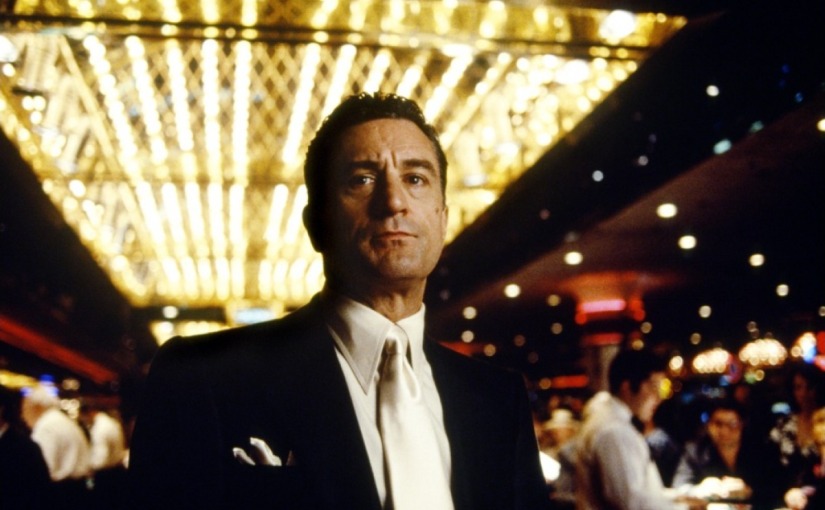
When a movie is set in Las Vegas, doesn’t it feel like it should be overly exaggerated, maybe a little loud, and quite bombastic?  That’s how I feel about Martin Scorsese’s three-hour opus, Casino.  The film opens with a car bomb exploding our primary narrator, Sam “Ace” Rothstein into the skies where he then makes his descent into the expansive signs that light up sin city in the desert.

Ace (Robert DeNiro) runs The Tangiers Casino.  He was especially picked by the mid-west Mafia back home (St. Louis, Mo.) to oversee everything that happens at the casino.  He’s looking for cheaters.  He’s making sure blueberry muffins live up to their name.  He’s dodging the FBI and their hidden bugs.  Most importantly, he’s making sure hefty suitcases are walked out of the casino and delivered on a monthly basis to the wise guys he has to answer to, and those deliveries better not come up light.  These guys treasure Ace because he never loses a bet.  Not one.  He can predict the outcome of any sports contest.  He can beat the odds on any table.  Ace is the best at his job because he also works eighteen hours out of every day, and he makes a lot of money for his superiors.

Everything should go smoothly.  However, the mob has also allowed Ace’s childhood friend, Nicky Santoro (Joe Pesci) to move out to Vegas.  Nicky is a heavy.  It’s not wise to upset or anger Nicky, because it’ll likely be the last time you ever do.  He’ll kick you when you’re down on the ground, but he’ll also stab you with a pen an endless number of times.  Don’t get your head caught in a vice when you are around Nicky.  This bull might have been sent out as a toughie to protect Ace and his work, but he’s not subtle about his methods.  When law enforcement gets involved, it only causes interference for Nicky and his crew to get back in the casinos or even in to Vegas.  Because Nicky won’t settle for that, it’s only going to make things harder, and especially challenging for Ace.

Ace’s other problem focuses on the one bet he did lose in life, and that was marrying Ginger (Sharon Stone in an Oscar nominated performance).  She’s a high-class hooker that Ace quickly becomes infatuated with, and the worst mistake he could have ever made was that he trusted her.  He trusted Ginger way too much.  Ginger may have quickly had a child and married Ace, but she never gave up on her loyalty to her scuzzy pimp, Lester (James Woods), and just wait until she starts carelessly confiding in Nicky.  Early on, everyone in the room, like even those in the comfort of their own homes, scream out loud why Ace would entrust a safe deposit box containing millions in cash with only Ginger’s name.  Ace can’t even get into the box if he wanted to.  He arranged it so that only Ginger could have access.  Keep the cash out of his name and the Feds can’t make a case.  As well, is Ace hiding his own interests from his own people?  Yet, that’s what he did.  He trusted his hooker wife way too much, way too often.

I’ve seen Casino a few times and I always leave it with the exact same problem.  I don’t think the film lives up to its title enough.  The first half of the film, while a similar blueprint to Goodfellas and later The Wolf Of Wall Street, is incredibly sweeping with Scorsese’s signature steady cams and voiceover work from DeNiro and Pesci.  You can travel from one end of the gambling hall, and then through clandestine back rooms and into secure areas all within sixty seconds.  Scorsese with a script from Nicholas Pileggi gives you a very fast education on how Ace operates a tight ship and keeps his mob superiors invested. 

Later, however, the film loses its way with an abundance of material on the Ginger character and how she is undoing Ace.  Stone gives an incredible performance as a constant drug and alcohol fueled spoiled brat of a trophy wife/former hooker.  She has wild outbursts that continuously threaten Ace and who he works for and with.  Minutes later, the film cuts to where the drugs have worn off and she comes back to her husband with her chinchilla coat draped over her shoulders.  The energy that Stone puts into this role must have exhausted her.  As a viewer, I get wiped out just watching her.  Yet, as engrossed the actress is in the part, what does it really have to do with life in a mob run casino? 

It’s not crazy to say that Las Vegas is city of at least 8 million stories.  It’s not called sin city for nothing.  In three hours’ time, much attention is given to how Ace’s casino funnels out monies to the mob.  Focus is also given to how they deceive the gaming commission and how Ace dodges the need to have a gaming license if he is to work at the casino.  There’s a great scene where he demonstrates what happens to cheaters who rip off the joint.  He also has to contend with the governing good ol’ boys who staked their claim in Nevada long before it became the gaming capital of the world.  If a dumb nephew is fired for not properly handling the slot machines, Ace is going to have to answer to someone with a big shot title.  Pileggi’s script is best in scenarios like this.  So, I can’t understand why he diverts his story into a domestic squabble of screaming and shoving between a husband and wife. 

The Ace/Ginger storyline populates over one third of the movie and then not much is talked about with the casino.  There are broken glasses and screaming and crying and drug fueled rages and opportunities to beat up Lester and now the film has become a personal picture, rather than Las Vegas mob cycle we were invited to observe.

Ironically, what I always hoped to gain from Casino is only a tease at the end, when Ace narrates how Las Vegas segued from mob rule and sold out to corporate America, even comparing it to Disney Land.  A wise shot is provided showing the senior citizens entering the doors of the casinos en masse, dressed in their sweat pants and polyester outfits ready to take a chance on the slots, not the more sophisticated gaming tables where the fat cats would lay down ten grand a hand.  Why couldn’t Nicholas Pileggi and Martin Scorsese devote time to this transition?  This seems like the bigger bet that Ace wouldn’t win out on.  Tons of married couples lose out and get married for the wrong reasons.  We’ve seen that kind of material before.  The real undoing of Ace Rothstein was likely the blue-chip organizations who pounced on what the mafia pioneered.  Hardly any of that is shown, only left to be implied.  I’m sorry, but Casino concludes on a missed opportunity.

EASY MONEY

By Marc S. Sanders

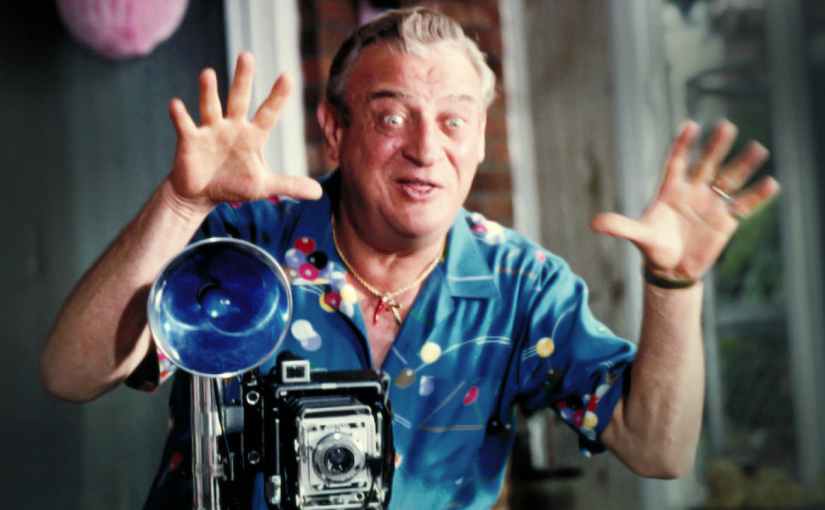
Monty Capuletti is played by Rodney Dangerfield in the comedy Easy Money. The name of the role is just there for script purposes really. This is basically just Rodney playing Rodney, and had he been in more scenes, this film would have been one of the all-time great comedies. It really would have been legendary. Unfortunately, it suffers from a side story that generates no laughs and bogs the picture down to a screeching halt.

Monty is a baby photographer, and I can’t think of a better or more appropriate occupation for Rodney Dangerfield to play for some easy, gut busting laughs. Let that sink in for a moment. Rodney Dangerfield…as a…baby photographer! I couldn’t contain myself when he was trying to get a plump toddler to sit still and finally unleashes a tirade of inappropriate expletives. Comedy works best when one party is tainted by another.

Monty drinks, smokes, gambles, overeats and often visits the local strip joints with his best pal, Nicky Cerone (a perfect partnership with Joe Pesci). His hoity mother-in-law (Geraldine Fitzgerald) has never approved of her daughter’s (Candice Azzara) marriage to this offensive slob. When mother passes away, she leaves Monty her ten-million-dollar furniture store enterprise to him, but only if he gives up on all of his habits as well as loses some weight. This is a perfect set up for a Rodney Dangerfield movie. Unfortunately, it does not go far enough with the gags.

The first thirty minutes are comedy gold as we see Monty and Nicky going from one moment of debauchery to the next. When they lose big on the horse races, I about died watching Nicky take to the field to punch out the rider. When they pick up the wedding cake for Monty’s daughter’s wedding and wedge it into the back of Nicky’s plumbing van next to the toilet, I had to pause the film to catch my breath and finish laughing. Plus, think for a moment of what’s gonna happen to that cake before the night is done. It’s more hilarious than you could possibly imagine. The first thirty minutes paint a perfect picture of Monty and his terrible ways.

When the turning point happens after Mother dies, the remaining hour only generates a handful of memorable moments. The film diverts to Jennifer Jason Leigh as Monty’s daughter who has now married a greasy gang member eager to take her virginity. She leaves the jerk on her wedding night and the film takes up too much time with the guy trying win her back. Dangerfield is not in much of this storyline, nor is Leigh. It focuses way too much on a boring performance from actor Taylor Negron as the jilted groom who is not funny in any way. As well, his selection of scenes come off unfinished at times. The groom, Julio, climbs to the outside of the second story of the house one night and falls off the pipe he’s holding on to, but you never see his reaction or where he lands. In Tom & Jerry cartoons, you were always treated to the aftermath of the fall or the big bang where little birds flew around poor Tom’s head. Did the editors just fall asleep in post?

The wedding ceremony at church and the reception in the fenced in New Jersey backyard? Now that’s funny. Really funny. Just look at the outfits for one thing. Purple tuxedos for the groomsmen. Lime green dresses for the bridesmaids and the inevitable overly, emotional, tears of joy family member who just won’t shut up. It’s a perfect tempo for laughs. I’m laughing as I recall this moment. The Italian gathering of hundreds of people dancing in a perfect overhead shot of a crammed in backyard is an absolute contrast to the elegance you’ll find in The Godfather.

Monty’s struggle with giving up on his unhealthy lifestyle is not touched upon enough and I can’t understand why. The door was wide open for these moments. Imagine Monty at an AA meeting or an Overeaters Anonymous gathering. Opportunities were missed in Easy Money. A perfect set up with not enough of an execution. I was ready to declare this film as Rodney’s best (better than Caddyshack or Back To School) but then the last hour settled in.

Easy Money is not a terrible movie. Far from it. It just could have been so much more. Watch the first thirty minutes, and then turn on Back To School to feel fulfilled.

GOODFELLAS

By Marc S. Sanders

Goodfellas is my favorite film by Martin Scorsese. It’s a fast-paced roller coaster narrative of Irish street kid Henry Hill’s experience in the mob, dramatized from his real life as part of the Gambino crime family of New York.

“How am I funny?,” the Lufthansa heist, Spider takes it in the foot and then in the chest, Morrie’s Wigs, the piano montage from Derrick And The Dominos, Billy Batt’s demise followed by an early morning breakfast stopover at mom’s, and Henry’s helicopter paranoia. All of these elements are assembled to depict the perceived glamour and undoing of street level hoods, proud to steal and dress in the finest threads while bedding dames behind their wives’ backs.

Scorsese along with Nicholas Pileggi uncovered something special when they adapted Wiseguy (Pileggi’s book) for the screen. I think they struck a nerve because they showed these guys as men doing a routine living. There was a process to their deeds. Give a cut of your theft to the man above and keep the rest for yourself. Above all else, stay off the fucking phone. Get out of line and get whacked, unless you’re a “made guy.” This is all code, normal to Henry and his cohorts (Robert DeNiro as Jimmy Conway; Joe Pesci as Tommy DiSimone).

Moreover, the wives understood this behavior as well. Henry’s wife Karen (Lorraine Bracco) knew these guys were not 9 to 5 husbands and the more it occurred, the more normal it all seemed. Including when the FBI presented a warrant to search the premises. Just let them in and go back to rocking the baby to sleep while watching Al Jolson on the box.

Scorsese took the best approach by not judging the actions of these raw criminals. They dressed well, but they weren’t reluctant to draw blood if an insult was tossed their way. Pesci, in an Oscar winning best performance, represents that philosophy. Scorsese, with his regular editor, Thelma Schoonmaker, are not shy about the violence. Watch how Jimmy and Tommy beat up a “made guy.” DeNiro just stomps his dress shoes into the guy’s face over and over. Pesci pistol whips him, but before he can shoot him, he breaks the gun…on the guy’s face. The romance of gangster life quickly undoes itself in moments like this. As Henry notes, your friends come at you with smiles before they whack you.

Ray Liotta is Henry, the primary narrator and centerpiece of the film. Most of the story is from his perspective. I’m sorry that Liotta didn’t get much award recognition. He really deserved it. His voiceover narration is superb. It gives a feeling like I’m talking to Henry in a bar with his tales of Mafia code and life in the criminal underworld. His voiceover is conversational. He’s also got great expressions of disregard, anger, and intense, raging fear on screen. When Henry is at his worst, his eyes are dry red, and his skin is pale and craggily. None of that is just makeup at work. That’s Ray Liotta performing with an exhausted energy in character. Watch the scene following his 3rd act incarceration where he argues with Karen over the last of their drug supply being flushed down the toilet. It’s not so much a party anymore. The manic response couldn’t feel more real as he slams his hand against the wall and then crouches up into a weeping ball of helplessness in the corner, on the floor.

Liotta and Bracco have sensational chemistry together in scenes of their courting nature when they first meet, followed by the ongoing, bickering abuse that enters their married life. There’s a great hysteria to them. Bracco got a nomination for her role. She deserved it.

Scorsese is a master at filming basic gestures as well to show the nature of these mob guys and their crimes. A key folded in a paper is then inserted into a knob and a stash is walked off with. A blood-soaked revolver is placed in a tin box and then Schoonmaker cuts over to the customary stomping of a glass at a Jewish wedding. Every prop and detail are connected.

Even better is Martin Scorsese depicting the wise guys’ incarceration midway through the film. Watch how the head mob boss Pauly (Paul Sorvino) slices onion with a razor for dinner complete with steaks broiling, pork sauce bubbling and even lobster ready to be boiled. Scorsese and Pileggi found it important to depict how attractive this life could be, despite a stretch in the joint or the violence that might come. Pay off the right guys and you could live like kings.

The master director doesn’t stop there. His selection of doo wop and rock period music paints the historical palette of the 50s through 80s. Music was being played and life was happening all the while an underhanded way of crime and violence occurred.

One of the best blends of film and song occurs during the classic one-shot steady cam where Henry escorts Karen through the back way of the famed nightclub, Copacabana. It’s one of the greatest scenes ever in movies. The walk journeys downstairs, through the kitchen, past wait staff, cooks, bouncers, people necking and to a front and center table to see Henny Youngman’s stand-up routine. The sequence is accompanied by the song “And Then He Kissed Me.” It’s a great character description to display a young guy, proud of his gangster image, with a whole world ahead of him and everyone offering their respects while he hands out twenty-dollar bills like gift coupons. This young guy had power, and the girl holding his hand couldn’t be more impressed.

Goodfellas is one of the greatest mob movies ever made. It’s one of my favorite films. It’s genuine in its grit and language. Every F-word uttered is necessary to translate the regard for code, or the blatant disregard for the law, loyalty within a crew, or even the ethics of marriage. It astounds me that it didn’t win Best Picture in 1990, losing to Dances With Wolves. Perhaps it got cancelled out with fellow mob nominee The Godfather Part III.

Regardless, the film struck a chord and pioneered a new way of showing criminals in celebration of themselves while sometimes encountering the inconvenience of the law or the women in their lives or worse, the betrayals among themselves. At any given moment you might rat on your friend and not keep your mouth shut.

Without Goodfellas, The Sopranos might not have been as welcomed into the pop culture lexicon. Maybe even the films of Quentin Tarantino or Guy Ritchie or Paul Thomas Anderson, or even other Scorsese projects yet to come.

Goodfellas is an electrifying film of unabashed humor, realistic and shocking violence, and authentic culture within a well established crime syndicate.

Goodfellas is a must see film.

LETHAL WEAPON 2

By Marc S. Sanders

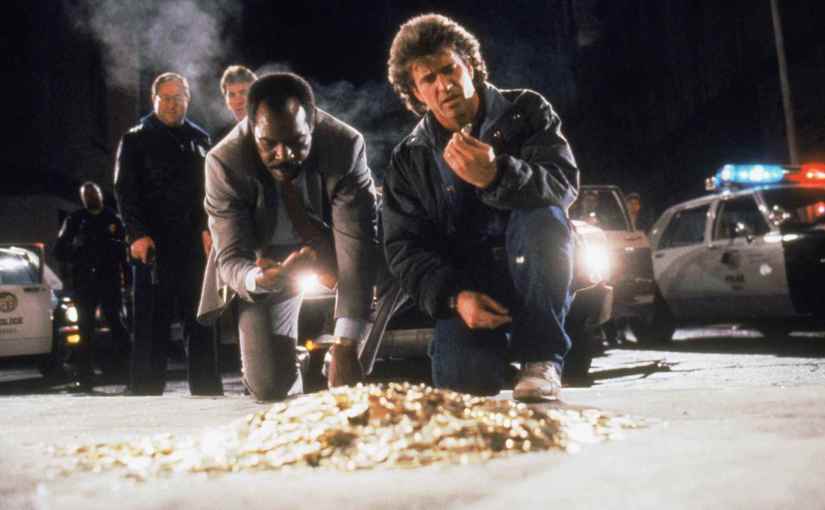
Richard Donner, Mel Gibson and Danny Glover successfully triumphed in 1989’s summer of sequels with Lethal Weapon 2. It was a big box office smash thanks to the pairing of the two leading men making a memorable team with Donner expounding on the beloved humor that the first film provided.

The story is ho hum; South African drug dealers with diplomatic immunity. The top henchman, nick named “Adolf,” has a mysterious connection to kamikaze cop Martin Riggs (Gibson). Nothing so shocking though, and somewhat contrived.

The big star addition here is Joe Pesci as Leo Getz, the sleazy accountant who has embezzled half a billion dollars from the South Africans. Pesci is such a rare talent and he comes up with his own routine of comedy. He is as unique as any of the great comics like Milton Berle or Jackie Gleason or Jerry Lewis. Mind you this film was released before Home Alone and Goodfellas, and after Raging Bull. So, his addition to the franchise was a great surprise.

Getz is a fast talking material witness that Riggs with his partner Roger Murtaugh (Glover) are assigned to protect. However, with the cops’ nose for constant action, it’s not easy protecting the little guy when he won’t shut up or sit still.

“Lethal Weapon 2” is more an assemblage of fun set ups with run on gags. There’s Murtaugh’s daughter appearing in a condom commercial, much to his chagrin. There’s his wife’s new station wagon that is progressively getting wrecked thanks in part to Riggs’ crazy ways. Then there is Roger stuck on a bomb rigged toilet as another reason to damage his family’s home. The Three Stooges would be proud of this material.

There’s nothing new here really, but what makes it entertaining is the ongoing chemistry between Gibson and Glover, with Pesci. It’s apparent that these guys had to go off script at times from a screenplay by Jeffrey Boam, based on the characters created by Shane Black.

Donner does as expected with some great action scenes like a car chase to open the film and a careening tow truck that has Riggs hanging from the fender. There’s shootouts galore, as well.

The beautiful Patsy Kensit has a small romantic storyline with Gibson. It wouldn’t have been missed if it didn’t make the final cut, but it’s here and it’s serviceable.

Yeah, there are some contrived elements to Lethal Weapon 2 and the villains are not the greatest, but the heroes hold the film together, like a fun party on a Saturday night at your best pal’s place.