HOMICIDE (1991)

by Miguel E. Rodriguez

DIRECTOR: David Mamet
CAST: Joe Mantegna, William H. Macy, Ving Rhames, Rebecca Pidgeon
MY RATING: 8/10
ROTTEN TOMATOMETER: 88% Fresh

PLOT: A Jewish homicide detective investigates a seemingly minor murder and falls in with a Zionist group as a result.


Homicide is one of those movies where the lead character experiences just one damn thing after another until he winds up in a situation that is not even barely hinted at in the film’s first half hour.  If I didn’t think it was being a little pretentious – and maybe if I understood the term just a little more – I’d call it Kafkaesque.  It reminds me a bit of Martin Scorsese’s After Hours, where that lead character is drawn unwittingly into the unexplored jungles of New York City at night.  Likewise, Detective Bobby Gold (Joe Mantegna) starts the film on a manhunt, searching for a wanted killer, and thirty-six hours later winds up begging Zionist activists to let him be involved in blowing up a storefront suspected of printing Nazi pamphlets.

In other hands, the events of the film leading up to Gold’s digression into racial/social activism could come off as comic.  First, he’s put on the manhunt case, searching for a man named Randolph.  Then a weirdo booked for killing his family wigs out at the station and attacks Gold, ripping the strap off his holster, and giving him a bump on the head that’s visible for the rest of the movie.  (I was unavoidably reminded of Jake Gittes’s nose in Chinatown.  Both wounds serve as constant reminders of either the odds the characters face or of the unpredictability of the world they inhabit.)  On their way to interrogate Randolph’s mother for his whereabouts, Gold and his partner, Sullivan (William H. Macy), randomly run into what looks like a hostage situation which turns out to be a cop cornered by a vicious dog in a candy store.  In the store is a dead woman.  The commanding sergeant arrives at the scene and gives Gold the dead woman case.  Turns out the dead woman is Jewish.  Her family shows up at the scene, learns Gold is Jewish, and insist he be their personal liaison for the case.  Meanwhile, Sullivan has to carry on with the Randolph case on his own.  A recurring theme will be how Gold keeps missing out on important events with the Randolph case while babysitting the family of the dead woman, a case he considers unimportant.

What happens next unfolds so naturally and surprisingly that I will not spoil it for you.  What I will say is that Mamet turns a standard police procedural into a searing character study of a man who has never really considered who he is in terms of his heritage.  At one point, he speaks with a Jewish scholar who shows him a page of Hebrew text.  Gold says, “I can’t read it.”  The scholar tells him, “You say you’re a Jew and you can’t read Hebrew.  What are you then?”  This is a question that Gold will try to answer for the rest of the film.

On a personal note, that bit of dialogue resonated quite a bit with me.  I’m full-blooded Puerto Rican on both sides of my family.  Yet my knowledge of Spanish is barely passable.  When faced with reading Spanish text, I can sound out the words, but my comprehension level is probably only 60 to 70%.  My conversation with fluent Spanish speakers is halting, at best.  I just never took the time to learn it as thoroughly as my parents or my sister did.  Does that make me any less Puerto Rican?  I don’t think so, and I might feel resentment towards a stranger telling me that I’m not Puerto Rican just because I don’t speak Spanish.  I know who and what I am, and my identity is not tied to what language I speak.

But things are different for Detective Gold.  Earlier in the film, he talks to his partner, Sullivan, on the phone and talks about how the Jewish family he’s now working for, or with, are high-strung, crying wolf (they claim someone is shooting at them from the building next door, but there are no bullet holes to prove it), how they saved ten bucks a week by letting the old lady work at the store herself, how they’re “not MY people, baby.”  Only after he realizes he’s been overheard does he feel immense guilt and obligation to help the family.  Not to just solve the case, but to “find the killer.”  So, he’s experiencing all sorts of new emotions that may or may not be interfering with his ability to do his job impassively.

The people in Homicide sound as if they are speaking in subtext only, using Mamet’s unique writing style to bypass what we think of as “normal” speech and deliver lines that are almost poetic, even when laced with racial epithets and curse words.  This makes the overall tone of any Mamet-scripted film seem hyper-stylized, as if the characters are one level removed from reality, but not in a bad way.  It elevates the film somehow.  I’m at a loss to describe it more accurately.

One bit of dialogue exemplifies what I’m talking about.  Gold is being thrown out of a building.  The gentleman at the door tells him, “Don’t bother to return.  The next time you come, there’ll be nobody here.”  Don’t bother to return?  That’s unnecessarily decorous.  “Normal” conversation would be something like, “Don’t bother coming back.  If you do, we won’t be here.”  However, Mamet’s signature word choices here suggest an almost Shakesperean construction, as if the words are being shoehorned into a buried structure or pattern that operates subconsciously.  Based on what happens with Gold throughout the film, I could theorize that Mamet is trying to create a mood reminiscent of Greek tragedy, and the actors are reciting dialogue that has been translated from Greek or some other language.

But that’s just me.

The experience of watching Homicide will never be quite as exciting or kinetic as other superlative crime dramas like, say, Heat or The Departed, movies that also examine their characters in detail, sending them on similar journeys of self-discovery.  Those other movies are defined as much by their action as by their intelligence.  In Homicide, any “standard” action scenes are purely incidental, or sometimes accidental, intended not to thrill but to move the plot forward with a minimum of fuss.

In any event, the action is not the linchpin of this film.  We watch Homicide, not to see who Gold kills or who tries to kill Gold, but to see if he is capable of resurrecting the person within himself that he thought he had killed long ago, a sacrifice he made on the altar of being a good cop.  He has a painful conversation where he realizes that everything he’s done to suppress his own self has been, “Not for me.  All for someone else.”  He must decide whether to act in service of his conscience or his sworn duty as a cop.  The choices he makes have consequences he never anticipated, as with all good tragedies.  Homicide reminds us of that inescapable fact, not with a bang or a whimper, but with the calm, flat gaze of an impassive Greek god who lets us draw our own conclusions.
SUSPECT

By Marc S. Sanders

Okay. Fair Warning. I am going to spoil this movie with my review. Why? Well, if you haven’t seen Suspect, directed by Peter Yates, then I’m telling you that you absolutely do not ever need to see Suspect directed by Peter Yates.

What is Suspect worthy of 33 years later? Nothing beyond my personal allowance to spoil the film for you. I know! It goes against my principals as a film critic, but I choose, for YOU, MY READERS, to fall on my sword.

Scripts of any variation whether they be stage plays, television episodes or feature films should always show the unusual. If it’s mundane, it should never be made. You don’t want to watch two hours of someone brushing their teeth. You want to watch epic films like Malcolm X or witness a man that flies in Superman: The Movie or the murderous ways a person will devote his affection for his mother in Psycho. Unusual and special stories make the best stories. Unusual! Not utterly preposterous!

Now, I’m sure in the annals of trial law there had to have been a handful of cases where a defense attorney got involved socially and/or romantically with a member of the jury. Otherwise, we’d never hear of the term “jury tampering.” So, there’s something unusual to sink our teeth into. Preposterous though (AND I WARNED YOU) is that within this very same trial, you know the one where the defense attorney and jury member are getting some from each other on the side, that one, the presiding judge turns out to be the killer. Okay. Now Mr. and Mr. Filmmaker, you’re no longer using your imagination. You’re just throwing spaghetti at the wall, hoping it’ll all stick.

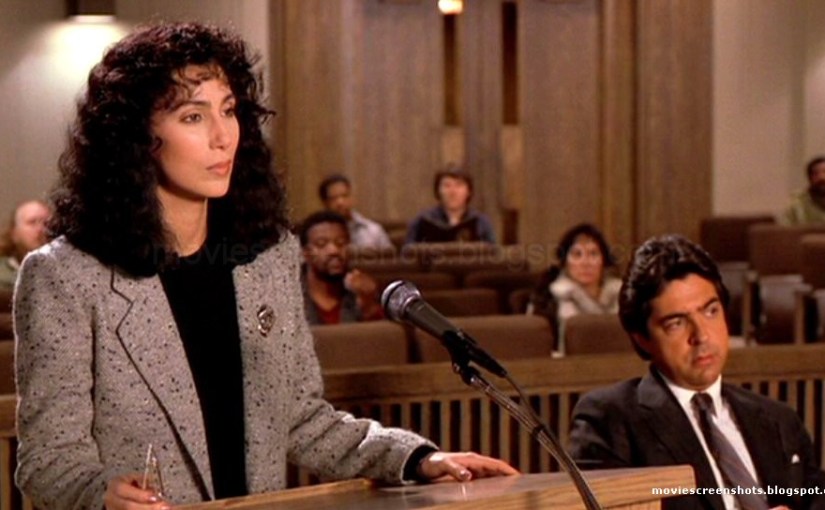
Cher plays a public defense attorney named Kathleen Riley. Dennis Quaid is a handsome DC lobbyist named Eddie Sanger serving on the jury. Liam Neeson is the deaf mute title character who is a vagrant homeless person, and John Mahoney is the presiding judge aka the actual killer revealed at the end. Lawyer and juror meet up outside of court to find clues and eventually make out. The judge is the killer. People please!!!! Washington DC is not this effed up, is it? (Maybe don’t answer that.)

Frankly, Kathleen is not a very good attorney. She’s not aggressive enough with her objections and I don’t think she applies herself well enough to win her case. In fact, without Eddie’s self motivation to dig into the case himself and help her out, then this suspect (Neeson) doesn’t have a chance in hell of being exonerated. The victim, a political staff member, had her throat slashed. Kathleen doesn’t even consider if the killer is right or left handed? Really? Eddie did at least. Still, I’m okay with watching an inept lawyer in a movie. Too often, movies show us lawyers that are too brilliant and quick on their toes. They’re almost too brainy. So, okay yeah, I’ll accept a lawyer whose not the sharpest crayon in the box for a change of pace.

On the other hand, Mahoney, the actual killer, is easy to predict when he voluntarily takes this case and then rules against literally every objection that Kathleen brings up. Every single one! Plus it stands to follow Roger Ebert’s economy of characters. There’s only so many characters in your multiple choice of cast members to consider as the killer. I can’t fathom Quaid, the juror, as the killer, nor Cher the defense attorney. So either Neeson, the suspect on trial, is the killer (not likely because then why have a movie) or it’s the judge. Nah! It couldn’t be the judge. Could it? Hmmmm.

Washington DC makes for a great setting for legal thrillers or courtroom dramas. It’s full of secrets and government and dealings and politics. A million and a half motivations and any one of its residents could find a reason to kill. The script for Suspect, written by Eric Roth, never cares to try that hard though. We are treated to a wasteful side story of Eddie doing some lobbying for milk (I’m sorry. MILK? LIKE DAIRY MILK????) when he’s not in court. He sleeps with a congresswoman to get her vote…and why am I seeing any of this?

There’s no build up in the murder trial either. The few expert witnesses called to the stand are forgettable. Nor do they foreshadow anything. Cher’s character doesn’t seem to work hard enough in questioning a witness. Instead, this dumb lawyer relies on a juror she shouldn’t ever be talking to.

Once again, normally, it’s against my policy to spoil a film. After 40 years, I won’t even spoil The Empire Strikes Back, cuz someone out there still hasn’t seen it. However, this film is ridiculous. This would even be too ridiculous for a Maury Povich episode or a Lifetime TV movie. How absurd must one murder trial be?

Think about it. All in one movie. One murder trial. One case. The defense attorney is involved with a juror AND the judge is the killer????? There are odds….and then there are gazillion to one shots.

SEARCHING FOR BOBBY FISCHER

By Marc S. Sanders

In a game of chess, if your queen is taken, it might mean a permanent loss of what was thought to be a god given talent. Seven year old Joshua Waitzkin does not realize that, and thus it allowed him to become the greatest chess champion in the country.

Josh (Max Pomeranc) is not a chess player. Josh is a boy who plays chess, as well as baseball. He also builds Legos, plays Clue and does just about anything else including fishing with his dad. He knows this about himself. The problem is the adults in his life only see chess, and nothing else. Writer/Director Steve Zaillian assembles a film that turns the world’s most historic board game into a means of recognizing self-worth and the limits of talent with its correlation to identity.

Josh gains influence from a cutthroat formal chess instructor named Bruce (Ben Kingsley) who doesn’t just teach chess but also offers guidance in manners of contempt and dislike for your opponent. It helps that he recognizes Josh’s talent but is Bruce coaching with the best intentions?

Contrary to Bruce is a city park speed player named Vinnie (Laurence Fishburne) who reminds Josh to always play on offense. Play the board, not the opponent. Josh’s father (Joe Mantegna) only sees victory through beautiful trophies. When Josh loses interest in champion accomplishment, his father only sees nothing but failure. His mother (Joan Allen) sees the boy losing his boyhood.

These are all good people and necessary for Josh. The conflict lies in the clash of their different ideals. I love that. There isn’t a villain here. There’s a debate.

Zaillain devotes time to footage of renowned champion Bobby Fischer who eventually went into seclusion probably due to the lack of any worthy challenger beyond himself. The worry of the film lies in whether Josh will end up with the same sad fate of Fischer. Everyone is on the hunt for the next Bobby Fischer. Does everyone want to be the cruel, cold and isolated Bobby Fischer, though; a man with talent yet also hates his talent?

Zallian films very effectively in a majority of close ups, hardly showing the surroundings of the settings. He wants his camera to maintain a tunnel vision to only allow Josh, and those that discover and observe him, per se, to see what’s directly in front of him. Nothing else. Nothing but the chess pieces on a board and how many moves until check mate arrives are all that matters.

The film edits beautifully in sound as the speed play pounds the chess pieces in an aggressive music accompaniment. Pieces are KNOCKED onto the board, and when a queen is taken it is SLAMMED on to the table. A person has ultimately been disabled and weakened. When check mate eventually comes, the king piece weakly drops over.

Josh is not proud of his ability to conquer. He’s proud of his ability to play.

HOUSE OF GAMES

By Marc S. Sanders

David Mamet is one of the most renowned writers of the last fifty years.  The first film he directed was for his script, House Of Games, with his wife at the time, Lindsay Crouse, and Joe Mantegna.  It’s also important to point out that he recruited well known con artist and card trick player Ricky Jay to consult on the film and join the cast.  When you are constructing a film about the confidence game, a guy like Ricky Jay, who is widely known for his slight of hand and scam artistry, is important to ensure your story remains solid and airtight. (Note: seek out videos of Ricky performing eye popping card tricks and magic on You Tube.  He’ll make you believe that you’ve never seen a card trick before because not many come close to his mastery with a deck in hand.)

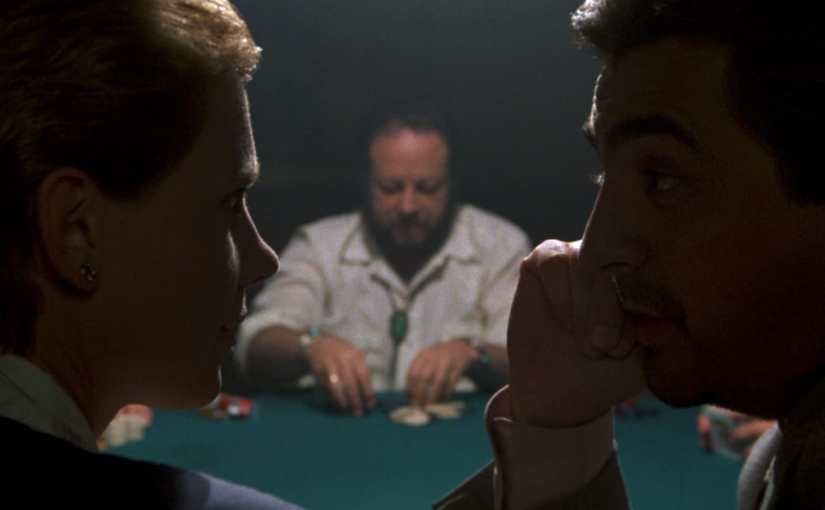
House Of Games plays like an instructional or “how to” video demonstrating how to be a successful con artist.  Crouse portrays a psychiatrist with a best-selling book titled “Driven” that focuses on obsessive behaviors.  One of her clients reveals that his compulsive gambling habits have put him $25,000 in debt with a card shark.  Crouse takes it upon herself to confront the card shark (Mantegna) on behalf of her frightened client.  Shortly thereafter, he’s got her acting as his wife to determine if the guy at the other end of a poker table is bluffing.  Then he’s introducing her to his con artist buddies, and she is becoming enamored, not only with him, but with the art of the con and the steal.  Her mundane life gives her the urge to see more.

The other Unpaid Critic, Miguel, recently reviewed this picture.  At the time of this writing, I have not read his review, but he forewarned me that the performances are stripped down to nothing.  Mantegna and Crouse are left bare to just delivering Mamet’s dialogue.  Miguel hadn’t liked this film the first time he saw it many years ago.  On my first viewing, this past week, I was engrossed.  However, I could foresee the ending as quickly as the film began.  I dunno.  Maybe it’s because I’ve seen several con artist films before like The Grifters and the granddaddy of them all, The Sting.  Films that focus on the best liars seem to always move towards a twist where even the viewer is scammed.  It’s fun to participate in the activity.

With House Of Games, the sequence of events move step by step.  Following the two characters’ introductions to each other, Mantegna is caught in the middle of doing another con but now he’s reluctantly forced to include Crouse in on the game.  This time it is seemingly much more complex and grander than the first time they worked together at the poker table.  It also gets all the more confusing when an unexpected murder is involved.  This con spells out a long night for the couple who are also falling for one another. 

Miguel is right.  The performances are most definitely stripped down and often the dialogue is wooden.  Crouse and Mantegna are deliberately flat.  I don’t even think they laugh or smile if I remember correctly.  It is likely because Mamet wants the viewers to follow along and pick up on how a successful con job is meticulous in its methods.  A con artist is not going to make waves with loud, angry monologues or passionate seductions and outrageous silliness.  What’s important is that everything that plays out seems convincing with no distractions that lead to doubt.  So, when the only African American in the cast (extras included) leaves a key on a hotel counter, you notice it.  It happened for a reason.  Later, when the characters come upon a BRIGHT RED Cadillac convertible, you are going to remember it.  A Swiss army knife with tropical artwork on the handle.  A gun metal briefcase with a large amount of cash.  A gun.  A murder.  Props and scenarios guide Mamet’s picture. Not the characters. 

Fortunately, the film remains very engaging.  As well, while I could figure out what was being played here during the entire course of the picture, as a viewer I had no choice but to feel proud of myself for uncovering the puzzles and riddles at play.  For me, watching House Of Games was like answering “Final Jeopardy” correctly when none of the contestants on screen had a clue. At least I was smiling by the end.

HOUSE OF GAMES (1987)

by Miguel E. Rodriguez

Director: David Mamet
Cast: Lindsay Crouse, Joe Mantegna, J.T. Walsh, Ricky Jay
My Rating: 8/10
Rotten Tomatometer: 96%

PLOT: A psychiatrist is led by a smooth-talking grifter into the shadowy but compelling world of stings, scams, and con men.


I’m sitting here trying to figure out how to summarize the story of David Mamet’s House of Games without giving away plot points, and it’s virtually impossible.  Mamet’s screenplay is composed almost entirely of double-crosses, triple-crosses, short cons, long cons, and the kinds of surprises that are greatly diminished in their description.  Remove one surprise, and the whole thing collapses like a house of cards.

A distinguished psychiatrist, Margaret Ford (Lindsay Crouse) pays a visit to a handsome con artist, Mike (Joe Mantegna), on behalf of one of her clients, who is distraught because of how much money he owes to Mike.  Dr. Ford is unexpectedly intrigued by Mike’s business methods, Mike senses this, and takes her to a back room where he and some other gentlemen are playing poker.

(These men don’t talk much, but when they do, it’s almost exclusively in poker patter.  “A man with style is a man who can smile.”  “Damn cards are as cold as ice.”  “The man says you gotta give action to get action.”  “Everybody stays, everybody pays.”  It’s like they learned how to talk from watching endless episodes of the World Series of Poker on ESPN2.)

Mike makes a deal with Margaret: if she helps him beat the hot player (Ricky Jay) at the table, he’ll tear up her patient’s marker.  The hot player has a tell when he’s bluffing.  Mike will go to the restroom.  If the hot player shows the tell, Margaret will tell Mike, and Mike will beat him because he’ll know he’s bluffing.  Mike goes to the bathroom, the hot player reveals his tell, and Margaret tells Mike when he comes back.  The hot player raises the pot, but Mike can’t cover it.  Margaret comes to the rescue: she’ll stake Mike with her own money.  But, uh oh, turns out the hot player wasn’t bluffing…and now Margaret owes $6,000 to a total stranger.

And that’s where I have to stop. If you think I’ve given too much away, you’ve got to trust me – I haven’t.  That’s barely the preface.  What follows is a character study of a woman who suddenly realizes that, after a lifetime of helping patients, she needs some kind of release, a change in routine.  Mike can provide this much-needed change.  The fact that it involves conning innocent people out of their hard-earned money is incidental.

Her fascination lies in Mike’s method.  For a great con to work, you can’t take someone’s money.  They have to give it to you.  They have to trust you to do the right thing.  The trick is working out how to gain the other person’s confidence without them realizing what’s happening.  We are shown two or three examples, and they’re all brilliantly sneaky.  At one point, Mike tells Margaret the cardinal rule of the con: “Don’t trust nobody.”  After watching this movie, I can’t say I agree 100% with this credo, but a healthy dose of skepticism never hurt anybody.

So how does Margaret square that credo, or anything about Mike’s lifestyle, with her profession?  She helps people for a living.  Her livelihood depends on getting strangers to trust her, but not to take their money…although let’s not forget she is well paid for her services.  Is her fascination with Mike an acknowledgement of the similarities between the two of them?

The screenplay doesn’t provide easy answers.  When we get to the final shot of the film, we can clearly see the choices Margaret has made, but it’s still unclear as to why she made them.  This is one of those movies where the complexities only really come alive during lively discussions afterwards.

Before watching it for this review, the last time I had seen House of Games was over thirty years ago.  At the time, I was unimpressed.  I originally gave it a 2 out of 10 on the IMDb website.  It was slow, the actors looked like they were giving bad performances, and nobody talked like real people talked.

Since then, I’ve had the opportunity to see not one, but three films by a French director named Robert Bresson.  (Bear with me here, I do have a point.)  Bresson, who was active mainly in the ‘50s and ‘60s, was famous for his method of shooting scenes over and over again, take after take, until all emotions had been drained from the actor.  His philosophy, in a nutshell, was that, in a film, the story isn’t everything, it’s the only thing.  If a screenplay couldn’t carry an emotional impact just by virtue of the story alone, if he had to rely on someone’s specific performance to make the movie work, he wasn’t interested.  The results are films that are curiously compelling, despite their utter lack of anything modern audiences might recognize as a typical acting performance.  His films are routinely included on the most prestigious lists of greatest films ever made; seven of them made it onto the 2012 critics’ poll by Sight & Sound magazine, a feat unequaled by any other director.

Sitting down to watch House of Games for the first time in three decades, after having seen Bresson’s films for the first time, I think I see what David Mamet was going for, in this, his directorial debut.  The actors aren’t quite dead-panning the entire time, but their performances (with one or two necessary exceptions) are pared down to the bare minimum of emotion.  Vocally, they’re angry, curious, flirtatious, what have you.  Facially, they’re ciphers.  Which, if you’re a good con man, that’s exactly what you want to be: a blank slate for the unlucky mark to interact with, then forget immediately.

I think back to those poker players and their mournful aphorisms, always said in nearly monotone.  And then I think to the film’s finale when Margaret believes she might be able to turn the tables on Mike (long story), and as the frantic words come out of her mouth, there’s not a smidgen of emotion on her face.  Like…a poker player.  Neat.

THE GODFATHER PART III

By Marc S. Sanders

Francis Ford Coppola and Mario Puzo finished out their Corleone trilogy in 1990 with The Godfather Part III. Not so much a sequel, this third film feels more like an epilogue jumping towards Michael Corleone’s (Al Pacino) elder years as the Don of the most powerful Mafia family in the late 70s/early 80s.

Michael seems exhausted with his rule as he suffers from diabetes as well as remorse for his past sins; especially feeling the guilt of ordering the execution of his brother Fredo.

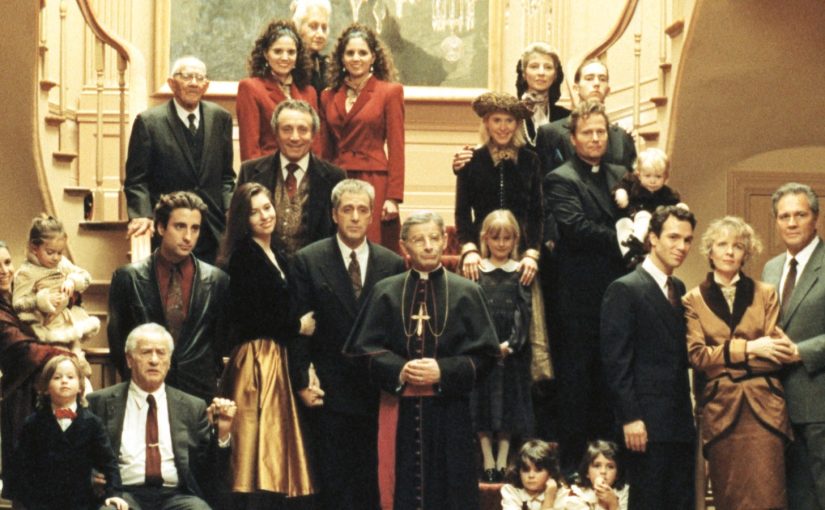
Still, he is drawn to crime, but on a more sophisticated and righteous nature by taking advantage of the Roman Catholic Church. Michael intends to purchase the powerful bank associated with the church but that’ll have to fall in line with the Pontiff’s agreement. It doesn’t help that the Pope is in failing health. The setup of all this lends to another grand opening where Michael earns a prestigious award from the church in the same tradition of an austere celebration of many guests that lend to character set ups for the film. A Godfather movie is not a Godfather movie without a grand reception to open the film.

The most interesting character is Michael’s nephew, Vincent (Andy Garcia), a fierce hot head like his father Sonny. He wants to work for Michael desperately while fending off a street hood boss (Joe Mantegna). An older don also comes into play by the great character actor, Eli Wallach. Diane Keaton as ex-wife Kay is also here but more or less to quietly bicker with Michael. Sister Connie is here, too, with Talia Shire. The Connie character always changes from each movie. Here she’s a deadly black widow. There’s also Michael’s daughter Mary (Sofia Coppola, contrary to popular opinion, I insist she’s very good in the role). Is Mary a legitimate cover for the family as the spokesperson for a fundraising effort? Is the possibility of Vincent and Mary (as cousins) getting intimate a terrible risk?

I like this film and hold it in high regard. Namely because Coppola and Puzo took an approach straight out of the news when there was an embezzlement scheme occurring within the Vatican bank. The problem for many I believe was that the plot of this grand scheme was not flashy or bloody enough, even if a participant is revealed to be hanging from a London bridge with fraudulent receipts falling out of his pockets…which actually happened in real life.

The film allows many opportunities for Michael to allow his anguish in guilt to flow. Fans grew used to a fierce Michael Corleone from the first two films. The elder Michael here would rather not get involved. Hence the introduction of Garcia’s character. He’s very good in the role. Yet there’s not much dimension to Vincent. He’s a scary violent guy, and a contradiction to what Michael seeks. Yet, thats about all there is. I would have wanted more dimension to this role; the guy destined to carry on the reign.

Sofia Coppola is fine in her part and undeserving of the lashing she received upon the film’s release. She’s Michael’s young daughter; a young adult dangerously close to the fray. The one innocent constant within the family. For me, I found a dramatic stake in her character.

The ending is very powerful. Slowly methodical as the family assembles in Sicily to see Michael’s son’s stage opera debut. There are elements that are consistent with the other films’ endings, but this violent conclusion comes with quite a shocking result. I was really moved by it.

Coppola didn’t measure up to the first two films with this effort. I agree with that. Still, The Godfather Part III is worthy of holding its place in the saga. It carries the traditions of the prior films in set up and music and operatic narrative. Be patient with its slow pace because I think the ending will grab you.