JOKER: FOLIE à DEUX

By Marc S. Sanders

Joker: Folie à Deux is an unnecessary sequel.  A lethargic bore.  That is its one problem, and it infects the merits the film clings to but never gets off the ground.

It amuses me, with a pinch of vitriol, that at the closing credits the picture is said to be based on characters published in DC Comics.  My perspective still stands as it did with Todd Phillips’ first film.  These characters are not consistent with any variation that appears with any superheroes/super villains who occupy the assorted comic books.  It is especially true in this new installment.  Just because the players are named Joker, Harley Quinn and Harvey Dent does not translate to where these folks stemmed from.  Joker: Folie à Deux stands on the shoulders of a hot, pop culture, geek property simply to bank on the residuals.

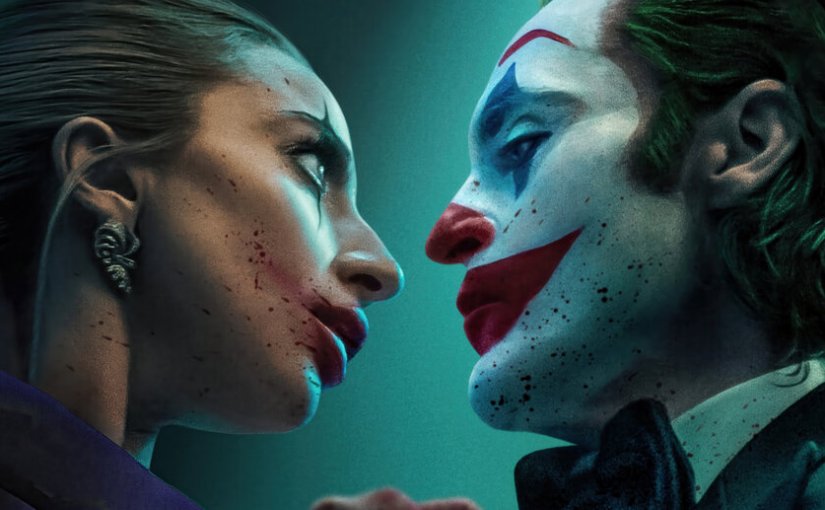
This sequel picks up two years after the original Joker left off.  Arthur Fleck (Joaquin Phoenix, returning to his deserved Oscar winning role) is imprisoned and awaiting trial for the murder of five people including the famed talk show host he shot on live television.  He’s abused both physically and verbally by the prison guards led by actor Brendan Gleeson, who is a better actor than this unoriginal dreck has to offer.  His attorney played by Catherine Keener believes in upholding a defense by reason of insanity.

Arthur normally keeps quiet while endlessly smoking cigarettes (boring stuff). Everyone else talks.  None of this goes nowhere for a very, very long time.  The one positive that enters his life is a fellow inmate named Lee Quinn played by Lady Gaga, another actor worthy of better material.  Lee is being held for setting fire to her parents’ house.  The two develop a quick kinship.

Within his psyche, does the clown image of Arthur’s Joker personality let loose in morose song and dance performances with Lee, also known as Harley.  Uplifting musical montages of classic numbers would normally invoke toe tapping cheerfulness.  Yet, that is not what happens for this disturbed man. Numbers like That’s Entertainment, Get Happy, and What The World Needs Now are given somber and depressing interpretations for these sad sack clowns to sing.  Singer Lady Gaga is not belting out the numbers.  Rather, she puts on a weakened, hoarse inflection to her performance.  Joaquin Phoenix works in tow with his co-star. YOU HAVE LADY GAGA!!!! YOU HAVE JOAQUIN PHOENIX WHO CAN ALSO SING (Walk The Line)!!!!! WHY WON’T YOU LET THEM REALLY, REALLY SING??????

The overall problem with Joker: Folie à Deux is that it remains very stationary.  Director Todd Phillips and Phoenix will set up a performance scene with building intensity of the original score.  You hear the treble of the string instruments build and build.  The camera will zoom on Arthur while signing a book or smoking cigarette as he gets taunted, and you think the animal inside is going to unleash, but then it doesn’t and the moment pancakes flat out.  Nothing means anything in this picture, and it looks like the script is being made up as the film goes along.

About halfway through the movie, the Catherine Keener character is simply dispatched from the film altogether with one line, never to be seen or focused on again. I guess this is supposed to be an impactful moment, but it seems to occur because the screenplay by Scott Silver and Todd Phillips had a bout of writer’s block and decided to “let’s try this!”.  I got to know this person, only to realize she’s pointless.  This is what an edit looks like within a finished product. 

The difference between this film and its predecessor is the Arthur Fleck character actually does not appear in every single scene of the movie this time.  The last film focused on Fleck’s internal struggle with an alternative personality and the cruel world he’s forced to live in.  This film seems to observe Arthur as a subject from the outside.  I believe Joaquin Phoenix has less dialogue this time as we get to hear from his attorney and the prison guards and Lee, and how each of them respectfully perceives Arthur.  So, I credit the film for going in that different direction.  It’s an alternate narrative.  Yet, there’s no advance in Arthur’s plight or story development.  The film just meanders and meanders.  You’d be drunk about ten minutes after the movie begins if you paced yourself by how often a cigarette is lit.  At the very least, Phoenix and Gaga could have exhaled smoke rings for a little fun.  Only Big Tobacco will be this film’s biggest fan.

Look there’s Harley Quinn!  Look there’s Harvey Dent!  He’s the one that becomes Two-Face, right?  Ha!  They said the word Gotham.  Oh, and check it out!  Arthur and Lee are being held at Arkham Prison!  Hold the phone!  Did I hear that witness’ last name is Kane, as in Batman creator Bob Kane? 

So what?

If you are seeking another DC Comics vehicle, look further please.  Joker: Folie à Deux is a possessor of someone else’s intellectual property and the film should surrender it.  Name drops from the universe of Batman does not constitute another variation of the celebrated Clown Prince of Crime.  As good as Joaquin Phoenix’ performance was in the first film (here, in the second film it is nothing special, just the same old same old), his Joker does not belong anywhere in the fraternity house that is shared with the likes of Romero, Nicholson, Ledger and yes even Leto.  Lady Gaga is doing the best she can here.  Beyond the sleepy song and dance numbers, this role is not up there with some of her other memorable performances though.  She is Lee, but she is not Harley Quinn.  No one will remember Lady Gaga for this film.

The original Joker was a box office smash that truly hinged on a very special and impressive performance from Joaquin Phoenix.  It also relied on the Joker label which Hollywood will never have enough of, despite Batman’s impressive vastness of villainous rogues.  That first film garnered a worldwide box office of over a billion dollars.  It stands to reason that Warner Bros would demand a follow-up film for more bucks to stuff under the mattress.  Whatever this new picture earns is not merited on anything but the theft of the brand names it incorporates.  This is a shameless cash grab that surges only to the top of that uncelebrated list. 

I recommend movie goers find a real Gotham City to step into.  Joker: Folie à Deux takes you on an endless detour you can’t find your way out of.

NAPOLEON

By Marc S. Sanders

I never knew much about Napoleon Bonapart.  He was short.  He’s French of course. There’s that famous painting with his right hand tucked into his tunic. Or was it his left?  The big hat. I’d heard he was kind of a brat.  Ridley Scott’s latest period piece, Napoleon, confirms most of what I recall.  The painting was nowhere in sight though.

Joaquin Phoenix portrays General Bonapart, and he surely had a great challenge ahead of him. I cannot say that I was bored with any part of the film, but I did find Napoleon to be quite bland during the first act of the film.  Phoenix, doing his best with a script by David Scarpa, seems to be a stand in with nothing of much consequence to say.  It is only when the Captain all but invites a promotion upon himself to the rank of General, following the guillotine beheading of Marie Antoinette, that his arrogance begins to show.  Thereafter, he takes it upon himself to force the hands of the governing council to resign from their positions, a very entertaining sequence for sure.  Then Napoleon sees no other purpose but ongoing conquest. 

With each passing scene in Napoleon, the ego of the title character grows and grows and that is the underlying theme of Scott’s picture.  We journey to the pyramids of Egypt to witness Napoleon lead his armies towards further conquest.  Alternatively, we also trek through the raw winters of Russia and on to a blazing Moscow.  Who set the Russian city alight is a question that history may contradict of the General’s claim.

Napoleon is sure to get a slew of Oscar nominations.  However, it will likely not be in any of the major categories.  The numerous battles are outstanding in whatever setting Ridley Scott offers.  Whether it is in the desert or murky winter grounds, I could not tell if the armies were physical extras or CGI.  It all looked seamless in its construction.  David Lean would be proud.  Sound editing was also perfectly in sync.  The set designs of the many scenes throughout are exemplary from bedrooms to halls and the wallpapers, furnishings and floors and even the outdoor landscaping of the French estates.  Even Napoleon’s tent on one battlefield after another are absorbing.  The costuming always makes a statement.  Every stitch and distressed shade of blues, reds and whites tell a story.  Yes, it’s all very impressive.  However, I did not go to Napoleon to grade a college project assignment in fine arts.  Overall, it has to be the movie itself that grabs me.

Unfortunately, Ridley Scott’s film suffers from shortcomings that cannot be forgiven.  I have to lend credit to my wife who pointed out flaws that did not come to my attention until I heard her input, and thus could not deny.  There are topics brought up in the film that are either not followed through clearly or are left with questions. 

One moment in particular occurs when Napoleon opts to marry the daughter of a leader. Do not ask me to remember which leader. Characters leave the picture just as quickly as they enter.  One daughter is of proper age.  The other daughter we are told is only age fifteen and Napoleon turns down the idea of the latter, but in the scene afterwards it appears that he actually did choose to marry the fifteen-year-old.  The girl certainly looked like a teenager.  So, how did that come to be? 

A storyline I really took an interest in was Napoleon’s marriage to Josephine (Vanessa Kirby).  The widow of a dead soldier, with three children, he marries her for love.  Then he leaves to conquer some more and more around the world.  Yet, the general returns when he realizes she is happily having affairs in his absence.  The bruised egotistic response of Napoleon is very well played out. Joaquin Phoenix has his best moments in the storyline he shares with Vanessa Kirby.  However, while I thought I understood, my wife pointed out that the film does not clearly explain how the relationship continues.  There’s animosity at first but then there is a mutual love between the couple and how exactly did that flourish and change?  When was the mutual affection eventually sparked?  What works best is how the two are unable to bear a child together.  Napoleon is nothing but forceful in his moments of sex with Josephine.  He will damn well force a pregnancy even if it means he has to thrust harder and harder inside of her.  Yet, no results come of his efforts. An heir must carry on the Bonapart legacy.  Since one does not appear, it taxes heavily upon the powerful leader.

Later in the film, following the couple’s dissolution of marriage, a child is born but who exactly carried the offspring?  Details like these seem to be glossed over.

Few directors are as skillful at showing grand scenes of battlegrounds with sharp, clear edits of how the fighting progresses.  Ridley Scott demonstrates that over and over again with one scene after another.  He accomplishes fare like this so well in other films like Gladiator and his interpretation of Robin Hood.  The dark hazy cinematography works beautifully on a big screen.  However, I’m not sure if it will be as effective on a sixty-inch flat screen where there’s a risk of intrusive glares in your living room.  These magnificent scenes need to be watched on a big screen.

Unfortunately, the attention to detail is not lent to the story as effectively. Napoleon’s mark in history did not just happen in a period of a few years.  For a brief window of time, France was a superpower ahead of the likes of Egypt, Britain, Austria, Prussia and even Russia.  Two hours and forty minutes may seem like a long film and yet Napoleon likely needed at least an additional hour to serve a complete historical recount.

If you want to see Napoleon, now is your chance while it plays in theaters.  Again, I do not believe it will have the same effect at home.  Regrettably, the film does not offer enough on the plate.  No one in the cast is doing anything of Oscar caliber accomplishments.  Ridley Scott comes up short of end of the year award considerations for not inviting tighter storytelling, and that also goes for David Scarpa’s script. 

The visual marvels of this period piece are what is to behold.  Watching Napoleon, I certainly felt like I was there amid the glorious costumes, set designs and cinematic photography.  Nevertheless, while I may have been in the room, the hosts of the picture were not sharing their entire conversation with me around the dinner table.  Alas, at times, I was left to stand in the corner, feeling like an unwelcome guest.

GLADIATOR

By Marc S. Sanders

Ridley Scott’s Gladiator is a terrifically sweeping sword and sandal epic adventure.  It contains well drawn characterizations of its heroes and its one tyrannical villain, along with superbly bloody hack n chop violence and action that live up to its title. 

Rome has finally finished its campaign of conquer throughout at least one quarter of the world.  General Maximus (Russell Crowe) is ready to return to his wife and son to live out the rest of his days as a farmer and family man.  However, the dying Emperor Marcus Aurelius (Richard Harris) begs him to take over his position so the Roman Empire may carry forth with prosperity.  If Maximus does not take over, the empire is at risk of being inherited by Marcus’ spoiled son Commodus (Joaquin Phoenix).  While Maximus ponders the request, Marcus dies and Commodus quickly takes over, and orders the immediate deaths of the celebrated General and his family.  Maximus and Commodus will eventually circle back with one another, however.

Gladiator feels like an epic film in the vein of a David Lean picture that would require time and work to follow through its various developments.  Maximus certainly goes through a widespread arc.  One of the advertising bylines described it as the man who was General, who became a slave, who became a gladiator. Russell Crowe is right for this role.  Not only is he lean and built for the part, but he brings a empathetic approach to the character.  Maximus is loyal to his country, but he also carries pain and longing for his family and when he is wronged, Crowe does very well at displaying his character’s plot of  vengeance against Commodus with strategy and skill.

Joaquin Phoenix rightly earned his first Oscar nomination as a wonderful villain.  The screenplay from David Franzoni, John Logan and William Nicholson offer memorable pieces of dialogue for the bratty son.  “I feel vexed. I am very vexed.”  – a line that sounds so minimal and yet when Phoenix delivers it, it’s only more terrifying.  This little monster captured in an adult body can respond to anything that slightly irks him.

The battle between Commodus and Maximus is hardly physical.  Maximus realizes through his companions that a better and wiser form of revenge is to win Rome’s admiration away from its ruler.  Commodus lives off his ego.  So, when Maximus is encouraged by his slave owner to “win the crowd” amid the games performed in the famed coliseum, it not only lends to the gladiator’s ongoing survival, but it tears away at Commodus’ rule.  A great subplot is included focusing on the ruler’s nephew, Lucius (Spencer Treat Clark).  The expression on Joaquin Phoenix’ face when young Lucius role plays as the great Maximus works like a frozen moment in time.  Imagine a famed quarterback’s child cheering for the defensemen who performs an unforgivable sack during the final ten seconds of a game.  It’s terribly bruising.

When Gladiator was first released in theaters, I found the CGI to lack texture and it appeared very dark like a bad 3D film.  It looked too animated.  This most recent viewing was on a restored 4K transfer and the picture quality is astounding.  Every element of the broad landscapes within the battlefields and especially in the gold sheen photography of the coliseum battles blend perfectly.  If you still don’t understand the importance of 4K, turn to this film to uphold the argument. 

Ridley Scott does not waste a shot in this picture.  Reactionary sequences are just as effective as the cuts to the action.  Blades and barbaric weapons shed gorgeous splashes of blood. Every thrust and parry are easy to see. I’ve never forgotten when a chariot rider is cut in half at the torso from an oncoming blade attached to rolling wheel.  The choreography and editing of the battles are thrilling with sound editing that compliments the moments. 

Beyond Russell Crowe and Joaquin Phoenix, the cast is wonderful.  I’ve always admired Richard Harris’ quiet approach in the twilight years of his career.  He never had to do much to offer a presence.  Connie Nielsen portrays Lucilla, Commodus’ sister who he has affections for.  Her subtle resistance allows Joaquin Phoenix more opportunities to feel “vexed.”  Oliver Reed passed away during the making of this film. Fortunately, Ridley Scott and company did not opt to cut out his role as the gladiator/slave trader, Proximo.  He works well as a kind of mentor to Maximus and the band of other warriors, coaching them on how to stay alive and rise above Commodus’ monarchy.  “Win the crowd and you win your freedom.”  Djimon Hounsou is a loyal sidekick to Crowe’s character. Derek Jacobi is once again that guy you have seen before allowing his expert craft in Shakespearean performance to flesh out the political angle of the story among the Senators.  Every actor serves a valuable purpose in the film.  None of these performances feel like walk on roles.  So, the overall casting of the picture must be commended.

Gladiator is a crowd-pleasing film. Though it is based in ancient history, there remains a fantasy element to the movie when you look at grand designs of the settings, costumes, and dialogue.  Storylines of politics and tyranny hold relatable to modern current events.  What can occur when one man takes over everything for his selfish purposes?  Pointless displays of theatrics can occur at the behest of others who were once heroes, instrumental in placing a despot atop a throne.  I presume Ridley Scott’s film is just one more example of the inherent nature found in humans.  Some of us are destined to rule and control.  That alone is cruel and selfish.  It is even worse when this totalitarian mindset is unleased upon those that put these rulers in their place.  History and especially modern times demonstrate that loyalty is only fleeting.  The ability to possess totalitarian control, however, is hopefully even more short-lived.

PARENTHOOD

By Marc S. Sanders

Once you’re a parent, you’re always a parent.  You’re also always a child to someone.  No matter if you are close with your mom and dad, or estranged and not on speaking terms, or your parents have passed on, you are always a child to someone.  Parenthood from 1989 demonstrates that you never clock out from being a parent or a child.

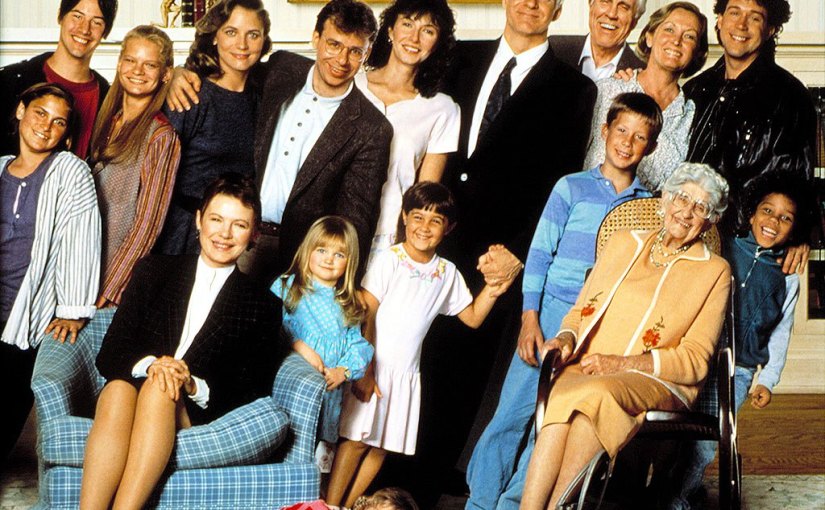
The Buckmans consist of four adult children portrayed by Steve Martin, Dianne Weist, Harley Kozak and Tom Hulce. They all got little ones to tend to with respective partners (Martin with Mary Steenburgen, Kozak with Rick Moranis and the other two are currently on the single status).  Their parents are portrayed by Jason Robards and Eileen Ryan and even the generation before them is represented by Helen Shaw.

With a cast of characters this large, there are various storylines and dynamics of raising and supporting children to go around.  Each child, or in other words, each parent has daily struggles to deal with.  The nuclear family of Steve Martin and Mary Steenburgen’s is given the most attention when it is uncovered that their eldest child of three is struggling with anxiety.  Elsewhere, Robards finds himself trying to rescue his immature, lying twenty-seven-year-old son, Hulce, from gambling addiction and debt.  Weist is doing her best to survive a sexless life after her letch of an ex-husband has left her to deal with a daughter (Martha Plimpton) pregnant and married to a stock-car racing airhead (Keanu Reeves) and a quiet, distant teenage son (Leaf, later known as Joaquin, Phoenix).  Kozak’s storyline really belongs to Rick Moranis as her genius, nerdy husband determined to raise their three-year-old daughter as a virtuoso prodigy.  Kafka is a bedtime story.

Wow, that’s a lot of baggage to unload in two hours’ time.  Yet, it works so efficiently in a film directed by Ron Howard.  I’ve used this compliment before, but it bears repeating.  You can write a full-length screenplay about any one of these characters.  I guess that is the goal you strive for when you produce a film featuring an all star cast filling the slots of a large collection of characters.  A film like Boogie Nights and Love, Actually accomplishes this feat so well.  Parenthood just the same.

Favorite moments for me occur with Jason Robards’ character.  It is evident that he was not the best father, particularly to Martin’s character, and his admiration is likely misdirected towards the kid who hasn’t made the best choices in life, played by an aloof Tom Hulce.  I really like the story arc of Robards and Hulce’s relationship when the truth rests like an ugly slime on the surface that just can’t be filtered away.  Suddenly, a man prepared for retirement and rest, has to acknowledge that his adult son needs help but is he worthy of support and love any longer?  This movie is arguably not even the highlight of Jason Robards career, but you can not deny what a gifted actor he was.  His timing and delivery are so recognizable as a hard-edged retiree parent.

Dianne Weist, the only cast member to be nominated for an Oscar for this film, has a couple of good storylines as well.  Much of her performance stems from all too common drama where a spouse leaves her and abandons any relationship he had with their children.  It’s so unfair for the child.  It’s hard on the mother who has to maintain a career while raising teenagers who are entering a new phase with regards to love and sex.  Plimpton gets into an argument with Reeves, her boyfriend, and Weist starts to swat him away.  Then Plimpton unexpectedly announces they just  got married and Weist turns to swatting Plimpton.  Weist is funny while the material holds dramatically.  It’s a real nice balance.  

Steve Martin has a good storyline as well.  He’s a hard working white collar executive who wants to prioritize attention for his son though it kills him to lose out on a promotion he knows he’s entitled to.  At the same time, he battles with how his own father (Robards) treated him at a young age.  He makes sure that his son’s birthday party is the best.  He encourages the boy to play second base on the little league team.  He attempts to do everything denied of his own childhood for his son, now.  Still, it’s not enough.  Parenthood can often feel like a winless battle. 

Martin also has good scenes with Steenburgen, and they remind me of my relationship with my wife.  She’s the sensible one.  I’m the one who gets trapped in insecurity and anxiety and low self esteem as a worker, a friend, a husband, and especially as a parent to our teenage daughter.  I excel at taking care of the bills though. 

Why am I making this personal all of the sudden?  Well, perhaps it is to call out the true nature of family and marriage that exists within the script for Parenthood, written by Babaloo Mandell, Lowell Ganz and Ron Howard.  There are some moments where Martin’s character daydreams of scenarios for his son.  One time the boy becomes a valedictorian with a speech offering complete recognition towards his father.  In another moment, he’s a rooftop sniper blaming dad for making him play second base and missing the game winning out.  When I get trapped listening to the thoughts in my head, I envision what could be.  More often than not I’m predicting dread, which almost never arrives.  Yet, I believe parents yearn to raise the perfect child that they never were.  It’s an impossible stretch.  I write that here and now, and still, I’ll try and try.  So what, though! While I’m working for perfection and absolute happiness for my daughter, I must remind myself that my efforts are contributing towards a successful path for her full of fulfillment and happiness.  More importantly, while at least half of my efforts could lead in failure on my part, my intentions are always done with absolute love and care for her.  That’s what I see in the here and now.  I’m blessed. My whole family is blessed.  So many families have it so much worse and I wish them well.  I have to remind myself not to take what I have for granted.

Ron Howard’s film is not entirely perfect.  I could have done without some of Steve Martin’s recognizable schtick from his stand-up routines.  I always like his material.  I just think some of it doesn’t belong here, the same way Robin Williams would let his known antics creep into some of his films.  Some scenes are also spliced into the film jarringly, like when a dentist’s office is suddenly vandalized.  Thematically, these break away moments should have remained on the editing floor.  Fortunately, the movie isn’t anchored by these plot points for too long.

There’s much to relate to with Parenthood.  Kids who gleefully sing about diarrhea, to parents mired in regret and doubt.  Teenagers who think they have found love to the absence of father figures.  Grown-ups who just haven’t grown up and parents who are just getting a little too ambitious in their child’s upbringing.  This is not a film, necessarily about the love a parent has for a son or daughter.  Rather, I appreciate how it questions the role these characters serve towards their fathers, mothers and children. 

Love is only one dynamic in fatherhood, motherhood, and childhood.  Parenthood focuses on everything else.

her

By Marc S. Sanders

Director/Screenwriter Spike Jones is a master at adding multiple dimensions to what we always know exists. It’s been evident in his prior films, Adaptation, Where The Wild Things Are, (which I did not care for personally), and most especially in Being John Malkovich. He plants the seeds of fantasy in what we can normally touch, hear and see. Then his elements of fantasy receive a supportive crutch from what his viewers have always been familiar with.

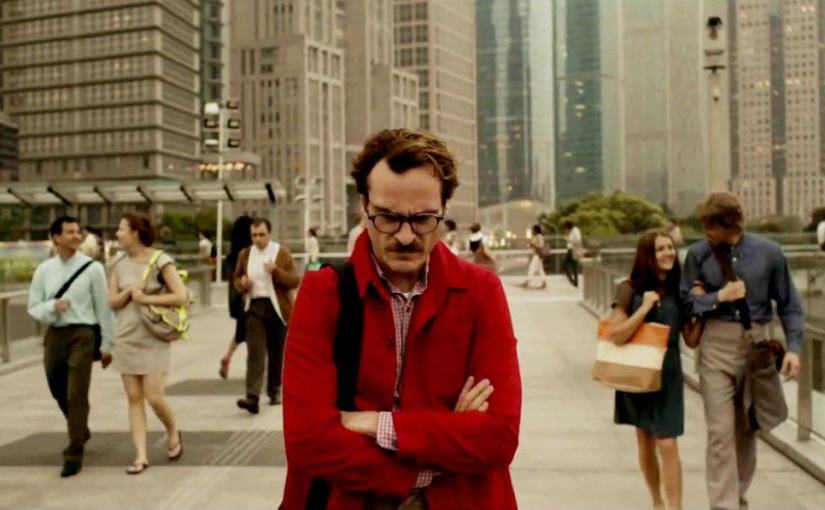
her is another masterwork; a film that takes place in the not too distant future that expounds on our current digital age. If we can already talk to “Siri” or “Alexa” and trick–umm, excuse me, “her” (I mean “Siri”) into making sophomoric dirty jokes, then of course we are bound to approach the stage where we can literally, truly fall in love with her and then she can reciprocate.

With her raspy yet silky vocals, Scarlett Johansson is inspired casting as the voice of “Samantha.” Had she actually had a physical presence in the film I would have totally fallen for her affections. The film hinges on the performance of Joaquin Phoenix as Theodore. If we can’t believe that he loves “Samantha” more than he loves himself (a surefire test of true love as far I’m concerned) then “her” falls apart. Phoenix passes abundantly. He deserved his Oscar nomination.

From the start, you become very accustomed to the banter between Theodore and his electronic device voiced by “Samantha.” Both have personal feelings. Both have personal longings (more especially “Samantha” the computer, of all things!!!).

Spike Jonze explores all the diameters and dimensions of a loving relationship. The ups, downs, and in betweens. What’s different is how all of these layers of a relationship are received in this currently fictional (bound to come true, one day) dynamic of a relationship. Theodore and “Samantha” are affectionate. They argue, they laugh, they even make love. Watch the movie to understand that last point. It happens, and it is perfectly executed with the residual effects of their lovemaking bringing the film into its next act brilliantly.

Jones won the Oscar for original screenplay simply for how innovative this picture is. I’m not sure it’s the most exciting two hours of film, however. Personally, I think other films in this category back in 2013 had sharper and more interesting scripts. her is practically all talk and when it ended, I was ready for it to be over, and it concluded as I expected.

Still, Jones is fortunate that his cast (Johannsson, Phoenix, Amy Adams and Rooney Mara and Chris Pratt) trusts him. If they hadn’t, this movie would have lost its magic by probably how absurd this script must have originally been perceived on paper. Well done work by all involved but credit has to begin with Jones, the screenwriter.

JOKER (2019)

by Miguel E. Rodriguez

Director: Todd Phillips
Cast: Joaquin Phoenix, Robert De Niro, Zazie Beets
My Rating: 10/10
Rotten Tomatometer: 68%

PLOT: In early-‘80s Gotham City, mentally-troubled comedian Arthur Fleck, disregarded and mistreated by society, embarks on a bloody downward spiral of crime and social revolution.


Most comic book movies, by default, require at least a little pre-existing knowledge of the universe inhabited by these characters, in order for the stories to make sense.  There are precious few exceptions.  Batman Begins (2005) is one.  Superman (1978) is another.  And now we have Joker, an origin story like no other, presented to the viewer as if no previous Batman movies existed, as if the Joker was a creature as new and original as Hannibal Lecter was nearly thirty years ago.  (Or, dare I say, Travis Bickle, over FORTY years ago…)

It’s incredible, if not impossible, to believe this film was directed by a man (Todd Phillips) whose most famous movies to date have been the Hangover trilogy and Old School.  There is nothing in this gritty psycho-drama that bears any resemblance to anything Phillips has directed before.

And I haven’t even mentioned Joaquin Phoenix’s performance yet.  More on that later.

The story: Arthur Fleck (Phoenix) is an everyman, your average nobody, living in Gotham City in the early ‘80s, a time of garbage strikes, graffiti-riddled subways, and a porno theater on every downtown corner.  He lives with his invalid mother and pays the bills as a clown-for-hire, doing everything from entertaining bedridden children to sandwich-boarding on the street.  His real dream is to be a stand-up comedian and appear on a late-night talk show hosted by Murray Franklin (Robert De Niro), whom he idolizes like a long-lost father.

(The similarities of this plot point to The King of Comedy [1983] have been well-documented and need not be explored here; that would require a whole separate article.)

So far, this is really heavy material, a real downer.  But then the screenplay strikes gold.  It turns out Arthur suffers from an unsettling, but very real, affliction, although it’s never quite named in the film: Pathological Laughter or Crying (PLC). Also known as the pseudobulbar effect, it is a neurological condition defined by episodes of uncontrolled laughter or crying.  People with PLC often laugh out loud or cry for no apparent reason.

In other words, Arthur simply bursts out laughing for no reason, and often, as we’ll see, at the most inopportune or inappropriate moments.

To me, this was genius.  It gives a legitimate grounding for the Joker’s iconic laugh.  What would normally be comic-bookish or hammy in previous incarnations becomes a little sad.  I felt empathy towards this guy whenever his affliction overcame him, especially in the scene on the bus when he’s amusing a little kid by pulling goofy faces, and the kid’s mom tells him to stop bothering her child, and he starts laughing despite his obvious disappointment.  The empathy for me came when I could see through the laughter, could see Arthur’s face contorting with genuine sadness and misery even as he guffawed helplessly.  It was touching.

The real turning point of the movie comes when he is accosted by three drunken yuppies on a subway, and he starts laughing uncontrollably, and the yuppies start beating him up…but they don’t know about the gun he’s carrying for protection.

But that’s enough of the plot.  I think I’ve described only the parts of it that you might have guessed anyway from the trailers.  The sensationally well-told story, not to mention the complexity of the story itself, is only one half of the movie’s greatness.

The other half, it must be said, is Joaquin Phoenix’s performance.  The trailers don’t do it justice.  A lot of the performance has to do with his tortured facial expressions when he has a laughing fit.  There are a couple of extraordinarily long shots where Arthur SHOULD be crying, but is instead laughing, and his agony is evident.  He WANTS to cry properly, but he can’t.  I don’t know how he pulled it off, but you can see both emotions on his face at the same time.  It’s a masterstroke.

Another remarkable factor at work in his performance is his subtle nods to previous Jokers in movies, and even TV.  If you watch really carefully, you’ll notice a quick reference to Mark Hamill’s celebrated voice work as the Joker in the Batman animated series and films; Cesar Romero’s eccentric dance moves from the ‘60s television series; and Heath Ledger’s hair.  (If there’s a reference to Nicholson, I must have missed it.)  I just thought it was a brilliant touch to bring in all of those influences and incorporate them into this newest incarnation, as if to acknowledge the pop-culture roots of this character, while still breaking new ground.

Joker is the comic-book movie for people who don’t like comic-book movies (even Deadpool).  It’s The Dark Knight crossed with Se7en and Taxi Driver.  It’s utterly unlike any comic-book movie I’ve ever seen, and I doubt anyone will ever be able to make another one like it without comparing it to this one.

JOKER

By Marc S. Sanders

It’s important to understand first and foremost, Todd Phillips’ film Joker is really not a Batman story, a comic book story or even the derivative of a Batman comic book story.

Consider the Martin Scorsese pictures Taxi Driver and The King Of Comedy. Both films focus on two different characters descending into a variation of psychological madness. Yet the the titles of each film are pretty random, generic almost. Joaquin Phoenix plays wannabe comedian Arthur Fleck (to my knowledge never a DC comics character before this film) and this latest release from Warner Bros is billed as the origin of the Joker. Nevertheless, other than calling the setting Gotham City and having a billionaire character named Thomas Wayne with a son named Bruce, there is nary any calling to the mythos that fans are so familiar with. Why not just present this film with a title called “The Comedian” for example and run with it? Calling it Joker feels like a shameless cash grab. This is not a Batman villain tale, folks.

Joaquin Phoenix is astonishing in the lead role. He’s in every scene of the film and the method to own the character of Fleck is shown both physically and mentally. The known method actor must have lost at least 75 pounds to show weird, stretching contortions that easily shown his rib cage and pale complexion. Phillips films Phoenix at times where there is no dialogue either grimacing in a mirror, randomly dancing or simply leaning his head against a cold transit bus window. Surprise moments also come with head slamming against walls or glass doors. This was not all direction by Phillips. Phoenix had to have invented some of these instances.

Robert DeNiro is an obvious nod in casting as a Merv Griffin/Johnny Carson role meant to salute the Scorsese films of his heyday. When he was the man bordering on insanity, DeNiro performed with method material. Think back to when he’s Jake LaMotta in Raging Bull bashing his head against a wall while in solitary confinement.

While Joker certainly offers probably the best performance of the year in any category, it’s not a pleasant film to watch. It lacks any sense of wryness or humor. It’s a very depressing film about a man’s inevitable descent into madness. I couldn’t take my eyes off of Phoenix in the role, but like other comic book based films it didn’t leave me wanting more. I’m not eager for a continuation of this character.

If they wanted to a popular comic character story then I wish there could have been some more slight nods to the ingredients of this pop culture legacy. Couldn’t Arthur Fleck have been mugged by Oswald Cobblepot or sidled up alongside Mr. Zzazzz? How about a quick encounter with Selina Kyle or Edward Nygma? There’s just not enough evidence here for me to accept this is a Batman tale. Again Warner Bros banked on the title and not much else.

I got my money’s worth from Phoenix and I’m gunning for him to win the Oscar (not just nominated), but I can’t help but feel a little let down as well.