INDIANA JONES AND THE KINGDOM OF THE CRYSTAL SKULL

By Marc S. Sanders

Indiana Jones And The Kingdom Of The Crystal Skull succeeds on so many levels of storytelling and construction. It stays true to form of its title character protagonist. Indy is not only a hero. He’s also a traveler of history. The film takes place in the year 1957, and director Steven Spielberg delivers visuals that reiterate the time, when the Cold War was on the horizon, and Nazi Germany was behind us. It’s time for the Russians to step up as the big bad.

David Koepp’s script really is quite brilliant as it never loses sight of the times with references to McCarthyism, communist red scare, and flying saucers and aliens directly inspired by the B movie serials of the decade. Even Shia LeBeouf portraying a sidekick to Indy is a model of Marlon Brando from The Wild One.

I’ve mentioned before how simply the silhouette of the famed archeologist with his fedora hat and bullwhip is as recognizable as Batman or Darth Vader or James Bond. Here, Spielberg uses the visual motif against a mushroom cloud of a nuclear bomb test site, and later against a flying saucer. As noted earlier, Dr. Jones moves with time; truly living up to his famous phrase, “It’s not the years honey. It’s the mileage.”

Harrison Ford maintains the character quite well, still skeptical of what is not literal. He’s not prepared to believe in higher powers until he sees it for himself. Ford conveys Koepp’s interpretation very well.

It’s refreshing that he is paired up again with Karen Allen as Marion Ravenwood (from Raiders), the best of Indy’s female companions. Their sparring remains natural. Allen folds back into her role quite comfortably.

Stalin’s top underling is dispatched with recovering a legendary Crystal Skull and revealing it’s true power. Master character actor Cate Blanchett makes for a great Russian bob haircut villain, with uniform physique. She’s smart but she’s got every fighting skill known to pose great threat.

An infamous scene involves Indy sheltering himself in a refrigerator to survive a nuclear blast. Majority despise this scene. The phrase “Nuke The Fridge” became almost as iconic as “Jump The Shark,” simply for the audacity of its imagination. After having witnessed the near-death escapes of his past adventures (parachuting from a plane in an inflatable raft, sliding under a speeding truck, becoming “a penitent man” to cross a cavern), what is so wrong with this moment? Heck, Spielberg knows it’s crazy which is why he offers a close up indicating the fridge is “lead lined.” The scene works because it holds true to Indiana Jones’ series of absurd survival.

Besides all of the periodic references, the set design of Kingdom… is spectacular. Looking at the final act of the film, we are treated to a column that opens itself up with ingenuity as sand must pour out of the column in order for the structure to open with a receding downward staircase. Then, there’s a beautiful open sesame moment before entering a circular throne room.

Another earlier moment stages a hidden chamber that is revealed on a large, stone, tilted disc. All of this collectively speaking is truly one of the best set pieces in all four of the Indy films.

A delightfully fun car/motorcycle chase on Indy’s college campus is great as well as there is jumping from bike to car and back to on to the bike before swerving into the library. The scenic background design has to be admired for showing protest signs to Communism on campus. The film never loses sight of where its story is set. Detractors of this film fail to recognize any of this.

Fans also took issue with LeBeouf. Not me. He’s got an adventurous fun side to him. The smart aleck way of Ford’s younger years, but not the same character background. He has fun with swinging from vines and sword fights, in the same vein of a mine car chase from a prior installment.

The story is moved by clues and maps and deciphering a welcome John Hurt who speaks in a gibberish of riddles that stem from a brainwash his character experiences. This is all good for a great pursuit. Nothing is easily revealed. Mayan writing needs to be interpreted; maps need to be read. Stories of legend need to be told. Indy needs to apply his professional knowledge to move forward through the Amazon to his final destination.

I’d argue that Indiana Jones And The Kingdom Of The Crystal Skull is one of the most misunderstood and divisive films of all time. People gave up on it too easily, I think. They reserved their approval because of either a ridiculous title (a great B movie title), or LeBeouf’s casting, or Ford’s age, or vine swinging and big ass red ants (a great monster horror scene by the way). I say those folks just didn’t get it and failed to recognize where all of this stemmed from. David Koepp, George Lucas and Steven Spielberg were very aware of what to present. If I were them, I wouldn’t have changed a thing.

Again, it’s not the years. It’s the mileage.

CLOUD ATLAS (2012)

by Miguel E. Rodriguez

Directors: Lana Wachowski, Lilly Wachowski, Tom Tykwer
Cast: Tom Hanks, Halle Berry, Jim Broadbent, Hugo Weaving, Jim Sturgess, Doona Bae, Ben Whishaw, Keith David, Susan Sarandon, Hugh Grant
My Rating: 10/10
Rotten Tomatometer: 66%

PLOT: An exploration of how individual lives impact one another in the past, present, and future, as one soul is shaped from a killer into a hero, and an act of kindness ripples across centuries to inspire a revolution.


Okay, faithful readers, I hope you’re comfortable.

Cloud Atlas is one of those movies like Baraka that leaves me with the urgent need to tell people how amazing it is.  It’s visually spectacular, thought-provoking, and hopelessly optimistic about love and the good side of human nature, even in the face of the worst humanity has to offer.

Based on a critically acclaimed novel by David Mitchell, the movie tells six separate stories, linked by the fact that a core group of actors plays all the principal roles in each story, and by the fact that at least one actor in each story carries a curious birthmark shaped a bit like a comet or a shooting star.  Each story is separated from the others by decades or centuries, taking place in the years 1849, 1936, 1973, 2012, 2144, and an apparently post-apocalyptic 2321.

I cannot imagine the lengths to which the filmmakers, and the film editor in particular, went to make this movie work.  The film jumps freely from one story to another, forward, back, forward, and back again, somehow maintaining a clean flow and keeping each storyline absolutely clear.  Although the stories are unique, the editing keeps the idea of connection alive for nearly three hours.  Just based on the editing alone, that makes Cloud Atlas kind of exhilarating to watch, especially when things heat up in the 2144 segment.

Let me see if I can quickly summarize each story, without giving too much away:

  • 1849 – An American lawyer visits property holdings overseas and witnesses the brutal whipping of a slave, who stows away on the lawyer’s ship returning to San Francisco; meanwhile, an unscrupulous doctor has plans to steal the lawyer’s gold en route.
  • 1936 – A struggling composer, Robert Frobisher, is hired as an amanuensis (a fancy word for a music stenographer) to another aging composer, which allows Frobisher to compose his own masterpiece, The Cloud Atlas Sextet. The aging composer demands credit for the piece and threatens to expose Frobisher’s bisexuality, including his deep, unconditional love for a gentleman named Rufus Sixsmith.
  • 1973 – An investigative reporter stumbles onto a conspiracy at a nuclear power plant, thanks to a whistle-blowing report written by none other than Rufus Sixsmith, now in his sixties.
  • 2012 – An author on the run from hooligan creditors takes refuge in what he thinks is a hotel, but is in fact a nursing home, to which he has inadvertently committed himself.  He and three other residents plan a daring jailbreak.
  • 2144 – Set in a vastly futuristic New Seoul, a renegade “fabricant” is brought in for questioning by the ruling government known as Unanimity.  The fabricant, known only as Sonmi-451, spins a tale of oppression, liberation, and horrific realization as she becomes the voice of a revolution that will ripple across centuries.
  • 2321 – In a post-apocalyptic Hawaii, peaceful Valleysmen live in constant fear of attacks from vicious cannibals, the Kona tribe.  They also receive periodic visits from Prescients, a highly advanced society that apparently lives offshore.  One day, a Prescient, Meronym, asks a Valleysmen leader to guide her to a remote mountain peak where she hopes to send an SOS signal to off-world colonies.

Confused yet?  Don’t be.  The editing keeps everything crystal clear.

But that’s just the clinical description of the movie.  What catapults Cloud Atlas into the stratosphere is how the fancy editing and visual effects occasionally take a back seat to a really deep philosophical question that leaves me with a sense of awe.  It’s really a what-if question, one of the greatest what-if questions of human existence.

What if…death isn’t the end?

I know that countless other movies have asked this question. We all have our own answers and beliefs.  I am not suggesting that Cloud Atlas has somehow figured out THE answer to this question, or that the answer it provides somehow trumps your own beliefs. But of all the movies I’ve seen on this topic, Cloud Atlas is the only one that really, genuinely, truly left me in awe of the possibilities it proposes.

I mentioned earlier that key roles are played by the same actors over and over again in each of the stories.  While that was initially distracting, I realized that the filmmakers were actually making a genius move.  It was nothing more than a simple way of illustrating the concept that a life in one era is echoed in another, decades or centuries later.  Heavy makeup is used to indicate how one person’s life as an Asian woman could, in theory, be echoed in the life of a Mexican woman in another era.  Or perhaps the life of a British man might be echoed later as a British woman.

And then there’s the question of that recurring birthmark.  One key character from each storyline bears a birthmark that resembles a shooting star.  So many people (including me the first time around) wanted to attach some kind of conventional story-based meaning to that birthmark.  Did it mean these characters were all somehow blood-related?  Was it a prophecy of some kind?  Something mentioned in the book, perhaps, that had to be left out of the film for pacing reasons, or some such thing?  No.  It’s just another visual reinforcement of the idea of recurrence, or reincarnation.

And that’s where I get awestruck by the movie.  Reincarnation is not a new concept in films, but Cloud Atlas really got under my skin.  Imagine.  What if…the person you love, your soulmate, the one you’ll love until the day of your death…what if, centuries hence, you’ll meet each other again?  Maybe you’ve walked down the street, or been eating in a restaurant, and for a fleeting second you lock eyes with a total stranger across the room, and you think, “I KNOW that person,” but the moment passes and life goes on.  What if that happened because you have met in some past life?

Or maybe you go on a date, and it goes phenomenally well, as if you’ve known each other for ages?  Well…maybe you have.  It’s your destiny to meet and love this person because you’ve already done it before.

I know I’m getting a little woo-woo/touchy-feely here.  It’s not a new idea.  It’s just that Cloud Atlas presents the idea so well that my breath gets taken away when I think about its implications.

I just have to bring up the stunning visuals again.  There’s a scene where the composer, Frobisher, is writing to his lover, Rufus Sixsmith, and there’s a passage where, in his mind, he meets Sixsmith in a china shop.  In a wonderfully poetic moment, they start smashing the china in slow motion as Frobisher’s composition plays in the background.  Then, just as the music reaches a crescendo, the two of them stop in place, and hundreds of china vases and plates rain down from the ceiling in slow motion, hanging in space, descending slowly to the ground like gigantic snowflakes.

I’m at a loss.  I’ve come to the end of whatever I can discuss about this movie without repeating myself endlessly.  I want to reiterate that I don’t believe this movie has THE answer to what lies beyond death.  But it has a truly lovely hypothesis, one that leaves me awestruck with its implications.

So let me just end with a line from the movie that makes my heart swell every time I hear it.

“I believe there is another world waiting for us, Sixsmith. A better world…and I’ll be waiting for you there. I believe we do not stay dead long. Find me beneath the Corsican stars, where we first kissed.”

THE CHRONICLES OF NARNIA: THE LION, THE WITCH AND THE WARDROBE (2005)

By Miguel E. Rodriguez

Director: Andrew Adamson
Cast: Tilda Swinton, James McAvoy, Jim Broadbent, Liam Neeson
My Rating: 8/10
Rotten Tomatometer: 76% Certified Fresh

PLOT: In London, during the German blitzkrieg, four children travel through a wardrobe and discover the fantastic land of Narnia.


In the ranks of books aching for cinematic adaptations, C.S. Lewis’ classic fantasy riff on Christian symbolism surely must have been at the top of Hollywood’s list for years.  With the raging success of Peter Jackson’s Lord of the Rings and the Harry Potter films, someone must have decided it was finally time to get this on movie screens.

The only problem is, TCON: TLTWATW [it’s a mouthful] will inevitably be compared to those other immensely successful franchises.  As a result, while the movie itself succeeds admirably, I find myself thinking, “Yeah…but it doesn’t QUITE pack that Return of the King punch.”

But film appreciation/criticism/whatever is not about how a movie performs in comparison with other films.  It’s about how the movie tells its own story in its own way.  So.

This first installment in the Narnia franchise is a good old-fashioned, rollicking fantasy yarn.  Elements of the film will remind people of everything from Star Wars to Spartacus, in all the good ways.  There is, perhaps, a tendency to believe this movie is only for children, particularly due to the talking animals and the fact that the main characters are children.  (There’s also the unexplained appearance of no less than Father Christmas himself.)  But I disagree.  I think the story has a lot to offer to both kids and adults.

Take, for example, the overt Christian overtones of the story.  [SPOILER, SPOILER, SPOILER, SPOILER ALERT!!!]

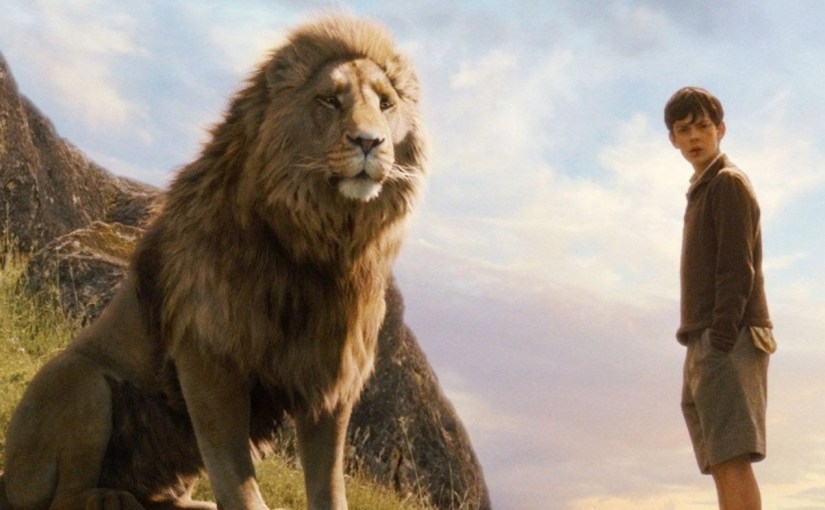
Aslan, the lion king of Narnia, sacrifices his life to redeem the life of Edmond, one of the Pevensie children who briefly turned traitor.  The White Witch murders Aslan in an unexpectedly creepy ritual featuring orcs, minotaurs, and what appear to be some kind of vampire hybrids.  But, because of the “old magic”, Aslan returns to life.  There hasn’t been a Jesus story this obvious since E.T.…or maybe The Matrix.

This might make some folks believe the whole film is some kind of Christian propaganda, but it’s not.  To me, it’s a way of simply re-framing an ancient story in a way that brings that story to life for modern audiences.  Robert Zemeckis tried the same thing with Beowulf, of which I can only say, hey, better luck next time.  George Lucas did it with Star Wars, Cecil B. DeMille did it with The Ten Commandments, and so on and so on.

If I’m going to be picky, I give it an “8” instead of a higher score because of the “deus ex machina” nature of the finale, which can hardly be surprising due to the Biblical influence of the story.  It feels a little too convenient.  And I thought the battle scenes, while entertaining, were a little too bloodless…but what are you gonna do, they needed to keep it PG, this is a Disney film, for gosh sakes.

TOPSY-TURVY

By Marc S. Sanders

For those that are unaware, I dabble in community theatre. I perform on stage. I direct. I produce. Occasionally, I write plays. So while watching Mike Leigh’s film Topsy-Turvy, I could not help but ask where have I heard some of these conversations before.

As Leigh’s film focuses on the making of the Japanese inspired opera The Mikado from Gilbert & Sullivan, I felt assured that the backstage tendencies of actors, composers, directors and producers has always been the same. They have egos. They are diva like. They are perfectionists, and the best ones of all catagories rehearse over and over and over again until it feels and sounds just right.

Gilbert (Jim Broadbent) is the writer. Sullivan (Allan Corduner) is the composer. Early in the film, Sullivan seeks to break away from the more playful stage escapades of Pirates Of Penzance material. He wants to do more human interest material that don’t just rely on whimsy and “magic potions” or elixirs. Gilbert finds nothing wrong with continuing on the same tract. Audiences seem to respond to it and it comes naturally to him. When the pair are recruited by a producer to write a new production for the Savoy Theatre in London, they find themselves at odds in their artistic goals.

Only after Gilbert attends an expedition featuring Japanese culture does the idea arrive for the opera to be famously known as The Mikado. Sullivan finds himself inspired as well. After all, the English are not so familiar with Japanese lifestyle. Who says films and theatre can’t teach you anything?

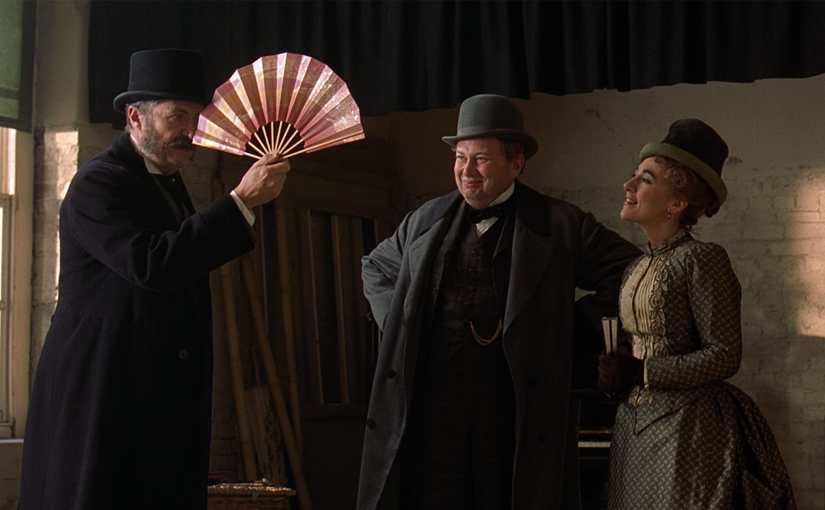
From there, Topsy-Turvy presents backstage scenes of rehearsals where there is stop and start readings from the script. Personally, I could not understand why none of the actors wrote their own blocking down, but I digress. The scene with Broadbent as Gilbert directing a portion of his cast by perfecting enunciations and staging is a joy to watch, and a lesson in the efforts to stage a perfect showpiece. It also amuses me how they dress for a backstage rehearsal. The men in their finest day wear suits with top hats. The actress in her well tailored silk gown. Somehow, theatre has diminished itself to my superhero t-shirts and shorts for a seven o’clock call on a Tuesday night.

There are costume fittings. Makeup on the Anglo Saxon performers to make them appear Asian is a constant humorous sidebar.

Dressing room banter is also on display. I love the back and forth ego trips between the lead actor, a fabulously snobbish diva played by Timothy Spall cast as the production’s Mikado, and another cast member played by Vincent Franklin. These actors are not shy about their self regarded importance to Gilbert & Sullivan’s reputable accomplishments. They are even nervy enough to question if the writer/composer still have the knack…but only discuss this backstage when no one is listening. Later, you see how an actor’s insecurity shows when Gilbert considers cutting one of the Mikado’s most popular numbers. Spall’s expressions of hurt say so much.

Another great scene is realizing that another actor questions his costume. Heaven forbid but he cannot perform on stage without an undergarment corset. It’s unheard of.

Mike Leigh’s film was one I was never familiar with. I didn’t know anything about it until Miguel introduced it to me. Technically, it’s spectacular, offering outstanding period set designs and costumes from the the early 1900s before turmoils of war and conflict invaded Europe.

The film runs a little long as it takes just a little bit of effort to get accustomed to period setting and high brow dialogue. On a second viewing I imagine it’ll leave you with a pleasing grin as you’ll feel more in on the jokes and attuned to the nature of operatic theatre. Topsy-Turvy is a well researched and a terrific examination of life in theatre. It explores the disagreements and struggles to stay relevant as a writer, composer or actor. Most importantly, it demonstrates that live theatre is never considered a hit until its one true test; the test of performing in front of a live audience.