CIVIL WAR

By Marc S. Sanders

On the drive home, my wife and I left saying that we could not recall this country existing on a such a divisive plane within our lifetimes as it is currently.  Maybe we were not paying enough attention as we were growing up.  With that in mind however, it’s not unreasonable to see a possible future coming to life from Alex Garland’s Civil War.  What’s clear is the vitriol displayed in Garland’s film is not surprising.

Civil War is an observational piece as it is told through eyes of photojournalists who function with no stake in the conflict.  Lee (Kirsten Dunst) has become a legendary war photographer.  Along with Joel (Wagner Moura), who’s a reporter, they intend to journey through the Northeastern battlegrounds from New York City to Washington D.C.  As they believe, the seceded states of California and Texas are close to overthrowing the government, they are determined to interview and photograph the President (Nick Offerman) before he’s taken prisoner or more likely, assassinated.  An old-time New York Times journalist named Sammy (Stephen McKinley Henderson) and Jessie (Cailee Spaney), a young photographer who idolizes Lee, tag along.  To do this trip is a crazy undertaking, but Lee and Joel know what importance their purpose serves and the fact that they have press passes should uphold their survival amidst violence and chaos. 

My wife asked which side does writer/director Alex Garland lean towards politically and I said I do not know as he’s primarily known for science fiction movies (Ex Machina, Annihilation).  Garland likely wants his political leanings to remain unknown as it upholds what Civil War deliberately steers its focus away from.  We never learn what policies each side of this war stands for or what instigated it.  In fact, it is quite intentional of Garland to make what are arguably the bluest and reddest states in the United States the united seceders who lead one side of this bloody chess board. 

This fictionalized war is well established when the picture opens.  The President attempts to deliver a speech that is clearly uncertain despite the staple resilient vocabulary he includes.  Nevertheless, buildings on fire randomly appear, looters are bloodied pulps who are strung up by random factions, downed helicopters are the carnage occupying a parking lot in front of a JC Penney.  Nothing that anyone says, much less the President of the United States are going to sway this country into a state of comfort.  That time has passed.

The production value of Civil War is astonishing.  Sometimes it looks just like photographic accounts of what we see on the evening news coverage from the Middle East.  Garland also never forgets that his main characters are photographers as he captures in freeze frame people being randomly shot or beaten or simply screaming at one another.  The film abruptly turns off the sound and a black and white photograph interrupts the chaos for you to catch a freeze frame glimpse.  The editing lends to the character designs of the story’s four main players.  I did question, however, why video footage was not also taken beyond just photographs.  Cell phones are not used or mentioned in this picture.  The inconvenience of Wi Fi on a laptop is however. 

The sound design of the film is spectacular and reminiscent of how powerful it served in the Oscar winning film The Zone Of Interest.  As the characters set up camp for the night, rapid pop pop pops are heard in the distance.  On multiple occasions, Garland gets you right in the middle of the various firefights that occur in and around office buildings or what were once shopping districts.  The machine gun fire and rubble blasts are all around you.  The cinematography is also quite eye opening.  I like to think of areas like Virginia and the Carolinas as beautiful American spots during the summertime, and that is when these events unfold. Yet, to see how ugly it is amidst endless debris and bloodshed is an awful, still convincing effect.

My Cinemaniac pal Thomas made a good point about Garland’s approach.  Out of nowhere a needle drop of songs will intrude on the picture and often I found them to be overly distracting and definitely unnecessary.  One such number is a hip hop tune with samples from an 80s tune (I can’t remember which one now) that plays over a gunfire scene.  Regrettably, it takes me a little out of the picture.  Thomas is entirely correct in this area. This technique is not effective as when Oliver Stone or Francis Ford Coppola included The Doors in their set pieces. 

Kirsten Dunst is quite good in her role.  Lee knows where to point her camera, and Dunst lives up to the legendary status that her character is supposed to have.  You can feel the exhaustion that teeters on her mental stability, especially as the story reaches its third act.  Lee has been doing this for far too long and the horrors are a part of her now.  Her trauma can never be erased or covered.  Cailey Spaeny is the standout performer though as Jessie, the young girl who is eager to reach the levels of her idol.  Lee wishes Jessie would just not tag along.  Alex Garland writes good characters, but they are not what stayed with me following the conclusion of the film.  What upholds Civil War is the depiction of this all too convincing reality. 

I write this article the morning after Iran delivered missiles and drones in the direction of Israel and with every article I’ve read, I ask myself again and again what is the purpose.  These efforts are not done for strategic overthrow.  Rather, actions are executed with hate and revenge and the only ones who are paying for it are those that are not arguing; those that are just trying to raise families and live in peace.  Alex Garland might know what finally began his fictionalized American civil war, but none of that matters any longer.  It’s what the pawns do to one another in place to place to place.

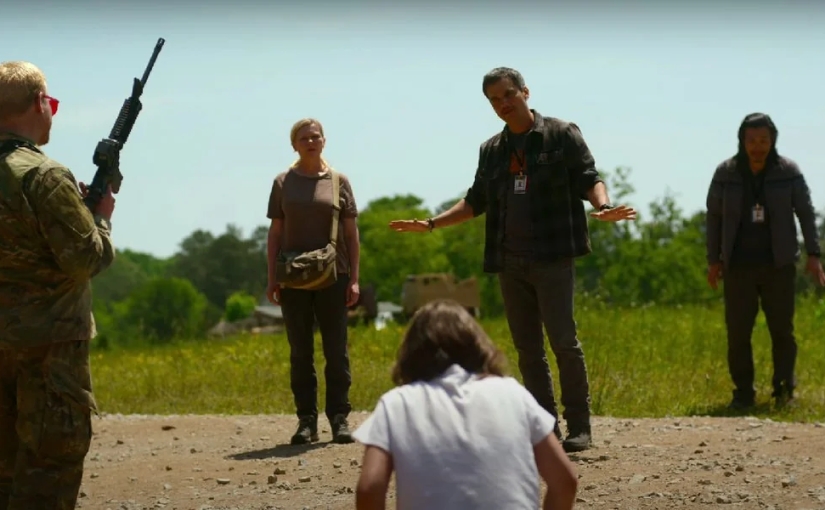
The fighters and individuals you meet in his film all move with their own ulterior motive.  A chilling scene includes Jesse Plemons (Dunst’s real-life husband) dressed in camouflage fatigues who does not even have a statement or a cause to deliver.  His minimal dialogue is nowhere near as expressive as the vast graveyard of Americans he’s sprinkling with lye and burying. When the press team comes upon him, nothing they say matters or motivates him to lower his machine gun.

Fighting, fighting, fighting.  That’s all you see in Civil War.  You don’t even know the position that the President holds, or even what his name is.  You never learn what party he represents either.  I salute Alex Garland for not leaning one way or another.  It is the divide that is tearing our country, our world, apart and not what we stand for. 

Sadly, some commentators on social media have already devised in their own minds that Civil War is a “woke film” (whatever the fuck that means) simply because of the pink (HOT PINK!!!!!) sunglasses that Plemons’ sadistic character wears.  Reader do not listen to the voices in your head.  There is no political agenda to this film.  Rather, Civil War shows us what occurs when political agendas have been entirely deafened by gunfire.

BLACK MASS

By Marc S. Sanders

Black Mass tells the story of an FBI agent, and his two childhood friends who are brothers.  One brother is Billy Bulger, a Massachusetts state senator.  The other is notorious Boston gangster James “Whitey” Bulger.  The script has a lot of elements to make for a great crime drama, but I wonder what Johnny Depp is doing here made up to perform like a crazed ghoul.

The FBI agent is John Connolly (Joel Edgerton) who turns to Whitey (Depp), a fearful leader of the Irish mob in South Boston during the nineteen seventies through eighties to work as an informant, providing intel on the competing Italian Mafia.  It’s no secret about Whitey Bulger’s dealings or what territory he covers.  Agent Connolly does his best to protect his friend, so long as he collects pertinent information that leads to arrests.  However, what’s the limit to Bulger’s activities, and how does this reflect on a public figure like Whitey’s politician brother, Billy (Benedict Cumberbatch)?

Much of Black Mass reenacts recorded testimonies after everything has shaken out.  Guys who survived Whitey’s violent crew (Jesse Plemmons, Rory Cochrane) offer information on the gangster’s activities and what he compelled his captains to carry out.  Mixed in with these voiceovers are how Connolly responds to the progress of his operations.  Time and again, his superiors (first played by Kevin Bacon and later by Corey Stoll) question Connolly about how beneficial Bulger can be if the crook always has his finger on the trigger, killing those that might rat him out.  Black Mass is told from an assortment of different perspectives and sometimes that muddies the water.

The most interesting storyline is how Connolly uses and protects his criminal friend, while also stepping away from getting blood on his hands.  Joel Edgerton gives the best performance of the film as an FBI guy who turns a blind eye to Whitey’s crimes. Connolly thinks he can continue his own corruption while Whitey cooperates and leads him to big, heroic indictments of the Italian mob.  As long as the arrangement upholds, the corrupt agent will always have an answer for his actions and stay ahead of the ethical lines he knows he’s crossing.  More importantly, even if his wife protests, Connolly is getting prestigious promotions and collecting substantial paychecks for his progress.  Scott Cooper directs Edgerton with conflicts of overwhelming complications.

One problem is that Whitey Bulger is a loose cannon who is never intimidated, not even by the Feds, especially not by his childhood friend.  His brother Billy looks away to maintain a clean political image.  Therefore, it is quite easy for Whitey to gun down a rat associate in broad daylight in the middle of a wide-open parking lot, shotgun and all.  The killer doesn’t even need to run away from the scene of the crime.  This is Whitey Bulger.

Johnny Depp is great in the role, but does his portrayal belong in this film?  Depp’s career is widely celebrated for the quirky, makeup clad parts he plays such as Jack Sparrow and Edward Scissorhands.  Even Ed Wood is delightfully weird.  In Black Mass, the actor dons steel grey eye contacts, white slicked back hair making him appear almost bald, and skeletal teeth beneath a near albino complexion.  He looks like Skeletor without the hood.  Throw in a brooding, deep Bostonian accent and you have the ghoul I referred to earlier.  Is this Whitey Bulger?  Online photos of the real guy do not seem consistent with the film’s appearance.  Depp’s delivery of dialogue and even his wicked Freddy Krueger laugh seem too far beyond the realm of this crime drama.  The actor is working on another plane than everyone else in the cast who wear hairpieces, three-piece cotton suits and cheesy off-the-rack polyesters and denims to populate this time period from forty years ago. 

A scene showing Bulger dining on steaks with Connolly and his FBI partner (David Harbor) was famously used in preview showings ahead of the film’s release.  Take this scene out of context like the trailer did and Depp looks scary good as he terrifies Harbor for doing something as simple as revealing a long-time secret family recipe.  Afterwards, Whitey goes upstairs to harass Connolly’s wife (Julianne Nicholson) at the bedroom door.  The dinner scene sold me on getting a ticket for the movie as soon as it was released.  However, put it back into the framework of the script and I feel like Black Mass is diverting itself from a complex crime drama to a vampire in a Member’s Only jacket.  As good as Depp is with his makeup and his vocal inflections and pace, it just doesn’t seem to belong in this particular film.  Marlon Brando as Don Corleone with the shoe polish in the hair and the cotton in the mouth? That works.  Johnny Depp as Count Dracula in Sergio Valente skinny jeans is not as effective.

Because the script changes hands from one perspective to another and then another, I found the reenactments of Connolly and Bulger’s reign of crimes to be a little inconsistent.  I found much potential for Benedict Cumberbatch’s purpose as Whitey’s brother, but there is too much diverted away from that character because the picture is trafficked with what everyone else is doing and seeing on top of giving Johnny Depp a lot of scenery to chew.

Black Mass pursued the potential for a very interesting gangster picture like Goodfellas or Donnie Brasco, but it wants to capitalize too much on the latest Johnny Depp routine.  I think James “Whitey” Bulger is an interesting twentieth century bad guy with a violently daring and checkered background.  He had associates within his family and gang to color in a movie that’ll grab you.  The tainted lawmen who were involved are also intriguing.  Scott Cooper and the screenwriters knew this, but often they opt to go in different directions.  

Now that a loose interpretation of Bulger has been played by Jack Nicholson in Martin Scorsese’s Oscar winning The Departed and again here, it’s time to tell the cold-blooded killer’s story once more.  Just go simpler without all the clownish theatrics.

KILLERS OF THE FLOWER MOON

By Marc S. Sanders

Killers Of The Flower Moon reflects on a period in Oklahoma history that I imagine has hardly been told.  In the early 1920s, the Native American residents, consisting of four tribes, came into a blessing of wealth when oil was discovered on the land they occupied in Osage County.  Almost immediately, white folk from all over the country migrated to this area and built up an infrastructure of capitalism that included private practices, pool halls, movie houses, law enforcement, pharmaceuticals, and even cab drivers.  However, they didn’t want to just stop at developing the area.  They wanted to seize it and they proceeded to do so by wiping out the Native American residents.  Family lineages were all but erased as the whites married into the race and gradually found ways to kill and bring about surprising deaths that would ultimately allow them to legally inherit what was rightfully owned by the Indian people.

Director Martin Scorsese has introduced a new kind of historical education with a film that I believe will be my favorite picture of the year.  I was mesmerized by every photographic shot, closeup, edit, and musical accompaniment contained in this movie.  Everything works so well. 

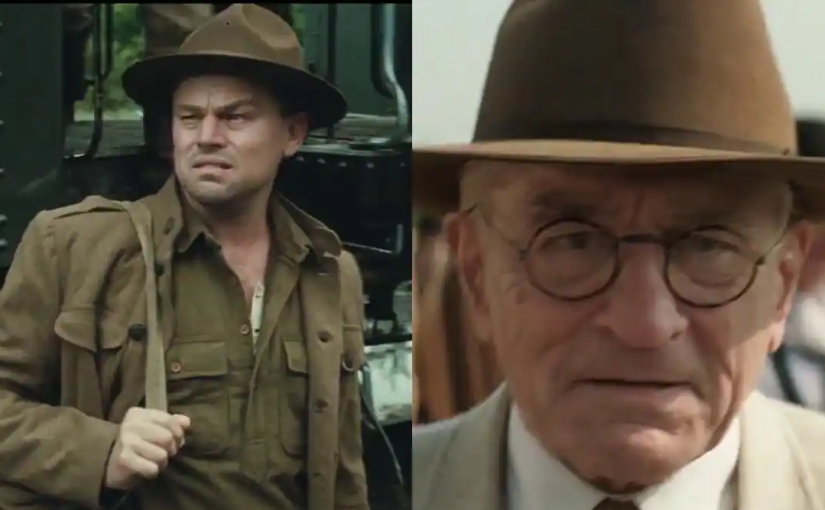
Robert De Niro reunites with the director for the tenth time; an amazing legacy of a partnership spanning fifty years.  He portrays William “King” Hale.  King is a kindly old fellow on the surface, but his intelligence shows as he strategizes how to take over more and more of this area.  He oversees a control of the white gentlemen folk, leading them into quick marriages with the young women of the tribes.  From there, they have children and over time will gradually purify the bloodline.  It’s a ruthless and scheming tactic and it successfully works thanks to how taciturn Mr. Hale is.  De Niro might win his third Oscar for this role.  This character joins that exclusive fraternity of the best villains in cinematic history, ranking up there with The Wicked Witch, Harry Lime, Norman Bates, Darth Vader, Joker, Daniel Plainview and Hannibal Lecter.

Early on in the epic film, The King’s nephew, Ernest Burkart (Leonardo DiCaprio) has returned from the war to work under his uncle.  Ernest starts as a cab driver and meets Molly (Lily Gladstone), the Native American woman he will take as a bride and establish residence together.  DiCaprio does some of his best work following a very boastful career of roles.  He’s also sure to get at least an Oscar nomination.  This is already his sixth film with Scorsese.  Ernest is not very bright, but with The King’s guidance and instruction he’ll also come to own much of this territory.

Mysterious deaths of unexpected natures occur within the tribes of Osage County, particularly in Molly’s family.  Over the course of the film, one relative after another perishes until what’s left of her bloodline is practically only herself.  The children she bears are a mix of Molly and Ernest.  Molly knows something is amiss.  She is starting not to feel well, and her suspicions speak to her.  Others in the community are also suffering peculiar deaths following doctor’s visits or evenings of drunken binging.  An investigation is warranted before it becomes too late.

Lily Gladstone will become a surprise hit at Oscar time as well.  A breakthrough role where her feared silence and bravery matches well against the deceit emanating from the King and even the poorly hidden conniving of her husband Ernest.

Scorsese builds his film with suspense and shock.  A quiet beat of instrumental music haunts certain scenes.  Who will be the next target of the King’s bidding?  The King hides behind his empathy for loss by attending funeral services and allowing the survivors to cry into his shoulder.  On another side, he instructs Ernest to carry out an assignment to some flunky to make a murder appear like a suicide.  A shot in the back of the head will not send a convincing cause and effect though, and the King and Ernest must make up for that. 

The King is everyone’s friend in Osage County, but he’s also a puppet master Grim Reaper.  With the circular rim glasses that DeNiro wears along with his peaceful beige suits, it’s a wonder that this man is an executioner using the hands of others to carry out his bidding.  He dances in the middle of town during festive gatherings.  It even amuses the Sheriff’s office when he voluntarily offers himself up following a warrant for his arrest.  At the risk of getting politically sided, DeNiro was recently interviewed during a press junket for the film.  His animosity towards President Trump is no secret.  I was in the audience at Radio City Music Hall when he led a unified roar of “Fuck Trump” during the Tony Awards.  Still, the skilled actor said he used the enmity he harbors to his advantage for this role.  In the latter half of the film, William “The King” Hale preaches in a similar approach to Trump.  There are figures in our history who just know what buttons to push and absorb massive amounts of influence while earning respect through fear. 

Killers Of The Flower Moon covers a wide berth of its period in history.  Scorsese takes an inspired approach by cutting away on occasion with black and white footage and photographs of the Native Americans coming along with their good fortune and then on to how the white “immigrants” of this area enter this land and assume a daily life within the community, whether they were welcomed or not.  All is depicted from how Osage County quickly changed following the discovery of “black gold,” to how Ernest becomes wise to the advantages of power. 

Leonardo DiCaprio has a great undertaking.  Ernest is not very bright.  He can hardly read.  He’s not subtle with his approach like his uncle.  Yet, the actor maintains an expression of no choice to abide by but what he’s been told is right.  DiCaprio does this incredible expression with long frowned lips and a fat chin that stands out from beneath his nose.  It almost seems like a barrier to finding the humanity he may have once had when he was an infantryman fighting with the allies in Europe.  It is just a haunting performance.

The third act picks up with J Edgar Hoover’s newly established Bureau of Investigation entering the story to investigate the odd happenings in Osage.  Jesse Plemons again plays that guy that you have seen somewhere before.  Often, he occupies similar kinds of roles, and still, I like what he contributes to this picture as Investigator Tom White.  Screenwriter Eric Roth lends the character simple, plainly worded questions for Plemmons to work with and it seems to come off as nothing intimidating.  Rather, the presence of Tom White on Ernest’s doorstep, with Molly mysteriously sick in the bedroom, is enough to rattle Ernest, the King, and the whole county.

It’s no secret that Killers Of The Flower Moon has a long running time at nearly three and a half hours.  However, it is necessary.  This widespread crime is not done in just minutes.  How it is gradually orchestrated needs to be seen, followed by those that uncovered how sinister it became.  Then attention needs to be given to how biased the trials of Ernest and The King had become.  Men who conspired with the King and Ernest serve on the jury.  A lot of unfair wrongs occurred during this time spanning what I believe was at least a decade and a half. 

Roth and Scorsese bring the conclusion of the film with a welcome invention.  In a time where Netflix, Dateline, 20/20 and ABC News thrive off true life crime documentaries that become so addicting, the filmmakers resort to a radio show to sum up what happened to the main players of this devastating episode in twentieth century American history with the director making a cameo to offer his final words for the main victim of the piece, Molly Burkhart.  This bookend to the film has stayed with me since I finished watching the movie, and I applaud Scorsese and Roth for their execution.  Newsmakers of today go for the most sensationalized crimes that have occurred; the ones that leave the most shock and awe and even audaciousness.  What happened in Osage County is unforgivable.  Likely a genocide of bloodlines that were unjustly ceased so that what was rightfully theirs to own could be seized.

Killers Of The Flower Moon is a drama that had to be told because the motivations that led to the series of crimes happens not only to Native Americans, but to practically any other demographic across the globe.  This is a captivating story and one of the best films Martin Scorsese has ever made.

Again, this will likely be my favorite film of the year and Oscars are deserved for DeNiro, DiCaprio, Gladstone, Roth, Scorsese and for Best Picture of the Year. 

NOTE: As I watched this movie, I could not help but think of the film August: Osage County, the motion picture adapted from Tracy Letts’ Pulitzer Prize winning play.  There is one Native American character in the film who is hired to serve the white family living on a wide expanse of land in present day 2013 (2007 for the play).  The first time I watched the movie, I could not recognize the purpose of the character.  On a second viewing, following a conversation among the dysfunctional family of characters about Native Americans, it was much clearer.  Having now watched Scorsese’s film, this picture serves as a great companion piece to watch afterwards.  I’ll be directing a stage production of this soon and much of what I learned from both films will be incorporated into my interpretation.  Even the architectural designs of the homes in both films, interior and exterior, are uniquely similar. 

Look for my review of August: Osage County (featuring Julia Roberts and Meryl Streep) on this site as well.

JUDAS AND THE BLACK MESSIAH (2021)

by Miguel E. Rodriguez

Director: Shaka King
Cast: Daniel Kaluuya, LaKeith Stanfield, Jesse Plemons, Martin Sheen
My Rating: 9/10
Rotten Tomatometer: 97% Certified Fresh

PLOT: In the late ‘60s, William O’Neal, offered a plea deal by the FBI, infiltrates the Illinois chapter of the Black Panthers to gather intelligence on party Chairman Fred Hampton.


By the time it was over, Judas and the Black Messiah made me think of that scene in Psycho (1960) where Norman is cleaning up after his mother and the car starts to sink in the swamp and then stops…and Norman gets nervous.  At that moment, I started rooting for Norman, getting in his headspace: “C’mon, car, sink.”  I was empathizing with the bad guy.  Neat trick.

That’s how I felt during Judas and the Black Messiah.  Instinctively, I know I’m supposed to be rooting for one character, but the movie empathizes with the “villain” character so well that I found myself rooting for him, too.

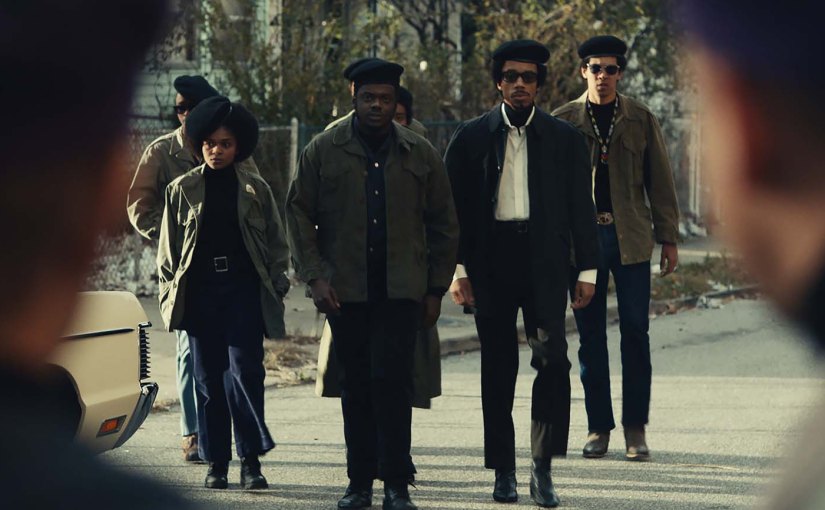
In the late 1960s, Fred Hampton’s star was on the rise in the black community.  As portrayed in a sensational performance by Daniel Kaluuya, Hampton is a fiery, charismatic, passionate public speaker who publicly advocates armed patrols of Black Panthers in black neighborhoods to keep an eye out for harassment from white cops.  When he is made Chairman of the Illinois chapter of the Black Panthers, the FBI takes an interest.  Well…Hoover takes an interest, which pretty much means the FBI followed suit regardless.

Meanwhile, a petty thief named Bill O’Neal (LaKeith Stanfield) is arrested by the FBI, who gives him a choice: serve a 5-year stretch for impersonating an FBI officer, or…go undercover into Fred Hampton’s Black Panther chapter and bring out good intel that will help them arrest Hampton.  O’Neal agrees, and what follows is an exercise in classic cinematic storytelling and misdirection, done up with glossy modern cinematography that looks like the best movie Oliver Stone never made.

(…actually, “misdirection” is not the right word.  I’m not sure what the right word is.  I’ll explain.)

Fred Hampton is clearly meant to be the hero of the film.  Hoover even refers to Hampton as a “messiah” of the black movement.  This all takes place a few years after both Dr. King and Malcolm X had been assassinated.  (If things had turned out differently, Fred Hampton’s name would be synonymous with King and Malcolm X, but it’s not, and based on this movie, that seems distinctly unfortunate and unfair.)  He boldly walks into a local meeting of white supremacists and, incredibly, turns them around to his way of thinking, using a brilliant metaphor of America as a house on fire.  If that moment is not based on fact, it should be.

So, if Hampton is the hero, then O’Neal is clearly meant to be the villain.  Hampton is the messiah of the title, so O’Neal is Judas, the traitor, the informer.  As a direct result of his intel [SPOILER ALERT], the FBI makes several arrests, including Hampton himself, and eventually initiates a raid during which Hampton is killed in his bed with his pregnant wife in the next room.  (This is all a matter of public record, though it’s interesting that it took this movie to really make me aware of it.)

But it’s easy to make a movie with a two-dimensional villain.  Judas and the Black Messiah does something much more difficult.  It asks us to empathize with both Hampton AND O’Neal.  We see the conflict in O’Neal’s face when Hampton promotes him to chief of security for their chapter.  We see O’Neal’s fear when he is recognized by a member of a local gang.  We see how few choices he really has in his various meetings with his FBI handler (Jesse Plemons), who constantly reminds him that, if he runs, they will find him and put him in jail.  Hampton says numerous times in the film that if he were to die for the cause, it would be a life well spent.  O’Neal has no such ideals.  I’d go as far to say that, if that were me in O’Neal’s shoes, I might do the same thing to stay out of jail.  I know my limits.

So, the entire film, I was pulled back and forth between admiration for Hampton and his cause and feeling anger towards O’Neal; and feeling terribly sad for O’Neal and what he’s essentially being forced to do by the FBI.  In other films depicting the Jesus story, I felt no such sympathy for the Judas character.  Director Shaka King accomplishes what so many other films do not: total alignment with one viewpoint while also demonstrating that not everything is so – forgive me – black and white.

Frankly, for me, the movie is worth watching just for the closing epilogue alone.  We get a glimpse of the real Bill O’Neal being interviewed for a real PBS documentary in 1989, and he is asked what he might tell his son about his role in the events surrounding Fred Hampton’s death.  His answer feels like something he’s rehearsed and said all his life.  And then there’s a closing subtitle…and it’s devastating.

I feel like there is more I could say, but it would involve getting into much more detail about several plot points, and I would prefer to leave them for the viewer to discover on their own.  Judas and the Black Messiah is worthy enough to stand with Spike Lee’s Malcolm X (1992), Ava DuVernay’s Selma (2014), and Steve McQueen’s 12 Years a Slave (2013) as one of the best films ever made about the black experience in America.

THE POWER OF THE DOG

By Marc S. Sanders

Don’t blame Jane Campion.  Blame me. 

The ending to The Power Of The Dog feels ambiguous, but writer and director Campion invites you to think and ponder.  It also helps that I have a good friend who shed some light on how the film actually wrapped up.  I’m grateful because I appreciated the picture even more.  Ironically, my friend didn’t care for the movie.

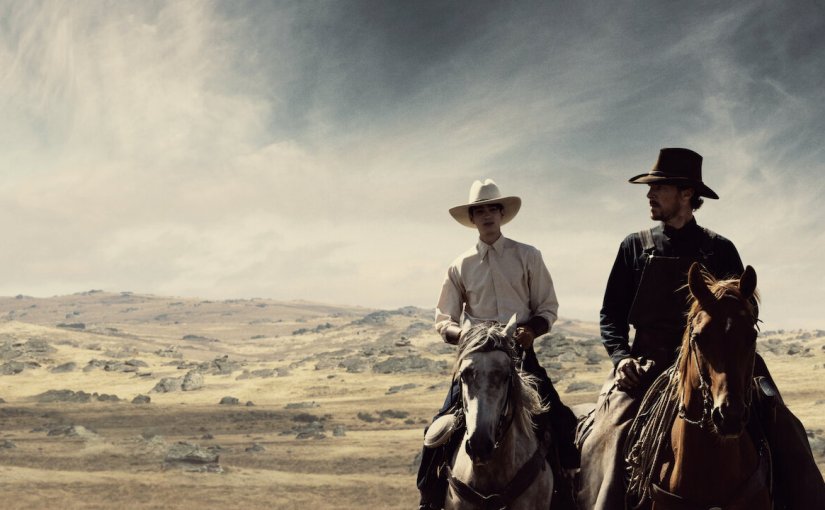
Technically, Jane Campion directs an absolutely breathtaking film with majestic cinematography and art design of open Montana fields taking place in 1926.  Tech work can only take me so far though, and I appreciated the four different perspectives of the headlining cast that includes Benedict Cumberbatch, Jesse Plemons, Kirsten Dunst and Kodi Smit-McPhee. 

Cumberbatch is Phil, a cowboy relic of the Old West.  He’s an expert horseman donned with spurs on his boots, and leather padding on the jeans along with the worn in staple cowboy hat.  He also has a fearful and intimidating temper.  Maybe that’s because his era is soon to be passed by and he’s not designed or updated for anything else.  Plemons is George. Phil’s subdued, business wise brother who knows his way around their Montana ranch, and more importantly knows how to build connections that’ll provide fiscal and political support, while he drives his Ford buggy to get from one place to the next.  Dunst is Rose, the artist of appetizing delicacies and designs who marries George.  She manages the kitchen of her restaurant and can play piano; not exceptionally well but her love for the instrument is what matters.  Her son is Peter, played by Smit-McPhee, a lanky and weak, yet book smart, young adult with his focus on the science of medicine.  He aspires to be surgeon.  So, as the 20th century is now over a quarter complete, these four individuals represent what once was, what is now, what is trending and what will become.

Campion sprinkles her film in more atmosphere than telling dialogue.  The gist of the story is how Phil’s tormenting presence scares both Rose and Peter.  A hair-raising scene occurs midway while Rose attempts to play a song on the piano, only to be drowned out by Phil’s cruel banjo interpretation from the top of the staircase.  Cumberbatch is really scary here as the bear teasing the cub to poke him.  Rose tries again and again to play only to be further interrupted by Phil.  A banjo is an instrument of a bygone era, the Old West.   The piano is the more sophisticated and elegant device to use now within the decorated designs of a reading room.

The future is also upon the characters.  Young Peter purchases a pair of sneakers to wear; not exactly the most appropriate for a horse ranch, nor are his suppressed homosexual yearnings.  Still, the future carries forth as he studies the latest in medicine and surgical practices, whether it is through dissection of a rabbit or studying the most up to date medical journals.

George is the symbol of transition.  He was raised like his brother Phil to be a rancher, but he knows that time has passed.  Currency, technology and longevity are necessary and it is not wise to remain stagnant in a time gone by.  It’s practical to develop connections with the Governor of the state, to drive himself and Rose in a car as opposed to by horseback.  To carry on the family name, it is also prudent he marries and builds a new generation.

I appreciated the subtle visuals and behaviors that Campion weaves into her adaptation from the novel by Thomas Savage.  Over the course of two hours, I was always learning something new, whether it be about the characters or the period setting.  Most telling is the fact that the past can not live in an updated future such as Phil with his suprising and deeply inhibited attraction to Peter.  As well, the future is not going to adjust well to the past like when Peter is trying to learn horse and ranch handling from a teasingly cruel Phil while wearing a ridiculous cowboy hat, white sneakers, and factory tailored jeans.  Furthermore, even if you’re only a frequent movie watcher, you likely are aware that Westerns would pit cowboys against Indians.  Rose demonstrates with her talents for craft how Native Americans are appreciated in this still young new century.  Phil and his ranchers would never imagine such relations to ever exist.

Our history is not comfortable with our eventual future, and our future can not fathom how we ever lived within our past.

Because these two worlds can never mesh in accordance with each other, a loss will have to be committed.  In another storyteller’s hands, The Power Of The Dog, might have resulted in a gun shot, or a stabbing or an illness to eliminate what cannot survive.  As well, long speeches of dialogue would spell out what must cease to continue and what must continue to flourish and go on.  With Campion’s lens, and with Savage’s work, it works atmospherically, however.  The environment of the Montana landscape along with life on a transitioning horse and cattle ranch serve the conflicting time passages and the characters who are relegated to a past, or a present, or a future. 

Don’t watch The Power Of The Dog with expectations of simplicity or quotable dialogue.  I value Campion’s approach to not spoon feed me.  Rather, take in the visuals of the four main characters’ behaviors.  Allow yourself to become more observant of the nature of how things end up.  Powerfully speaking, Jane Campion shows that some people will work well together, while others will crave to blend effectively, and sadly some can never live within another environment or time period, much less someone else’s.

The Power Of The Dog offers a thought-provoking message of loss and reflection while gazing into what’s just beyond.  It’s a very well-made film.

VICE

By Marc S. Sanders

Christian Bale is one of the greatest method actors working today. He’ll put on muscle mass for Batman. He’ll shrink himself down to a skeletal 100 pounds for roles in The Mechanic and his Oscar winning turn in The Fighter. In Adam McKay’s new film, Vice, Bale puts the weight to present an uncanny resemblance to former Vice President Dick Cheney. Without Bale and co-star Amy Adams as wife Lynne Cheney, Vice would not succeed. Both will be nominated for Oscars this year. McKay can expect nominations for himself and Best Picture.

McKay approaches Vice similarly to his winning film The Big Short, where a historical debacle of great proportions is told from a comedic approach. However, the gags of Vice don’t necessarily measure up to the absurdity of the real estate investment collapse of The Big Short. Cheney’s accomplishments were just too sad, too tragic, too shocking to laugh at entirely.

Dick Cheney was a drunk who suffered multiple heart attacks. He got kicked out of Yale University. His daughter, Mary, is gay. His other daughter, Liz, went into politics herself and dismissed her sister’s sexual orientation. Dick has remained married to his very wise and very aggressive wife Lynne who more or less rescued him from a wasted life. Dick Cheney shot his close friend accidentally while hunting, and never apologized for it. He was fortunate to receive a heart transplant that continues to prolong his life, and Dick Cheney became Vice President of the United States for two terms. You don’t have to like the guy but you have to admit he’s got a colorful past.

It’s all in the movie. Immediately, McKay puts in a few words of a byline that this film is based on fact to best of their knowledge but they more or less tried their fucking best.

My impression of what could be considered a very divisive film was actually not divisive to me at all actually. Bale along with McKay’s screenplay show a Dick Cheney who truly sees no other way to carry on a political career than with a silent yet ruthless touch. Later, it required more aggressive tactics not labeled as torture and not appearing beyond his authority even if he is only the Vice President. Bale has the voice down, the walk and as noted before the appearance. This film will likely win Best Makeup.

Having recently seen three potential nominees for Best Actress in The Favorite, I have to say Amy Adams as Lynne Cheney beats them all. This is not an Amy Adams we’ve seen before. Lynne is depicted as smart, aware in a mindset of no nonsense bullshit. She gets the job done, and if she had her way she’d take the job herself but she’s aware of her limits as a woman. Adams easily shows her Lady Macbeth in a scene where daughter Mary reveals herself as gay. Dick promises to love Mary no matter what. Adams as Lynne does not. Adams offers an expression that kills. Right there in this scene is her Oscar moment. This is one of the best performances I’ve seen all year.

Back to Macbeth for a moment, McKay has a great imagination for gags including elevating the fantasy of Dick and Lynne reciting MacBeth to each other in bed while mulling the possibility of becoming George W Bush’s running mate. It’s more than that for Dick. Both know this is absolute power…finally. I’d accept if their decision to run came down to something like this. It takes an ego trip to obtain power after all. If you’ve already been denied power before, the power trip only becomes more powerful on another occasion.

The Shakespeare gag works. Some others fall a little flat. Some really win. Out of the blue, prior to running on Bush’s ticket, McKay wraps up the first portion of Cheney’s life and literally rolls end credits. Then a phone rings and Cheney’s biggest story begins. The end credits moment is a great psyche out.

Vice is not a perfect movie. A huge misfire occurs midway through the end credits that derails McKay’s best effort at a neutral point of view for the Republican. It’s a moment that screams of present day chaos of opinion. McKay said screw it and folded his hand to take advantage of showing how he really feels. Before this scene, McKay and his cast embraced the Cheneys despite their hard to swallow viewpoints and actions. If you are going to make a movie about Dick Cheney or Barack Obama or Mickey Mouse you, as the storyteller, have to develop an appreciation for the centerpiece. If all you are going to do is bash and mudsling, then perhaps you are not qualified to tell the tale. McKay failed at the finish line.

Still, the journey is always interesting. There are things to learn here, things to recollect and things to question how it all came to be a reality.

A good cast is offered including a surprising appearance by Tyler Perry as Colin Powell; make a movie about this guy and get Perry back. Steve Carrell plays a buffoonish Don Rumsfeld. Was Rumsfeld this stupid and this haphazard? I don’t know. McKay uses him to play the fool and the jester. I doubt Rumsfeld has a loyal fan base ready to wave pitch forks. So who cares, really? It’s in the past.

A casting misfire is Sam Rockwell. Moviegoers are too familiar with the real George W. Bush especially in 2018 following the loss of his parents and his deeply appreciated eulogies. Rockwell teeters on 12:45 am Saturday Night Live material, as he chomps down on chicken wings, with a good ol’ boy Texas dialect. I know people want to believe Bush 43 was this stupid. I’m just not ready to accept that. Ironically, a producer on this project is Will Farrell, widely known for his George W Bush on SNL. Farrell would have been a better George here.

Compliments also go to Jesse Plemons as a narrator with an unknown connection to Cheney. Plemons’ delivery plays well on an even keel.

Vice is a complicated film about a hard man to like with little to know redeeming qualities. Adam McKay is cornering the market on films about American absurdities of the past. He’s good at this kind of filmmaking. This isn’t his best film but it still works. Just get ready to leave the theatre as the real end credits roll. Again, it’s a moment that serves the film’s worst flaw as McKay leaves his imagination at the door. Everything before that was right on track. Adam McKay…next time, don’t think too hard.