
By Marc S. Sanders
No. This is not a reality show. This film feels much more authentic than the “reality” of a reality show.
Ali Abassi is the director making broad strokes that cover the early career of one Donald J Trump (Sebastian Stan). By the time I was finished with the picture, I gathered that Abassi was depicting how one monster created his own monster, and then that creation destroyed the original creator. This might as well be the story of Darth Plagieus The Wise. Watch a Star Wars movie for a change, would ya?
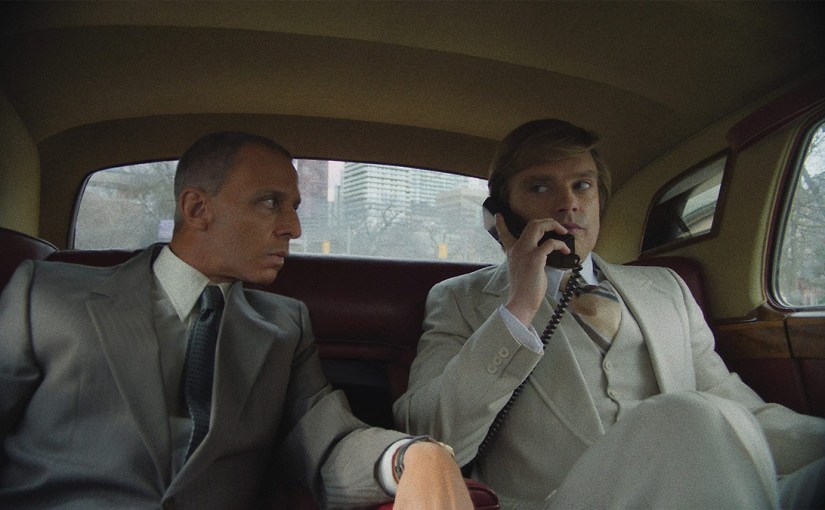
The original creator is the infamously corrupt attorney Roy Cohn (Jeremy Strong) who proudly knows how to dodge one indictment after another while standing on the precipice of his historic conniving. In a private New York City club one night in the early 1970s, Mr. Cohn will lock eyes with Mr. Trump across a crowded room. Cohn will mentor this kid about the three rules of business which include denials when necessary and never admitting you’re wrong.
Trump works for his uncompromising father Fred (Martin Donovan, bearing a striking resemblance to the real person, complete with the bushy mustache, bushy hair, and towering height). The family is in the business of real estate while fighting accusations of forcing out lower class minorities from their run-down tenement buildings. Donald is not even fearful of knocking door to door with late rent notices and threats of evictions. Still, he knows they are up against a wall and if there’s anyone who can exonerate him and his father it is Roy Cohn. Yet, Roy does not weaponize with legal research and law jargon to uphold a defense. Instead, he digs up dirt on those figures that are in the way. To keep skeletons from going public will mean a drop of the case. Thus, Donald has received his first lesson in cutthroat business operations.
From there, Trump gets the impression that with Roy there’s no limit on what can be achieved. New York City is slum area, but Trump knows he can revitalize the streets with his invested infrastructures, beginning with Trump Tower on 5th Avenue. It’s time to pressure Ed Koch for tax breaks even if there’s no justification. If Ed doesn’t want to cooperate, it is to the press Donald J goes with how he truly feels about the Big Apple’s Mayor.
As the fast tracker gets more and more visionary, so does the recognition of a guy who…well may be crazy enough to become a game show host or even President of the United States.
Much of The Apprentice seems legitimate based on the very public image of Donald Trump. The common gestures like the thumb and index finger held together to drive home a point or the repetitive adjectives that construct much of the man’s vernacular (“…tremendous, tremendous…”). The junk food eating is covered. Trump’s hyperactive ranting and slamming of those in his way work towards his drive along with his disregard for not honoring loan payments. The growth of his empire in casinos and resorts break ground too. None of this is slander. The news showed how it happened.
Private moments are where skepticism could be merited. The prenuptial agreement that Cohn drafts, and a supposed forcible rape on his first wife Ivana (Maria Baklova) by Trump are given attention. The disdain he has for his alcoholic older brother reveal the workings of a family life never based on love, and only on platforms of business and prestige. His sneaky approach to get his senile father to sign documents may or may not have happened. I dunno. When his mother found out about it, she threw him out of the house. Perhaps? Doesn’t sound so farfetched.
Trump’s obsession with his appearance is also given attention. A constant habit with fixing his hair is redundantly shown. I believe it. If he was not obsessed with his hair, he wouldn’t look like he does, and that haircut begs for some proper attention. If he’s not going to eat right and exercise, then his doctor will conduct surgery to preserve his youth, and a hair transplant will be completed to conceal a bald spot. Apparently, Trump took diet pills as a means to offset his terrible nutrition. Doc insists they are amphetamines that his patient has to stop using, but for a guy like Donald Trump, he has to keep going and going. No time to sleep when there are worlds to conquer and beach front property to build upon. I don’t suppose any of these private activities away from the paparazzi can be validated with tangible proof beyond heresy. Nevertheless, again as the world knows Donald Trump today and for the last forty years, what is offered in Ali Abbasi’s account, with a screenplay by Gabriel Sherman, seems consistent from what the public sees regularly. Don’t get me started on the board game my dad got me for Hanukkah in the early 1990s, or the fact that Trump eats a filet mignon with ketchup.
As Trump goes up the scale, Cohn is quickly descending and the man who gave the kid access to everything is disregarded during the age of AIDS spreading in the early 1980s when Reagan seemed to inspire the use of disposable income for many middle-class yuppies. Cohn is a victim of these prosperous, yet unexpected times. Being a closeted homosexual and contracting AIDS did not suit the cloth of this shark. Also, the mounting charges against the lawyer for his unseemly practices eventually caught up to him. Couldn’t have happened to a better guy, quite frankly.
Jeremy Strong is known for his literal method acting and he personifies Roy Cohn, the guy with chutzpah not just found in him but in everyone he associates with including criminal mob bosses. This is a very powerful guy that no one should underestimate. The only thing that could kill him is if Donald gets out control…along with Roy surrendering to the residual effects of a secret gay sex life in the early 80s.
This is not so much a polarizing film based on red and blue politics. Donald Trump actually functions like the one depicted in The Apprentice. Sebastian Stan wisely steers away from a Saturday Night Live impersonation. You don’t hear Trump’s voice but with talented hair and makeup artists, you recognize the delivery of dialogue. It changes from a polite young man who wants to be the emperor he sees in his father, only not as conservative and a lot more aggressive. Later, with the help of an overly confident ego accompanied with a loud and brash mouth, do you see the person most of us are familiar with.
The Apprentice has a documentary style narrative with Abbasi’s reliance on hand held cameras. The grainy photography of the 1970s Nixon years enhance the crime and disruptive unsettling Northeastern America. Donald Trump, in his beige linen suits and ties, does not fit in this environment. There isn’t an authority to him yet. He looks too liberal actually. In the 1980s, with much accumulated for the mogul, the graininess changes to look like footage played back on a VCR. Trump has the tuxedos and overcoats that do not hide his belly well enough. The navy suit and red tie surface for the first time and his surroundings are often decorated in gaudy layers of gold. The royalty he’s placed himself in is here to stay. Roy Cohn used to go all out with his parties and sex orgy binges, but never like this. This new Donald J Trump is so overinflated that even the great Roy Cohn is drowned out of existence.
Ali Abbasi allows some winks and nods at what we know will become of Donald Trump. Name drops of other bigger than life businessmen enter the scenes and you nod your head when you see guys like Rupert Murdoch or Roger Stone arrive. Trump’s brand has always been defined by the power pawns he associates with.
A side story glosses over Donald’s relationship with Ivanna. I know why it has to be here. It’s played well by Maria Baklova and Sebastian Stan. Though in comparison to Donald’s relationships with his father and brother, plus Roy Cohn, the marriage storyline does not carry the same kind of weight. Much of the material seems conjured up here and not as genuine. Maybe that is because the general public has never seen how the husband and wife truly treated each behind closed doors.
The Apprentice declares that there are portions of the film that are fictionalized for dramatic effect. Yet aren’t most biographies? Sebastian Stan seems to have a lock on his portrayal. If he judged his character at all, he lent credence to how the real man is satisfied with how he carries himself. I don’t know how the actor sides politically or how he particularly feels about Donald Trump, but Stan grew a respect for the figure. He doesn’t make the guy look like a buffoon. This Trump is passionate about every new project he pursues and just as equally he’s focused on pushing obstacles and enemies out of his way. If he doesn’t push, then he steps on them. It doesn’t matter if it is his wife, his brother, his father, his mother or the one that got him everything he needed, his good friend Roy. Even a once respected mentor can become a casualty in the pursuit of greatness.
I can’t say how any one person might respond to The Apprentice. A Trump follower, or even Donald J Trump himself, may feel very flattered by this reenactment and how the guy got to the top of his gold pyramid. Others will be offended and exhausted over even more exposure of the largest ego the world has encountered. Either way, I attribute my compliments for the outstanding pairing of Sebastian Stan and Jeremy Strong. A partnership is at the center of this piece, and now we bear witness to how the connection between these two characters moved along, and then eventually very far away from each other.
 2 UNPAID MOVIE CRITICS!!!!