THE PROFESSIONAL (Léon)

By Marc S. Sanders

The cult following that has come with Luc Besson’s first American made film seems unwarranted to me.  It’s currently listed as number 40 on IMDB’s top 250. I have no idea why. I recognize the artistic style of the picture, but what is here to relish beyond an enlightening introductory performance from would be Oscar winner Natalie Portman?

To watch Besson’s use of the camera makes me feel like a viewer from the director’s native France.  The setting is Little Italy, New York and it has a feel to it like Besson just stepped off the plane and decided to hone his lens on a condensed city section, but lacking an education of its culture or history.  The Professional certainly doesn’t look or feel like Dog Day Afternoon, When Harry Met Sally…, or Die Hard With A Vengeance.  (Perhaps the music from Éric Serra altered my mood.)  I never took issue with this aspect of the movie. It is unfortunate however that Besson’s film comes off too perverse in its storytelling, especially with its character blend.

Portman is Mathilda, a spunky kid who survives the murder of her family when a corrupt, drug dealing DEA agent named Stansfield (a way over the top Gary Oldman) carries out the slaughter after her father fails to pay a debt.  Fortunately, as Mathilda is returning home and coming upon the bloody aftermath, Stansfield and his crony of killers opt not to take her out too as they believe she belongs with the occupant of her neighboring apartment.  Léon lives there and happens to be a skillful hitman and weapons expert who pulls Mathilda inside to safety.  He’s played by Jean Reno.  These killers who massacre by day have no care to eliminate the other tenants living on the same floor, including a little old lady.  Why?  I don’t know.  Maybe they called in sick on the day assassination school covered “Chapter 6: Leave No Witnesses.”

Besson does not apply much brainpower to the script he wrote and directed.  Oldman’s characterization could not be more obvious with how unhinged he behaves.  His department colleagues who take less than a minute and a half to question him don’t even raise an eyebrow.  While the storyline can be dismissed as a pulpy kind of graphic novel come to life, isn’t it lucky that if your family is going to get shot up, you have a professional hitman living right next door? I mean c’mon.  This is only the set-up of the picture, within the first ten minutes, and my suspension of disbelief never arrived.  

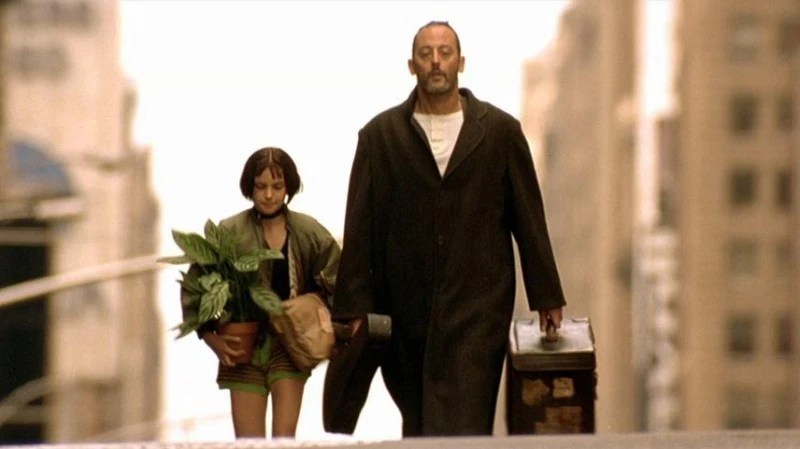
The most egregious lack of consideration falls within the relationship between Reno and Portman’s characters though.  She’s twelve.  He’s in his late thirties or early forties, but his silence implies it is time for assisted living.  When they are not relocating from apartment to apartment, trying to stay out of sight of Oldman’s gang, they are valuing the life of Léon’s beloved plant, drinking milk and demonstrating the fine art of sniper operations.  That’s fine – it’s the stuff of Tarantino fare.  

However, when the pair decide to entertain each other with Portman doing routines of Madonna and Chaplin for play fun, there’s a cringey temperature to the picture.  Besson was seeking out a relationship between a random man and child without any element of sexual proclivities involved and yet, it’s there.  In another writer/director’s hands, there would have been a stronger attempt to develop a paternal relationship between the two characters.  Yet, Natalie Portman doing a childlike song and dance performance of “Like A Virgin,” with Jean Reno’s Léon acting unaware seems artificial and perversely moving in the wrong direction.  When danger crosses their path later and they both say “I love you” to one another, I can’t help but question how this bond might have turned out if they were never forced to separate and save themselves from the bad guys while continuing to live a quiet life with a house plant and gallons of milk.

The final third of The Professional has the inevitable shootout and explosions.  Out of context, it looks good but again this is New York.  So, when Stansfield brings in the firepower of the entire city police to force Léon and Mathilda out of the tenement building, shouldn’t someone be questioning someone?  Anyone? It’s ridiculous.  None of the neighbors run for cover or are given warnings to divert away as a small rocket launcher is propped up for blasting the front door open, along with anyone inside.  

The Professional contains a boring, inappropriate middle section accompanied with a ridiculous opening and ending.  Therefore, I have trouble locating the merits for this piece.  I can recognize the potential of Natalie Portman in her performance.  Yet, if this were the first film I ever saw Gary Oldman in, I might not be so prone to watching anything by this best of the best character actors.  “EVERYONE!!!!” he screams, shouts, screeches, and bellows all at the same time.  Whether you’ve seen the film or not, most cinephiles relish in that sound byte from him on social media. I’d argue it’s in no way a salute to the actor.  Frankly, it’s indicative of the material when a guy as accomplished as Gary Oldman cannot uncover enough of a quirk in a bad guy from a very unimaginative script.  It’s not your fault Gary, so much as it is Mr. Besson’s.

Jean Reno has a cool looking, silent poise to Léon, the professional hitman, but there’s nothing lent to him to work with except a pair of opaque, circular sunglasses, milk, a plant and at least as many guns and ammo as found in The Matrix.  Reno functions on little dialogue and no background save for a few scenes he shares with Danny Aiello as the mob boss who frequently hires him for jobs.  Reno’s scenes with Natalie Portman only demonstrate how inappropriate their connection as actors in a scene are, as well as how their characters are supposed to serve each other. 

The faults of The Professional ultimately lie with its puppet master, Luc Besson.
THE DA VINCI CODE

By Marc S. Sanders

Akiva Goldsman’s screenplay adaptation of the bestselling novel The Da Vinci Code by Dan Brown suffers from an overabundance of information; like A LOT of information, a TON OF INFORMATION actually. The book is an incredibly fast read with brief chapters and plenty of diagrams and images to study. It surprises me, though, how in depth director Ron Howard’s approach is with the film. Howard must have literally shot every page Brown documented including his edits. Amazingly there is a Blu Ray EXTENDED CUT. It seems Goldsman and Howard at one point couldn’t help themselves. Restraint had to step in for the controversial story’s cinematic debut.

Tom Hanks plays the great modern literary character, Robert Langdon. He is very good in the role of a research expert on historical symbols and cryptology. Hanks even masters Langdon’s self-debilitating weakness of claustrophobia very well, which proves to be a hinderance. It’s maybe an under celebrated part in Hanks’ career because the film is so heavy. Little is talked about this film any longer. (The second sequel, Inferno, flopped at the box office. I’ve yet to see that one.)

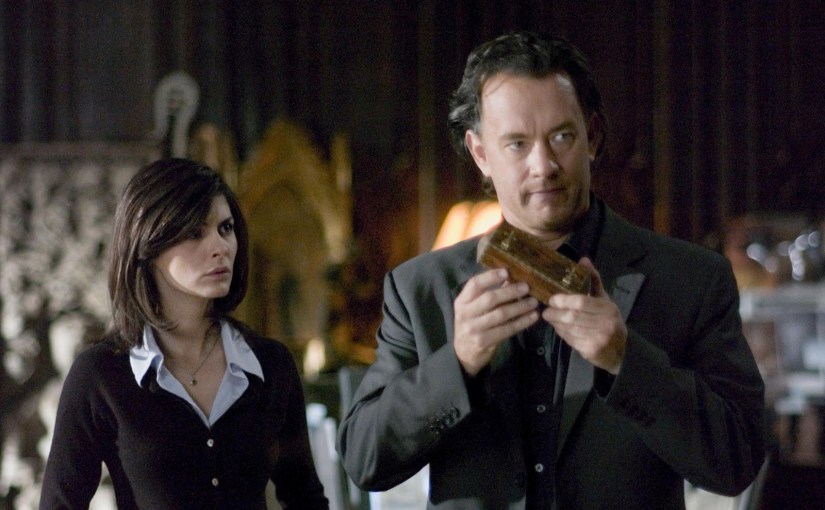
Langdon is recruited to go the Louvre in Paris one evening to look over a recently murdered victim left with a pentagram carved in his chest and a gunshot wound in his belly. The victim’s name is Sauniere (Jean-Pierre Marielle). Soon Langdon is teaming up with Sophie (Audrey Tatou), Sauniere’s granddaughter, to uncover one puzzle or clue after another left behind most prominently within the artwork of Leonardo DaVinci, including the “Mona Lisa.” Gradually, a conspiracy is uncovered revealing a strong possibility of how Mary Magdalene and Jesus Christ are actually connected. Amidst all of this, Langdon and Sophie become fugitives under the suspicion of murder. Now the cops (headed by Jean Reno) as well as a secret society within the Catholic Church are hot on their trail to stop them from revealing the truth. A dangerous, self torturing Albino monk (Paul Bettany) also comes into play.

That’s a long ass paragraph I just wrote and it hardly scratches the surface of how in depth The DaVinci Code really is. Because it is so nuanced, I had some major problems with the film. For one thing the cinematography from Salvatore Totino is very dark. I know. Most of the film takes place in the middle of the night within the hallowed halls of the Louvre and the streets of Paris. However, I think certain liberties should have been taken here. The details thrown at the audience never stop. Long summaries of dialogue come into play and at times Totino and Howard will highlight a code or a portion of a piece of art or a passage in a book. Because the story is so deliberately murky, I wish at times what I was looking at could have been presented all the more clearer.

Another issue is with Audrey Tatou who is of French descent and whose character is that way too. Her French accent is too thick to clearly understand every word she is saying. A lot of details become lost because her dialect swallows her words. Natural dialects can be a slippery slope in film. You want the characters to be as genuine as possible but none of that means much if you can’t follow along.

The best surprise of the film reveals itself when Ian McKellen appears, portraying Sir Leigh Teabing, a mentor and friend to Langdon. Yes. He offers up a ton of information too. Too much for any one film really. However, McKellan is so giddy in the role. Leigh relishes the fact that Langdon and Sophie appear at his home. He’s elderly and crippled and excited with glee to come across them so he can share his own theory of Mary, Jesus and what is possibly the real interpretation of the Holy Grail. At ninety minutes into the film, McKellan’s introduction is quite a welcome, relief from the heaviness of everything before.

The DaVinci Code clocks in at over two and a half hours. It feels longer actually. There are multiple endings as surprise traitors need to be revealed, more history and theories need to be uncovered and more European locales need to be visited complete with secret passages and hidden staircases. It took a lot of mental effort to remain patient with the film, and I had already read the book!!!

Ron Howard’s film merits the discussion of whether Brown’s bestseller should have ever been filmed. As good as Hanks and McKellan are, I say no. This is not Indiana Jones with bullwhips and truck chases. This is a treasure hunt that sticks to what is on a page and within an exhibit. To mask what is discovered by dictating endless dialogue from the cast becomes incredibly tedious.

Dan Brown’s story is wildly out there in theory and supposition. It’s what makes it fun, really. So, do I recommend The DaVinci Code? You bet I do. I definitely recommend you read the book.

MISSION: IMPOSSIBLE

By Marc S. Sanders

Brian DePalma directed the first installment of Tom Cruise’s film adaptation of the Mission: Impossible series. It’s good, but not necessarily the best of the bunch.

DePalma’s approach with a script by screenwriter Robert Towne (Chinatown) & David Koepp opens with last ditch effort at a Cold War setting. (By 1996, Pierce Brosnan’s James Bond had already abandoned that point in history.)

Cobblestone streets in Prague glisten under wet street lamps as a team of spies, led by Jim Phelps (the “Captain Kirk” of the original series) with Cruise’s Ethan Hunt as point man. They are attempting to prevent a buy/sell exchange of a disc containing identities of undercover agents spread across the globe. There are shadows. People walking covertly and other people watching people through cameras on eyeglasses and computer monitors. Everything is going according to plan, until as we expect, nothing goes according to plan, and Tom Cruise seems to be the only one surprised by it all. Now he’s accused of being a traitor having gotten his whole team murdered and he must go rogue (he does this a few times in the M:I films). DePalma’s opening is straight out of a John LeCarre novel. All good stuff.

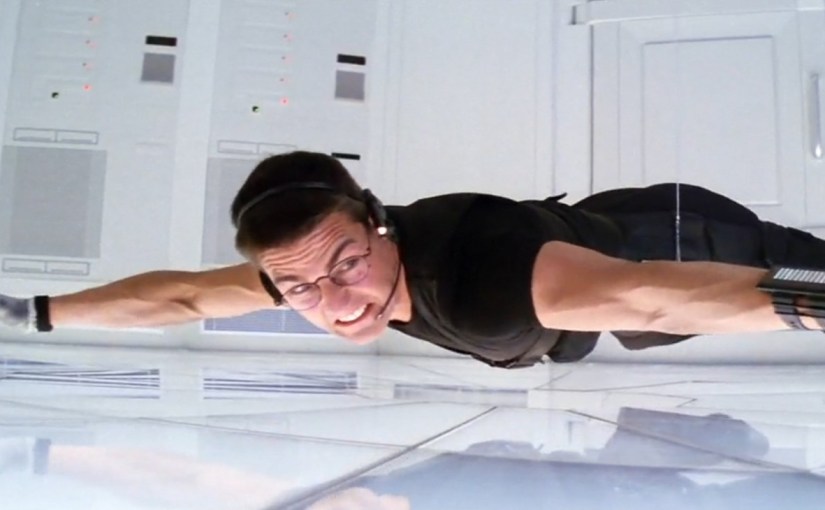
More good stuff appears in act 2 when Ethan Hunt has to infiltrate CIA headquarters to retrieve another disc and allow himself to cable down into the most high tech secure room in the…well lets just say the world, that is conveniently run by the most incompetent dweeb in the…well let’s just say the world…again. The primarily silent sneak is as beautifully choreographed as a Russian ballet. It’s spectacular.

Even more good stuff occurs in act 3 in a high speed super train crossing through the Chunnel in Europe. There’s a helicopter and Tom Cruise on the roof of the train and even some exploding chewing gum. Act 3 is where DePalma, Towne & Koepp opt to leave the Cold War behind because let’s face it, no spy can remain covert when a helicopter gets tethered to a high speed train in a tunnel.

So yeah, there’s lots of goodies in Mission: Impossible, but it falls terribly short because Tom Cruise produced the film with his ego in the way. For example, he sets up a team of four, all with different specialties. They get properly introduced and then they are given not much to do except watch Tom Cruise “Ethan Hunt” his way out of one dangerous situation after another. Ving Rhames seems like an especially interesting character but all he’s reserved to is typing on a keyboard. Vanessa Redgrave puts on a charming mystery about herself for one short scene as an arms dealer only to do nothing else but sit on the train later on.

Lots of talent was assembled for this film including Jon Voight, Emilio Estevez, Jean Reno and Kristen Scott Thomas but they’re only here to be a live studio audience for Cruise’s heroics.

Compare this film to Eddie Murphy’s Beverly Hills Cop. Murphy is no doubt the centerpiece, but he does not own every scene. Big moments come from the supporting cast as well. There’s more variety to that picture, which Murphy produced, than Cruise’s production.

A well utilized cast can be the difference between a good picture and a great picture.

RONIN

By Marc S. Sanders

John Frankenheimer directed the exceptional thriller Ronin, featuring Robert DeNiro and a band of baddies all hired to intercept a mysterious suitcase. The contents are never revealed, and it really doesn’t matter. It’s the pursuit that’s important. Consider this a glossier version of Reservoir Dogs and Pulp Fiction. Not big on exceptional dialogue but huge on top notch car chase action.

Frankenheimer works with a script co-written by J.D. Zeik and David Mamet (using a pseudonym), and all that’s necessary to assemble a gripping two hour story is to have the characters team up, then abandon each other and then double cross each other. How do you identify professionals like these? Well, recruit Michael Lonsdale (former Bond villain from Moonraker) to explain the meaning of the samurai known as Ronin who have become masterless; skilled swordsman with loyalty to no one any longer.

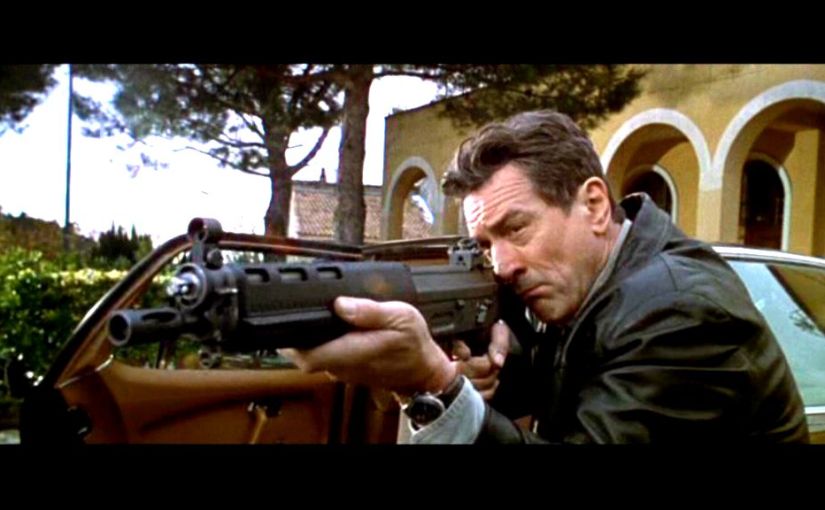
DeNiro plays “Sam” who may be former CIA. He’s one of five men hired by an Irish woman named Deirdre (Natasha McElhone) to retrieve the well-guarded package. This entails intercepting a convoy of cars riding along the French countryside. The fun in the car chase action of all this is that the characters are implied to be at least as ruthless as the subjects they’re stealing from. Therefore, Frankenheimer and his team of 300 (yes, that number is accurate) stunt drivers can offer up reckless collateral damage; cafes are crashed into, buses flip over, and motorcycles skid out of control. It’s Vice City before there was ever a Vice City video game. These guys are not stopping for little old ladies crossing the street.

Jean Reno partners up with DeNiro for a time as a Frenchman and Stellan Skaarsgard plays a German ex-KGB agent. Eventually, Jonathan Pryce comes in to play as well, representing more Irish influence. Sean Bean is here too. (Have you been paying attention? That’s three Bond villains in one movie!!!!) All good casting.

That’s about all there is to say. The plot is deliberately thin with a slight, mediocre twist, and a romance that’s nothing truly interesting.

Still, Ronin is watchable. Frankenheimer and his cinematographer, Robert Fraisse, present awesome locales of a thriving Europe from 1998. Editing is quick and sharp too. Consider Ronin a precursor to Paul Greengass’ Jason Bourne films.

If nothing else, beyond the various car chases and high stakes shootouts, DeNiro had me convinced he was clearly instructing his colleagues on how to remove a bullet from his gut.

Yes. You pretty much see everything.