F1

By Marc S. Sanders

Miguel and I are the two unpaid movie critics who find ways to entertain ourselves beyond the IMAX picture on the screen.  By now, I know when Nicole Kidman is arriving and I start her off by saying out loud “We come to this place…”. Mig turns his head down in sarcastic annoyance.  We applaud at the return of Jaws in theaters this August.  There’s a rhythm we chemically thrive on.

Thirty minutes after a series of trailers plus an unwanted Allstate commercial (Thanks a lot AMC), the film begins, and the personal hand gestures begin.  Excuse me a moment.  I must pause for a moment.  (a-hem!) 

GET YOUR MINDS OUT OF THE GUTTERS!!!  

Now, where were we?  

Oh yes…

During the running time of Brad Pitt’s racing movie, F1, there were animated fist pumps (“Yeah!  Alright!!”).  There was rhythmic poking in and out of my right index finger jamming into my left thumb and forefinger (“Brad is about to get it on with Kate, the staple romantic interest, played by Kerrie Condon”).  A palm up facing twirl of the wrist (“Of course.” “Naturally!”). There’s the muted gasp pat on Miguel’s arm (“Is it?” “Could it be?” “Don’t tell me!” “Brad is fully recovered and walking through the steam cloud to pilot his race car?” “Again?”  “For one last time?”).  F1 covers all the expected beats.  

Frankly, I am not aware of too many racing films.  Days Of Thunder with Tom Cruise, of course.  Ron Howard did an engaging piece called Rush.  Ford Vs Ferrari works better as a bio than just a racing movie.  Pixar has its series of cute films. Still, just like the new Jurassic World picture, and I’m sure the latest Superman iteration arriving later this week, F1 is all too familiar like any kind of sports movie or Top Gun on the track Jerry Bruckheimer pic.

Tom Cruise—I mean Brad Pitt—is legendary stock car racer Sonny Hayes, a middle aged, washed up and broke recovering gambler desperately invited by his friend and former teammate Gabriel (Javier Bardem) to rescue his racing team from going belly up and leaving him hundreds of millions of dollars in debt.  Gabriel already has a cocky, promising driver named Joshua enlisted. He is performed very well with a lot of appeal by Damson Idris.  However, the young man does not have focus yet and lives for his social media likes and attention.  It’s up to Sonny to make the Formula One racing squad look like a contender while reigning in Joshua who can’t let go of personal conceit and a jealous animosity.

Kerry Condon is the engineering designer of Sonny and Joshua’s racing vehicles.  With each race, Kate trouble shoots what needs improvement and what can advance the drivers’ rankings.  Too bad she can’t fully invest her expertise as F1 demands she flirts with Sonny.  (Cue my right index finger while Miguel is ready to brush it away.)

The most impressive moments from Joseph Kosinski’s (Top Gun: Maverick) film are the racing scenes.  You are seeing both Pitt and Idris tucked within the snug cockpits of these low to the ground speedster machines.  The editing is superbly matched with the roaring sound and a pulsing soundtrack from another Hans Zimmer masterpiece.  

My one issue is the final cuts of the various races lacked overhead shots.  I would have liked to have seen moments from above where I could follow when the race cars pull in and out of a pit stop for example and stay on pace with unnamed competitors.  Kosinski gives an overabundance of close-up shots of the actors in the cars but not as much outside of the vehicles.  It’s all very exciting though, and when a film opens with revving engines playing in tandem with Led Zeppelin’s Whole Lotta Love, well you have me hooked.

F1 is like another exciting amusement park ride that you’ve experienced a hundred times before.  In between the races, while there are well drawn characters played by good actors, there’s ho hum filling material that keeps this speedy ride going about a half hour to forty-five minutes too long.  The guys have to argue.  They have to lose the race.  They each have to crash their cars.  They have to be tricked into getting along.  There also has to be a traitor among the ranks.  There has to be sequences of music overplaying a series of different races and the voiceover commentators chiming in with standard fare like “…and here comes Sonny Hayes from behind…” As well, Pitt and Condon have to get it on.  She has to tell him she doesn’t get romantically involved with racers before they hump each other’s brains out (Cue the index finger!).  

Sonny also has to be told he’s finished, before emerging from that humid, sunlit steam cloud where Joshua and the pit crew slowly raise their sunglasses and drop their jaws, upon his return. (Cue the muted gasp, followed by my twentieth fist pump.)

Look, F1 is entertaining.  It’s well made.  It’s got great action with impressive direction and an enthusiastic cast.  Still, I’m tired of this more of the same.  I alluded to my same feelings yesterday with Jurassic World: Rebirth.  It’s all the same flavor and these iterations are not daring enough to take big risks or surprises with what they offer.  Consider Avengers: Infinity War and Endgame.  Those films were expected to play by the same beats and yet there were some shocks to come through.  Look at what happened with The Empire Strikes Back.  Anyone see those surprises when first encountered?  The stakes were always surprisingly high, and the heroes were getting personally affected, not just episodically, but permanently.  

Blockbusters need not be so cookie cutter all of the time, but that’s exactly what is happening.  I already know the outcome of the upcoming Fantastic Four movie.  It could not be more apparent and unimaginative.  

I watched Companion which just hit HBO MAX earlier this month and in ninety minutes, that bloody delicious film diverts in so many different directions with a bare minimum setting and a small cast.  It’s as bloody as most thriller movies we’ve seen but an applied script turns on its axis over and over again.

On an IMAX screen, F1 especially delivers. Yet, while I’m absorbing well staged cuts of movie made racing footage, my mind is turning into comatose mush and the only thing that keeps it electrified is to acknowledge the standard beats.  

Declaring “Gentlemen, START YOUR ENGINES!” will not hold my attention for 200 laps.

Do it with me now:

Fist pump!

Finger fuck!

Muted gasp!

The Of Course!

Now you know the drill! Hit the gas!!! Turn up the volume and let Robert Plant remind you that You need coolin’/Baby I’m not foolin’

COLLATERAL

By Marc S. Sanders

A salt and pepper haired gentleman in a knitted suit with sunglasses arrives at LAX before the sun sets.  He exchanges bags with a man he runs into, played by Jason Statham. Elsewhere, a driver does a polish and check on his taxi cab before beginning his evening shift.  He picks up an attractive, overworked attorney named Annie (Jada Pinkett Smith) and before she hands him her business card, the driver has at least convinced the woman to re-examine her life’s purpose and consider simple ways to escape reality.  The man in the suit is Vincent played by Tom Cruise.  The cab driver is Max played by Jamie Foxx.  They are about to collide with one another on this night and put Michael Mann’s film, Collateral, into play.

Following being a massive fan of the TV show Miami Vice, and the films Thief, Heat and The Insider, I remember my anticipation sky rocketing when I saw the trailers and write ups for Collateral.  Mann, Cruise, Foxx, and crime in a cool looking L.A. with a symphonic soundtrack? I’m there!  It seemed like a perfect formula.  When I finally saw the movie, I think I was let down because it was too formulaic following a step-by-step recipe.  The editing for Collateral is abundantly cookie cutter, never taking any risks with its story.

Vincent chats with Max as soon as he gets in the cab.  He offers eleven hundred dollars to occupy Max’ evening, transporting him from one location to the next. Max has dreams of running his own limo company one day and this easy money is too good to resist.  It’s only when Vincent tosses someone out a fourth-floor window to land on the roof of the cab that Max realizes there’s a hitch to this arrangement.  

Vincent is a hitman out to check off a list of targets before sunrise, and he needs Max as a cab escort.  Threats to Max’ ill mother in the hospital will keep the driver in check, and if inconveniences like a shattered windshield draw the cops’ attention then Max will have to abide by Vincent’s demand for no interference with his plans.  

The two hour running time of Collateral is structured on one stop after another.  Mann abides by side scenes from Stuart Beattie’s script to look at the undercover night detective (Mark Ruffalo) who is one step behind the pair’s frequent stops within the city.   I guess it’s fortunate for this guy that ballistics and coroner’s reports are quickly and readily available within minutes and hours to connect some dots.  

In between the kills, Vincent and Max chat in the cab.  Standard stuff really where Tom Cruise is at one time charming and other times sociopathic.  Jamie Foxx is the bright but frightened guy with dialogue that doesn’t amount to much in convincing this unwanted passenger to either let him go free or to give up on his mission.

Ironically, the many scenes shared between Tom Cruise and Jamie Foxx are the least interesting parts of the film.  When the sound editing isn’t failing by making their dialogue sound like incoherent mumbling, neither guy is ever convincing the other to look in a new direction or consider another idea.  Therefore, the conversations never go anywhere.  Look at films like The Silence Of The Lambs, Cape Fear, Seven, and especially Mann’s best picture to date, Heat by comparison.  Those films work when either the antagonist or protagonist allow themselves to consider the arguments, even if it’s just for a second, against the ones they are debating.

There is action and violence in Collateral, but it’s really a talking piece.  Still, the best exchange of dialogue occurs with Foxx and other cast mates besides Cruise.  A great scene occurs when Vincent insists that Max act under the guise that he is Vincent when he has to report to the drug kingpin employer who originally hired him (a surprise welcome from an at the time unknown Javier Bardem); great acting and writing happening here.  The early scene between Jada Pinkett Smith and Jamie Foxx also works at a thought provoking and interesting level.  These scenes are short one act plays that belong elsewhere.  Jamie Foxx is doing some great work in these moments.

Unfortunately, when Foxx and Pinkett Smith reconnect later in the film, they are not written with the same kind of intelligence during a run and hide third act climax.  The suspense is absent here because the setup is ridiculous.  While standing on the top level of a parking garage, Max can easily see Annie in a fourteenth-floor office window, blocks away across the city, and specifically direct her where to run from the dangerous killer who is a few floors below, all while using a dying cell phone.  

More to the point, why is Annie still wearing a suit and heels, with her hair and makeup done up, at four o’clock in the morning? I know an aggressive lawyer never stops working, but don’t they go home, pour a glass of white wine, get into sweats and pop open the laptop while Miles Davis plays softly on the stereo?  How would these guys even know this is where Annie would be at four in the morning? Reader, you might tell me to dismiss what’s merely circumstantial here, and normally I would.  Yet, if I’m an expert hitman like Vincent is supposed to be, my first instinct is to go to Annie’s home first before the office in the middle of the night.  It’s the circumstances that negate the believability of the main character.  

As expected, Los Angeles looks moody and cool like in any other Michael Mann picture.  He’s got blazing overhead shots that emit a white glow in the thick of night.  The wolf is holding a fang and claw to the neck of the sheep as they careen through this endless city maze.  In that respect, the environment of this film works like a great character game master. What turn or straight avenue or bridge is going to work in either saving Max or getting him killed?

The technique of this filmmaker, who I usually favor, is here.  It’s been seen many times before for the other sharp, well-dressed killers in Michael Mann’s worlds. I welcome it back, but it’s not new or inventive in Collateral.  I guess that’s why the film is ordinary.  It lacks the depth that other productions from Mann rely upon.  The setups are quite amateurish and most of the talking is wholly uninteresting.

In spite of a phenomenal and reputable cast and crew, it’s a shame this Michael Mann installment is only ho hum in its finished product.  Collateral needed another script rewrite, followed by some additional reshoots.  There was a better movie to made here. 

THE LITTLE MERMAID (2023)

By Marc S. Sanders

Film remakes can go either way.  It’s even more of a challenge for it to succeed artistically if the original interpretation is such a favorite among the masses.  The 2023 updated version of Disney’s The Little Mermaid directed by Rob Marshall is fair, but it also never overcomes the challenge.

The new film primarily repeats the same story that many are familiar with.  A youthful mermaid girl named Ariel dreams about living among the humans above the surface.  Her father refuses the idea as he finds humans to be vile and dangerous.  Ariel makes a deal to trade in her beautiful voice to Ursula, the sea witch, in exchange for becoming a human.  She is granted three days to fall in love with Prince Eric.  If at the end of the three days she has not kissed the prince with a means of true love, she will turn back into a mermaid and will remain a prisoner of Ursula forever.

To call this new film adaptation of the Hans Christian Anderson fairy tale a live action film is only partially true.  If we are to witness the undersea life of mermaids and talking fish, well then, it’ll have to be animated somewhat, even if it is done digitally.  Therefore, to have the freedom to animate the sequences set to unforgettable numbers like “Part Of Your World” and “Under The Sea,” I wish the filmmakers were paying a little more attention. 

Consider some lyrics to “Under the Sea:”

Down here all the fish is happy…

Up there all the fish ain’t happy

They’re sad, cuz they’re in the bowl

It doesn’t win my attention if Sebastian the singing crab is singing about fish while the heroine of the story, Ariel, is swimming among dolphins who are scientifically regarded as mammals!!!!!!  You can show me any number of different colorfully prancing ocean dwellers, and you show me dolphins?????  In a musical number, the choreography must serve the purpose of the song.  In the original 1989 film, every animated image of any particular song lines up with the lyrics of numbers written by Alan Menken and Howard Ashman.  Regrettably, Rob Marshall seems to have turned the sound off while reinventing this moment. 

Sadly, I didn’t care for the updated composition of “Under The Sea” (an Oscar winning number) or “Part Of Your World.”  Why alter the notes and vocal delivery of some of the most famed pieces in Disney’s musical library?  Steven Spielberg’s update of West Side Story didn’t do that.  Spielberg knows that if ain’t broke, don’t fix it.  These are favorites!!!!  I can’t be the only one who doesn’t like it when the artists change everything about his/her/their greatest hits when I’m at their concerts.  The same accounts here. 

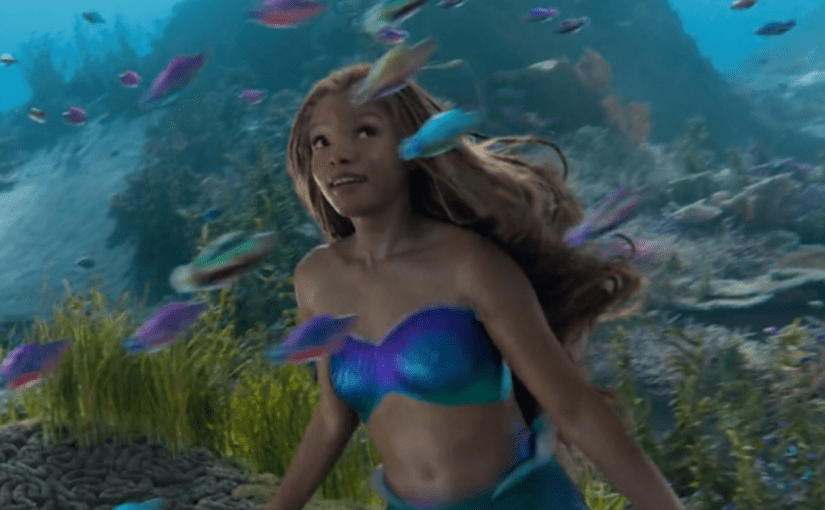
Still, it’s not all bad in this new The Little Mermaid.  Most of the cast is quite good.  Newcomer Halle Bailey (sure to be memorable in the upcoming musical version of The Color Purple) is sensational and she’s wonderful to look at as either the mermaid or the human version lacking a voice.  She has a wonderful singing voice and she’s a terrific actor against a CGI world of complicated water shots and imaginary creatures serving as her companions.  Melissa McCarthy is unrecognizable as Ursula, the sinister squid sea witch.  Her voice has a gruff intimidating edge to it and her torso and head donned in purple texture flow nicely with the CGI tentacles.  Javier Bardem is not doing his best work here because the script doesn’t demand it of him, but he fits in nicely as Triton, king of the undersea and father to Ariel.

Jacob Trembley lends a preteen personality to Flounder whose role is significantly diminished in this update.  That’s a mistake.  Instead, we get more of Scuttle who doesn’t look like a pelican any longer but is a bird who can somehow hold his breath under water for long periods of time to carry on panicked conversations with her pals.  Awkwafina voices Scuttle, and though I heard some laughter from the audience in response to her performance, it just didn’t win me over.  I found this Scuttle to be a nuisance that took me out of the film with each appearance.  The hip hop rap number (written by Lin Manuel Miranda) she performs was a very underwhelming substitute for comedy.  What was sacrificed was the hilariously silly, slapstick number from the original, where the French chef enthusiastically sang “Les Poisson,” as he torments poor Sebastian in a kitchen full of knives, boiling water and searing hot stoves.

Sebastian, the well-known sidekick, is just okay.  Daveed Diggs is a talented vocal performer, but I don’t think the final product served him well.  Often, I looked at this little guy and was not impressed, as remembrances of disappointment came back to me when I saw Jar Jar Binks for the first time.  Just like that Star Wars character, the googly eyes are detached from the head and Sebastian only evokes expression in that one area.  Nothing is done with the tiny mouth or cheekbones or ears.  Not even his claws or tiny legs offer much to do.  This crab lacked life.  As my colleague Miguel simply put it, the crab was not funny.  He just wasn’t funny in the slightest. 

A nice surprise comes from Jonah Hauer-King as the dashing Prince Eric, rescued from a shipwreck by a mysterious woman with a hypnotically, sensuous voice.  Eric’s role is thankfully expanded with the inclusion of his mother the island Queen (Noma Dumezweni).  Grimsby, the Prince’s aid, is also a welcome appearance (Art Malik) with more to do this time around.

I know for sure that I preferred the second half of the film over the first where new surprises are offered.  Rob Marshall’s film switches the influence of the story to a calypso/Caribbean vibe which is different from the slightly implied Greek environment of the 1989 piece.  This change allows a variety of different people of color and cultures to blend nicely together with believability.  After Ariel transforms into a human and Eric guides her across the island for a day of fun and escape, the story and settings come alive in color and calypso harmony.  In this area of the picture, much of the script is concentrated on Eric and his debates with his mother and her disapproval of the undersea colonies.  Confidant conversations also arise between Eric and Grimsby that I liked.  There’s more innocent flirtations between him and Ariel.  Hauer-King has good scenes with all of his co-stars from Halle Bailey to Noma Dumezweni and Art Malik.  The first half of the film is where much of the underwater life takes place, and it only convinced me so far, really taking me out of the film with the reinvention of the movie’s most famous songs.

Ultimately, like the live action interpretations of Aladdin and Beauty And The Beast this new version of The Little Mermaid is not a must watch and as much as I’m impressed with Melissa McCarthy, Halle Bailey and Jonah Hauer-King, I can’t recommend seeing it at $15 a ticket.  Why should you when the easily accessible and wholly original film is available?  This is just an unnecessary venture.

I’ve grown up as a Disney fan, but once again the Mouse House is demonstrating a lack of will to broaden its imagination.  They’d rather run in with another cash grab at the box office by issuing a substandard product repeat. 

SKYFALL

By Marc S. Sanders

Skyfall is a great James Bond film. One of the best. However, …it has one major shortcoming that always gnaws at me. Regrettably, it has a contrived middle section that steals some of the magic away from the film. Yes, for a moment, my suspension of disbelief is robbed from me.

Daniel Craig’s third outing as 007 has become a favorite among fans and movie goers. Craig is magnificent in a primarily dramatic turn in the part. Following a fantastic action packed opening where Bond pursues an assassin through the streets of Istanbul, Turkey (widely known as a favorite locale of Ian Fleming), the chase involves cars, motorcycles, rooftops, fruit stands and trains for well edited shootouts and fist fights. Alas, the assassin gets away and Bond is left for dead.

Following an attempt on the life of M (Judi Dench in her absolute best portrayal in the role), Bond returns for active duty. However, he’s not what he used to be. His aim is off and his body is worn. The question remains if Bond is ready to be back in the field.

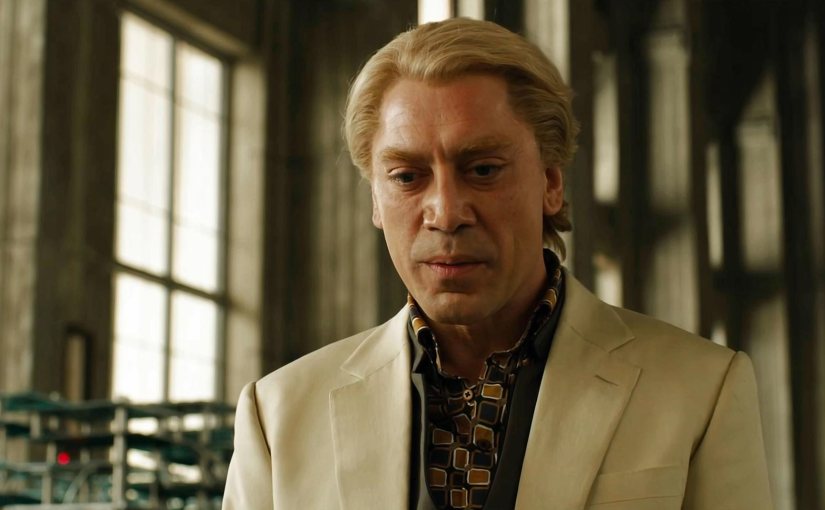
The plot centers on a bitter former MI6 agent named Silva (Javier Bardem in a potentially Oscar worthy performance) out to seek revenge on M for the sins he believes she’s committed.

It’s funny. The Austin Powers films, and even film critic Roger Ebert, would always draw attention to the fact the villain would just longingly speechify when they have all the time in the world to just shoot Bond dead and move on with their devious plot. Silva is a response to that issue. He has a mutual respect for Bond, and you can see he’d rather keep him alive for the time being to allow the game to keep running. It’s not said outright, mind you. Yet that’s what I took away from the character. A superbly written monologue to introduce Silva at the midway point of the film compares him and Bond to the last of two rats surviving a trap. Which rat will win out?

It’s also quite special that Bardem shapes his villainous role with a homosexual tendency. Silva is fashionable and proudly dons a bleach blonde hairstyle. He gleefully rubs Bond’s legs and opens his shirt to examine his scarred chest, pronouncing that Bond must ponder his “training” at the moment. Silva is beyond the typical femme fatale. It’s different and it’s time the Bond franchise acknowledges the differences in people. A welcome trait for a major character.

The plot set up of Skyfall‘s devices are ingenious in simplicity with a basic revenge tale but also with broadening the legacy and responsibilities of the M character. What Casino Royale did for a story arc for James Bond, Skyfall does for M, and with Dench in the role it works beautifully. She must answer to superiors, like a very welcome Ralph Fiennes, for the death of several agents and a bombing of MI6 headquarters. She must resist the pressure of early retirement. This is the most that M has ever had to contend with personally, and it’s here at last.

My one reservation with the film occurs just after the midway point. Silva somehow arranged to get apprehended and then managed to escape, don a police uniform, travel through London’s tube, and time an explosion on a runaway train ready to crash into James Bond who is on his trail. Thereafter, he’s able to locate the interrogation session where M is making a public statement in her defense and try to kill her. There are way too many factors at play that work too conveniently to Silva’s advantage. It’s a tension filled sequence. It looks great. It has great action and effects, but it’s overly contrived. I wish the script from Neal Purvis, Robert Wade and John Logan made this middle section a little more believable.

Sam Mendes (American Beauty) directs a terrific, action-packed film filled with more drama and minimal tongue in cheek that the series is primarily known for. I was grateful for the more serious Bond. Like the other Craig installments as well as the Dalton films, Skyfall offers a different and fresher approach.

Granted the ending plays more like an Arnold Schwarzenegger action piece from the 1980/90s, but it’s highly entertaining, well edited and well shot, nonetheless.

I highly recommend Skyfall for its outstanding cast that also includes Ben Whishaw as a nerdy variation of Q, the gadget man, and Naomie Harris in a secret role that has a satisfying payoff. As well, the standard revenge story works quite well here when you have Bardem, Fiennes, Craig and most especially Dench doing some really top notch acting with terrific dialogue. Mendes is a stage director first, and it shows quite admirably here.

Again, Skyfall is not the best Bond film but it’s at least one of the best.

NO COUNTRY FOR OLD MEN

By Marc S. Sanders

Joel and Ethan Coen have an odd collection of films under their belt. No Country For Old Men, an adaptation of Cormac McCarthy’s novel is no exception. You’re likely to meet the oddest hit man you’ve experienced in a film. (Reader, I’m going under the presumption you’ve never encountered a normal or odd hit man in real life. If you survived long enough to read this passage, you are truly blessed.)

Anton Chigrh follows a discipline that likely no one ever taught him. His code is to continue until he finds what he’s looking for and dispose of any lead in his ongoing quest. His weapon of choice-an air gun hose connected to an oxygen tank. It’s instant in serving its purpose. Its sound is quick and jarring.

Javier Bradem delivers an Oscar winning performance as Chigrh in search of $2 million when Llewelyn Moss (Josh Brolin) takes possession of it after coming upon the sight of a drug deal gone bad.

Tommy Lee Jones is perhaps one of the old men in the title. A Texas sheriff not surprised by the carnage he comes upon, but not of much use either. I think he regrets that he can never do more or better and simply can only surmise what’s already been done. I gathered that especially from a scene depicted in a hotel room during the third act of the film. His approach on the scene and his need to sit down translate that for me. His periodic anecdotes during the course of the film seem to say so as well. This sheriff has likely never rescued anyone from harm despite how intuitive he may be.

The Coen Brothers are never shy with blood. A lot of directors are not, really. Yet with the Coens, it seems the bloodshed is disturbingly honest. The instant splatter and flow following another act by Chigrh couldn’t be more truthful. They tell this tale very well, never concerning themselves with how unsettling they can be. Sun filled deserts are not comfortable. Evenings are sleepless. Blood is dark, thick, sticky, messy.

Moss is a hunter who has no idea what he’s up against. Brolin plays him with quiet reservation. He could not resist the urge to take the bag of money, but he also knows he’ll pay for it as well. When he realizes there’s no way to escape, by even crossing the border, he can only try to kill the devil incarnate. He’s likely aware of how this will all play out though.

Among this trio of fine actors (with Woody Harrelson also briefly in the fold), the film is nevertheless celebrated for Bardem. Whenever the story returns to Chigrh, you sit up in your chair a little more alert. He’s got disturbing dialogue exchanges with those he encounters and Bardem’s method makes you wish you never have to decide your fate with a coin toss.

No Country For Old Men is not an action film. The pace takes its time, invested in three men with respective histories who cannot change what their meant for. No incident will change their lifestyles. They are meant to be an assassin, a washed-up lawman, and a poor country hunter. Until they die, no moment in time will alter their caricatures. That’s what I took from the Coens’ Best Picture winner.

I appreciate its honesty.