CARRY-ON

By Marc S. Sanders

Action movies have been done to death, haven’t they?  Yet, don’t we still get a kick out of them?

Sure, I need my TCM classics like It Happened One Night or my updated biographies like Angelina Jolie’s Maria, but action movies are like the best junk food without any of the calories.  Still, an action picture has to have that special attraction if it is to stand apart from the others.  I got bloated by the time I got to the fourth Lethal Weapon.  The first is a perfect wham bang shoot ‘em up set during Christmas time. Now Netflix grants us a long-lasting candy cane with its airport run around chaser flick known as Carry-On.

What makes this mad bomber fest a smash is that the hero, TSA agent Ethan Kopek (Taron Egerton), actually cries out of fear and pain as the bad guy beats up on him and frightens him into direct obedience.  He begs with tears coming down his cheeks for the bad guy to just stop with his mission.  He screams “WHY ME?”  The Rock, Stallone, Schwarzenegger, Willis, Ford, Gibson – those guys don’t cry.  Yet, little Ethan Kopek does, and once he gets his wits about him does he truly become a super hero.  I recall the moment happens in the last twenty minutes of the picture.  Ethan throws off his pansy TSA uniform shirt and makes a go at saving the day in his black undershirt.  Now he’s earned John McClane’s respect.

On the busiest travel day of the year, December 24th, Ethan is assigned to scan the carry on luggage ensuring travelers have not packed contraband items.  He and his colleagues have to put up with all the typical TSA complaints that come with the job.  My hat’s off to screenwriter T.J. Fixman for allowing some time to show the challenges of this occupation.  It adds some truth, comedy and depth to a thankless job that’s hardly celebrated or acknowledged like cops, doctors, athletes, and attorneys.  

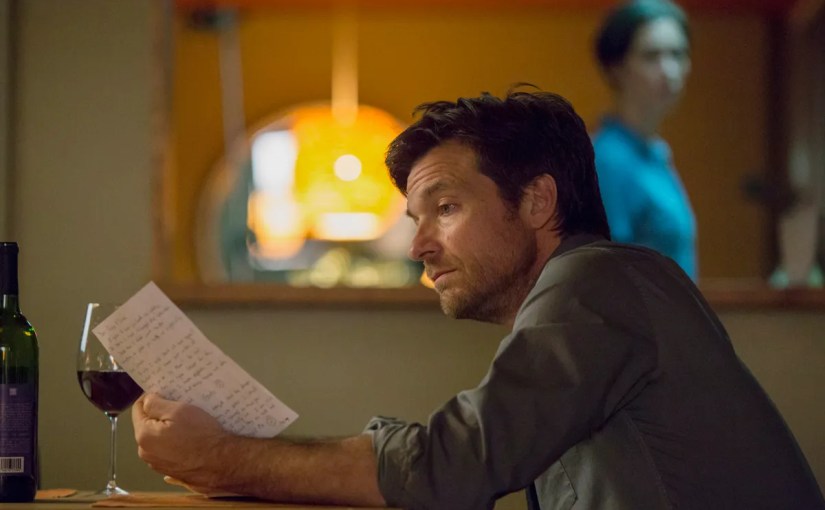
Ethan is handed an earpiece and a mysterious voice, provided by Jason Bateman, gives him direct instructions to allow one black suitcase with a red ribbon to pass through inspection.  If Ethan deviates in any way at all, the voice promises that Nora (Sophia Carson) will be killed.  She is Ethan’s pregnant girlfriend and also runs airport security at LAX.  

Movies like this function like a game or sport.  The villain sets up boundaries.  How is Ethan going to save the day or get around the unexpected while trying to avoid harm to Nora or the airport as a whole?  As far as he knows, he is always being watched by the guy talking in his ear.  There’s rules and obstacles he must observe.  Granted, Carry-On allows a lot of unlikely and hard to buy conveniences to let our hero obtain the advantage, but he’s also not Superman, and at times when you believe Ethan is coming out ahead, Bateman’s antagonist changes up the game.  

Heck! A bomb is activated not at the end of the movie, but dead center right in the middle of the story.  Normally, the end all be all explosive serves as the final exclamation point with the expected digital clock countdown.  However, in Carry-On if it can get deactivated, there will still be more story to go.  Bateman’s villain really has everything thought out and Egerton’s character has no choice but to man up to the plate once again.

A side story with Danielle Deadwyler as an investigative cop named Elena will eventually intersect with the main narrative.  It’s nothing special until a car ride on the way to the airport plays Wham’s Last Christmas on the radio and the scene explodes into a mind-blowing thrill reminiscent of what I saw in Children Of Men twenty years ago.  The construction of this scene alone is absolute fun.  

Deadwyler’s character is written with a lot of carte blanche to allow Ethan to save the day.  No, none of this is ever likely to be how things go.  Yet, I recall Arnold Schwarzenegger being thrown out of an airplane and surviving a crash landing in a garbage heap thirty thousand feet below (Eraser).

If you watch Carry-On, I will not be surprised if you protest its merits based on a collection of plot holes.  The most glaring one to me is that LAX does not look nearly as crowded as the script insists, nor what I’d expect on Christmas Eve day.  Also, traffic is really easy to get around on the way to the airport.  (New Orleans fills in for Los Angeles.). However, just because Dreamworks and Netflix cut corners on spending for more extras and scenic inconveniences, it does not mean my enjoyment with the film is suspended. 

To make up for where the film’s budget might have come in the way, there are storyline surprises that enter from nowhere. Logic is applied to what’s inserted at these opportune times.  Ethan and Elena experience a set back and now new forms of game play must take hold.  You accept what’s thrown at you because of the cast and set ups.

Taron Egerton is a deliberately wimpy, but also an attractive, unlikely hero.  Jason Bateman ranks with other impressive Die Hard type movie villains like Alan Rickman, Tommy Lee Jones and Dennis Hopper.

Carry-On’s director, Jaume Collet-Serra, is well aware of the near miss escapes that allow his movie to…well…carry on.  He really doesn’t try to hide or distract from the plot holes or questions that audiences may argue.  Yet, I say who cares? This cast of mostly unknowns step up to embrace the dialogue and circumstances of the script while trying to win the game.  

Look, anything you see in Carry-On can theoretically happen.  

Would it happen?  

Let’s just change the subject please.  You have a plane to catch.

AIR

By Marc S. Sanders

Pop culture for me began in the early 1980s.  Burger King had Star Wars glasses to collect. Everyone was running to the theatres to see Beverly Hills Cop.  Ray Parker Jr asked us who we were gonna call, and a little old lady wanted to know “Where’s The Beef?” 

Apparently, basketball was big too.  I wouldn’t know.  I only followed sports once in a blue moon.  However, I wanted the high-top sneakers that all the guys were wearing, the Nike Air Jordans.  Couldn’t make a free throw shot to save myself, but I explained to my mom that I just had to wear the shoes.  I owned two pair – one was charcoal and white and the other were black and blue.  Beautiful accessories to go with my Levi jeans, Ralph Lauren Polo shirts and my Member’s Only jacket.

All of these memories flooded back to me as I watched Ben Affleck’s latest directorial production called Air.  The film recaps how Nike, a distant leading third place sneaker brand in the USA, signed the eventual greatest basketball player to ever perform on an NBA court, Michael Jordan of the Chicago Bulls, as the celebrity face for its flagship shoe that still reigns supreme today, over forty years later.  Air is not so much a sports movie, as it is that rare breed of film hardly touched upon.  Air is an inspirational, stand up and cheer success story of capitalism and materialism. 

The year is 1984.  Nike’s headquarters reside in the sleepy state of Oregon.  Affleck’s longtime friend Matt Damon portrays Sonny Vacarro, an out of shape Vice President of Marketing for Nike who is tagged with finding the next flash in the pan basketball star to sponsor their shoes.  Sonny can recite statistics and facts about any past or present player in the league verbatim.  He also has a knack for recognizing the potential of up-and-coming stars fresh out of high school and college.  Nothing seems interesting, however.  Sonny religiously watches videotapes of game footage and one night it occurs to him that a rookie kid named Michael Jordan is the answer to Nike’s stagnant profit and loss statements. 

Sonny’s got challenges to overcome though, like convincing his fellow executives played by Jason Bateman and Chris Tucker to jump on his campaign.  He also needs to get Phil Knight (Nike’s CEO, played by a bearded and often barefoot Affleck) to invest their entire $250,000 budget in the faith of one player with no proven track record, as opposed to spending the money on multiple players.  It’s like playing roulette with everything on Red 23.  Perhaps the hardest obstacle will be swaying Mr. Jordan’s tough and intuitive mother, Deloris Jordan (Viola Davis, a clear front runner for Best Supporting Actress), to go with this company, as opposed to Adidas and Converse who seemingly can provide for any of her son’s requests, including a shiny red Mercedes coupe on top of any dollar figure imaginable.

Ben Affleck’s direction, with Alex Convery’s script, works so well because it operates on industry.  Vaccaro not only travels unexpectedly to the Jordans’ home in North Carolina, but he’s constantly working the phone on Michael Jordan’s ball busting, slick and foul-mouthed sports agent (Chris Messina giving a hilarious performance worthy of a nomination as well.).  The negotiations these guys communicate with hinges on how descriptively ugly they can be with their dialogue and tete a tete cursing.  Every conversation has to end with that much more of a dramatic hang-up.  Sonny also must take the elevator down to the design center basement, and delegate a quirky kind of guy (Peter Moore, played by Matthew Maher) with designing a shoe that stands above anything ever seen before. 

There’s a process to how to some of the most well recognized manufactured goods in the North American continent came to be and continue to circulate for decades on end.  It could be Coca Cola, or Ray Ban sunglasses or Ford Mustangs or Nike Air Jordans.  Matt Damon is the energetic thread that is connected to every ingredient and participant responsible for this finished product. 

Outside of the operation is the quiet Deloris Jordan protecting the best interests and image of her talented son.  She will ensure he is not taken for granted and most importantly he will be the one credited for every consumer who puts a pair of Air Jordan shoes on their feet. 

In less than two hours, Ben Affleck uses Convery’s script with perfect efficiency and time devoted to a passion for Sonny Vaccaro and a careful process of examination by Deloris Jordan.  Matt Damon and Viola Davis are so much in tune with their respective roles. In fact, the whole picture is perfectly cast.

This is a story that takes place in boring offices and cubicles.  Yet, the film comes alive with a culturally relevant soundtrack of pop culture music of its specific year, 1984, when life for middle class families seemed easier following an exhausting Vietnam War and an assurance of politics from a US President who held office for most of the decade.  People went to the movies in the summertime. They watched Dallas and Miami Vice on Friday nights.  Teens wore the one glitter glove on their hand as a salute to Michael Jackson.  Kids collected Care Bears, He-Man toys, and Garbage Pail Kids cards, and they saved up their money to emulate a basketball superstar by wearing his brand name shoes.

Too often films reflect back on business and industry that has betrayed the buyers and investors.  Films like The Big Short and a few interpretations of Bernie Madoff’s pyramid scheme come to mind.  I’m waiting for the movie that will focus on one of the greatest foul ups in business history, New Coke.  Air reminds me that we don’t have to always embrace the tragedies of business operations by focusing on where it has failed us time and again. 

Nike Air Jordans are an expensive epitome of materialistic need.  Yet, business is also about giving consumers what they want, and if that is done, then its success spreads to prosperity and financial security for many parties throughout the nation and the world.  Air is a film that should be shown to business majors in universities.  It teaches the art of risk, passion and confidence when taking on an investment and holding on to who can be each generation’s next hero. 

Air is a standout film, and I’ll accept the risk of declaring it one of the best films of 2023.

THE GIFT

By Marc S. Sanders

Blumhouse Pictures had a monster year in 2017 with the release of Jordan Peele’s smash hit thriller Get Out.  It was by no means some slasher film for cheap scares.  It built on those typical shocks to deliver a message over a well-crafted three act storyline that commented on present day race relations while the action of it all knocked the hell out of you.  Get Out was one of my favorite films of that year.  

Having just watched Joel Edgerton’s The Gift from 2015, I see a pattern from Blumhouse.  This is a company intent on making high grade material on very small budgets.  This company knows how to spend its money wisely, while showing you something that looks familiar but is altogether new.

Edgerton wrote and costars in The Gift as a stranger who intrudes on the life of a happy couple with a promising future, played with great chemistry by Jason Bateman and Rebecca Hall.  

Casting Bateman and Hall was a smart move.  In other respective efforts from both actors, they are at their best by giving the less is more approach to their resume of performances.  In this film, they come off as nothing special really when the film begins; happy and minding their own business.  It’s important because it enhances the disruption of Edgerton’s character, Gordo “the weirdo.” All that Gordo is doing is being friendly by leaving gifts on the couple’s doorstep. Harmless, really, but I found my own instincts on alert. The question is, however, was I ever right to question my instincts in the first place.

The Gift is a top notch psychological thriller.  Do Edgerton and Blumhouse follow the same trite cliches of suspense films like this though? That’s what is eye catching about the film.  You really don’t know how developments are going to end up until the movie is completely over.  For the most part, this film is wildly unpredictable.

I really liked it.  It was a new kind of disturbed piece written with foreshadowed detail by Edgerton.  He writes with common, nervously laughable awkwardness for his couple to struggle with.  This new guy is only signing his cards with happy faces and leaving gifts.  What’s so wrong about that?  

Edgerton’s direction is just as fine with wide shots during the daytime suburban scenes to offer comfort for Hall’s housewife character, and a narrow lens to unsettle you as you peer down a dark endless hallway.  For cripes sakes, it’s only your house.  Is your new house really that scary?

The ending is satisfying for me even if I did predict an early scene would return to make its point later.  Narratively speaking though, I credit the screenplay for inventing something beyond a final fight that would probably include kitchen knives and crashes through windows followed by someone falling to his gruesome death from a great height, or drowning a villain in a bathtub before shooting him when he miraculously comes back to life. 

See, that’s what the other movies are doing. Films like The Gift and Get Out are completely doing something else entirely.