DJANGO UNCHAINED

By Marc S. Sanders

Quentin Tarantino’s scripts have never been shy with using the N-word or any other colorful terminology.  He turns harsh and biting vocabulary into rhythmic stanzas of dialogue.  When he films these scripts, he’s not bashful with the buckets of blood splashed all over the set either.  His interpretation of violence works in a kind of slapstick fashion among his seedy one-dimensional characters.  Normally, I never get uneasy with his approach.  I know what to expect of the guy.  Yet, as well cast, written and formulated his Oscar winning film Django Unchained may be, I wince at both his word play and physical carnage.  I think Tarantino gets a little too comfortable with his slave era storylines and the African American actors he stages in his set ups.  A good portion of this Western may be thrilling, but it’s also cringy like watching a drunk uncle at a three-year old’s birthday party, and I defy viewers not to squint at the movie if they so much as live day to day with even the smallest shred of kindness in their hearts.

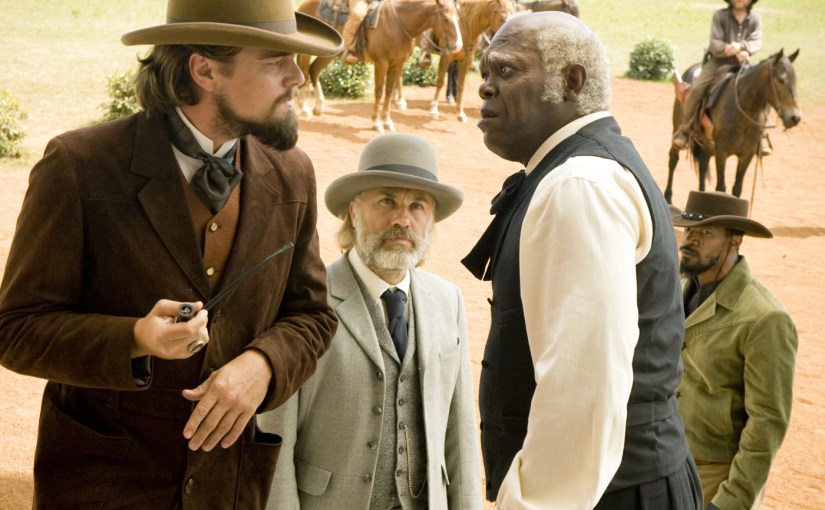
Django Freeman (Jamie Foxx) is released from slavery by the former dentist now bounty hunter, Dr. King Schultz (Christoph Waltz, in his second Oscar winning performance cast by Tarantino).  Django is a good man, though uneducated and mostly illiterate.  Once he assists the doctor with locating and collecting a bounty, the two make an arrangement to stick together through the winter collecting further ransoms.  In return for the former slave’s help, Dr. Schultz will assist in rescuing Django’s wife, the German speaking Broomhilda (Kerry Washington).  She is believed to be held at the infamous Mississippi slave plantation known as Candyland, owned by the ruthless Calvin Candie. He is played by Leonardo DiCaprio in one of his best roles while also delivering one of his most unforgiving portrayals.  Calvin Candie is a mean son of a bitch slave owner who has too much fun with investing in slaves for brutal Mandingo wrestling matches that don’t finish until the loser is dead in bloody, bone cracking fashion.  

All of these figures belong at the top of Quentin Tarantino’s list of sensational character inventions, particularly Django.  He has more depth than most of the writer’s other creations.  This guy goes from an unkempt, nearly naked, tortured and chained slave to a free man proudly wearing a bright blue court jester costume on horseback.  His third iteration places him in a gunslinger wardrobe comparable to a Clint Eastwood cowboy and when the conclusion arrives, Django is meaner, more confident and instinctively wiser, glamorously dressed (purple vest with gold inlay designer seems) like a graphic novel superhero ready to take on an endless army of redneck slave abusing outlaws.  Django is taught everything he needs to know from Doc Schultz.  Christoph Waltz and Jamie Foxx stand as an impressionable mentor/student pair.  They are the spine of Django Unchained.

The villainy of the piece belongs to DiCaprio and his head slave in charge, known as Steven, played by the director’s go to player for happy street slang and N-word droppings, Samuel L Jackson.  Steven is Jackson’s best career role because as an old, decrepit and frightening individual it’s this portrayal which looks like no other part the actor has ever played.    Both actors are funny, and you can’t take your eyes off of their unlimited grandstanding, but they will leave you feeling terribly uncomfortable.

I think what is most unsettling about Django Unchained is that the cruelty persists for nearly the whole three hour run time, and it is more so at a shameless attempt of comedic, pulpy entertainment, rather than just insight and education.  A Schindler’s List finds no glee in the torment that kept the Holocaust alive.  Tarantino didn’t even go to great heights with Inglourious Basterds because that film featured ongoing grisly heroics with his assortment of vengeful protagonists.  The Nazis were never celebrated in that film at the cost of innocent Jewish lives that faced peril and threat.

In Django Unchained, it’s hard to watch the Negro characters and extras getting brutally whipped while bound by inescapable chains.  Kerry Washington’s nude character is yanked out of a sweat box on the Candyland plantation and while I’m watching it, I ask myself if I’m too much of a prude.  No.  I don’t think I am.  This teeters on torture porn. The N-word is now being used way too freely to stab at the slaves for gleeful poetry. It grows tiring and, yeah even for a Quentin Tarantino picture downright ugly and offensive. I imagine Tarantino grinning behind the camera every time DiCaprio or Jackson happily drop another N-bomb.

Quentin Tarantino has been applauded time and again for his excessive abuse and tortuous murders committed by his characters.  Because he’s courageously gone so far before, the line of acceptance is either pushed out farther or maybe in the case of Django Unchained it is entirely erased.  

My compliments to a well-known humanitarian like Leonardo DiCaprio for energetically acting through this bastard of a role that requires a twisted pleasure in watching two husky black bruisers beat the bloody tar out of each other in a formal drinking parlor.  Later in the picture, a weeping slave is shredded to pieces by ravaged, bloodthirsty dogs.  These fictional scenes staged by Tarantino and his filmmakers come off a little too real and even by the director’s standards much too over the top for the temperature of this film’s narrative.  

What could these extras cast to play these slave and Mandingo roles have really been thinking while shooting this picture?  Did these men recognize the racially poetic humor in Tarantino’s verbiage? Did they find a commitment to demonstrate a once historic atrocity for a lesson learned? I doubt it. Did these actors simply succumb because they needed the work?  Believe me.  I empathize.  Yet, Tarantino took this film to a very uncomfortable extreme for a movie intended on following his reputable and always admired lurid material.  Here, despite my reverence for his work, I think Quentin Tarantino goes unnecessarily over the line.  The whippings and dog torture are quite uneven from what The Bride commits in Kill Bill when a Crazy 88 henchman gets spanked with a sword and there’s nothing to compare to whatever sick, graphic novel atrocities occur in his later western, The Hateful Eight – both are PG rated compared to what is offered in Django Unchained.

Much of Tarantino’s signature comedy works.  The Ku Klux Klan of the late 1850s are represented with brilliant stupidity by a cameo appearing Jonah Hill and a racist, foul speaking, plantation owning charmer played by Don Johnson, known by what else but Big Daddy.  The filmmaker turns these guys into bumbling stooges who can’t even wear their hoods properly. And yes, they also freely drop the N-word in cruel like fashion. I get it, Mississippi and Southern Plantation owners were not the Mickey Mouse sort, and I’m not asking for whitewashing what the real-life despicable characters stood for or how they carried themselves. Still, when all of this compounded together, it goes too far. In a drama like 12 Years A Slave, I see an authenticity to an ugly slave era. In Tarantino’s world, I see a kid who learned a bad word and dad said go ahead son, play with the machine gun but make sure the vocabulary ammo will riddle the entire script to pieces.

Django Unchained is a gorgeous looking picture.  Tarantino goes to the outdoor plains following the interiors of Pulp Fiction and Jackie Brown.  Jamie Foxx and Christoph Waltz’ cowboy antics look marvelous riding on horseback or even simply camping by the fire as well written exposition is revealed on cold moonlight evenings.  

I can watch this western on repeat and feel a free-spirited energy when Django steps out in his cowboy outfit with boots, spurs, the hat, and a brand-new saddle to ride off on his steed while Jim Croce’s uplifting “I Got A Name” cues into the picture.  I love how Jamie Foxx appears as a super heroic action star, especially in the final act of the movie.  I can absorb the sadism of DiCaprio’s downright mischievous evil, particularly when he uses a bone saw and skull prop to make a point.  I feel like I’ve gained a comforting friend in Christop Waltz’ kindly sensible Doc Schultz, and I welcome a very funny and altogether different Samuel L Jackson that finally arrives.  

It’s the filling within these strong moments and characterizations that is very hard to swallow.  Django Unchained is that great picture that still should have been made but with a modicum of caution. Perhaps one of the Weinsteins, or maybe even these powerhouse, marquee actors who led this piece should have shared some constructive input with the writer/director.

Django Unchained is fun, but it’s not entirely fun.

COLLATERAL

By Marc S. Sanders

A salt and pepper haired gentleman in a knitted suit with sunglasses arrives at LAX before the sun sets.  He exchanges bags with a man he runs into, played by Jason Statham. Elsewhere, a driver does a polish and check on his taxi cab before beginning his evening shift.  He picks up an attractive, overworked attorney named Annie (Jada Pinkett Smith) and before she hands him her business card, the driver has at least convinced the woman to re-examine her life’s purpose and consider simple ways to escape reality.  The man in the suit is Vincent played by Tom Cruise.  The cab driver is Max played by Jamie Foxx.  They are about to collide with one another on this night and put Michael Mann’s film, Collateral, into play.

Following being a massive fan of the TV show Miami Vice, and the films Thief, Heat and The Insider, I remember my anticipation sky rocketing when I saw the trailers and write ups for Collateral.  Mann, Cruise, Foxx, and crime in a cool looking L.A. with a symphonic soundtrack? I’m there!  It seemed like a perfect formula.  When I finally saw the movie, I think I was let down because it was too formulaic following a step-by-step recipe.  The editing for Collateral is abundantly cookie cutter, never taking any risks with its story.

Vincent chats with Max as soon as he gets in the cab.  He offers eleven hundred dollars to occupy Max’ evening, transporting him from one location to the next. Max has dreams of running his own limo company one day and this easy money is too good to resist.  It’s only when Vincent tosses someone out a fourth-floor window to land on the roof of the cab that Max realizes there’s a hitch to this arrangement.  

Vincent is a hitman out to check off a list of targets before sunrise, and he needs Max as a cab escort.  Threats to Max’ ill mother in the hospital will keep the driver in check, and if inconveniences like a shattered windshield draw the cops’ attention then Max will have to abide by Vincent’s demand for no interference with his plans.  

The two hour running time of Collateral is structured on one stop after another.  Mann abides by side scenes from Stuart Beattie’s script to look at the undercover night detective (Mark Ruffalo) who is one step behind the pair’s frequent stops within the city.   I guess it’s fortunate for this guy that ballistics and coroner’s reports are quickly and readily available within minutes and hours to connect some dots.  

In between the kills, Vincent and Max chat in the cab.  Standard stuff really where Tom Cruise is at one time charming and other times sociopathic.  Jamie Foxx is the bright but frightened guy with dialogue that doesn’t amount to much in convincing this unwanted passenger to either let him go free or to give up on his mission.

Ironically, the many scenes shared between Tom Cruise and Jamie Foxx are the least interesting parts of the film.  When the sound editing isn’t failing by making their dialogue sound like incoherent mumbling, neither guy is ever convincing the other to look in a new direction or consider another idea.  Therefore, the conversations never go anywhere.  Look at films like The Silence Of The Lambs, Cape Fear, Seven, and especially Mann’s best picture to date, Heat by comparison.  Those films work when either the antagonist or protagonist allow themselves to consider the arguments, even if it’s just for a second, against the ones they are debating.

There is action and violence in Collateral, but it’s really a talking piece.  Still, the best exchange of dialogue occurs with Foxx and other cast mates besides Cruise.  A great scene occurs when Vincent insists that Max act under the guise that he is Vincent when he has to report to the drug kingpin employer who originally hired him (a surprise welcome from an at the time unknown Javier Bardem); great acting and writing happening here.  The early scene between Jada Pinkett Smith and Jamie Foxx also works at a thought provoking and interesting level.  These scenes are short one act plays that belong elsewhere.  Jamie Foxx is doing some great work in these moments.

Unfortunately, when Foxx and Pinkett Smith reconnect later in the film, they are not written with the same kind of intelligence during a run and hide third act climax.  The suspense is absent here because the setup is ridiculous.  While standing on the top level of a parking garage, Max can easily see Annie in a fourteenth-floor office window, blocks away across the city, and specifically direct her where to run from the dangerous killer who is a few floors below, all while using a dying cell phone.  

More to the point, why is Annie still wearing a suit and heels, with her hair and makeup done up, at four o’clock in the morning? I know an aggressive lawyer never stops working, but don’t they go home, pour a glass of white wine, get into sweats and pop open the laptop while Miles Davis plays softly on the stereo?  How would these guys even know this is where Annie would be at four in the morning? Reader, you might tell me to dismiss what’s merely circumstantial here, and normally I would.  Yet, if I’m an expert hitman like Vincent is supposed to be, my first instinct is to go to Annie’s home first before the office in the middle of the night.  It’s the circumstances that negate the believability of the main character.  

As expected, Los Angeles looks moody and cool like in any other Michael Mann picture.  He’s got blazing overhead shots that emit a white glow in the thick of night.  The wolf is holding a fang and claw to the neck of the sheep as they careen through this endless city maze.  In that respect, the environment of this film works like a great character game master. What turn or straight avenue or bridge is going to work in either saving Max or getting him killed?

The technique of this filmmaker, who I usually favor, is here.  It’s been seen many times before for the other sharp, well-dressed killers in Michael Mann’s worlds. I welcome it back, but it’s not new or inventive in Collateral.  I guess that’s why the film is ordinary.  It lacks the depth that other productions from Mann rely upon.  The setups are quite amateurish and most of the talking is wholly uninteresting.

In spite of a phenomenal and reputable cast and crew, it’s a shame this Michael Mann installment is only ho hum in its finished product.  Collateral needed another script rewrite, followed by some additional reshoots.  There was a better movie to made here. 

BABY DRIVER

By Marc S. Sanders

The first chords of the alt rock number “Bellbottoms” by The John Spencer Blues Explosion kick in and we see four people donning sunglasses in a parked car. Three of the people get out to rob the bank across the street. The driver known as Baby stays behind to rock on to the beats playing on his iPod. When the other 3 return, the car chase through the streets of urban Atlanta is on.

Edgar Wright’s quirky imagination delivers a balletic symphony of action, cars, guns, romance and music. His title character played with cool swagger by Ansel Elgort suffers from tinnitus and can only operate with a select tune that maintains the best his character needs to function.

With Lily Collins playing Elgort’s love interest you get moments as sweet as strawberry ice cream as they envision a life together driving down I-85 with music as their companion. But Baby is committed to underboss Doc played by Kevin Spacey and is forced to chauffeur ruthless criminals played by Jon Hamm, Jaime Foxx and Jon Bernthal. They are great in their respective parts by the way.

Music is Wright’s main device here. The dialogue, the gunshots, the screech of tires and the close ups for romance all travel to the beat of the film’s lengthy soundtrack including renditions of “Harlem Shuffle” and “Easy” by The Commodores, which I’ve developed a new fresh affection for.

The editing is quick, never relying on CGI. Car chases are actual car chases here. The cameras are held steady and close ups of Baby and other drivers blend perfectly with the action scenes.

Baby Driver is one the best films of 2017. It presents what it promises by introducing a new way for action delivery. Elgort makes a great character who provides casual dance both behind the wheel and outside of the car. I always like to see a character dance or lip sync. It reminds me of what any of us are capable of without any special effect to enhance the moment. Dancing can be as natural for any of us, much like it is for Baby.

QUICK TAKE: Jarhead (2005)

By Miguel E. Rodriguez

Director: Sam Mendes
Cast: Jake Gyllenhaal, Peter Sarsgaard, Jamie Foxx, Chris Cooper
My Rating: 10/10
Rotten Tomatometer: 61%

PLOT: A newly minted Marine sniper is sent to Iraq as part of Operation Desert Shield, only to find himself slowly losing his mind as he waits for a chance to make his first kill.


If Three Kings was the Gulf War version of Kelly’s Heroes, then Jarhead is the Gulf War Full Metal Jacket.  It’s a glorious paradox: a war film where it looks like the hero may never get to fire his weapon.

Jake Gyllenhaal is phenomenal in the lead role of Swofford, but Jamie Foxx steals every scene he’s in, as Staff Sergeant Sykes.

There’s beautiful imagery in the film, from the oil fires in the desert, to an arresting dream sequence where sand makes an appearance from a very surprising place.

I don’t know why, but I empathized a LOT with the Swofford role.  He learns how to use his sniper rifle with deadly force, he finally gets shipped out to where the fighting is…and air power nearly makes him obsolete.  What are they even doing there if airplanes can end the battle in minutes instead of hours?

There’s a great line when someone hears a helicopter flying overhead, blaring The Doors from loudspeakers.  A soldier looks up with exasperation: “That’s Vietnam music…can’t we get our own music?”  These guys wanted to fight, to carve their place into the history books with honor, and blood.  They wanted to distinguish themselves from their fathers or grandfathers who fought in other faraway countries.  The soldiers in the Gulf War of this movie wanted to “do it right.”

Jarhead offers searing insight disguised by a simple story.  It puts me into the head of a soldier who wants to do the right thing, the honorable thing – hell, ANYTHING – and who finds himself frustrated.  It struck me, and still does strike me, on a level I never expected.  I don’t know if I’ve clearly elaborated that with this review.  But there it is.

JUST MERCY

By Marc S. Sanders

I’ve learned so much from movies. I really have, and I’m continuing to learn. An important lesson that I absorbed from Destin Daniel Cretton’s film Just Mercy is that we have a long way to go in this country. A racial divide is sadly still in existence. As I watched this film while the nationwide protest response to the killing of George Floyd is still prominent, it’s glaringly obvious that this story, taking place from 1987 to 1993, has likely only made a tiny dent in the reach for equal and fair justice between black and white Americans.

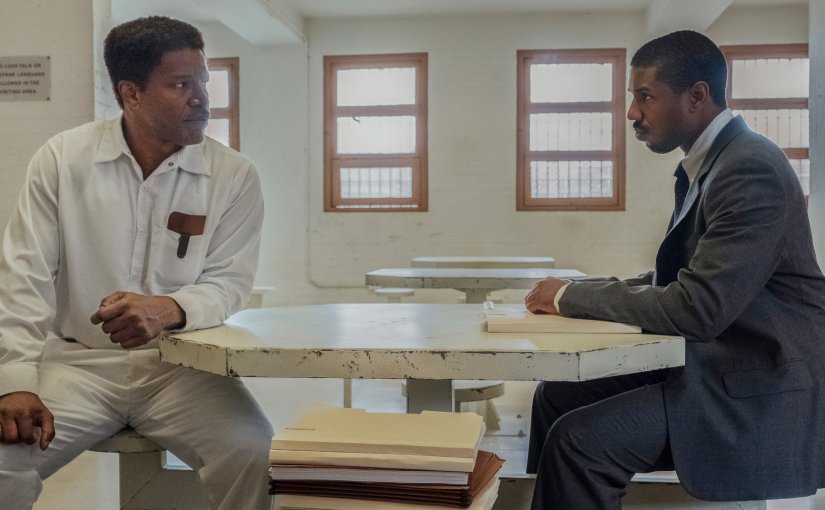
Just Mercy follows newly appointed Alabama civil rights attorney Bryan Stephenson’s (Michael B Jordan, who I still insist will win an Oscar one day) pursuit to overturn a murder conviction for Walter “Johnny D” McMillan (another magnificent performance from Jamie Foxx). Johnny D was easily ruled to have murdered an eighteen year old white woman. The trial hinged on the testimony of another convict (Tim Blake Nelson) pressured into making up an outrageous story that put Johnny D at the scene of a crime he had nothing to do with. All that mattered was that the all white jury believed this ridiculous testimony.

Bryan is newly graduated from Harvard University with nothing but righteousness and the intent of making a difference in this world. Against his family’s urging for fear of his life, he deliberately moves to Alabama with Federal Grant money to start the Equal Justice Initiative (EJI) with Eva Ansley (Brie Larson), a passionate white southern mother who is prepared to face the danger of a prejudiced community that’s hypocritically proud to boast that it is the hometown of writer Harper Lee (To Kill A Mockingbird). Bryan is informed that he can actually visit the Mockingbird museum and see where Atticus Finch actually stood. I question if the majority of Monroe, Alabama have even read Lee’s book.

Bryan’s intent is to research and represent those prisoners that likely never received a fair trial. One man is a Vietnam veteran who did in fact kill a woman with a home made bomb. Sadly though, his PTSD likely motivated this regrettable action. This man is more mentally ill than guilty and his country could care less.

Most of the film’s focus goes to the egregious acts that convicted Johnny D. While it’s plain to see how innocent he is, Bryan is faced with bigoted pushback from the local police force as well as the District Attorney (a very good and effective Rafe Spall). Bryan obtains a material witness but then that is compromised. Now he must rely on if the convict who originally testified against Johnny D will come clean with telling the truth.

There’s a lot you can become more aware of while watching Just Mercy. First, our legal system can be very tainted with extreme prejudice. Second, slavery may have been long abolished by the end of the twentieth century, but it’s racial underpinnings and need to dominate a black community still appears justified in many southern eyes. There’s a sad food chain that exists in the state of Alabama. It therefore becomes an impossible obstacle for Bryan and Johnny D when they take their case to the state Supreme Court. This doesn’t take a law degree to recognize such an apparent wrong. Yet, that means nothing if the judicial system won’t even read a simple and otherwise obvious explanation.

A third aspect that Just Mercy presents is police brutality against black men. It exists. A black man, such as a hard working tree cutter like Johnny D or a Harvard graduate in a suit, can get pulled over. The man can cooperate completely with hands shown and calm politeness when faced with an authority. Yet, with next to no action that black man will suddenly have a gun drawn on him and get slammed against a truck and put in handcuffs.

Moments like this continue to occur simply because of the color of their skin. It matters not where they were going or where they were coming from. If they just look guilty, then they must be guilty.

Just Mercy is a demonstration of a large menu of wrongs being committed against black America. Cretton’s script with Andrew Lanham, is a well edited and focused film that doesn’t drift into any side stories. Bryan Stephenson seemingly takes in a lot of cases all at once but for a two hour and twenty minute film, only so much can be presented.

Yes, Johnny D’s case is most prominent but time is also devoted to what could be his overall fate, a trip to the electric chair. Bryan Stephenson sees this first hand with another case. It is often a wrong and terrible outcome but it at least amplifies his motivation to represent these wrongly convicted men.

Bryan Stephenson is a tremendous hero portrayed by a humble yet passionate performance from Michael B Jordan. How many Harvard graduates would truly take their expensive Ivy League degree and put their lives on the line in an unwelcome community with no pay to save the lives of convicts who no one else has ever regarded?

Most especially during the current climate of our country, Just Mercy is an absolute must see film.