CLEAR AND PRESENT DANGER

By Marc S. Sanders

Tom Clancy’s Jack Ryan finds himself in an inadvertent private war between the United States and Colombian drug kingpins in Clear And Present Danger.  Harrison Ford returns as the heroic government operative. I like this film for much of the same reasons I liked the prior Jack Ryan pictures.  These movies give an inside view of internal politics within Congress, the CIA and inside the hallowed halls and Oval Office of The White House.  The Clancy adaptations are not just about action set ups and shootouts.  Though we are treated to plenty of that material as well.

The film opens with a luxury yacht being raided by the Coast Guard. They uncover Colombian killers that have murdered a wealthy American and his family for reasons of a failing partnership with drug dealers.  The incident can be bridged to the President played by Donald Moffat, a terrific character actor who also shared the screen with Ford in Mike Nichols’ Regarding Henry. He secretly initiates a retaliation for what has occurred while also insisting on collecting over six hundred and fifty million dollars he feels the US is entitled to, following his friend’s murder.  Henry Czerny, playing a carbon copy of his role in Mission: Impossible, headlines the covert plot and recruits a mercenary named John Clark (Willem Dafoe) to place a clandestine militant team into the South American jungles to take out the drug runners one by one.

The suit and tie formal dynamics fall on Jack Ryan when he swears testimony on the legitimacy of the country’s response.  However, the President’s armament exercises are unbeknownst to Jack.  When it finally dawns on him what has been occurring, into the field Jack Ryan goes to clean up the mess.

A lot of spinning plates structure the storytelling of Clear And Present Danger which is on par with Clancy’s thousand-page novels.  There’s an abundance of characters to address, betrayals to happen and even the mechanics of various weaponry and policy decisions that need exploring, despite the innate complexities of it all.  It can feel overwhelming.  However, with this film, as well as with The Hunt For Red October and Patriot Games, I feel included.  If you’re patient through the exposition and set ups, then these fictional controversies become very absorbing, and you feel like you’re there.  

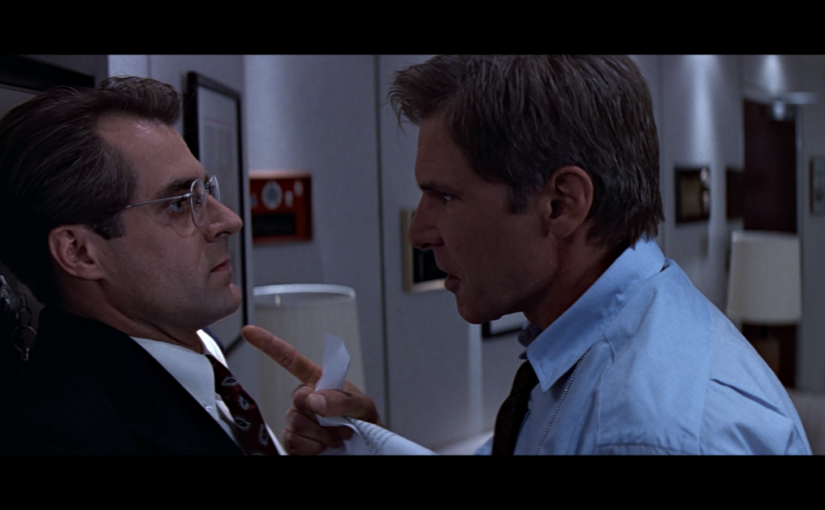
There’s a great scene between Ford and Czerny racing to download vs delete some suspicious files on a computer.  These guys are in their boring offices, dressed in their boring suits and they’re clicking on the mouse pad and typing away on the keyboard.  Director Phillip Noyce gets nail biting back and forth closeups on each guy as they are off to the races trying to get ahead of each other.  Then it becomes a yelling match in the hallway with threats of prosecution between both men, and I feel I’m in on the whole thing.

There is also a good amount of internal conversations between the main drug czar (Miguel Sandoval) and his top henchman (Joaquim de Almeida).  Almeida’s role is written very well as we witness how smart and resourceful he is while protecting the best interests of his employer.

For the most part, the action is nothing special.  However, the highlight of the whole film involves an SUV convoy getting ambushed by Colombian terrorists mounted on rooftops firing missiles at the government vehicles below.  Harrison Ford prefers to do as much stunt work as possible and it definitely helps the ten-minute sequence.  This is an outstanding part of the picture with perfect editing of sound and photography. Later on, we see Ford leap on to the landing gear of an ascending helicopter. Very impressive. Harrison Ford always does his best to invest himself in his movies.

I also admire many of the explosions that went into the Special Forces’ continuing storyline of sabotaging the drug lords’ laboratories and various locales. Nothing is miniaturized here, and the resulting blasts are really big and eye opening. This movie did not shortchange on anything it was attempting to accomplish.

The film adaptation of Clancy’s fourth book takes some major liberties.  In the novel, the story is primarily focused on John Clark and his mission, with Jack Ryan not appearing until after the midway point.  However, at this stage of Harrison Ford’s career there was no way he’d accept just a supporting role.  The notable changes hold well within the screenplay though, and a showdown between Jack Ryan and the President is one for the ages.

Overall, Clear And Present Danger was a successful picture at the box office. Critics and Clancy fans alike had favorable responses to the picture.  So, it’s disappointing that producers decided to try numerous reinventions of the Jack Ryan franchise subsequentially.  Those other movies, along with a TV show, would prove well.  Yet, it is regrettable that Harrison Ford, or at least this interpretation of the hero, did not move on through Tom Clancy’s ongoing stories transcending within other areas of government and espionage.  If you have read the books, then maybe you recall the unbelievable ending to Without Remorse.  Boy, would I have loved to see what Harrison Ford did with the cliffhanger that closed out that book. Care to know? Then this Unpaid Movie Critic suggests you pick up a book.

NOTE OF TRIVIA: James Horner conducts the music for this film and he includes samples that were used in the beginning of Aliens. Interesting to catch this as the music works for both a science fiction piece, as well as for a political thriller.

PATRIOT GAMES

By Marc S. Sanders

You may remember Patriot Games as a tense thriller featuring the favorite hero Jack Ryan doing the wherewithal action that is demanding for the adaptation of Tom Clancy’s best-selling novel.  Harrison Ford (taking over the role from Alec Baldwin) plays the guy who will thwart an assassination attempt on the Royal Family or punch out a terrorist thug invading his home or on a speed boat during a dark and stormy night.  Only a small bit of the action sequences are flawed, but that doesn’t take away from what makes the picture truly special.  In the follow up to The Hunt For Red October, Jack Ryan goes back to the CIA to investigate who wants revenge against him and who was responsible for that assassination attempt.  What the picture serves as the covert halls of the Central Intelligence Agency is what is especially convincing and most fascinating.

On the surface, the Irish Republican Army appears to be the scapegoat for attempting to murder members of the Royal Family as they are pulling out of the front gates of Buckingham Palace.  Jack Ryan is in London vacationing with his wife Cathy (Anne Archer) and daughter Sally (Thora Birch) when he comes upon the incident just in time to foil the crime.  In the process, Ryan takes a bullet to the shoulder and kills the younger brother of the most dangerous squad member, Sean Miller (Sean Bean).  A quick trial puts Miller behind bars and Jack is recognized as a hero.

However, Sean Miller escapes with his surviving comrades and vows revenge on Jack and his family.  An attempt is made on the Ryans’ lives and Jack insists on getting back into the CIA to locate Miller and his team.

The revenge plot is the main thread and its pretty ho hum.  We’ve seen all that many times before.  However, what branches off are the conflicts within Irish politics and how Jack Ryan gradually uncovers who and where this small faction of terrorists may be.  Cold War commentary is delivered by an under the radar performance from one of my favorite character actors, Richard Harris.  He attempts to deny responsibility of these attacks and offer an olive branch to Ryan.  Ford and Harris have three good scenes together, two of which are minimal on dialogue but effective in sending their messages to one another. 

As well, Harrison Ford occupies another great heroic role.  I agree with a majority who believe he was too old to play the novice Jack Ryan described in Clancy’s early novels.  Many insist casting Baldwin was perfect.  It was. Yet, I am able to look past that as the character does not have the rookie appearance or regard in this picture.  With Harrison Ford, Jack Ryan is now at a point where he looks seasoned and experienced like the character eventually becomes in the book series.

Director Phillip Noyce is good at using the mysterious and quiet orchestral accompaniments of James Horner to follow Jack as he studies photographs or reflects on the day of the assassination attempt in order to piece together random clues.  In other films, this might get boring and tedious.  However, the director captures good closeups of Harrison Ford and quick flashbacks are edited to help identify what were important blink and miss it moments necessary to assemble the puzzle.  A simple visit to the restroom for Jack Ryan and a glance at a woman’s ponytail lead to a solid conclusion.

Sean Bean has the physical and quiet intensity to his role.  He’s the muscle of the terrorist group, not the leader (played by Patrick Bergen).  Bean serves the revenge element and his physique and weapon handling work well as a nice threat to the hero of the picture.

As the story progresses, the audience follows along with Ryan.  Satellite photographs are studied and zoomed in seeking some semblance of an image in a blur.  Sometimes Jack Ryan is moving in the right direction but in other times he’s unsure.  Even though we always know how the bad guys are doing and where they are, we empathize because Harrison Ford’s character does not.  Still, it’s a thrill to witness him eventually make his discoveries.

A nice approach occurs when the CIA sends in troops to what they believe is an enemy base camp.  We watch Jack Ryan and all of the government officials stare with intensity on a big screen as little black pixels drop down and move at a running pace from an overhead satellite shot.  We don’t have to endure one more machine gun battle.  This kind of intensity is much more interesting where lives are taken as a means of protection, but still a principled man like Jack Ryan does not feel good about what has to be done.

Patriot Games works well with its plays on espionage, spy activity, traitors, and government relations between America, Great Britain and Ireland.  The select action scenes are done well and hold their suspense for quite long.  However, the final sequence is challenging to sit through. 

As the enemy prepares a covert attack on the Ryans’ Virginia home where the Royal Family are guests, there is much running around upstairs and down, in the basement, and outside the roof and so on.  It’s pouring rain with the standard thunder and lightning in the middle of the night as well.  Once the villains and the hero make their way to some getaway boats, the film unravels.  The picture shakes like crazy against the waves and rain.  There’s little light on any of the shots as well and the sound goes loud due to the boat engines and the storm setting.  All of these elements make it challenging to get absorbed in the movie’s climactic ending. 

Hollywood pictures fall back on this approach often in films like Ang Lee’s Hulk and the first installment of The Hunger Games.  It’s dark and wet and shaky and rainy. So, it is hard to decipher who is hitting who and who is shooting at who and who is driving which boat and where are they now.  It’s a shame really because Patriot Games is a taut thriller that holds your attention for nearly two hours, but then you give up in the final few minutes to simply rely on your instincts for how the story is going to wrap itself up.

Jack Ryan’s second adventure is worth watching but oddly enough, maybe wait for your restroom break until the last ten minutes of the picture.

FIELD OF DREAMS

By Marc S. Sanders

Fantasy can be a real challenge.  The audience must convincingly accept what could never possibly be real.  The Wizard Of Oz from 1939 will always be the best of all fantasy films.  The most visually significant element was bookending the film in black and white, with illuminating color in the center for the Land of Oz to come to life.  You feel transported.

Phil Alden Robinson’s screen adaptation of W.P. Kinsella’s novel, Shoeless Joe, had a big challenge.  The film became known as Field Of Dreams.  How would any of us believe that an Iowa corn crop farmer hears voices and gets the inspiration to throw all common sense out the window and build a baseball field in the middle of his property?  It’s absurd.  Maybe only Kevin Costner, a modern-day innocent Jimmy Stewart of the time in the late 1980s, would convince any of us that this is something that needs to be accomplished.  Robinson’s script offers no logic that any of this should be done.  Re-watching the film, I was still skeptical of accepting the outrageousness.  Then again this is Kevin Costner in his mid-thirties with a toothy grin on his face, chestnut hair, beat up jeans, and an adorable 8-year-old Gaby Hoffman for a daughter and a spitfire Amy Madigan for a wife.  I can’t explain it any more than Ray can explain to his wife why he needs to tear down acres and acres of valuable crops for a baseball field that’ll run him into enormous debt. You just gotta roll with it, I guess, even if your suspension of disbelief isn’t there. 

Thankfully, the authenticity of the fantasy welcomes itself as Field Of Dreams moves on. 

Costner plays Ray Kinsella who had a very estranged relationship with his father who only briefly played in the minor leagues before aging quickly and working himself towards a premature death.  Ray went on to Berkeley in the ‘60s and got caught up in the hippie movement leaving his father’s baseball heroes of Ty Cobb, Rusty Miller and “Shoeless” Joe Jackson behind. 

After Ray builds the beautiful field and waits months and months for something, anything, to happen, the ghost of “Shoeless” Joe Jackson, (Ray Liotta) donned in his White Sox uniform, appears.  Jackson was part of the infamous Black Sox scandal and was denied of ever playing professional baseball again, following being caught accepting bribes to fix games with seven other teammates.  Ray spends the evening with Joe pitching and fielding together.  Now, whatever hasn’t made sense to the viewer suddenly presents some light on this outrageous feat we’ve been witnessing.  Dorothy has met the Scarecrow.

Ray has dreams to find a recluse author named Terance Mann (a superb James Earl Jones who should’ve gotten an Oscar nomination; just an astonishing actor).  Later, he meets a ball player who only played one inning in the major leagues, Archie “Moonlight” Graham – portrayed charmingly by an elderly Burt Lancaster and a spry Frank Whaley.  How they both play the role is a surprise I’ll withhold from this write up.

I share this summary because Field Of Dreams improves itself as it progresses.  The ghosts, the fantasy, and the sheer nerve that Robinson (director and writer) grants to Costner and the cast send you into the imaginary.  You’ll be twenty minutes into the picture and ready to give up.  Thankfully, the storyteller who made the film introduces something unworldly that encourages us to learn more and more.  That’s what happens every time you watch The Wizard Of Oz.  Not just the color, but the décor and strangely adorable munchkins draw you in with curiosity and you want to discover more about this place you’ve never visited before. 

With Field Of Dreams, you don’t have to know anything about baseball.  What you need to understand is that people of a past enter Ray’s life when he never expected them. Now, he’s destined to aid them in fulfilling what they were denied of during a time gone by. 

We all wish to take advantage of our dreams gone by.  Fantasy makes that possible.

Perhaps Ray Kinsella was denied an experience, as well.  You’ll have to watch Field Of Dreams to find out.

ROGUE ONE: A STAR WARS STORY

By Marc S. Sanders

On my 4th viewing of this film, I second guessed myself over and over. I know I’m a Star Wars junkie, but can I truly give an objective opinion about Rogue One? I think I can.

Rogue One: A Star Wars Story is of one of the best films of the last ten years. Now there are conditions that accompany that observation. It’s difficult to follow its trajectory if you haven’t seen A New Hope (the intended follow up story; the original Star Wars film). Frankly, reader if you are watching this film without ever watching A New Hope, I’d imagine you’ve been on a deserted island with a volleyball for a friend, unaware of this pop culture geek-oriented phenomenon from a galaxy far, far away, and upon your return to civilization you were just randomly flipping the channels. So, let’s just go ahead and dismiss that parameter right now.

Disney is the only studio with enough resources and scrutiny to ensure a good product is developed in the franchise. Rogue One proves that theory. From the Rebel uniforms to the Stormtroopers, to the Yavin 4 set recreation, and even a harkening back to Darth Vader’s original 1977 appearance (red eyes in the helmet), director Gareth Edwards, Lucasfilm and Disney ensure consistency in its side chapter apart from the 9-part saga. You relish the familiarity of it all, and what’s new you welcome with appreciated enthusiasm. It all works within the long-established universe.

The cast is superb with major highlights from Felicity Jones as Jyn Erso (great name) as a brash no nonsense rogue in and of herself. Jones comes off with tough bravado reminiscent of Susan Sarandon and Geena Davis, as well as Jodie Foster. Nothing will intimidate her, though she will show her heart and soul for her father, the reluctant architect of the Empire’s Death Star played by Mads Mikkelson, an important character to the story but not much material for him to capitalize on.

Alan Tudyk is a marvelous voice actor here as the tall droid K2SO, with a personality combination of Chewbacca & C3PO. He’s honest, maybe a little to honest, but he’s also physically strong and a smart aleck. His tone is Anthony Daniels, but his delivery is snide and arrogant. He’s just so entertaining.

Ben Mendohlson plays Imperial Director Krennic as a frightening antagonist who embraces the terror of this super weapon he oversees. “Oh it’s beautiful,” he sighs and really believes he sees beauty as a planet gradually combusts under the laser blast emanating from the Death Star. He expects greatness from his accomplishments and Mendohlson is also good at surrendering to what he’s not permitted to celebrate thanks to a strong Darth Vader and welcome return of Grand Moff Tarkin, a beautifully recreated CGI of deceased actor Peter Cushing. Tarkin is important to the Krennic storyline and his insertion in the film is flawless.

The cast also boasts Donnie Yen. He’s a real crowd pleasing blind martial artist. Not a Jedi, yet arguably even more fun.

The planets are crowded and different. Scarif where the final battle takes place is draped in palm trees and ocean blue. Great because it’s daylight setting allows all the action to be seen. Nothing is blurred.

The story structure is phenomenal as it centers on a race to make contact with an Imperial pilot who has just defected and then on to Jyn’s father in order to prevent this new Death Star from going into operation. I especially salute its honest, uncompromising, but still necessary ending. You’ll get a lump in your throat, followed by an adrenaline shot of excitement in the last five minutes. The end is pure genius. One of the great cinematic endings. Absolutely absorbing.

I really appreciate the various demographics in the film as well. For a story about an unending and lived in galaxy everyone should look and sound different. So, we are treated to Caucasian, African American, Hispanic, Asian, and English, and then you have the droids and fictional alien species.

If anything is shortchanged, it might stem from some of the actors’ dialects. Forrest Whitaker, Diego Luna and Riz Amed play primarily roles that at times are hard to comprehend, even in a fourth viewing. This is forgivable though. The story lends value to all of the players on screen.

So yes. Rogue One: A Star Wars Story is sensational; the best of the 4 Disney produced films thus far. There’s weight to its story, and its characters on both sides. It moves at a fast pace of action, dialogue and runaway suspense. It will go down as one of the best installments in the vast franchise that’s thrived for over 40 years so far.

THE HUNT FOR RED OCTOBER

By Marc S. Sanders

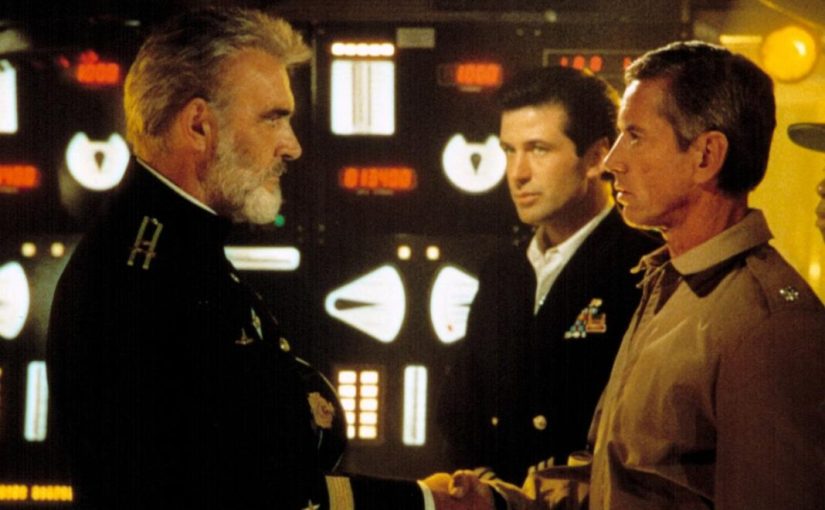
John McTiernan’s adaptation of Tom Clancy’s first bestselling novel, The Hunt For Red October, might seem dated but it’s still a crackling good thriller. It’s one of those films where you truly feel like you’re walking through the secretive hallways of DC government buildings with their elevators accessed only by an Admiral’s key. Soon you’re in a dark, underground boardroom. You’re also there on the various naval crafts and submarines with alarming lights, shiny steel and glowing monitors. The biggest treat is being in the command center of the titled sub, Russia’s Red October, commanded by their captain, Marko Ramius (Sean Connery). All in all, Terence Marsh built a convincing production design.

Clancy’s story takes a different approach than most thrillers involving Cold War politics. Ramius might have been a James Bond villain in another film as he hijacks Red October, but there’s more to him actually. Rather, Ramius wants to defect to the United States. Most of his command crew is in agreement as well. America doesn’t necessarily see it that way; a Russian, missile equipped submarine quickly approaching the eastern seaboard with other subs following him?!?!?!? Let’s not polish the tea set so quickly.

Fortunately, one man had the pleasure of meeting Ramius once and doing extensive research on the General’s background; Jack Ryan (appropriately cast with a young Alec Baldwin). Ryan is given three days to catch up to Ramius and guide him safely to the United States while avoiding getting the famed submarine shot down by either power nation.

I must point out my favorite scene and it actually takes place in that secret boardroom where it dawns on Ryan of Ramius’ true plan. Baldwin is great here. The young guy who is green when it comes to military and political protocol. McTiernan gets his company of generals and high ranking officials into a large quarrel over what to do and then he zooms in on Baldwin thinking for the close up before he calls Ramius a SON OF A BITCH. It’s at this moment, that the movie going consensus and fans of Clancy overall determined that Alec Baldwin was the best of the cinematic Jack Ryans. (No slight to Harrison Ford, who was too middle aged for the role when he took the part).

Connery at least has the commanding appearance of Ramius’ stellar reputation. He is not very exciting or charismatic. Then again, I don’t think Clancy built the character that way. Connery plays the role as silent, yet wise and experienced as implied by his well groomed, white beard and hairpiece plus his square stature. If this man is standing in your presence, you better give him an update. You shouldn’t have to ask if he wants one.

Good moments are made available to Scott Glenn, James Earl Jones, Sam Neill and Stellan Skaarsgard as well. It is the talking scenes among all these fabulous actors that really build tension. The underwater scenes…not so much. The subs look like long, black blobs weaving their way through depths and avoiding missiles coming their way. It’s forgivable because McTiernan always keeps the characters at play. This isn’t a film that relies on the dog fights depicted in Top Gun or Star Wars. McTiernan keeps his audience away from drowning in the underwater murkiness.

The makers of this yarn really are a great combination of imagination. We got Tom Clancy and John McTiernan to thank for a gripping tale from 1990 that still holds up today. The Hunt For Red October is definitely a film worth revisiting.

COMING TO AMERICA

By Marc S. Sanders

Now Coming To America is a special kind of film. It’s rare movie where you’ll find a G rated story wrapped in R rated material and ultimately that is what Eddie Murphy and director John Landis brilliantly achieved.

Murphy plays Prince Akeem living a privileged life in the country of Zamunda where he has his own personal butt wipers and concubines who ensure him the royal penis is clean. He is now of the age where he is ready to meet his bride who has been groomed since birth to accommodate every need and preference the Prince has. However, Akeem is mature enough to realize that he wants to be married to someone who likes him for who he is, and not his wealth and stature. So with his best friend Simi (Arsenio Hall) in tow, they travel to Queens, New York under the guise of poor, humble people to find Akeem’s true love.

The story is Disney like and very simple. The gags are what has allowed Coming To America to hold on to its beloved longevity over thirty years later. It is one of Murphy’s last great films before he resorted to a lot of silly kiddie tripe like Daddy Day Care. This is a film that does a 180 flip on the Beverly Hills Cop storyline. In Cop, Murphy was the loudmouth offensive stranger in strange land. In this film, he remains a stranger, only this time the setting is full of loudmouths; this is Queens after all. Akeem is a lovable guy with good intentions and sensitivity. When he meets Lisa (Shari Headley) the daughter of a McDonald’s rip off franchisee (a hilarious John Amos), he becomes enamored and approaches with care despite her dating a jerk (Eriq La Salle) who inherited his family’s “Soul Glo” hair product enterprise.

The best attraction of the film however are Murphy and Hall’s various other characters they portray like Murphy as Randy Watson, lead singer of the band Sexual Chocolate (you know him as Joe the Policeman from the What’s Going Down? episode of That’s My Momma) and Hall as Reverend Brown who believes “There is a god someWHERE!!!” Not to mention the barbers who hang out beneath their apartment. Murphy and Hall are such a skilled pair of chemistry together. Why didn’t they do more films together? Harlem Knights? Ahem…let’s just not talk about that.

Landis was a good comedy director, a staple of the 1980’s films who would let the talents play for the camera and not try to reinvent the wheel. His approach here is the same as when he directed Murphy with Dan Aykroyd in Trading Places, or when he helmed Michael Jackson’s legendary Thriller music video. He knew these guys knew what they were doing. So, he just positioned the camera and let them go. Coming To America does run a little too long in some moments. I’m impressed by Paula Abdul’s choreography of tribal dancers, but I didn’t need to see all three minutes of it. A few of those moments run long, when all I want to do is get to the next gag or story development.

Still, if you are not a prude, I recommend Coming To America for a family viewing with your pre teen kids. I showed it to my daughter who is at the age when the sheer utterance of a curse word is hysterical; that’s a rite of passage in childhood as far as I’m concerned. The film contains no overt sexually active scenes, but there is some female nudity, and so what? My daughter knows what she is looking at. Bottom line Coming To America is a sweet Cinderella story that kids will love and adults will laugh at, over and over again until they know every line by heart.

RETURN OF THE JEDI

By Marc S. Sanders

There’s a moment in Return Of The Jedi where Luke Skywalker (Mark Hamill) is about to be forced into Jabba The Hutt’s monstrous Sarlaac pit. R2D2 launches the Jedi Knight’s lightsaber in the air. Luke catches the hilt of the saber and just before he ignites it, the hero gives a smile. The Star Wars saga is not just fun for audiences. The players in the film are enjoying themselves just as much.

Following the mind-blowing cliffhangers of The Empire Strikes Back from 1980, the third film in the original trilogy picks up to tie off all those loose ends. The result is nothing but giddy, refreshingly inventive, swashbuckling adventure. I always admired the sets of the original trilogy. No two locations looked the same. Prior films have introduced desert, snow, swamp and cloudy locales. Jedi takes us to a forest moon known as Endor. It’s no surprise that a forest moon will not offer much technology even in science fiction/fantasy. So, we are treated to a welcoming and ironic final battle to overthrow Darth Vader’s evil Empire. Ewoks, cuddly looking teddy bears, known for the means of survival with primitive devices like rocks, sticks and logs will face up against armored Stormtroopers and gigantic, zippy little speeder bikes, and steel chicken walkers armed with powerful blasters. The battle scenes are fun, and they work. Just before the heroes break into an Empire bunker, Han Solo outstretches his arms and gives a smirk at the Imperial troops. Even Harrison Ford is having a good time. There’s much opportunity for the audience to clap along.

The main story involves Luke making an effort to defeat Darth Vader once and for all after he’s urged by Yoda and Ben Kenobi (Frank Oz and Alec Guinness) to confront the dark lord as a means to complete his training to be a Jedi. It will not be easy as it also means that Luke must resist the evil Emperor Palpatine’s seductive nature to join the dark side.

Ian McDiarmid is the Emperor and I always say this guy never got enough recognition. He’s as masterful with the role as Margaret Hamilton was with The Wicked Witch of the West. He chews the scenery and like the good guy actors, he’s also having fun in the part.

Jabba The Hutt is also a terrific surprise that’s finally revealed (if you had been following the more preferred original cuts of the trilogy). This large, slug like puppet character is an amalgamation of Marlon Brando in The Godfather and a very bulky Orson Welles. The infamously controlling gangster on Luke’s home planet of Tatooine gleefully displays a captive Han Solo still frozen in carbonite. The sets within his palace are magnificently detailed in creature extras and sleazy decor, much like a seedy strip club.

I think the appeal of Star Wars comes partly from the nature of human beings and the planet Earth where we reside. All looks familiar in a way the first time we see something and it’s easy to make presumptions of this galaxy’s inhabitants and what they are respectfully capable of. We can recognize that Ewoks might be as constructive as the Swiss Family Robinson with their tree like village. At the same time, a giant slug with a green skinned, dancing concubine chained to him commands over a peasantry. Elders in black robes carry an instinct to almost gaslight a weaker opponent for personal gain.

George Lucas sourced from prior films of all different categories used before. He only made it his own original work with some modifications. So you get sword fights, only in this world the swords are beams of light. You get a strip club bar, but it’s science fiction polish allows it to be a little more PG rated.

Return Of The Jedi serves as a great time to watch a movie. It’s swashbuckling and even well-acted, especially with Mark Hamill in the lead. His character changes from one film to the next. He’s no longer a child here. He’s now an absolute leader walking into the depths of hell aboard a new and more powerful Death Star, ready to sacrifice himself to fulfill a likely prophecy, as well as to save the Rebellion he commands.

It may not be the best film of the original trilogy, but Return Of The Jedi was one of the most satisfying movie going experiences from the decade of the 1980s.

THE EMPIRE STRIKES BACK

By Marc S. Sanders

My absolute favorite film of all time is the Star Wars sequel The Empire Strikes Back.

It is a film that brilliantly reinvents the outstanding product that George Lucas introduced to the world three years prior. The dialogue is sharper for every single character from Han Solo (Harrison Ford giving a breakneck, adventurous performance) to C3PO (Anthony Daniels, masterfully giving the perfect and necessary inflections to a golden droid with a sole expression of worry, but still quite intelligent) to the man in black, Darth Vader (with David Prowse’s hulking physicality playing much more aggressively, and James Earl Jones’ voice giving a more sophisticated nuance to the character’s coldness). Lawrence Kasdan, the screenwriter, uncovered new ways to apply story to these characters above the incredible special effects of miniature models and matte paintings, as well as set design. Just look at the underground tunnels of the Hoth rebel base for convincing set pieces. Director Irvin Kershner knew how to apply the beats. A director and screenwriter make a perfect duet of cinematic filmmaking.

For one thing, settings were unlimited. While the first film showed a great contrast of sandy, sun-drenched desert and lack of development against the industrialized steel of a massive space station, Empire opts to introduce new, previously unseen environments for the characters to play in. A planet made of snow? Yup! There’s that. A planet mired in mud and swamps? Yup there’s that as well. A planet with a city in the clouds? Yup, got that too!

As the film opens, the Rebellion, heroically led by Jedi in Training Luke Skywalker (a terrifically believable Mark Hamill) is in hiding from the evil Empire on the desolate snow planet Hoth (filmed in Norway, accompanied by realistic matte paints in post production). The first battle sequence moves with a kinetic pace as the band of heroes are defeated and forced to retreat when the Empire’s giant four legged walkers (inspired by the monster films of King Kong and Godzilla) locates them.

From there, the film really lives up to its title as the heroes never win the advantage over the domineering bad guys. Han Solo with Chewbacca desperately escorts Princess Leia (a fiercely sarcastic Carrie Fisher to play against Harrison Ford) out of danger, only to find worse encounters to come as Vader remains hot on their trail. There’s a spectacular sequence that includes John Williams beloved score involving the Millennium Falcon in a crowded asteroid field. Meanwhile, at the request of Obi Wan Kenobi (Alec Guinness, in spirit), Luke visits the swampy planet of Dagobah to be trained by a mysterious Jedi Master named Yoda.

Assuming you can avoid focusing on all that you may already know of the film, including events that lead to discoveries in Empire, you have a film that never stops surprising you. Sure, by now we all know who Yoda is and what he looks like. What I remain curious about is Luke’s own image of what Yoda could be before it’s revealed midway through the film. Isn’t it a brilliant surprise and sleight of hand that Lucas, Kasdan and puppet master Jim Henson, with the voice of Frank Oz, to offer up the most unlikely person to be this great warrior or Jedi Master? It’s refreshing and it remains that way to me, no matter how many times I’ve seen the film. No matter how small or odd looking any of us could be in the eyes of someone else, our true strength and wisdom and bravery will show itself in unexpected ways. Yoda must be the most unlikely hero ever to grace a film. It’s smart storytelling when two entire scenes in Luke’s story arc come before the curtain is lifted on who Yoda actually is. Later, we are treated to a demonstration of the small creature’s strength and skills. It’s done beautifully with the absence of a lightsaber or any kind of attention-grabbing fight scene. The moment Yoda lifts Luke’s ship out of a swamp still raises the hair on the back of my neck. This scene shows that the mysterious “force” is more than simply sword fighting. There’s something more intrinsic in the willingness to believe in this element of fantasy. For us, I think it reminds us to believe in unlimited possibilities. I’m comfortable with that philosophy.

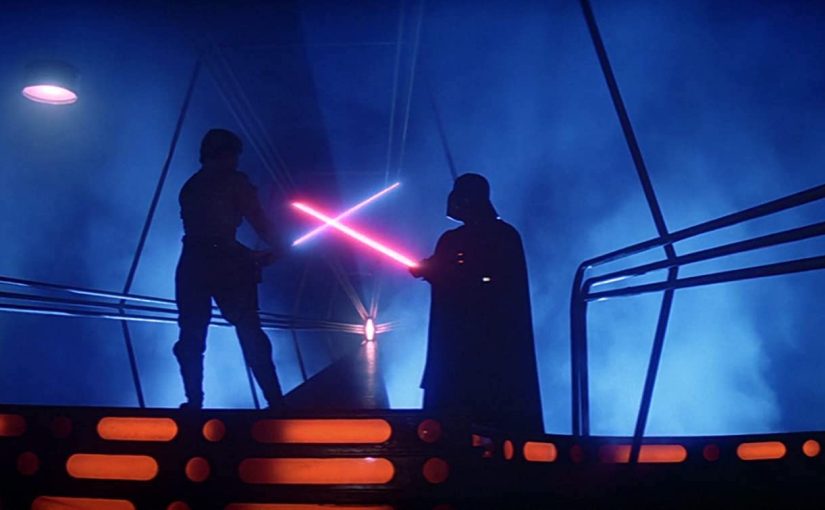
Masks are a theme I’ve always embraced in the Star Wars films. It’s not discussed enough actually. It’s ironic to me. Characters like C3PO or Darth Vader or Chewbacca and Boba Fett have these blank facial images to them. However, with the economics of Kasdan’s dialogue they say so much with brief statements of anger, despair (including a howl from Chewbacca) or worry. The expression physically never changes on C3PO’s face and yet I see different moods in the character thanks to the miming techniques of Anthony Daniels, the actor. A nod of the head will say something. With the practically silent Boba Fett agreeing to a contract with Vader, you see how methodical this bounty hunter dressed in dented armor really is. The character hardly gets any action scenes, yet you know how threatening he is. Every dent and scratch of his green armor tells a story. An aggressive walk shows a fear inducing Vader, one who is intolerant of any shortcomings. Sometimes Vader is simply matter of fact. If a minion fails in their assignment, he’ll force choke them and just walk away. As he duels with Luke, he simply puts his saber down when Luke is struggling with a massive wind current. We know that Darth Vader is cunning. So he hardly ever pushes himself further than necessary. We understand all of these characters’ emotions and motivations, and yet they are covered by masks.

The big surprise at the end of the film is the main crux that’s sustained the success of this sequel. It’s an absolute surprise out of nowhere but it seems to belong, as it is consistent with my belief in the mask motif throughout the whole film. There’s a veil draped over many developments of the film.

Allow me to digress. I’ve already discussed Yoda. Also consider other elements of the film though. Han decides to hide his ship from the Empire in the deep cavern of a large asteroid. Later, we learn it’s no cave. We also meet a charming new character named Lando Calrissean (Billy Dee Williams, who’s also great). He might not be what he seems as well. Since the first film came out, we’ve never had a full grasp of what or who Darth Vader is. He murdered Luke’s father and he’s someone or something in black. So, he must be the villain. That’s all we know, however. Yet, we eventually discover there’s something more. Because this is fantasy and science fiction with no roots in Earth based science, Lucas and Kasdan are well aware that they can color outside the lines and make up their own rules to this unfamiliar galaxy we are immersed in. Why not, actually? There are simply no boundaries.

A favorite scene of mine is when the Millennium Falcon makes a daring escape from that cave. It turns out to be the stomach of a giant slug…living in a rock…that floats in space! That’s the beauty of the original trilogy of Star Wars films, nearly anything could be put on the table, and it would be easy to accept and believe. In The Empire Strikes Back, almost every scene is layered and then further layered in imagination. Other storytellers would stop at just making this setting a cave and nothing else. It just might be shocking though. Put it this way, I’ll never forget taking my dad to see the special edition of this film in 1997. When the space slug revealed itself, dad burst out laughing. He didn’t see it coming. Kasdan hooks his audience with the furthest thing from your mind. When we got to the surprise ending, dad turned to me and actually asked me if he heard what he actually heard. When I showed the film to my daughter at age 6, her jaw dropped. How could a being dressed in complete black have any more depth to himself when I can’t even see what he looks like? The storyline of this film in particular is not aimed at any one demographic. Anyone could absorb the merits of surprise stuffed into this piece.

Empire is also admired for its firm stance to wrap up the film with an unhappy ending and cliffhanger. No other film has ever accomplished that so well. Much uncertainty is left to our imaginations. Will a character turn out to be dead? Is Vader’s revelation true, and if so then how does that explain the exposition delivered from Obi Wan? What does this “Jabba The Hutt” I keep hearing about actually look like? Was I looking at Vader’s brain or a human head underneath his helmet? What is Luke’s destiny? He didn’t do so well here. Could that lead to a worse fate? That scene for Luke in the Dagobah cave seemed quite foreboding, after all. Yoda implies “there is another.” Who could he be talking about, and what does that even mean? What about the conflict between the Rebellion and the Empire?

In the year 1980, the internet was not available as a means to spoil certain surprises and dismiss our own theories. We simply had the storytelling to work with. We had to wait three long years, speculating and discussing among our friends and family. It’s what maintained the strength of George Lucas’ space saga. The idea that we could play in the sandbox over a six-year period made these films more than just movies. They were events and they symbolized turning points in our lives. Personally, I discovered the magic of imagination. When I’m the writer the only rules I need to abide by are my own. That is most especially true with The Empire Strikes Back.

STAR WARS

By Marc S. Sanders

Of all the infinite times I have watched Star Wars (now also known as Episode IV: A New Hope), what remains appealing to me is the depth of its outer space setting. It would have to, right? Otherwise, what was the point of making action figures beyond the main characters, Darth Vader & Luke Skywalker? It’s a film where it’s just as important to get to know the extras seen in the film like a “Walrus Man” or a “Hammerhead,” or green skinned “Greedo.” Unquestionably, Star Wars is a film with a very, very rich and very deep setting.

What kept moviegoers coming back to the film time and again in the late ‘70s through the ‘80s and on into the next century, is that there is just so much to get accustomed to. One moment, you are adjusting to a summary scroll that opens the film with John Williams triumphant music, and then you are trying to familiarize yourself with an unusual ship that is being pursued by a much grander one within the depths of space while circumventing an orange planet. Laser shootouts occur with robots caught up in some kind peril, and then we meet a towering figure in black with an asthmatic, incessant breathing mask.

Later, we have to get used to small scavengers, and then scarier scavengers tormenting a boy on the cusp of adulthood who only dreams of adventure. The boy meets a mentor and then we are in a saloon with the oddest collection of patrons we could ever encounter. The film carries forward to daring rescues and escapes and a sword fight that may lack sophisticated choreography, but makes up for it with lightsabers and a surprising death that leaves an air of mystery. Before that’s all over, we still have to become enamored with the daring dog fights within space among battalions of one man piloted space ships.

That’s what has always kept Star Wars alive with much to celebrate. There is always something new and different just minutes away from the current scene you are engaged in. No two characters or bands of people look the same. No two settings look the same either.

Lucas always sought out to build a “used universe.” The ships and settings beyond the villains’ (known as the Empire) powerful Death Star space station were beat up and bruised and rusted and dented. This galaxy is lived in, and mired in a history.

Considering the film released in 1977 is somewhat telling of that decade. Films like The French Connection and Dirty Harry showed the ugliness of their respective cities and citizens with broken down cars and trash in the streets, and hoods with unkempt beards and worn-out clothing. Lucas must have carried these visions over to his PG universe to give viewers the idea that a guy like Greedo is a dangerous bounty hunter unconcerned with drawing his pistol in public, and a gangster like Jabba The Hutt rules a territory with a threatening criminal fist. (Incidentally, I strongly oppose Jabba’s appearance in the reissue of the film; better to imagine how vile this guy is in my own mind when watching the picture for the first time).

Lucas also famously takes inspiration from Akira Kurosawa’s Japanese films (especially The Hidden Fortress) of samurai culture, and blends it perfectly with a sci fi interpretation of the Old West gunslinger as seen in Sergio Leone’s spaghetti westerns.

Star Wars pleases so many different demographics of audiences because it jump starts its multiple stories and settings with what made going to the movies so appealing to begin with. Present within the film are humor, childlike appeal, fantasy, western motifs, suspense and romance.

It’s a visual classic that remains unmatched. At least with the original trilogy, Lucas never allowed any two settings to look alike. With this film in particular, we are treated to the contrast of a desolate desert planet vs the cold industrial operations of a ruling regime proud to carry out their actions with menace and terror. (More pleasing contrasts occur in the next two films.)

Star Wars is well known for the simplicity of its story. It’s main hero, Luke (Mark Hamill), is recognized for his basic innocence simply with his white tunic and mop top head of hair. Same can be said for the damsel in distress, Princess Leia (Carrie Fisher) and the fearful but sweet droids she sets out to embark on a mission. She evokes a royal and dedicated government in her white robe with elegant hairstyle; the droids have an expression of worry for the tall one, and spunky nerve for the shorter fat one, like a Laurel & Hardy pair. Villainy is epitomized with Darth Vader (voiced with commanding authority from James Earl Jones), who dons all black with a terrifying mask/helmet. You don’t know what Darth Vader really is beneath that dark costume. It’s not important for the exposition of this film. All that matters is that Lucas shows you who is good and who is bad. The visual references are enough for the explanations. What we need to know about these characters are summed up with the wise but elderly prophet in quick summation by Ben Kenobi (Alec Guinness, in an Oscar nominated role). Kenobi serves as the historian of this universe.

Over time, even almost immediately upon its release, the commercialization of Star Wars hogged the spotlight of the original product. It’s reflected today based on a measure of expectations both financially and within the fraternity of diehard fandom. Ironically, in 1977 everyone was satisfied with the surprise that George Lucas shared on the big screen. There were no objections to be found. Today, though, it’s become an act of trying to satisfy the masses by what they believe the next developments should be. I’m guilty. I admit to sometimes being an accomplice to that notion. It’s impossible to please everyone. So new film products in the Star Wars franchise will never succeed as well as the original film managed to do.

I don’t let any of that bother me. I remain pleased that I can still feel the sensation of pumping my fist in the air when Luke & Leia swing across the chasm thereby evading Stormtroopers, or getting a thrill when their pirate escort, Han Solo (Harrison Ford), finally lets loose of his quiet, cool demeanor to run down a hallway while trying to take out an army of baddies. I get a lump in my throat when Kenobi gives a slight grin before surrendering to Vader in front of Luke’s eyes.

So much is to be seen in Star Wars, but not all of it is explained. George Lucas completed his film with routes left to wonder and think about; he gave an opportunity to continue our imagination long after we finished watching the film for the first time. On the multiple occasions we watched thereafter, we pondered where we could get a table in the Cantina/saloon, or just how many droids the Jawa scavengers kept in their sand crawler.

As well, what did the blue milky substance taste like. More importantly why exactly did Luke’s uncle give a concerned glance across the dinner table to his aunt during a slight mention of his father?

That’s the magic of Star Wars. Like the land of Oz or Willy Wonka’s chocolate factory, there’s just so much to explore and think about and imagine beyond its surface. Long after we are all gone and our grandchildren’s children are beginning to stimulate their imaginations, they may well turn to the cartoons and other films and toys in the vast galaxy from long ago and far, far away. One thing is certain, though. They should ALWAYS begin with the original Star Wars.

MATEWAN (1987)

by Miguel E. Rodriguez

Director: John Sayles
Cast: Chris Cooper, Mary McDonnell, David Strathairn, James Earl Jones
My Rating: 9/10
Rotten Tomatometer: 94%

PLOT: The (mostly) true story of a West Virginia coal town where the local miners’ struggle to form a union rose to the pitch of all-out war in 1920.


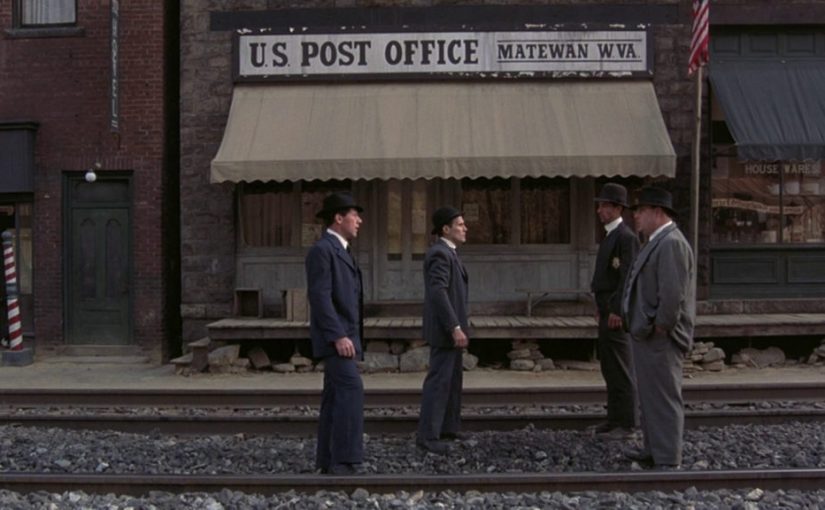
A few nights ago, I watched Matewan for the first time.  I haven’t seen many of director John Sayles’ films, but I’d venture to say it’s one of his best.  With loving authenticity and a keen ear for dialogue and music, Matewan depicts a nearly forgotten chapter of American history when coal miners in 1920 West Virginia attempted to unionize, the big corporation that owned the mine attempted to suppress and intimidate the workers, and everything came to a head one fateful day on the train tracks leading in and out of town.

I can’t pin down exactly why, but I haven’t been able to stop thinking about this movie.  When I was watching it, I tried to stop so I could go to bed and finish it in the morning.  But when I tried to sleep, my mind wouldn’t stop racing, thinking about the film, its message, its look, the SOUND of it.  I had to get back out of bed and finish it to the end before I was finally able to sleep.

The plot is nothing new, at least in broad strokes.  Small town locals take on corporate America and show them what for.  Seen it once, seen it a hundred times.  But for some reason, when this film showed scenes of company men evicting miners from their homes, or humiliating dinner guests at the boarding house where they’re staying, or spreading lies about union organizers, even employing a spy…I got mad.  I wasn’t just upset at the bad guys in a knee-jerk way, like disliking Nazis in a World War II film.  I was genuinely angry.  And I stayed angry for days whenever I thought about the movie.

Maybe it’s the thought of this particular kind of injustice depicted in Matewan that fueled my anger.  Here are people, poor people, desperate people, who lost their land, their homes, their dignity, and their lives so other men hundreds or thousands of miles away could report a six percent increase in profits at the next stockholder’s meeting.

There’s a powerful but terrible scene when the mining boss is introducing a group of new employees to the mine and its rules.  They are presented with tools…but they’re loans from the company, and their cost will be deducted from their first paycheck.  Miners can sharpen the tools with the company’s tool sharpeners…for a monthly fee.  The company provides a doctor…for a monthly fee.  The train ride to the mine was provided by the company…cost to be deducted.  The men are paid in company “script”, redeemable only at the company store.  Purchase any items available at the company store from an outside merchant…and you’re fired.

I remember thinking, this is literally slave labor.  How could anyone live like that, day after day, going down into a hole in the earth where the very real possibility of death, sudden or protracted, loomed over you every moment you’re down there?  And then to hear that the company could make conditions safer, but it’s just too expensive?  No WONDER they wanted to unionize.

Anyway.  Like I said.  It stuck with me.

Leaving aside the story, the film is extremely well made, especially considering the filmmakers were working within an extremely limited budget.  They employed the services of Haskell Wexler, one of the gods of movie cinematography, whose credits include Who’s Afraid of Virginia Woolf? (1966), In the Heat of the Night (1967), and One Flew Over the Cuckoo’s Nest (1975).  He employed a lot of low-light and natural-light photography, and as a result, even though Matewan was released in 1987, the movie looks and feels like a classic ‘70s movie.  It’s so precisely of a particular time and place that it’s a little jarring to see contemporary actors like Chris Cooper and Mary McDonnell in scenes that look like something out of Barry Lyndon or McCabe & Mrs. Miller.

The music choices are also out of this world, especially in a scene where musicians from three separate ethnic communities start riffing on each other’s music.  It’s an eloquent symbol of the kind of community and camaraderie that was needed for the miners to succeed in their task.

The story moves onward.  The miners first rally around Joe Kenehan (Chris Cooper), who came to town with the specific goal of unionizing the mine.  Then things go sour when company enforcers arrive.  The local sheriff (David Strathairn) makes a bad first impression, but later reveals his true nature in immensely satisfying style.  Guns are fired.  Lives are lost.  A spy is discovered.  And everything leads to a final showdown between powerful men with the might of corporate America backing them up and a few desperate miners who just want to be treated like men instead of so much dry goods.

If you’re anything like me, Matewan will stay with you long after it’s over.  Maybe not for the same reasons, but its memory will definitely linger.