THE PLEDGE

By Marc S. Sanders

The Pledge is a moody and bleak crime drama that follows a retired detective’s descent into obsessive madness.

Director Sean Penn opens his film with the gruesome discovery of a murdered nine year old girl found amid the snow covered woods outside a small Nevada town.  She happens to be discovered on the evening of veteran detective Jerry Black’s (Jack Nicholson) retirement party.  Upon receiving word of the crime, Jerry leaves his celebration to explore the scene that is carelessly compromised by the local sheriffs.  His protege partner Stan (Aaron Eckhart) rushes through a possible suspect’s (Benicio Del Toro) interrogation that draws a quick conclusion along with an unnecessary and bloody outcome.

Jerry surrenders his position with the police department, but he’s not entirely convinced the crime has been solved.  He obligates himself to uphold a devout promise he gave to the victim’s parents (Patricia Clarkson, Michael O’Keefe) that he will catch their daughter’s killer.

Time passes and rather than retire into a quiet life of fishing, Jerry purchases an old gas station located within the vicinity of the crime scene as well as nearby where two other murders with similar circumstances occurred.  Jerry is going to wait out the next attempt committed by “The Wizard” or “The Racoon Killer,” and catch him in the act.

The Pledge is a brooding and lonely film.  Sean Penn’s piece offers an impressive list of who’s who actors that appear in small roles to shape out the detective’s progress.  Amidst all of these familiar names in the cast, Jack Nicholson has never appeared so isolated or despondent before.  His character is limited on dialogue.  A thin mustache and a wrinkled complexion with a smoking habit hide any humor or joy.  Jerry Black knows he’s the last capable police detective in this area.  It pains him to abandon his post to the halfwits he leaves behind.

A promise is a dangerous gesture.  If you adhere to it, all obstacles become nonexistent.  Anything will be done to uphold a pledge and conclude your wild theories, even if proof is not conveniently supplemented.   Nothing stands in the way of pledge.  

The second half of The Pledge moves at a slower pace when Jerry welcomes an abused mother (Robin Wright Penn) and her daughter into his home.  A new life seems destined for these three people but at what cost?  Is the hero of this film at least as dangerous as the psychopath that supposedly remains at large?

Would you go to the great lengths that Jerry puts himself through?  Is the expense of his own sanity, and the safety of an innocent woman and her daughter worth this pursuit?

Sean Penn’s film does not operate on suspense. What action there is only fuels Jerry’s chase at a long-shot truth.  It’s a slow burn crime drama that makes the central murder a far second priority to how the initial discovery overtakes the main character.  Again, this kind of mania is a different breed from Jack Nicholson’s other crazed portrayals found in One Flew Over The Cuckoo’s Nest, Five Easy Pieces, or The Shining.  Nicholson is not as vocal or expressive in this role.  Yet, we all know what drives this guy with what few words he uses.

Robin Wright Penn and Nicholson share some effective scenes together. Their motive to be with one another stems from a misery loves company ideal. Good casting here, and throughout the film with small appearances from Helen Mirren, Harry Dean Stanton, Sam Shepard, Vanessa Redgrave, Mickey Rourke, Tom Noonan, Clarkson, O’Keefe, Del Toro and Eckhart.

Sean Penn is very good at creating visual moods to his film. The image of Nicholson standing within the pen of a crowded turkey farm with the anguished parents of the victim is truly haunting. Animals of all kinds seem to emote a cold harshness as well. The first image to appear consists of a swarm of large, winged birds soaring above this backwoods area where the biggest thing to happen is a town parade. Otherwise, as one girl tells Jerry there’s nothing else to do here. This remote Nevada area is unprotected from greater powers, and its only guardian is forced to accept retirement, leaving his community vulnerable. This formerly decorated Marine is now a formerly decorated cop, and the unseen animals-or monsters-still roam.

I won’t spoil the ending which I commend, but there is one moment that Sean Penn includes in the final cut that is objectionable.  For the first time in the picture since Jerry Black accepted the case, one moment near the end of the movie tells the audience everything they need to know while leaving Jerry in the dark.  I think it was a poor choice to go this way.  The audience is going along with Jerry’s pursuit until they are spoon fed a resolution they didn’t earn because Jerry never arrives at this conclusion.  A better route would be to leave the audience in the same dizzying haze that Jerry must live with.  Some hanging threads should be left untied. The Pledge is a pot boiling, well-made and disturbing film, but with minutes to go before the end credits roll, a less is more approach should have been adopted.
BATMAN (1989)

By Marc S. Sanders

If Warner Bros was to abandon the campy familiarity of the Adam West TV series, Tim Burton was the best candidate to deliver The Dark Knight into the macabre gloominess of a bustling crime ridden Gotham City.  Burton is proud of his grotesque weirdness which is what this famed comic book character demands.  

Despite a story that always teetered on flimsy to me, this close-out picture of the decadent 1980s, has so many elements that work. It begins with the marquee cast to the richly deserved Oscar winning hell on Earth art designs from Anton Furst to silly pop/funk samples from Prince and the orchestral score from Danny Elfman.  This is truly the film that put Elfman on the map.

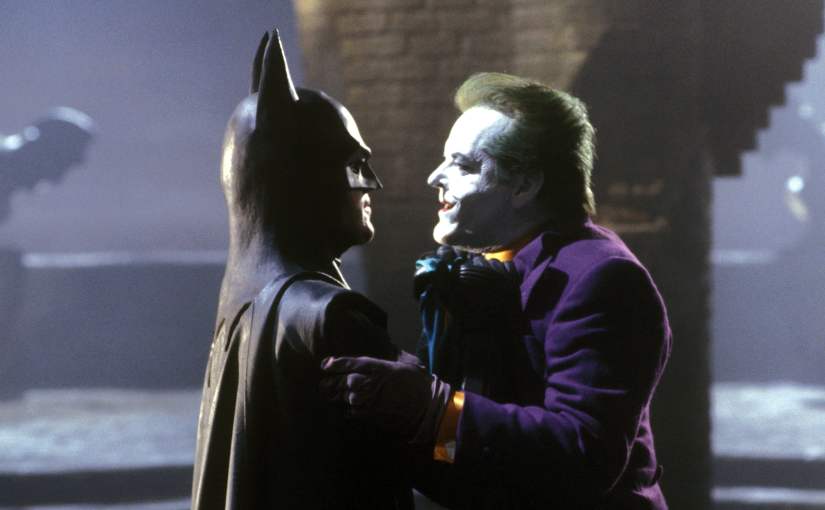
Jack Nicholson collected buckets and buckets of cash to bring Batman’s arch nemesis Joker to life.  He earned every penny.  There’s been copycat attempts (Hello Jim “Mr. Shameless” Carrey) to a handful of other interpretations of the psychotic clown, and still no one has overshadowed what Nicholson brought to the role.  His performance seems like a combined amalgamation of previous celebrated career roles from Easy Rider to …Cukoo’s Nest.  Prince served as his cheerleading entourage to compliment the purple and green color schemes.  This Joker is a perfect antithesis to the famed title character superhero.

Batman is portrayed by Michael Keaton.  Let the record show that when news broke of Mr. Mom occupying the part, I was not a skeptic.  I had seen the dark and dramatic side of the former standup comic a year prior (Clean And Sober, my review is on this site).  I knew he could pull it off.  His quiet pondering as either billionaire Bruce Wayne, whose parents were gunned down in front of him as a child, to the Batman under the cape and mask work on the opposite spectrum to Nicholson’s uncompromising insanity and hyperactivity.  

Keaton against Nicholson are a defined Yin and Yang.

The supporting cast have good moments too including the loyalty of Bruce’s butler, Alfred.  Michael Gough brings Wayne Manor alive and Burton, with a script from Sam Hamm, welcomes several spotlights from the expected council of the trusty character.  Kim Basinger is photojournalist Vicki Vale, Bruce’s love interest.  Frankly she has better scenes to share with Robert Wuhl as Gotham’s reporter.  The Batman fan in me stops short at Pat Hingle as Commissioner Gordon.  It’s not the actor’s fault however that the film offers little for him to do on screen.    Hingle never had much material to play with in the four films he occupied.  That’s regrettable.

The best supporting character is the setting of Gotham City.  With Burton’s penchant for a Vincent Price characterization, he relies on Anton Furst to bring the towering midnight blue steel, skyscraper pillars to enormous heights, reaching into the blackness of heaven.  Every street, alleyway, balcony, puddle, garbage can or mugger, policeman and cabbie that circumvent this city lend life to this hopeless, criminal world.  It’s astonishing how well constructed this Gotham is.  Designs go just as far with Wayne Manor, the underground Bat Cave and a chemical plant designed in hot steam,  with enormous barrels of rainbow, acidic liquids and rickety platforms. Even Vicki Vale’s apartment is gorgeous to look at as both Bruce Wayne and the Joker compliment it as having “lots of space.” Tim Burton and Anton Furst make certain the people who roam these environments are entirely aware of what they occupy.

Sam Hamm’s script doesn’t appear as solid as everything else on screen.  There’s never a cohesive beginning to end trajectory and a lot of the film feels like short story episodes.  Joker takes over the localized mob.  There’s that story.  Joker somehow concocts a chemical poisoning amid the various hygiene products.  Yet it only spreads to the local newscasters.  Gordon, Alfred, Vicki Vale, and certainly not Bruce Wayne ever gets exposed.  Once that storyline begins, it’s quickly disposed.  A little attention focuses on Batman’s beginnings.

The irony of Batman is that unlike other superhero films, this one does not hinge on an origin story for the good guy dressed in black.  That angle is devoted mostly towards Joker, and Nicholson makes the most of his large amount of screen time.  A favorite, sinister scene that maybe Edgar Allen Poe might have approved of is Burton’s invention for Joker to gradually reveal himself beneath the darkness.  He’s depicted sitting in a dirty office basement with an underground cosmetic doctor who witnesses a transformation in the gangster turned madman.  I just like it.  It’s hair raising.  The moment plays like Poe writing a new version of The Mask Of The Red Death.

For me, this is likely Tim Burton’s best film, just below his passion for detail in Ed Wood.  Batman offers up a lot of variety ranging from the darkness of the character to the disruptions revealed in the antagonistic, loudly dressed, Joker.  

There’s no denying how visually memorable the film remains and how quotable it is as well.  In 1989, when superhero movies were not the event release commodities they are today, the endless hype only enhanced the experience of finally seeing the movie on the big screen.  Over a year ahead of release, t- shirts, caps, action figures and costumes were of the highest demand among kids, teenagers and adults.  I actually miss the marketing blitz that overtook the finished film product.  Everyone you encountered was embracing Batman and Joker.  These might be pop culture phenomena, but they created a commonality among the masses of the world.  Batman was worthy of all its swag and endless mania.  It was a celebration of movies for people of all ages to take seriously.

Fortunately, the first half of the 1989 promotional partnerships were never squandered on a decidedly terrible movie.  The end product was immensely satisfying.

Tim Burton upheld his dedication while still a young director in a cutthroat and competitive industry.  As the later films, from a careless Joel Schumacher, demonstrated, it takes an endearing kind of passion to pull these eccentrics off on a silver screen.  Fanboys will happily toss that Bat logoed t-shirt away if they feel betrayed by the movie, they couldn’t wait to sink their teeth into.

An enormous sigh of relief came across the entire pre-internet world.  Keaton is great.  Nicholson of course.  Check out the Batmobile and Bat Jet as well!!! Prince’s music videos served as free commercialization to see the movie over and over again.  A separate record was released to highlight Danny Elfman’s work.

Rightly so!

The grand scheme of delivering Batman and Joker to audiences, was worth every second of the wait.

An astounding achievement of near perfect filmmaking, this Batman film was never overshadowed even with a better, leaner Dark Knight interpretation to arrive nearly two decades later.

Right this way Mr.  Nolan.  Your table is ready for you.

CHINATOWN

By Marc S. Sanders

Forget it Jake!  

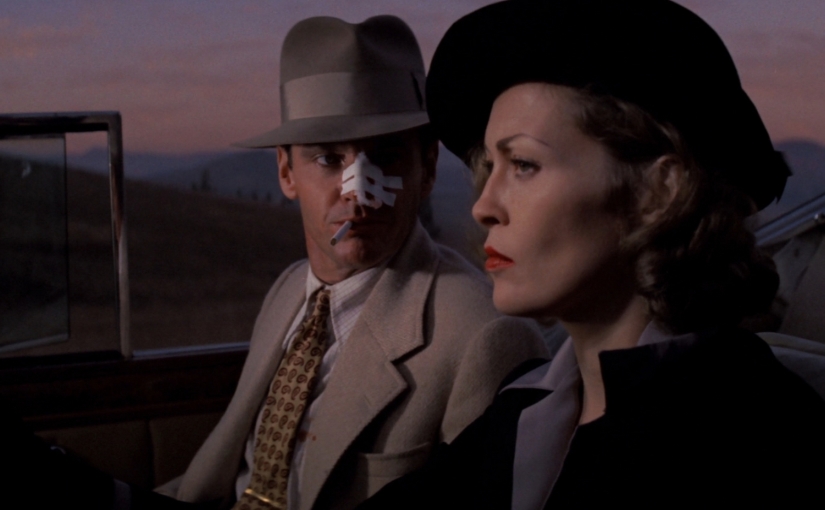
Roman Polanski turned Robert Towne’s page turning script into a noir mystery for the ages.  Practically every scene in Chinatown turns whatever you learned before off its axle.  The mystery of what Jake Gittes, a private dick played so well by Jack Nicholson, is attempting to uncover seems to repeatedly take the guy back to square one.  

Towne’s Oscar winning original screenplay, one of the best ever written, begins with simplicity in motion.  A Mrs. Mulwray insists on hiring Mr. Gittes to find out if her husband is having an affair.  The husband is in charge of the water supply within the surrounding areas of Los Angeles.  Despite Jake’s encouragement for her not to go down this path and recuse herself of heartache, he accepts the case charging his regular fee plus a bonus should he turn up anything that points to something illicit.

Just before meeting with the wife in despair, Jake wrapped up a case, handing over photographs of a wife to her bruiser husband (Burt Young).  The poor guy understands that his spouse was messing around.  None of it is shocking to Jake.  He’s seen the same results many times before and he’ll likely come upon the same situation with Mr. Mulwray.  However, as he follows her husband, it does not seem to be just an affair that is transpiring.  Jake finds himself driving out to a dried-up reservoir and then he’s adjacent to a drainpipe by the ocean shore.  The more he sniffs out, the more likely his nose is going to pay for what he gets closer to.

It’s hard to write about Chinatown as I reflect on the film for a review.  There’s just so much to spoil, even beyond what is now considered to be one of the all time great twists in film history.  I would dare not give anything away.  Some of the luckiest people today are those that have never seen the picture.  To watch Chinatown with a blank slate.  If that’s you…Wow!!! You are blessed of the experience that awaits you.

The cast is a bevy of recognizable faces; character actors who went on to popular television shows and movies (Higgins from Magnum P.I. and Miss Collins from What’s Happening!!!).  Faye Dunaway though is maybe the most unforgettable.  Jake is smart enough not to trust the famed actress’ character (I don’t even want to share the name of who she portrays).  Long before Sharon Stone hammed it up with a less creative eye rolling commando cross legged sitting, Faye Dunaway was best at being sexy, alluring and especially enigmatic.  With her Hollywood glamor appearance in costume wear from Anthea Sylvester, she has that classic noir dame appearance with a smooth inflection in her voice.  Word is that Polanski wanted Dunaway to reflect his own mother’s appearance.

Then there is the celebrated filmmaker John Huston representing old money, a lot of it, in a rare acting appearance.  He plays Noah Cross, a great name to be associated with water.  His gravelly voice and hulking mass lend to what he’s earned demonstrating his power over a commodity resource that everyone cannot live without.  Per Jake Gittes’ experience, he knows it’s best to seek out a motive long before he can uncover a crime.  Gittes’ perusal of some photographs on an office wall will allow him the gumption to go up against a titan like Cross. 

It’s a welcome setting to see late 1930’s L.A.  There is a drought going on and coincidentally Jake is perhaps tailing the guy responsible, but only because of a likely affair.  Still, when his pursuit takes him to the most unexpected places, something more sinister may be happening.  When someone turns up dead by drowning, Chinatown becomes more deliciously complex. Why would Dunaway’s character pay Jake, and later why would Noah Cross double the fee to hire the detective, as well? Jake’s clients may be playing against one another, but he’s the one being tossed in several different directions.

There has to be over a dozen twists in Chinatown.  Thankfully, none of them are contrived or thought up out of the blue.  New depths await further down the rabbit hole.  

I love how Jake Gittes functions.  He might be accused of being sleazy in his profession, but he drives a nice Pontiac classic convertible and dons a stylish wardrobe to go with his fedora hats, designer sunglasses and sterling silver cigarette case.  He’s also quite sharp.  He’s got methods to easily prove how long someone has been at a certain locale and how to follow another car at night.  All of it makes perfect sense.  

Jack Nicholson is great in his role. He does not go all looney like in other pictures, but he’s quiet with his tone, reserved of any kind of shock to the discoveries he finds.  Yet, this particular case might challenge the detective’s sense of acuity into another realm.

Polanski, Towne and Nicholson also thought it best to apply a crudeness to Gittes.  He’ll happily tell an off color joke to his colleagues.  When Dunaway, sneaks up behind him, Gittes is not quick to apologize.  Instead, he gives an annoying scowl for her being there when a prim, genteel woman has no business listening in.  When he gets a phone call, he’ll tell his partners in the room to “shut the fuck up.”  Sam Spade never talked like this.  

The production value is great.  Nothing in or on top of a desk, for example, looks out of place.  From the cars to the interior furnishings of the homes and offices, it’s a Technicolor transport back in time with the dialogue uttered like characters of the ‘70s and ‘80s might deliver.  Humphrey Bogart could never occupy the role of Jake Gittes.

I recently watched The Offer on Paramount Plus which explores how The Godfather made it to the big screen.  Chinatown was next on the horizon, but executives were left confused by a boring middle section about – excuse me, water???? Plus, there was an unsavory plot twist that is hard to even fathom.  The script’s first draft doesn’t even have a scene set in Chinatown.  So what’s with the title? Casting was also unsatisfying.  Now producer Robert Evans wanted you to see more and identify with the chutzpah of the ultra-powerful and wealthy, because only the super-rich are the ones who can get away with murder.

Despite the movie’s welcome yet perplexing surpises, it’s all incredibly satisfying.  Who is doing what to whom, and why?  The best mysteries are the ones that make perfect sense yet can’t be figured out until someone finally starts telling the protagonist the whole shocking truth.  In Jake’s line of work, nothing is shocking. However, the greater the secret, the bigger the liability for everyone involved. 

I’m sorry reader.  I know I’m being vague but therein lies the delight in watching Chinatown.  As you watch, you may throw your hands in the air.  Now what?  You’ll find yourself in disbelief and that would be the best compliment you can give to Roman Polanski, Robert Evans and Robert Towne.

Chinatown is the best example of a film noir pot boiling thriller.  It’s the reason movies continue to thrive; to witness a scene chewing villain, pine after a beautiful, lustrous woman who is not telling us everything, and follow a gumshoe detective who thinks he knows everything but actually could never fully comprehend anything until he makes it all the way back to Chinatown.

THE SHINING

By Marc S. Sanders

Stanley Kubrick’s The Shining has become a legendary film that set the standard for haunted house films. It’s a spooky story with a musical soundtrack never destined to be played at weddings or bar mitzvahs.

The whole movie is unsettling, beginning with a long winding road drive through the Colorado mountains as the title and credits unconventionally roll up the screen, one at a time. Kubrick was never typical. Here he was frighteningly weird.

The film, based of Stephen King’s bestseller, consists of four characters. Three of them are novelist Jack Torrance (Jack Nicholson), his wife Wendy (Shelley Duvall) and their son Danny. He’s one effed up kid with a mop top haircut. I think I’d be disturbed if I uncovered what Danny grew up to be hereafter.

The fourth character is the main attraction, the isolated Overlook Hotel; left empty during the harsh winter months to take advantage on reviving its morbid history of harsh violence by means of ghosts, bleeding elevators and hacked up innocent looking, pig-tailed, young girls. Don’t ask me to explain the guy with the gold lion mask about to go down on a happy partygoer. No. I also can’t explain what exactly happened in Room 237. Perhaps King’s book covers all of this. Kubrick opts not to and focuses on the naivety of Wendy while Danny and his imaginary friend Tony talk to the consciousness of the hotel only to understand it is gleefully influencing Jack into an obsession of murderous incentive, eventually leading him to charge his ax through some doors.

I once visited the Louvre in Paris. I couldn’t fully enjoy or appreciate it. It was too big and too overwhelming. I didn’t know where to start or where to end. I had a panic attack, but I didn’t know it at the time, and I was eager to leave. Kubrick works on that anxiety during the long exposition of the film. Effectively disturbing tracking shots are provided that shoot deep hallways, vast ballrooms, large furniture pieces, and loud colors of reds, browns, yellows and whites along with emerald, green in the bathroom of room 237. The pastel blues of the young girl’s dresses and pigtail ribbons are also deliberately garish. Colors are normally cheerful for me. Here, they are unwelcome and intrusive and when I say loud, I mean to say the colors scream at you,

You just want to get away with Danny on his Big Wheel that he pedals around the property, softly on the carpet and thunderously loud on the tile and wood.

The character of the setting continues its disturbing details by means of a maze. Kubrick offers a great transition when Wendy and Danny enter the maze while Jack overlooks (pun intended) on a small-scale model. The hotel’s haunts have its prey in sight by means of its possession of Jack. Kubrick clearly shows that with his camera work. There are wide shots both overhead and facing Jack, and narrow, trapped captions of Danny and Wendy lost in the labyrinth.

I won’t say The Shining is a favorite of mine. I think this is only the second time I’ve seen it. I’ll watch horror movies, but they often bother me; leaving me distraught and stressed, unrelaxed. Occasionally, while Kubrick is vague with his imagery, Nicholson is blatantly obvious in his urge to terrify; maybe a little too blatant. He is in direct competition with John Belushi in the facial expression department. He’s disturbing even before the hotel’s influence is available to take hold, and so I didn’t necessarily get a good character arc from him. Same with Duvall or the boy. This family is downright weird all on their own from the moment you meet them until the film’s cold, wintery end arrives. Kubrick gets you curious about what this hotel is capable of. Then he shows you. Then the end literally tires the story out.

The Shining is best when you have an urge for fear and frights. A house of horrors tale where a cat or bird will not suddenly fly into focus for a cheap jump-scare. Rather your vision and hearing will still feel shocked, leaving butterflies in the stomach, and shortness of breath. Repeat viewings will leave you awake at bedtime, and worried and agitated. There’s so much to explore, but do we really want to know what’s in that room, or down that hall or around that corner, or even how that photograph of a July 4 celebration from the 1920s ever came to be?

THE DEPARTED

By Marc S. Sanders

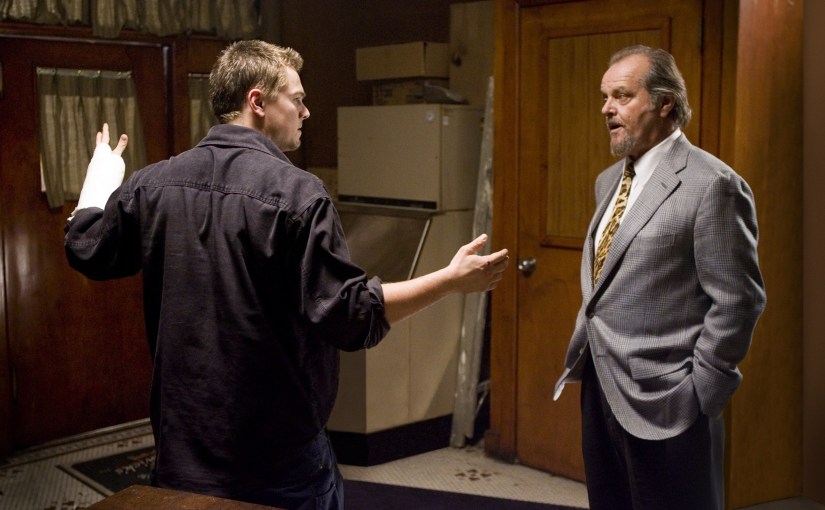
Martin Scorsese finally won his Best Director Oscar with the 2006 Best Picture The Departed, from a script written by William Monahan. The film is a remake of a Hong Kong crime drama called Infernal Affairs.

Also known as the one film in Scorsese’s library with a linear plot, The Departed depicts the stories of two guys who grew up in the south end of Boston and joined the police academy to serve. Only difference is one is recruited to go undercover within the Irish mob, while the other is recruited by the same mob to become a highly respected police officer and supply an unlimited wealth of information to his criminal boss.

Leonardo DiCaprio is the undercover cop Billy Costigan. Matt Damon is the criminal cop Colin Sullivan. Jack Nicholson is the Irish mob boss in the middle, Frank Costello.

The Departed works because Scorsese and Monahan allow the audience in on every deceit playing against the characters. Pleasantly surprising is that there are even twists to this layered story, and cellular flip phones assist all the players with trying to remain in hiding or hoping to one up and trap the other. However, because everyone is getting tipped from their own respective sources, people are either not ending up dead, or arrested or caught red handed. As Costigan builds his case against Costello, Sullivan is worming his way to protecting his cover in the police force while also tipping off his true boss.

Performances from DiCaprio, Damon and Nicholson are what you’d expect. Nicholson is chewing the scenery again appearing like the devil incarnate while hamming up the facial expressions. Damon is great at playing it like the Boy Scout cop in well-tailored suits, clean shaven and flirtatious within his department and earning respect among his peers, that is until it all seems to unravel. DiCaprio is wired as the cop who needs to show he’s a dangerous hood to be trusted among the mob cohorts. However, he’s getting more paranoid and unwound at the risk of being made.

Thelma Schoonmaker (one of my favorites) does a balanced approach edit to showing a parallel among the cops. She will insert a happening of Costigan for a snippet and then segue to Sullivan appearing to do honest police work, or reaching out to Costello with a warning of what’s coming for him.

Great support also comes from Ray Winstone as Costello’s right hand man, and Alec Baldwin, Anthony Anderson and Martin Sheen, all within the police department.

Ironically, the one Oscar nominated performance was bestowed upon Mark Wahlberg and I grew tired of his presence quickly as the cop who berates Costigan endlessly with yelling and fast one liners that involve someone’s mother. Could we just move on from this please?

I also found Vera Farmiga as a police psychologist to be mostly unnecessary until a contrived ending point needed to arrive. Her character naturally has affairs with both Damon and DiCaprio, who also attend her office for sessions. Of course they do! Whenever the film sidetracks to one of them with Farmiga, The Departed stalls for a moment. Her character carries no stake in the plot line and offers no further dimension to DiCaprio and Damon’s characters.

The film works best as the complications compound on each other. A great moment occurs between the cops when one of them picks up a bloody cell phone to dial back the most recent call. Silence on both ends of the line, and the moment just plays out until someone speaks or hangs up.

Moments like that is suspense similar to when a man is intruding in a dark house. However, this is suspense delivered by Martin Scorsese, and Martin Scorsese will film suspense that is anything but typical. Martin Scorsese’s suspense leaves you breathless.

A FEW GOOD MEN

By Marc S. Sanders

A Few Good Men really does hold up.

Anyone with even minimal movie going experience can predict how it is going to end almost as soon as it starts, but that doesn’t take away from Aaron Sorkin’s first screenplay based on his original stage play.

It is well cast. For the film, no one else could ever play the intimidating and terrifying Colonel Nathan R Jessup other than Jack Nicholson. It’s not that it is just him in the role. It’s really Nicholson’s whole career legacy against the arguably still ripening careers of Demi Moore, Kiefer Sutherland, Kevin Bacon, Kevin Pollack and Tom Cruise. Nicholson’s timed grandstanding is necessary for the role to work.

Cruise on the other hand left me feeling a little too overplayed. The role calls for cockiness, yes, but is Cruise too cocky? Some of the gags he does work. Some don’t, like impersonating Nicholson momentarily (leave that for the guys on SNL, Tom), or when he’s poking fun at Moore’s character to his own delight. It’s a little too much. Still, his courtroom scenes are like watching the best in live theatre. Those scenes play like great sport, notably thanks to Tom Cruise.

Major props go to JT Walsh as a conflicted witness. When I say conflicted, I mean he authenticates a seriously valid and personal dilemma beautifully. Had it not been for Jack Nicholson, Walsh might have had an Oscar nomination. A shame he didn’t come close to such recognition while he was alive. He was such a great character actor.

Recognition also goes out to Kevin Bacon as a well versed prosecutor/Marine. His timing exudes the experience his character has, despite his youthful appearance.

Demi Moore might be caught trying too hard, I think. Kevin Pollack is the wise mentor sitting quietly waiting for his great moments. Kiefer Sutherland is great in almost anything he does. He doesn’t ever steal the spotlight like Cruise, Nicholson or Moore but he makes a great presence; conniving and bold.

The direction is nothing special really. Rob Reiner does fine but honestly Sorkin’s script sells itself.

Yeah, yeah. “You can’t handle the truth.” Great line, but I got news for you. I’d argue there’s even better lines in this 1992 film. It’s worth revisiting.

ONE FLEW OVER THE CUCKOO’S NEST

By Marc S. Sanders

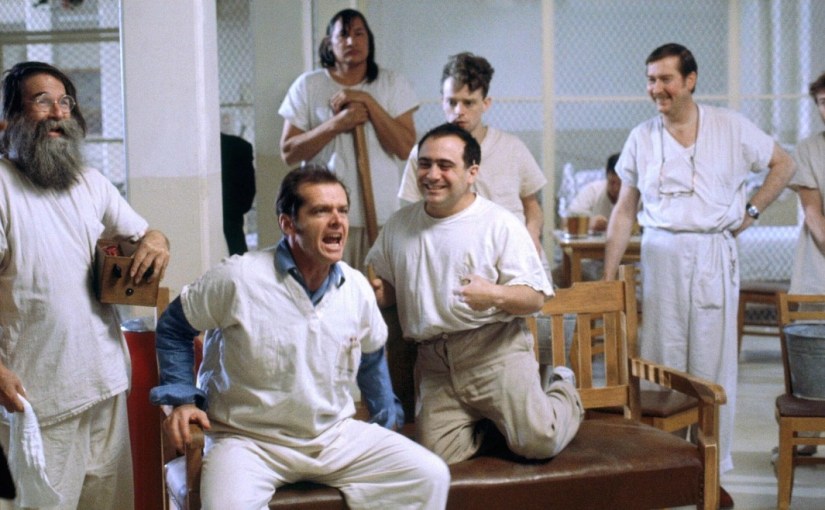
After watching One Flew Over The Cuckoo’s Nest for the first time in many years, I recognized a political dual taking place on the battleground of an insane asylum. Director Milos Foreman sets the stage for one patient to win over the community from the Head Nurse in charge.

Jack Nicholson is Randall P McMurphy, a criminal who is transferred to the asylum for examination even though there are likely suspicions he’s faking his current condition as a means to escape prison life work detail. Louise Fletcher is his opponent as Nurse Ratched who has maintained an organized control over the floor of 19 men with an assortment of mentally unwell behavior.

McMurphy is a cut up as soon as he joins the gang. At first he appears observant during Ratched’s daily sessions where she asks the men to contribute to the discussion but at the same time she couldn’t be less encouraging. She’s happy to welcome ideas with open arms but don’t disrupt the process. There will also be “Medication Times” and there will be samples of classical and childlike music to subdue the patients as well. McMurphy may request the volume be lowered, but that’s not a simple request that Nurse Ratched will honor.

McMurphy’s experience outside the realm of insanity works as a wake up call for some of the men which consist of introductory performances from great character actors like Christopher Lloyd, Danny DeVito and Vincent Schiavelli. The stand out is Brad Dourif as Billy Bibbit, the stuttering suicidal young man with the baby face who fears his mother’s judgment as Nurse Ratched methodically continues to imply.

McMurphy wins over the crowd eventually. A fascinating scene is when Ratched challenges McMurphy to obtain enough votes among the men in order to watch the World Series. The count of raised hands appears to tie, but then Ratched reminds him that he needs one more vote to win. Before he can get to that point, the session is ended by Ratched. The call for election is lost due to a technicality by the governing control. An election won’t silence the voice of the people as McMurphy quickly encourages the masses to watch a blank television screen imagining his own interpretation of the game. Ratched can only domineer to a certain degree. Here’s the flaw in the Ratched character. At last a breakthrough among these ill men is established as they’ve learned to vote for themselves. They want to watch a baseball game. Ratched won’t stand for progress though.

Questions arise in One Flew Over The Cuckoo’s Nest. Is McMurphy truly faking his mental condition? Is Ratched so drunk on control to disregard doctors’ opinions for his release and keep him institutionalized? If he’s not insane, then why would she want him there? Is it all about Ratched’s obsession with winning?

Ken Kesey wrote the original novel the film is based on. He hated Foreman’s approach particularly with disregarding telling his story from the perspective of the deaf/mute six foot five Native American that McMurphy regards as “Chief” (Will Sampson). Chief seems to be the quiet one who does not take sides until McMurphy demonstrates the ease of obtaining freedom such as when the Chief helps him escape over a barb wire fence and then takes the men on a boating joy ride. I can’t side with Kesey’s insistence that the film be done from the perspective of the silent, yet memorable Chief. Film is a different medium than what’s read on a page. You can’t watch people’s thoughts. What I do find interesting is that Kesey opted for a Native American as McMurphy’s best sidekick. This is a man whose ancestors historically lost their land. McMurphy attempts to rob the rule of the asylum from Nurse Ratched. The political undertones just seem so apparent. The government control, however, is hard pressed to surrender even after McMurphy arranges for his own party of celebration complete with booze and alcohol. Ultimately, and sadly, the fate of McMurphy shows that he eventually becomes a product of his own environment. The Chief however, acknowledges his independence though.

One Flew Over The Cuckoo’s Nest is the second of three films to win the five main Academy Awards (Best Picture, Director, Actor, Actress, and Screenplay). It deserved it, and because of the film’s unsettling and messy nature it’s almost surprising that it was so well received. It’s not a glamorous film. It can show the ugliness of men drowning in their own consciousness.

At the same time, the film shows the subtle yet brutal control of those living fulfilling lives at the expense of the constituents they oversee. Sure, let’s have an open minded community of provoking thoughts, but only if it’s confined to the restrictions that remain in place. Step outside those lines and a more permanent technique will be applied so you adapt to what’s mandated…unless you can bodily lift a concrete water fountain and smash it through a cage bar enclosed window to freedom.

TERMS OF ENDEARMENT

By Marc S. Sanders

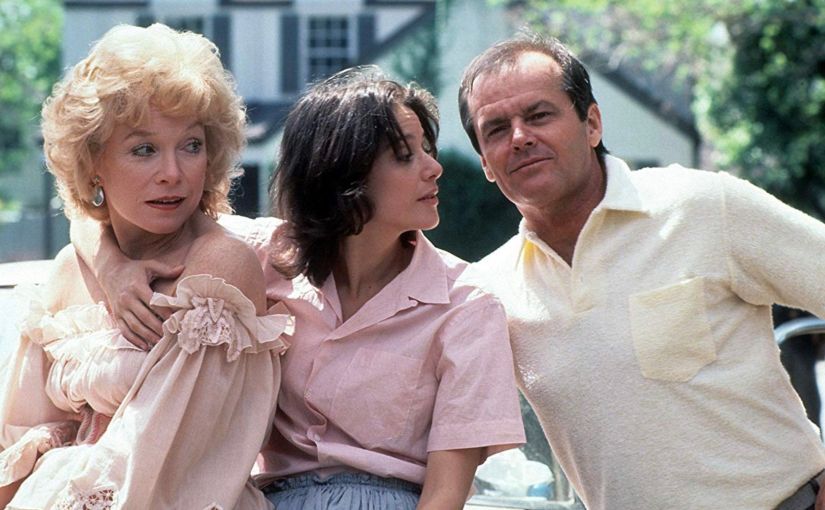
Acclaimed television writer James L Brooks’ first feature film was the 1983 Best Picture Winner Terms of Endearment.  The movie succeeds in more ways than one because of its varied relationships among the characters.  You have Aurora Greenway (Shirley MacLaine) and her daughter Emma Greenway-Horton (Debra Winger).  There’s Emma and her husband Flap Horton (Jeff Daniels).  There’s Aurora and Flap, and then there is Aurora and her neighbor Garrett Breedlove (Jack Nicholson).  Sounds like a lot to take in for a two hour picture, and yet Brooks manages to adapt a script from Larry McMurtry’s novel that smoothly covers realistic depth and dimension among these characters, and how they connect with one another.  Brooks is at least an incredibly efficient writer/director.  Honestly, I’m not complimenting him nearly enough.

Shirley MacLaine provides one of the best female performances to ever grace the silver screen.  She doesn’t have to utter a word of dialogue to say so much about how Aurora feels.  One of her greatest facial expressions is when she is addressed by her grandson as “Grandma!”  This moment is so utterly hilarious that the studio selected it to close out the original theatrical trailer.  If anything is going to get you in the seat at the theatre it’s this moment.  Aurora is a widow who can be difficult to please, judgmental and always conscious of her part in the world-even while she is hosting multiple gentlemen suitors in her Houston, Texas home.  This character is so powerful that it is hard to understand why Hollywood really never followed suit with presenting more films focused on the middle age woman or man.  There are still interesting things to be found in being a widow and dealing with ageism, motherhood and a resurrection of sexuality.  Think about The Golden Girls which dominated television sets on Saturday nights for most of the decade.

Aurora disapproves of Emma marrying Flap.  Flap has no imagination or drive and is as devoid of affection as his name suggests.  Best he can do for Emma and their three children is find whatever college professor job he can muster and uproot his family from one mid-western state to another.  Emma knows of her mother’s disdain for Flap, and can’t disagree with her.  She knows Flap is a loser, but if it means aggravating her mother then it is worth it at least to marry him.  Early in the film it amuses Emma to frustrate her mother a little more and a little more.  Contrary to Aurora’s instincts, Emma is naively unaware that life settles in soon enough and the happy nuptials fade away.

Still, Aurora and Emma have a strong mother/daughter relationship where numerous phone calls each day happen between them.  These conversations consist of Emma reluctantly telling her mother that she may be pregnant, yet again, or that Aurora is proud to let her guard down and approach the boorish, drinking next door neighbor astronaut, Garrett, played with a devil may care seductiveness from Jack Nicholson.  Aurora’s serene peacefulness in her beautiful backyard garden and home is always disrupted by Garrett’s loud bellow before diving into his swimming pool.  Still, she can’t help but be attracted to him while putting on a façade of disapproval in his presence.  The first lunch date that Aurora and Garrett share must be one of the best dates ever depicted on film.  The scene might have been written and staged by Brooks, but it is thankfully hijacked by Nicholson and MacLaine.  One of the funniest moments to ever come out of 1980s cinema for sure.  There’s much reason that MacLaine won Best Actress and Nicholson won Best Supporting Actor.  These actors easily stage a scene of realistic comedic chemistry while later expressing deep rooted drama and affection with one another.  Not easy to do all in one film.

Brooks masterfully writes these characters with such authenticity that you find yourself legitimately laughing at a scene or a piece of dialogue, while the person sitting next to you might embrace the dramatic element of the very same moment.  Both responses to random moments in Terms Of Endearment allow varied reactions like that.  When Emma suspects Flap of committing adultery, pay attention to the dialogue and the performance from Winger and Daniels.  Emma allows Flap to dodge a lie he’s about to tell by warning him that he may have just lost his senses, but if he continues down a wrong path, then he will end up worth less than he already is.  He doesn’t fight her on that observation.  Hard to explain here but listen to the vocabulary Brooks applies to Emma’s dialogue and watch how Winger traps Daniels.  You may nod with a smirk, or you may feel frightened for Emma and her marriage. 

I always say Terms Of Endearment is a comedy first and a drama second.  The film steers towards a frightening fate for the Aurora and Emma.  However, before that third act sequence there is so much to treasure, love and laugh at in the film.  When a cloud of imminent loss feels like it may approach, that is when the dramatic elements step forward.  To truly feel loss, you had to treasure wonderful moments with a loved one or a friend.  You had to value something important in your heart and soul to feel so terribly frightened and mad and hysterical when days might seemingly appear numbered.  James L Brooks and Larry McMurtry remind us of that.  Every person on the planet is destined for this feeling at one point or another.  What happens when the inevitable arrives is what sustains Terms Of Endearment to it’s satisfying end.  A character may appear on a hotel staircase to reconnect with support.  A hug goes a little longer than expected, and for the first time the one who normally lets go first actually tries to keep the moment frozen in time.  A gift from long ago is recovered to touch someone emotionally.  Brooks includes all of these moments in his film and that’s what I embrace most importantly.  Cinematically speaking, these points in the film are heightened by a memorable soundtrack of quirkiness and passage of life from composer Michael Gore.  His music is so effective that it has been used countless times over to enhance trailers for other films marketed at audiences that this picture was catered for.

Yes, after numerous viewings, Terms Of Endearment never fails to me put me in tears.  Like ugly crying!  I prefer to watch it alone actually, because I connect with the characters differently than most people I know, including my wife.  It’s a very personal film for me.  It reminds me of loss that I have felt and experienced.  More importantly though, it reminds me of all I’ve had, and all I continue to hold on to.  Terms Of Endearment is one of my favorite films.