SIX DEGREES OF SEPARATION

By Marc S. Sanders

John Guare adapted his celebrated Broadway play Six Degrees Of Separation into a screenplay directed by Fred Schepisi.  Having never seen a stage production of the show, I can still see how well it would work in live theater.  It’s a talking piece with colorful dialogue and fast paced monologues revealing the true nature of people whether they are telling the truth, exaggerating, or simply being lied to.  Can a piece of writing succeed at showing the phoniness of people while at the same time displaying the authentic nature of a con man and a liar? 

In a very early career performance, Will Smith plays a young man named Paul.  One night, he stumbles upon the Park Avenue apartment of Ouisa and Flan Kitteridge (Stockard Channing, Donald Sutherland), wealthy art dealers ready to make a multi-million-dollar deal with a South African guest, named Geoffrey (Ian McKellan).  Paul is a handsome black man in a navy blazer and college tie, with a knife wound in his side.  He has just been mugged while on his way to pay the Kitteridges a surprise visit.  They welcome him inside, clean his injury and loan him a freshly clean pink dress shirt from their son’s closet. 

Talking and interaction take effect.  Paul describes how he intimately knows the couple’s children away at college.  He segues into an insightful literary evaluation of Holden Caulfied from Catcher In The Rye, and he eventually makes his way into the kitchen where he impresses the high society people with his exquisite dinner preparation and his immense background of being the son of celebrated actor Sidney Poitier. 

By the end of the evening, Geoffrey is ready to sign the deal and the Kitteridges are over the moon with the dumbfound luck of meeting this young man, who is now going to arrange for them to be extras in the film adaptation of the musical Cats, soon to be directed by Sidney, himself.  It’s all too good to be true.  The next morning, after insisting that Paul stay over for the night, surprises abound and perhaps Ouisa and Flan don’t know everything they should have known about Paul.

The couple meets up for lunch with Larkin and Kitty, another high society couple (Bruce Dern, Mary Beth Hurt) who can’t wait to share an unbelievable story with them.  Only their anecdote is eerily similar to the experience they had with Paul.  Could these people have been duped?  The only option is to go to the police, and yet was there really a crime ever committed?  Fifty dollars was leant to Paul to get back to school, and he made off with the pink shirt, but that’s it.  All of their prized artwork and collectibles remained.  No one was physically harmed.  Nothing was stolen.  Still, the four people are insistent on uncovering the mystery of this man. 

Ouisa, Flan, Larkin and Kitty eventually catch up with their children to see how they had come to meet Paul.  The kids have no idea what their parents are talking about and are downright resentful of mom and dad.  Ouisa and Flan’s son (Jeff Abrams, as in eventual director JJ Abrams) is especially hurt they gave Paul his pink dress shirt.  The horror!  Their daughter describes them as ignorant and uncaring simply because of their wealth.

While I can’t describe the structure of the play, Schpisi’s film does a back and forth of Ouisa and Flan gleefully telling their tall tale to anyone who will listen.  While guests at a wedding reception, the crowd of listeners seem to grow around the pair, eventually to the point that the bride and groom are even listening.  Their story spreads at a funeral and dinner parties and on and on.

Later, a young couple (Heather Graham, Erik Thal) enter the frame to share their encounter with Paul after meeting him in Central Park.  Their tale is not as similar as the others, but there is enough to determine that they met the same “Paul” in their experience.

Paul’s existence seems to grow and grow, but not necessarily because of Paul.  Rather, it is because of how widespread his various intrusions become.  While making efforts to pursue the mystery, Ouisa and Flan get interviewed for the paper.  Even more people within New York City (revered for having eight million stories) reveal their own encounters. More people, especially their peers, become even more fascinated by the outrageous anecdote, and it becomes the centerpiece of dinner conversations and social gatherings.  People can’t get enough of the night Ouisa and Flan met Paul and what happened afterwards.

Guare’s script is focused not so much on dimension and character change, as it is in demonstrating what can happen when one story blossoms into a multitude of others.  The title follows the idea that every person on the planet can somehow be connected within six different people of one another.  What I took from the film is how inauthentic the ones who were duped actually are.  Flan wants nothing ever more to do with Paul, repeatedly declaring a fear that he may come back and “slash their throats.” Yet, he can’t resist sharing the story and what happened after that and then after that.  Ouisa follows along, until perhaps the end of the picture.

Stockard Channing plays the most dynamic of all the characters thanks to moments offered in the script where Ouisa begins to contemplate how fascinating it is how many people have come in contact with Paul and thus lending credence to the film’s title.  A memorable monologue towards the end earned her Oscar nomination for the film. 

Will Smith is the con man at the center of the script.  It’s an extraordinary performance and it’s an insightful character as well.  Paul is a con man.  That is the one sure thing that viewers assuredly walk away with from the movie.  It may be the only genuine fact in the film.  The people he seduces are eventually revealed to be fake for the sake of laying impressions upon their peers or for exacting aggravation, as the spoiled college age children seem to do.  Nothing that Ouisa, Flan, Larkin, Kitty or any of their high society friends and children come off with genuine affection and care for one another.  Their tales are told simply to impress and uphold relevance.  Only as the credits roll, does Ouisa perhaps have a revelation of how she behaves with her friends, and her children, particularly when in company with her husband, Flan.

Film Critic Roger Ebert didn’t care for this film as he asked what are we supposed to gain from this picture; that everyone in the world is a phony?  Maybe so.  The irony for me however, is that Paul is nothing but a con.  He never deviates from that pattern during the course of the picture all the way to his final scene when he’s alone on the street speaking with Ouisa on a pay phone. He still insists on being Paul Poitier, son of Sidney.  Therefore, let’s at least admire Paul’s consistent behavior of lying, while turning our backs as we realize how artificial the well to do folks really are.  Irony is thought provoking, and I think John Guare’s script at least succeeds in that respect. 
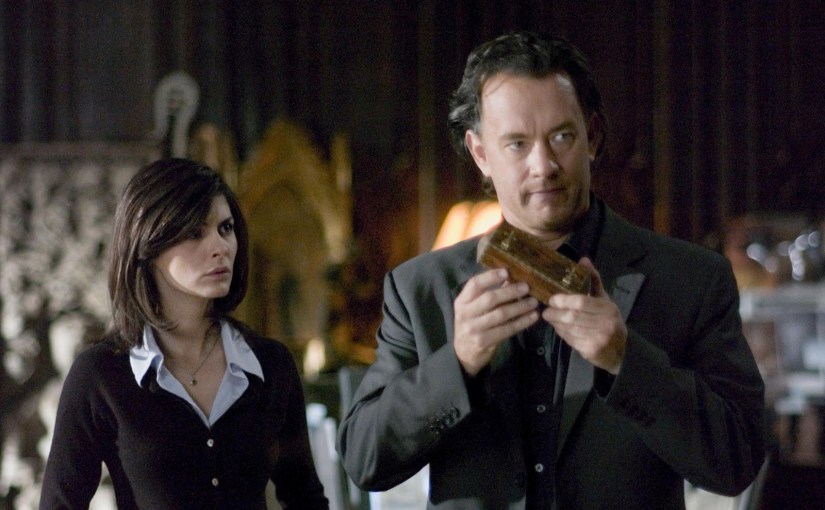
THE DA VINCI CODE

By Marc S. Sanders

Akiva Goldsman’s screenplay adaptation of the bestselling novel The Da Vinci Code by Dan Brown suffers from an overabundance of information; like A LOT of information, a TON OF INFORMATION actually. The book is an incredibly fast read with brief chapters and plenty of diagrams and images to study. It surprises me, though, how in depth director Ron Howard’s approach is with the film. Howard must have literally shot every page Brown documented including his edits. Amazingly there is a Blu Ray EXTENDED CUT. It seems Goldsman and Howard at one point couldn’t help themselves. Restraint had to step in for the controversial story’s cinematic debut.

Tom Hanks plays the great modern literary character, Robert Langdon. He is very good in the role of a research expert on historical symbols and cryptology. Hanks even masters Langdon’s self-debilitating weakness of claustrophobia very well, which proves to be a hinderance. It’s maybe an under celebrated part in Hanks’ career because the film is so heavy. Little is talked about this film any longer. (The second sequel, Inferno, flopped at the box office. I’ve yet to see that one.)

Langdon is recruited to go the Louvre in Paris one evening to look over a recently murdered victim left with a pentagram carved in his chest and a gunshot wound in his belly. The victim’s name is Sauniere (Jean-Pierre Marielle). Soon Langdon is teaming up with Sophie (Audrey Tatou), Sauniere’s granddaughter, to uncover one puzzle or clue after another left behind most prominently within the artwork of Leonardo DaVinci, including the “Mona Lisa.” Gradually, a conspiracy is uncovered revealing a strong possibility of how Mary Magdalene and Jesus Christ are actually connected. Amidst all of this, Langdon and Sophie become fugitives under the suspicion of murder. Now the cops (headed by Jean Reno) as well as a secret society within the Catholic Church are hot on their trail to stop them from revealing the truth. A dangerous, self torturing Albino monk (Paul Bettany) also comes into play.

That’s a long ass paragraph I just wrote and it hardly scratches the surface of how in depth The DaVinci Code really is. Because it is so nuanced, I had some major problems with the film. For one thing the cinematography from Salvatore Totino is very dark. I know. Most of the film takes place in the middle of the night within the hallowed halls of the Louvre and the streets of Paris. However, I think certain liberties should have been taken here. The details thrown at the audience never stop. Long summaries of dialogue come into play and at times Totino and Howard will highlight a code or a portion of a piece of art or a passage in a book. Because the story is so deliberately murky, I wish at times what I was looking at could have been presented all the more clearer.

Another issue is with Audrey Tatou who is of French descent and whose character is that way too. Her French accent is too thick to clearly understand every word she is saying. A lot of details become lost because her dialect swallows her words. Natural dialects can be a slippery slope in film. You want the characters to be as genuine as possible but none of that means much if you can’t follow along.

The best surprise of the film reveals itself when Ian McKellen appears, portraying Sir Leigh Teabing, a mentor and friend to Langdon. Yes. He offers up a ton of information too. Too much for any one film really. However, McKellan is so giddy in the role. Leigh relishes the fact that Langdon and Sophie appear at his home. He’s elderly and crippled and excited with glee to come across them so he can share his own theory of Mary, Jesus and what is possibly the real interpretation of the Holy Grail. At ninety minutes into the film, McKellan’s introduction is quite a welcome, relief from the heaviness of everything before.

The DaVinci Code clocks in at over two and a half hours. It feels longer actually. There are multiple endings as surprise traitors need to be revealed, more history and theories need to be uncovered and more European locales need to be visited complete with secret passages and hidden staircases. It took a lot of mental effort to remain patient with the film, and I had already read the book!!!

Ron Howard’s film merits the discussion of whether Brown’s bestseller should have ever been filmed. As good as Hanks and McKellan are, I say no. This is not Indiana Jones with bullwhips and truck chases. This is a treasure hunt that sticks to what is on a page and within an exhibit. To mask what is discovered by dictating endless dialogue from the cast becomes incredibly tedious.

Dan Brown’s story is wildly out there in theory and supposition. It’s what makes it fun, really. So, do I recommend The DaVinci Code? You bet I do. I definitely recommend you read the book.

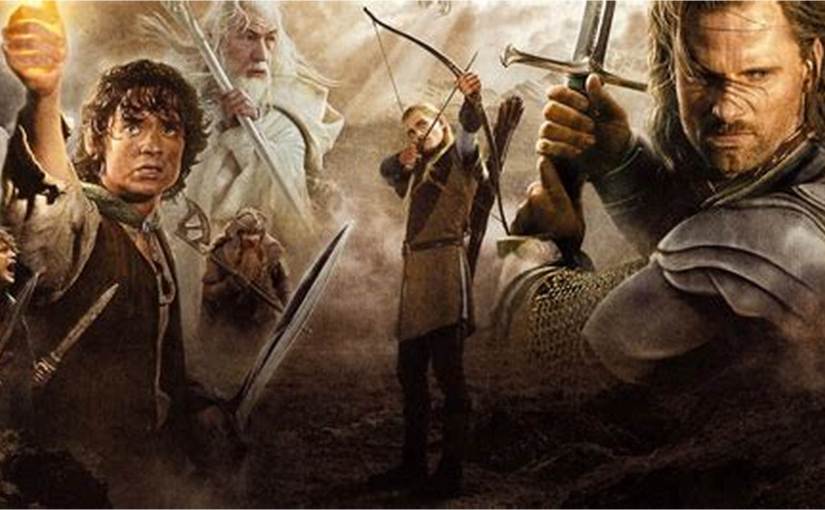
THE LORD OF THE RINGS: THE RETURN OF THE KING

By Marc S. Sanders

I remember film critic Gene Siskel once said that to take issue with the length of a film is not entirely fair. After all, you are getting more movie for your buck. Would Siskel have felt that way about The Lord Of The Rings: The Return Of The King? Peter Jackson closes out the film adaptation of JRR Tolkien’s sweeping fantasy with an epic that allows you to marvel at everything you see, but does that mean we want to feel as overly exhausted as its main protagonist, Frodo Baggins, feels? Trust me. Poor Frodo looks wiped.

More battles are enacted in the third film. Jackson just changes the dynamics up a little bit. Now armies don elephants with a number of enormous, curved tusks. Another army has a different looking giant troll. Haven’t seen elephants before. Haven’t seen that kind of troll yet either. As well, there is another King who is apprehensive to cooperate in the fight against Sauran and his Orc minions. There’s also a green glowing ghost army. Meanwhile, Frodo and Sam (Elijah Wood and Sean Astin) continue their journey to Mount Doom where the almighty Ring must be destroyed. Gollum (Andy Serkis) remains as their untrustworthy guide.

Jackson seemingly covers every page written by Tolkien. I’m talking about depicting every dream each character has or line they utter or slow motion expression they offer, or walk that they take. Peter Jackson is a completist.

The Return Of The King won Best Picture along with a bevy of other Oscars. Seemingly it should have won anyway. The first two films were recognized with Best Picture nominations as well. For the third film to win was to honor the entire trilogy and its achievements in filmmaking. The Lord Of The Rings trilogy reinvented movie making as a whole. The bar was set so much higher following its release and huge reception of these films.

That being said, it takes endurance to stay with the picture. Most especially with The Return Of The King as the film has multiple endings. Just when you think it’s over, it’s not, and it’s tedious and a little frustrating. Jackson seemed to have too hard a time saying farewell to his digital Middle Earth with its endearing characters.

The length is a problem I have with the film, but none of it seems wasteful either. Every caption and scene carry an importance to it. At least that’s how Jackson wants you to feel. The question is, if a number of momentary scenes had not been woven into the final edit, would I miss it, and my answer would be likely not.

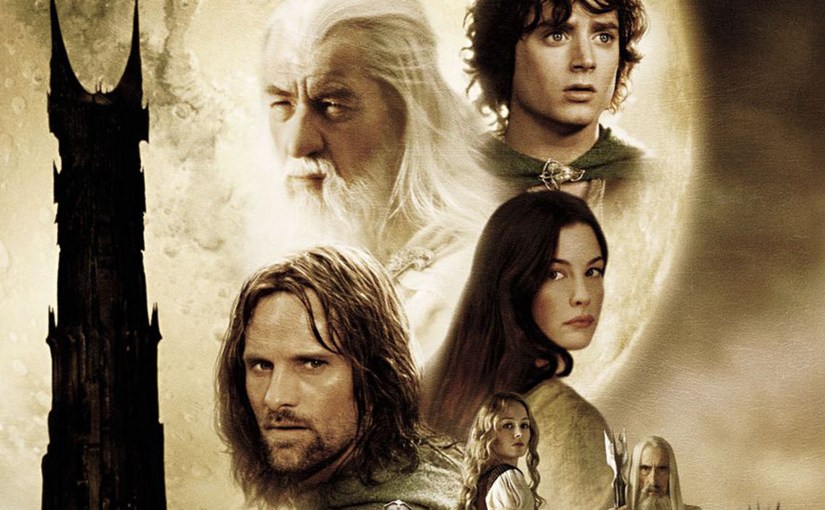
THE LORD OF THE RINGS: THE TWO TOWERS

By Marc S. Sanders

Peter Jackson’s second installment film adaptation of JRR Tolkien’s The Lord Of The Rings trilogy is The Two Towers. The captivating fantasy themes that audiences discovered in the first film continues.

Battle scenes with Orc armies are well edited and staged perfectly in digital settings. The film’s ending with a long, drawn-out battle located at the stone castle Helms Deep is stunning, full of heroic actions executed by favorite characters like Legolas the Elf (Orlando Bloom), Gimli the Dwarf (John Rhys-Davis) and especially Aragorn, destined to be King (Viggo Mortensen).

The Two Towers is almost marvelous with the exception of an overstayed welcome of the Ents – life size talking trees. Treebeard is the main Ent character, where the Hobbits Merry and Pippin take shelter by sitting on his branches. The effects of the Ents work. When the film returns to this storyline however, the narrative drags and the audience suffers. Treebeard converses in his own speak with the other Ents, the Hobbits ask “well?” and it’s supposed to be amusing that all they said was good morning. It’s not amusing. It’s boring.

The big centerpiece of the film belongs to Andy Serkis doing his full body animated effect to bring the untrustworthy, dual personality Gollum/Sméagol to life. Serkis should have received an Oscar nomination as he piggy backs on the continuous journey that Samwise Gamgee (Sean Astin) takes with the ring bearer Frodo (Elijah Wood). Gollum can’t resist what he once owned for himself-the “precious” Ring. Frodo’s good instincts insist upon not harming Gollum or Sméagol while Sam has strong reservations.

Jackson’s second film offers up a heightened urgency on all fronts. He’s good at showing the weight of the ring upon the psyche of Frodo and Gollum and he leaves time for other stories where Saruman’s (Christopher Lee) army conquers more lands-allegorical to the period of time when Tolkien wrote his novels following Nazi occupation within Europe.

Jackson is a completist and no stone is left unturned. A large portion of the film is appreciated even when you consider that you can take a bathroom break anytime Treebeard shows up.

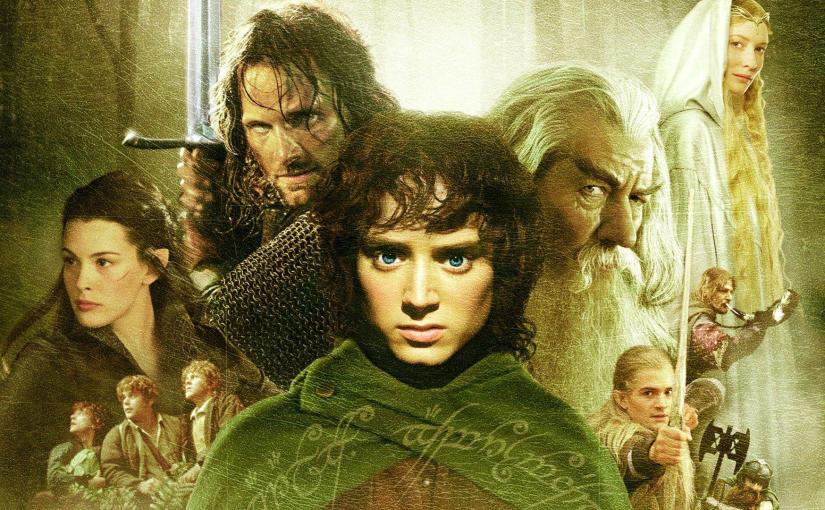
THE LORD OF THE RINGS: THE FELLOWHSHIP OF THE RING

By Marc S. Sanders

JRR Tolkien was one of the 20th Century’s greatest fantasy writers. The Lord Of The Rings series was a dense, sweeping epic inspired by the torn European climate during World War II and its conflict with the Axis nations, particularly Hitler and his organized Nazi Germany.

Peter Jackson found the opportunity to adapt Tolkien’s works. In 2001, The Fellowship Of The Ring amazed audiences with its epic landscape of Middle Earth, Isengard and Mordor where the fiery Mount Doom is located and the evil eye of Sauron waits for a resurgence of overthrow.

Much happens in each three hours plus Rings films. Tolkien’s story is not so much plot, but moreover a journey from one adventure to another. What’s special is that the main hero is a small, kind Hobbit named Frodo Baggins (Elijah Wood) who has been tasked with carrying the dangerously powerful “One Ring To Rule Them All” back to Mount Doom and destroy it. He is aided by eight fellows, three other Hobbits and four representatives of various nations and backgrounds to protect and escort him. The most significant member is the wise wizard Gandalf The Grey played by Ian McKellen in an Oscar nominated performance. The other characters’ significance become more established in later films.

This first installment is my favorite of the series because it is the most absorbing. I believe in the all but sinister and deadly value of Tolkien and Jackson’s MacGuffin, the Ring. Jackson does well of posing the threat of danger each time Frodo dons the Ring for the sake of invisibility while the Orc army of Saruman, Sauron’s Wizard henchman played by Christopher Lee, bears down on the Fellowship. The film shows one battle after another but the suspense is heightened each time as we become more familiar with Jackson’s digital world. It’s also quite dramatic to see Frodo become consumed in fear and a kind of sickness as the possession of the Ring weighs upon him. To precisely show that transition requires a three hour film, and Elijah Wood is up to the task, always appearing quite angelic and unsure of his assignment. Wood is quite the underrated actor.

There are a multitude of character descriptions in The Fellowship Of The Ring and a number of them come into play when centered around the viewpoint of the Ring. Backstories for others are really not necessary but Jackson attempts to cram as much of Tolkien’s narrative as possible. Beyond Frodo, and maybe Gandalf, the other most interesting character here is that of Boromir played by Sean Bean, often playing a variation of a hero in his films, but quite good at not being worthy of endless accolades. Boromir is a great character to show how the temptation of the Ring can cloud and poison the mind. Bean evokes that of one who might be a weak addict, needing a quick fix of the Ring’s power. There’s a complexity to his performance. Boromir is likable but Sean Bean makes the character quite shocking as well. He’s not a villain but his internal weakness presents a conflict for Frodo and his band. Sean Bean never got enough recognition for his role here.

Peter Jackson is the real hero though. This series is a massive cinematic accomplishment. Everything feels gratefully familiar. Perhaps that is from reading Tolkien’s visually descriptive books, or maybe even the animated film from the seventies. There’s something to see in every corner of the screen. It’s a world come alive in leaves, creatures on land or in the sky, sorcery and swords, flames and even saloons of overflowing drink and large platters of food. The Shire where Frodo lives with his uncle Bilbo (an excellent and jovial Ian Holm) comes off as a happy utopian village of farming and Hobbit celebrations of laziness and relaxation from any outside elements. Jackson contrasts this beautifully against the majesty of Rivendell and the hell of Mordor. It’s a nuanced universe.

Again, for me this first installment remains the best as it is cinched up tightly in its exposition and narrative. Later films are just as grand but maybe sidestep away from themselves a little.

I never got that impression with The Fellowship Of The Ring. Everything I see belongs in the film.