NIGHT MOVES

By Marc S. Sanders

As soon as composer Michael Small’s easy listening disco themes kick in and you see Gene Hackman make a u-turn in his green Ford Mustang convertible, I had vibes that Night Moves was going to operate like an episode of The Rockford Files.  I was alert and energized.  I liked where this was going.  A new, undiscovered gritty 70s movie to sink my teeth in.

Gene Hackman is Harry Moseby, a perfect name for a private detective.  Arthur Penn is the director in his second of three collaborations with the actor.  The film starts off well for Harry.  He’s giddily promiscuous and happily married to Ellen (Susan Clark), and he’s ready to take on a new case. 

A Hollywood has been actress needs Harry to find and bring back her sixteen year old, runaway daughter named Delly (Melanie Griffith, in her debut role).  Through a lead in the form of a young, punk kid (James Woods, in an early role), Harry flies out to the Florida Keys where Delly might have taken up with her step father.  

Seems easy enough, but before he departs Harry does some personal investigating on the side and discovers that Ellen is having an affair with a guy named Marty (Harris Yulin).  Harry’s carefree exterior is shattered.  Quickly, he becomes bitter towards all he cared about, from his wife and his profession which serves a purpose of lifting the veil on sins and secrets.  

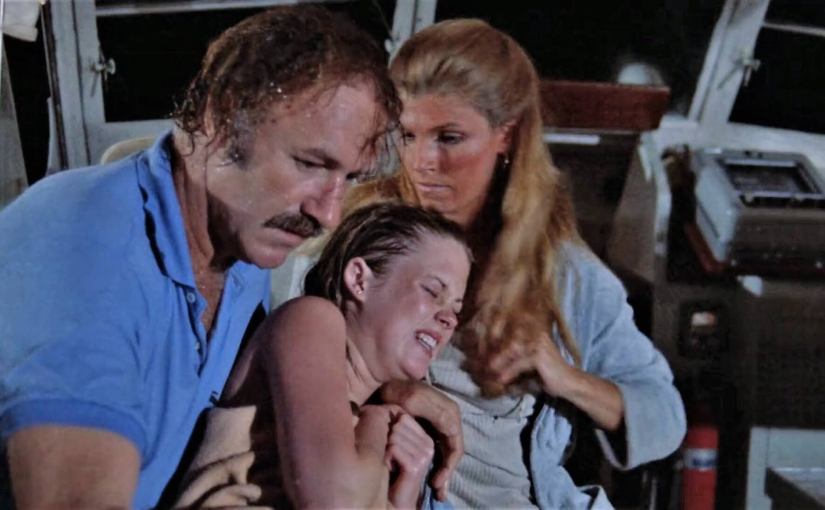
Night Moves performs with unpredictable directions and tempos.  When Harry finds Delly with her step father Tom (John Crawford) and his younger girlfriend Paula (Jennifer Warren), the rundown boat dock where they reside seems relaxing and tranquil.  Paula tends to a dolphin pen.  There’s a plane that Tom uses for shipment trips.  Drugs?  Harry is not all that concerned.  He’s only here to pick up Delly.  A boat is there for fishing and swimming off of too.  Delly feels welcome and independent here.  Though as a teen she’s resistant to Harry’s obligation to return her to her mother in Los Angeles.  

It’s only after he wraps up the case that unexpected twists occur and now he’s got to backtrack to find out what is really going among the ranks of these folks.  In parallel succession, Harry and Ellen have to wade through their own sordid conflicts.  

Watching the Criterion issue of Night Moves was really interesting.  After seeing the film, I watched two different interviews with director Arthur Penn.  There are lots of discoveries to find in the film all the way down the very last frame of the picture.  However, the revelations of the mysteries are not told but rather shown.  Dialogue hardly spells out this story.  It’s what Arthur Penn allows you to see.  He described it as explaining through a lens or view from a window, for example.  As Penn speaks, Criterion edits in quick moments where mirrors and windows that were woven into the final cut of the film provide new information and answers.  It’s a very clever strategy.

The sinister happenings of Night Moves are undetectable until Harry gets wise.  It made me think of what Jake Gittes experiences in Chinatown.  The new assignment seems so easy.  An open and shut case until the complexities surface from under water or even high above.  

What separates Night Moves from the Mickey Spillane gumshoe stories or Chinatown and The Maltese Falcon for example, is that Harry Moseby’s personal hell interferes with an occupation where he’s meant to serve from outside of all of the sordidness.  Harry won’t slack on his case, but he still has to grapple with a sudden broken marriage that he is so capable of uncovering from his wife and her bumbling lover.  He’s not a loner like Sam Spade, Jake Gittes or Mike Hammer.  He’s opted to open his own private practice and dig into others personal conflicts and misgivings.  On the side, he wants a happy home life.  Problem is he is just too damn good at what he does.  So, he’ll get hurt.  It’s the cost of his talents.

This is a great performance from Gene Hackman.  He seems like a put together Jim Rockford in the form of James Garner.  Yet, when the film steers into the tsunami of its conflicts, this character splinters apart.  Hackman has always been good at evoking strength and confidence in the romances and adventures his characters get into as well as with their various occupations.  He’s also a dynamo at showing how his characters crack and become undone (Crimson Tide, The Conversation, The French Connection).  

The supporting cast of lesser known but familiar character actors are collectively stellar as well.  Sharing scenes with Hackman only makes them look more engaging and natural in either their privileged Hollywood, California habitats or the earthy locales of Florida islands.  Arthur Penn assembles this whole cast in great footage and sequences.

Whether it’s a trip to Florida or back to California, a late night personal stake out and break-in at an ocean beach house, a visit to a film set, or a moonlit boating venture in the Keys, Alan Sharp’s script never foreshadows what’s too come.  Thus, Night Moves offers a verity of the sinister and complex.  Just when you think you don’t need to carry much thought with the picture, it suddenly begins to challenge you.

Night Moves will have you believe it gets its title from how Harry plays the strategies of two celebrated chess champions against one another.  He explains to Paula, that while it may seem that the players are three moves ahead of each other, they’re really not.  Instead, there’s play going on beyond a standard trap of check or checkmate.  When everything is laid out to the very last second, it all makes sense even if Harry never had the instinct to think of any likely scenario before.  

Was I a little vague with you just now?  

Good.  

That’s how Night Moves serves its audience best. A stunning, unpredictable thriller.
SCARFACE (1983)

By Marc S. Sanders

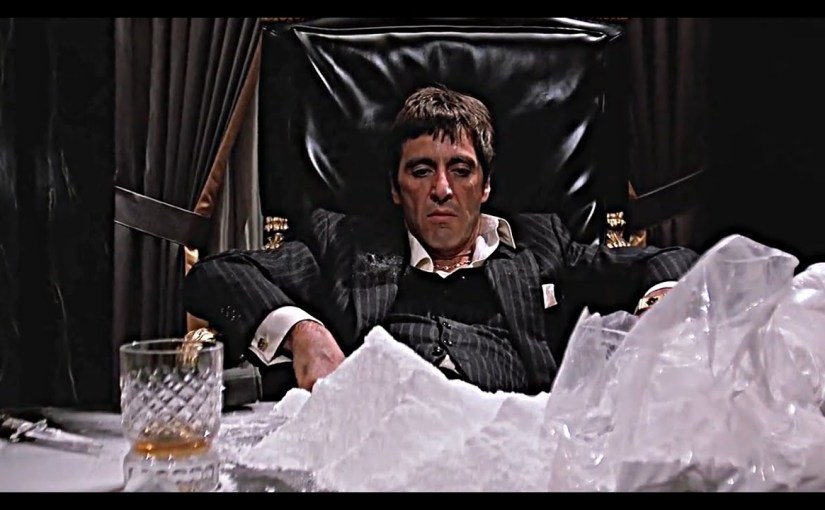
On Thanksgiving Day when we glutton ourselves with an abundance of food, it seemed highly appropriate to watch one of the most self-indulgent pieces ever put on film.  Brian DePalma’s Scarface with a script written by Oliver Stone and featuring Al Pacino.  This is a movie that brags about its boastfulness.  I mean look at everything that is mashed into this thing.  Blood, bullets, lots of cocaine and too much Al Pacino.

Pacino is Cuban refugee Tony Montana.  He is one of a handful of small time criminals who is shipped over to the United States when Castro wanted less people to oversee.  Refugee camps are fenced up under the highways of Southern Florida where no law is enforced among the tented populations.

Soon after Tony arrives he’s hot on the scene of pushing the newest underground product through Miami – cocaine.  With his buddy Manny (Steven Bauer) the two men get in good graces with a well dressed sleaze named Omar (F Murray Abraham), who is second in command to an established drug kingpin named Frank (Robert Loggia).  For Tony and Manny it’ll only be a matter of time before they take over as the numbers one and two bad guys.  That’ll include Tony marrying Frank’s blond trophy girlfriend Elvira (Michelle Pfeiffer in her breakout role) and winning a trusting partnership with a South American drug czar named Alejandro (Paul Shenar).  If you ever expect to get killed, you don’t want to be by the orders of Alejandro.  A helicopter serves much more of a purpose once it takes flight.

Scarface is a step-by-step movie or a climb up a three-hour ladder and then a gradual drop down off a balcony into a bloody fountain below.  There’s no depth and it works like a shopping list that you check off as it moves along. Props and houses and suits and jewelry and cars and cocaine and cash have more significance than what anyone has to say. Other than Tony, none of the people in this film matter. What Tony acquires and what he says about himself is all that is important.

This is a big ass movie with bloody graphics and killings, mountains of drugs and money, a lot of fucks, a gaudy estate home, a way over the top Al Pacino and lots and lots and lots of bullets and guns to go with them.  The film only settles for one chainsaw killing, though.  At the time, I recall that scene was up for big debate on the film’s MPAA rating.  Brian DePalma wanted to up the ante on brutality to grab moviegoers’ attention.  The scene remains quite stomach churning.

DePalma’s best work is at the beginning of the Scarface.  Following the establishing real life footage of the Cuban refugees arriving by boats in search of an American dream, Tony is taken into custody and questioned by a batch of immigration agents.  DePalma only keeps one steady camera focused on a very tan Pacino with a faint signature scar on his left cheek, sitting in the middle of the room and putting on a Cuban accent that only he could uniquely own.  Pacino’s concentration in this moment is admirable as he responds to questions from all different directions.  It’s all done in one take with the director’s camera circling around Pacino.  After this introduction is over, the tone of the movie changes for the next two hours and ten minutes into a gritty interpretation of Lifestyles Of The Rich And Famous.

Oliver Stone’s dialogue with Brian DePalma’s set ups don’t require much of the other actors.  It’s like everything caters to an always inebriated, hyperactive Al Pacino doing his Tony Montana with the gold chains and wide collared shirts over the linen suits.  He’s a motor mouth of endless f-bombs, with a slinky Michelle Pfeiffer in a blond bob-cut, dressed glittery evening gowns, at his side.  She has nothing of significance to say.  This is all you learn about Elvira; what you see of her materialism and all the coke she snorts.  She never smiles or exudes any connection to the Pacino character.  It’s all eye candy.  In fact, there’s never a clear answer of what becomes of this character.  That’s a problem because the movie is so much about Tony Montana, nothing else matters.

Other characters not given enough attention are Tony’s sister Gina (Mary Elizabeth Mastrantonio) and their mother (Miriam Colon).  Momma despises Tony for the criminal thug he is while Gina becomes enamored with the wealth and drug night life.  Unfortunately, Momma only has one meaty scene and Gina’s purpose to the script is to lend reason for another character’s eventual demise.  Both of these actresses are very good with what little they have.  Yet so much is devoted to Tony’s indulgence and the mania that Pacino brings that they are sidelined as well.

Brian DePalma seems to be more proud with how excessive he can make this guy than actually turning him into a guy.  Wait until you see the mansion that Tony gets. His office alone is of black, gaudy exuberance. His master bedroom contains a small swimming pool size tub right in the middle of the carpeted floor.  That setting occupies a fifteen-minute-long scene of Tony in a bubble bath, watching his five TV screens while not talking about anything meaningful except himself as he chastises Manny.  Elvira is only there to uphold her dread for her husband as she snorts coke off of her vanity.  When they both leave, an Oliver Stone monologue ends with a now recognizable sound byte of “Well say ‘allo to da bad guy!” Ah! Big deal! Tony never seemed so bad ass as he does feel obnoxious.

Again, Scarface is about not much else except the conceit of sleazy criminal.

When someone has to die it becomes a long drawn-out process as Tony, aka Pacino, puts on a performance or delivers a sermon.  Tony will meet with kingpins from Columbia along with other South Americans and dirty government officials.  There will be 5-7 guys in the room but for the most part it is only Tony talking.

“Say ‘allo to my little fren!” is one of the most memorable lines to come out of the 1980s decade of excess and it arrives during the ongoing and endless bloody shootout that closes the film.  There’s buckets of blood and truckloads of ammunition fired off.  These machine guns seem designed to kill things twice the size of elephants.  Little Al Pacino, with a ginormous cannon gripped in one hand, gets hit in all places and extremities except the head so that he can keep ranting – I mean this guy never shuts up – and going as he fends off the armies of goons coming at him from all directions.  Truly, it’s laughable and nowhere is it ever absorbing.  It’s like I’m watching someone else play a first-person shooter video game during a sleepover.  My friend is entertained while I’m just watching him be entertained.

Scarface comes to an abrupt halt when the final shootout stops.  There’s no footnote to ponder or real news story to follow up on.  The credits roll and the orchestral strings of the soundtrack cut in. You get the idea that DePalma, Stone, and Pacino became exhausted over this monster of a movie and simply declared “Okay! That’s enough!”

Considering the later insightful pieces that Oliver Stone delivered like Platoon and JFK, I wish he explored more of the politics and Cuban dealings affecting the United States.  As this film arrived in 1983, soon after there would be more of an intellectual standpoint to make us aware of a very real drug epidemic in this country.  It may appear to be sending some kind of message, but Scarface doesn’t challenge the brains that flourished this contraband industry.  Forty five minute episodes of Miami Vice tell more than this three-hour opus.

Plenty of gangster films like Chinatown, The Godfather, and Goodfellas offer up the greed and ego of the criminal mind, but the men of those pictures are never as self-indulgent or off putting as Tony Montana.

Besides, what does it say about a movie called Scarface when no one calls the main guy Scarface, and you hardly ever see the scar graced across his profile?  The real Scarface, Al Capone, would be very disappointed in Al Pacino.

CLEAR AND PRESENT DANGER

By Marc S. Sanders

Tom Clancy’s Jack Ryan finds himself in an inadvertent private war between the United States and Colombian drug kingpins in Clear And Present Danger.  Harrison Ford returns as the heroic government operative. I like this film for much of the same reasons I liked the prior Jack Ryan pictures.  These movies give an inside view of internal politics within Congress, the CIA and inside the hallowed halls and Oval Office of The White House.  The Clancy adaptations are not just about action set ups and shootouts.  Though we are treated to plenty of that material as well.

The film opens with a luxury yacht being raided by the Coast Guard. They uncover Colombian killers that have murdered a wealthy American and his family for reasons of a failing partnership with drug dealers.  The incident can be bridged to the President played by Donald Moffat, a terrific character actor who also shared the screen with Ford in Mike Nichols’ Regarding Henry. He secretly initiates a retaliation for what has occurred while also insisting on collecting over six hundred and fifty million dollars he feels the US is entitled to, following his friend’s murder.  Henry Czerny, playing a carbon copy of his role in Mission: Impossible, headlines the covert plot and recruits a mercenary named John Clark (Willem Dafoe) to place a clandestine militant team into the South American jungles to take out the drug runners one by one.

The suit and tie formal dynamics fall on Jack Ryan when he swears testimony on the legitimacy of the country’s response.  However, the President’s armament exercises are unbeknownst to Jack.  When it finally dawns on him what has been occurring, into the field Jack Ryan goes to clean up the mess.

A lot of spinning plates structure the storytelling of Clear And Present Danger which is on par with Clancy’s thousand-page novels.  There’s an abundance of characters to address, betrayals to happen and even the mechanics of various weaponry and policy decisions that need exploring, despite the innate complexities of it all.  It can feel overwhelming.  However, with this film, as well as with The Hunt For Red October and Patriot Games, I feel included.  If you’re patient through the exposition and set ups, then these fictional controversies become very absorbing, and you feel like you’re there.  

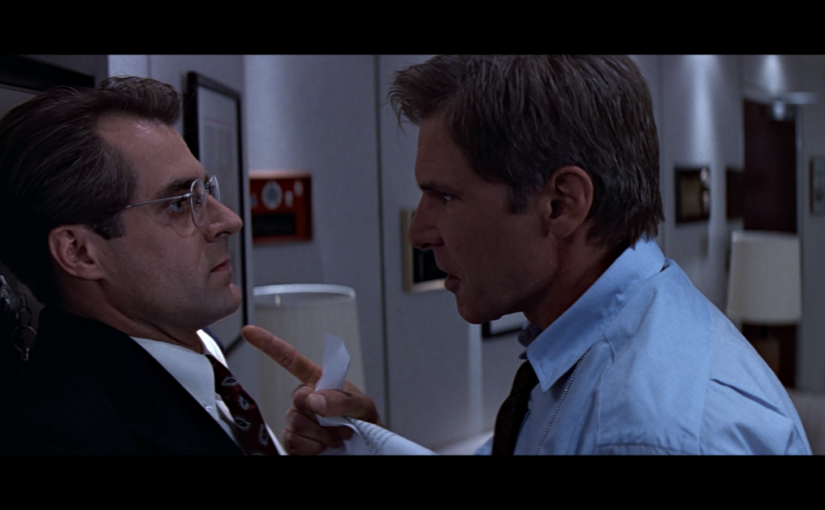
There’s a great scene between Ford and Czerny racing to download vs delete some suspicious files on a computer.  These guys are in their boring offices, dressed in their boring suits and they’re clicking on the mouse pad and typing away on the keyboard.  Director Phillip Noyce gets nail biting back and forth closeups on each guy as they are off to the races trying to get ahead of each other.  Then it becomes a yelling match in the hallway with threats of prosecution between both men, and I feel I’m in on the whole thing.

There is also a good amount of internal conversations between the main drug czar (Miguel Sandoval) and his top henchman (Joaquim de Almeida).  Almeida’s role is written very well as we witness how smart and resourceful he is while protecting the best interests of his employer.

For the most part, the action is nothing special.  However, the highlight of the whole film involves an SUV convoy getting ambushed by Colombian terrorists mounted on rooftops firing missiles at the government vehicles below.  Harrison Ford prefers to do as much stunt work as possible and it definitely helps the ten-minute sequence.  This is an outstanding part of the picture with perfect editing of sound and photography. Later on, we see Ford leap on to the landing gear of an ascending helicopter. Very impressive. Harrison Ford always does his best to invest himself in his movies.

I also admire many of the explosions that went into the Special Forces’ continuing storyline of sabotaging the drug lords’ laboratories and various locales. Nothing is miniaturized here, and the resulting blasts are really big and eye opening. This movie did not shortchange on anything it was attempting to accomplish.

The film adaptation of Clancy’s fourth book takes some major liberties.  In the novel, the story is primarily focused on John Clark and his mission, with Jack Ryan not appearing until after the midway point.  However, at this stage of Harrison Ford’s career there was no way he’d accept just a supporting role.  The notable changes hold well within the screenplay though, and a showdown between Jack Ryan and the President is one for the ages.

Overall, Clear And Present Danger was a successful picture at the box office. Critics and Clancy fans alike had favorable responses to the picture.  So, it’s disappointing that producers decided to try numerous reinventions of the Jack Ryan franchise subsequentially.  Those other movies, along with a TV show, would prove well.  Yet, it is regrettable that Harrison Ford, or at least this interpretation of the hero, did not move on through Tom Clancy’s ongoing stories transcending within other areas of government and espionage.  If you have read the books, then maybe you recall the unbelievable ending to Without Remorse.  Boy, would I have loved to see what Harrison Ford did with the cliffhanger that closed out that book. Care to know? Then this Unpaid Movie Critic suggests you pick up a book.

NOTE OF TRIVIA: James Horner conducts the music for this film and he includes samples that were used in the beginning of Aliens. Interesting to catch this as the music works for both a science fiction piece, as well as for a political thriller.