
THE IRON CLAW

By Marc S. Sanders

A compelling sports movie requires that uphill battle that must be overcome.  Rocky achieved that standard.  Raging Bull might not have reached a plateau for its protagonist to defy his faults, but Jake LaMotta’s demons were effectively on display. Reminiscent of that film, is The Iron Claw – the wrestling film that reenacts that supposed cursed theme linked with the famed all star Von Erich family. 

Writer/Director Sean Durkin opens his film with the patriarch of the family, Fritz Von Erich (Holt McCallany), in the ring and putting his signature move, THE IRON CLAW, on an opponent.  The title of the picture occupies the screen in big letters, and we jump to the late 1970s where the four sons of Fritz are having breakfast.  Fritz tells the youngest, Michael (Stanley Simons), that he needs to start working out, building his physique to catch up to his impressively built brothers if he wants to compete like them.  Fritz makes it clear he loves Mike the least but the rankings can change if he works at it.  Durkin’s breakfast scene sets off the pattern of the film where the four boys will have to live under the mantra of their father’s iron claw of unwavering expectations. 

The stand out role belongs to Zac Efron as Kevin Von Erich.  If he does not earn at least an Oscar nomination, then people have not been paying attention.  Kevin is establishing a name for himself in the nearby Texas wrestling federation, and Fritz sees opportunity for him to carry the torch of the family into national and worldwide championships.  What Fritz could not accomplish in his youth, he will ensure his sons complete.  If it is not Kevin, it’ll be one of the other boys.  Kevin is protective of his brothers, as best he can against their father.  The mother, Doris (Maura Tierney, another under the radar performance), makes it her mission to stay out of her husband’s controlling design of mentoring in a household where almighty God will lead the way, and handguns represent the American freedom to bear.

The other brothers consist of Kerry (Jeremy Allen White) and David (Harris Dickinson).  Kerry was on his way to Olympic gold in shot put until the United States opted to withdraw from the games.  Thereafter, Fritz directs his boy’s focus on wrestling as well. Kerry eventually finds himself in the center ring spotlight too. Durkin’s film shapes out each boy’s destiny as cause and effect based on the outcomes of the other boys.

I do not want to share much more.  While I had heard of the Von Erich family, I was not familiar with what they encountered during the boys’ young adult upbringing and within the spotlight.  Sean Durkin writes well drawn characters based on the real-life figures.  Fritz was a villain, a harsh antagonist, who was not so much a father as he was a chess player using his sons as pawns to win and win again.  If a setback occurred, then he turned to another athletic boy in his regiment to step up and fill a void.  If one of the boys were progressing, then he became the father’s primary focus, while another was pushed down a notch.  Holt McCallany is astonishing in this role. Fritz was a coach and hardly a father.  Any scene he occupies defines the obedience his character expects of his family.  Along with many others involved in the film, he is worthy of Oscar recognition as well.

Zac Efron has gone full method with a chiseled body and a mop top haircut that is a full departure from his pretty boy athletic physique.  As Kevin, what he’s done with his body should garner applause, but Efron’s character is tormented with never accomplishing enough, while accepting his father’s oversight when opportunity presents itself with one of his other brothers.  Kevin and his siblings are absolutely forbidden to cry at loss or setback.  This only allows the pain to remain unhidden on Efron’s face.  With no dialogue, the lead actor puts his insecurities and suffering on display whether he’s in the ring, working out or crouched in bed.  This is a stellar performance, in line with Robert DeNiro’s unforgettable portrayal of Jake LaMotta – a tortured, yet talented soul and athletic fighter imprisoned within inescapable circumstances.

Efron has terrific chemistry with Lily James as Pam, Kevin’s wife.  She is an impressive actress worthy of more attention to her career.  Lily James is not the headliner of this picture, but her response to scenes with Efron and a particular one with Maura Tierny make her acting partners all the more effective.

As the mother to these powerful men, Maura Tierny mostly hides in the background.  Should there be a chance she earns an Oscar nomination, the scene where she simply stares despondently at a black dress offers enough evidence.  This one standout moment deserves a lot of attention.

Sean Durkin is worthy of enormous accolades.  He has an ability to depict multiple stories occurring in one caption.  There’s a dizzying moment where Kevin, Kerry and David are working through their own respective progress.  Durkin blends the three athletes together, where you eventually see one hulking, flexing chest.  Above, are the blurred, sweaty faces of the three men meshed together and over one another, while working through their regimental exercises.  Their faces are layered upon each other.  

A later scene will show Kevin and Kerry practicing in an outdoor ring, with Kerry fighting a hard physical challenge.  In the foreground of this nighttime exercise, is a flashlight moving through the fields.  A subsequent moment will explain that significance.  Sean Durkin beautifully balances several biographies within this famed family.  You are viewing multiple stories at once, and nothing is ever distracting. This amounts to outstanding writing and directing that demands multiple layers.  

I became aware later that there is another son who remains unaccounted for in this picture.  Apparently, that story was cut for pacing issues.  I’m not sure I’d say it’s unfair to disregard that person within the confines of this picture.  Most biographical films take certain liberties to assemble an engaging structure, and frankly the destiny of that son is similar to what occurs with others in the movie.  Durkin opted to avoid appearing repetitive in his storytelling.  So, I stand by this decision.  

The Iron Claw is certainly the most surprising film of the year for me.  Based upon what happened within the Von Erich family, it seems so apparent that a movie would eventually be generated.  Yet, falling into melodramatic schmaltz with a drama like this is an easy trap.  Sean Durkin dodged that obstacle with a sensational cast.  There is not one weak performance in this picture.  You could make a separate film out of each perspective offered.  It’s fortunate that Durkin found a way to balance everything beautifully.

The Iron Claw is one of the best pictures of the year.
TRIANGLE OF SADNESS

By Marc S. Sanders

I’ve noted before that the value of satire lives off how divisive it is within audiences.  Satire will drive home a perspective by going to the extreme to maintain order or deliver a sense of logic that needs to be prompted. Ruben Östlund’s Oscar nominated film Triangle Of Sadness explores how a rank in social class values itself and what’s beneath them in different scenarios.  I do not think there is room to argue with the message delivered in the film.  However, for all the reasons I liked the film, in turn my wife hated the picture.  Yet, I can’t blame her.  The message is just.  The message is sound.  The envelope it was delivered in is quite grotesque, though.  I guess that is how satire should be served.

When your dependence on others becomes so reserved to only what your stature and money pays for, then what will you do when that assured reliance is absent from what you live for?  Ruben Östlund will have you believe you could end up getting violently sick, drowning in your own feces, and propagandized with debates about the needs for communism vs capitalism.  Then again, you could just be pirated by scavengers and shipwrecked on an uncharted island.

Östlund begins his picture with cattle of chiseled male models auditioning for a catwalk stroll.  Carl (Harris Dickinson) is asked to adjust his “triangle of sadness” – the area identified between someone’s eyebrows and above their nose.  Carl acquiesces, but I never saw the difference.  The casting agents apparently did, and it is implied that Carl is past his prime.  In the next scene, he’s in the front row of an audience ready to watch a fashion show, and he’s asked to move down the row of chairs until there are no seats left.  He’s left to take a seat in the back.  He no longer carries any value in the world of modeling.  More importantly, because he has only been a male model with good looks, he is no longer a value in any world, anywhere. 

Following this pretext, we are introduced to Part I (“Carl & Yaya”) of a trilogy of chapters involving Carl and his model/social media influencer Yaya (Charlbi Dean).  Östlund stages a scene duet with his characters at a restaurant table debating about who is going to pay the bill.  Yaya makes more money, but Carl is the man.  What is appropriate here?  What is the societal norm? The conversation turns into a tense exchange between boyfriend and girlfriend, that carries over to an elevator ride and I don’t recall any kind of resolution coming from any of it.

The centerpiece of the film is Part II (“The Yacht”) where Yaya has been complimentary invited to sail on a small, luxury yacht with other passengers, all stemming from the most elite and wealthy social class.  Yaya’s influence will lend testimony to the vacation voyage.  Carl is her plus one.  The other passengers include a husband who made his fortune “selling shit,” or more appropriately, fertilizer.  Another couple are thriving off their success selling hand grenades worldwide.  The staff of the yacht have a rah-rah session led by their cruise director, Paula (Vicki Berlin), who stresses that whatever the passengers say or need is right and should be completely satisfied.  What will that lead to?  Better tips!!!!!! WOO HOO!!!!!  She gets the primarily white and attractive looking staff in a clapping and stomping frenzy of enthusiasm for the voyage while the maintenance crew of darker skinned minorities are on the deck below waiting to clean or do housekeeping with no sense of gratitude for their service.  What’s in it for these people on the bottom deck?

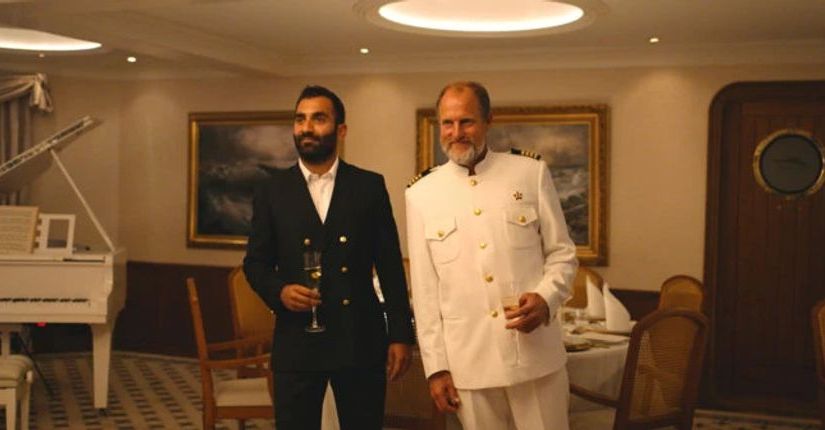
Part II of Triangle Of Sadness really drives home the point of the picture.  These wealthy folks rely on their satisfaction based upon how they are catered.  Carl thinks he is so elite that he inadvertently gets a maintenance man fired for cleaning the boat while shirtless.  A woman insists the sails are unclean compared to the pictures in the brochure.  Paula will ensure it is addressed.  Another woman insists that all the staff do a swim with her.  The cooking staff has to prepare for the Captain’s dinner.  If they swim, the food risks getting spoiled.  Doesn’t matter though.  This passenger has asked for a staff swim and Paula will make certain the upper class are accustomed.  It doesn’t help either that the Captain (Woody Harrelson) – the man in charge – refuses to leave his cabin and thus no one with authority is steering the ship away from choppy waters and a violent storm.  As such, the Captain’s dinner is going to be unforgettable for sure.

Part III is known as the “The Island” which depicts a turn of events when seven surviving people are marooned on a desert island following the graphic complications of that doomed dinner at sea.  Dynamics in social class take a drastic turn here.  The rich and privileged don’t know how to fish or build a fire.  So, what happens when a maintenance worker does?

The message of Ruben Östlund’s film is not surprising to me.  Yet, how many of us forget that we all biologically evolve the exact same way.  We come from the womb with the same appendages and capabilities to eat, breathe, learn, and digest.  Eventually we all face the same demise.  What I appreciate about the movie though is how many people of a wealthy social class are incapable of fending for themselves, even in the most desperate of situations.  What can a social media influencer do for her fellow man or woman beyond taking endless selfies of herself?  How can a man who profits off of selling fertilizer or hand grenades survive with just the raw materials of the earth?  How can a woman suffering from the aftereffects of a stroke with limited communication make due for herself? 

Östlund’s script examines the dependability of one for the other, and how it is taken for granted.  The dependability is not from equal peers though.  Östlund goes a step further when the one positioned lowest on the pole turns herself into the highest rank when any kind governing mandate is dismissed.  In any community, opportunity will allow someone to always usurp the higher cabal and assume his/her own dominance. 

There are many ways to deliver the message of what is unfair or what is right in a social class system.  I don’t think I risk much by declaring that anyone who watches Triangle Of Sadness should have a presumption of extending value and appreciation to his/her fellow neighbors, even if we don’t always live by that mantra.  What will divide audiences of this satire though is in the route that Ruben Östlund adopts to make his point.  In The Three Stooges, the wealthy would lose their dignity and authority when they got struck with a pie to the face, humiliated by the well-known vagabonds.  Here, the wealthy gradually toss their cookies as the boat continues to toss and turn with no Captain at the wheel, while they all continually try to consume the fancy prepared entrees that are not agreeing with them.  I could tolerate and laugh at that ugliness that surfaces during Part II of Östlund’s film.  My wife could not.  I can appreciate a good pie splattered in someone’s deserving kisser as well.  My wife doesn’t like The Three Stooges.  However, the point is what we agree upon.  The approach is where we differ.  My wife could have done without watching endless streams of vomit spew across the dining room or toilets bubbling over with brown sewage.  I can’t fault her for that, though.  It is disgusting.  It’s supposed to be.  I wouldn’t want to watch my wife or child get violently ill.  For that matter, I wouldn’t want to watch anyone in real life succumb to that state of helplessness.  Fictionalized mediums allow that opportunity though. 

An interesting angle that Ruben Östlund takes is as the ship is spiraling out of control, the Captain engages in a drunken debate with the wealthy fertilizer seller on the positives of communism vs capitalism.  Both men use the loudspeaker to preach the gospel of celebrated leaders like John F Kennedy and Karl Marx.  Our leaders are arguing.  The constituents of this doomed boat have no choice but to listen, all the while they are drowning in their own vomit and shit.  These are just words that our leaders are drunkenly shouting.  Heck, these guys didn’t even write these policies.  They stole them from pioneers before them.  Where’s the execution leading to a salvation for their community, though?

As I continue to write this column, it occurs to me how much I listen to the guidance of others.  A doctor tells me what pills to take.  An article will explain what foods are bad for me.  A politician will tell me his or her platform is the best course.  I write critiques of movies encouraging readers like you to watch or avoid. These are all sources of authority that we are exposed to everyday.  Triangle Of Sadness explores what occurs when those sources are taken away and we are each individually left to our own devices. Maybe Ruben Östlund’s testament is that only the meek shall inherit the earth.

I can not promise that you’ll like Triangle Of Sadness.  You will appreciate the message though, and whether you care to or not, you will think about it for a while after it is over.  Hence, another satire has done its job.