
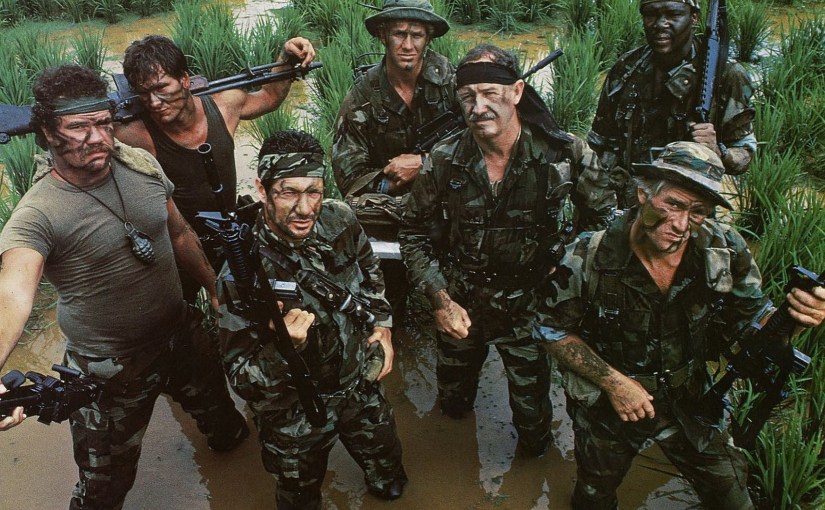
UNCOMMON VALOR

By Marc S. Sanders

In the decade following the Vietnam War a common denial (or ignorance, maybe) went towards American soldiers who were missing in action.  Many men were theorized to be prisoners of war long after the armed forces left the country, ending a losing battle with record numbers of casualties.  A handful of films of the 1980s brought focus to this topic, as a means for adventurous entertainment.  Chuck Norris had a series of Missing In Action films.  Even light action fare TV shows like The A-Team and Magnum PI brought attention to this issue.  Most predominantly, the possibilities of POWs were ingrained within Sylvester Stallone’s box office bonanza of Rambo pictures.  In 1982, Ted Kotcheff directed the initial entry of that series, First Blood, and he zeroed in much more precisely the following year, with Uncommon Valor.  

Gene Hackman is retired Marine Colonel Jason Rhodes who begins a decade long campaign convincing the U.S. government to seek out those who were left behind and are likely being held as prisoners of war.  His motivation stems from his belief that his son Frank is likely being held captive in a camp located in northern Laos.  

By the time 1983 arrives no action of recovery or rescue is taken.  The Colonel is committed to bearing the responsibility.  He appreciatively accepts financing of his own mission from an oil tycoon (Robert Stack) whose son might be with Frank.  The Colonel also recruits members of Frank’s unit who made it home (Fred Ward, Reb Brown, Randall “Tex” Cobb, Harold Sylvester, and Tim Thomerson). Patrick Swayze is a young guy named Scott who never served in the conflict but is an expert combat and weapons specialist who will get these men retrained for the upcoming rescue.  He also has his own reasons for partaking of this mission. 

Uncommon Valor is sporadic on humor and focused on the adventure and resourcefulness.  The first half provides footage of how the squad gets reacquainted with each other and the jungle elements they left behind in Vietnam.  They practice routines outlined by the Colonel with ground patrols, detonators, hand to hand combat, artillery, sabotage, and chopper rescue.  The second half follows them back into the Asian country where they have to obtain weapons and supplies, while making connections with locals who will escort them through the dense jungle area towards the camp.  

This is a rare occasion where Gene Hackman is not applying much of his acting craft. He is primarily going through motions of Kotcheff’s film direction with a script rumored to be co-written by Wings Hauser (also a producer on the film).  The trauma of the war is primarily carried by Fred Ward who struggles with PTSD long before it became so widely attributed to service men and women after returning from combat.  In First Blood, Stallone offered a much more substantial and convincing demonstration.  Yet, Ward does a serviceable job with a script that never goes terribly deep.

Uncommon Valor is better described as a present-day adventure picture.  It’s never boring.  There are fireball explosions and machine gun shootouts. The action set pieces still hold up with good art designs staged off the Hawaiian Islands in place of a sweltering Vietnam.  The prisoners who are recovered, supposedly held for over a decade, are chilling to look at with obvious malnourishment and dead-blank expressions.

Randall “Tex” Cobb and Reb Brown (the TV movie Captain America) are mostly doing wacky A-Team material here.  Gene Hackman, Fred Ward and Harold Sylvester are the straight characters.  

It’s not as grand as a Rambo film, but Uncommon Valor never lampoons or minimizes what was a horrifying experience for those enlisted soldiers who never came home, while their next of kin never obtained closure.  

For the 1980s, which feels like it had just passed yesterday, it’s fair to say that all those missing in action during that terrible and bloody war are no longer alive over fifty years later.  The opportunity to search and negotiate for their freedom has long expired by now.  While movies like Missing In Action, Rambo and Uncommon Valor focused on fictional triumphs that were never factually replicated, at least these films can serve as reminders for the sacrifices these people served at the behest of their country.  I’m not writing to ease lifelong pains.  All I can do is recognize, remind and be forever grateful.  These movies still serve a purpose beyond the pulpy Saturday afternoon adventures. 

AN OFFICER AND A GENTLEMAN

By Marc S. Sanders

You ever feel proud of a character in a movie?  Like you walk out, and you say to yourself, “Well done, Rocky!  You did it!!!”  That’s how I feel about Zack Mayo, the Navy enlisted candidate who has to survive his first 13 weeks of basic training on his way to eventually obtaining his dream of flying jets.  Just as important though, Zack has to mature as a responsible young man with a commitment to caring at least as much for others as they already care for him.  Richard Gere plays the guy who must become both An Officer And A Gentleman.

Director Taylor Hackford goes deep into the bottom of the well to show what makes Zack such a loner.  His Navy enlisted father (Robert Loggia) abandoned him and his mother, and only reenters Zack’s boyhood life once his mother commits suicide. Zack spends time growing up on the Philippine Islands Naval base where he gets bullied while remaining unloved.

Years later, after college graduation, not knowing of any other direction to take with his adult life, he opts to go down the same path of his bum of a father and join the Navy where he’ll perform basic training when he arrives at a coastal Seattle base. The enlisted men do not have a good historical reputation in this area.  Many are known for bed hopping with the local factory girls, and then they relocate to where they are going towards next in their servitude, leaving the girlfriends behind and forgotten.  Zack’s father was one of these guys. The ladies in the area also have a stained legacy.  Many of them will deliberately get pregnant or even lie about missing their period to keep these enlisted men from leaving them.

Sergeant Foley (Louis Gossett Jr, in his unforgettable Oscar winning role) oversees Mayo and his class, specifically warning all of them that these trends occur over and over again.  When he’s not cautioning them, Foley attacks the character traits that weigh Mayo and the others down.  If they had a rough childhood or checkered background, Foley will not hold back.  He has to prepare these men and women for a possible war or a position of captivity behind enemy lines.  If these young folks can endure Sgt Foley’s cruel mind games and unforgiving, hard-hearted nature, then they are more prepared for any worst-case scenario that can come while performing military service.  

Mayo is a leading candidate in his class.  He has the potential to break the record on the brutal obstacle course, and he’s secretly resourceful with selling polished boots and belt buckles to his classmates ahead of bunk inspection.  Not bad.  However, he’s not mature and he doesn’t even realize it.  The first time he completes the obstacle course he sits over on the side, proud of himself, rather than joining his teammates in cheering each other on to finish the job.

Love is also not something Mayo is experienced with. He meets Paula (Debra Winger in a superb Oscar nominated performance) who is ready to love Zack but he’s not ready to open up to her.  Perhaps he never wants to love or commit to anyone to save himself from loss or further abandonment because it’s all he’s ever known.  An Officer And A Gentleman is very good at subtly covering what makes a loner a loner.  

Contrary to Zack’s background is the best friend he makes, Sid Worley, a fellow classmate (David Keith).  Sid is a happy go lucky fellow, but eventually the film shares what motivated him to enlist and how his relationship with a local girl pans out. Perhaps there’s some sense to what Foley has been warning these people about.  

An Officer And A Gentleman is sad at some points and very uplifting as well.  Sometimes it’s hard to watch the encounters that Zack and company must endure during these first thirteen weeks of a committed six-year servitude to the Navy.  The glamour of flying jets can only arrive once you shed away the person you once were by developing maturity, respect, resilience and honor.  

I love the way Taylor Hackford’s film tests Zack.  He’s tested by Paula, by Sergeant Foley and even by his own father.  Can he let go of the drunken whore parties arranged by his dad? Raised by a guy who might have worn the officer rankings and uniform, but now beds the women he picks up in bars only to finish it off with a drunken vomit session in the morning.  

Foley puts Zach to his mental and physical limits after he catches him in violation.  The sergeant then insists on the kid’s DOR (“drop on request”).  It’s up to Zack if he wants to take this seriously or simply quit and remain a loser like his father.

Then there is Zack’s commitment to Paula.  Can he trust Paula will not trick him or let him down, again like his father, then his mother, and followed by his father all over again?  

Richard Gere is sensational at balancing two stories at once.  This remains the best role of his career.  It’s a dynamic, multi layered performance.  First, the physicality he devoted to the role is impressive.  That is Gere doing the obstacle course and cockpit test crash dives in the swimming pool.  Gere is the one doing endless pushups in the mud and running in place with a rifle above his head while Gossett’s character torments him with his abusive yelling and a dribbling water hose.  Gere is also the one riding Mayo’s motorcycle.  The actor is completely absorbed in this divided character.  Arguably, he should have been considered for an Oscar nomination.  

Zack Mayo is not always likable.  The purpose of the film is to discover what is to admire about the conflicted loner who never had anyone to care for him or anyone for him to lend sincerity towards.  If joining the Navy can pull this guy towards a meaningful life that can be purely earned and not cheated or circumvented, then it’s possible to feel proud of what this man becomes.  

An Officer And A Gentleman is now over forty years old. So, it might feel dated. Yet, the traits that make a man and a woman good, honorable, and loving people has never lost their immense value.  If you have never seen this movie, it’s time you did, and if you have seen it, it is due for a rewatch.  

The last line of the picture, depicted in one of the greatest endings ever to close out a film, is “Way to go Paula!”  Allow me to also say “Way to go Zack!”