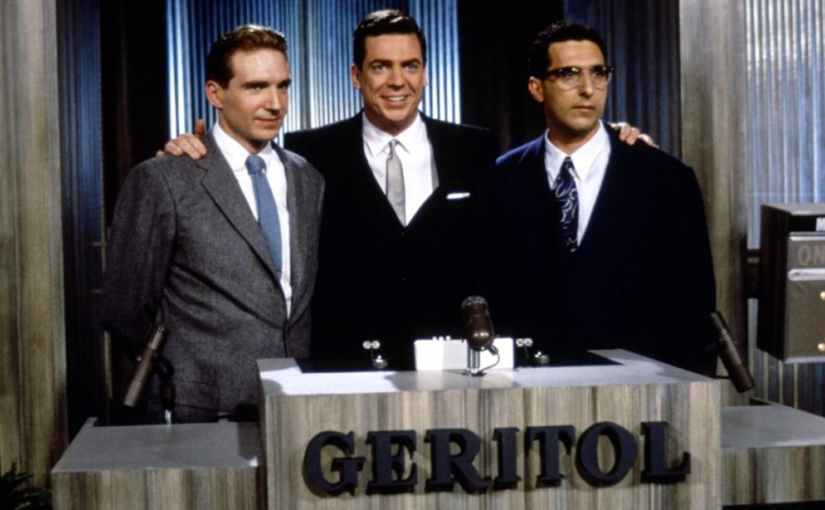
QUIZ SHOW (1994)

by Miguel E. Rodriguez

DIRECTOR: Robert Redford
CAST: John Turturro, Rob Morrow, Ralph Fiennes, Paul Scofield, David Paymer, Hank Azaria, Christopher McDonald, Mira Sorvino
MY RATING: 7/10
ROTTEN TOMATOMETER: 97% Certified Fresh

PLOT: In the late 1950s, a popular TV quiz show, along with its current champion, falls under federal investigation following allegations of rigging.


I imagine there will be no shortage of people more than willing to tell me how wrong I am, but while Robert Redford’s Quiz Show was well-directed, well-written, and well-acted, I never fell completely under its spell.  For that matter, it never felt like it had the director’s stamp on the material; a lot of it felt like a Ron Howard film.  No doubt the story captured a lot of attention when it happened in the late ‘50s, but it failed to grab mine, at least to that same degree.  It’s too well-made for me to skewer it mercilessly, but neither do I consider it a masterpiece.  It’s…okay.

It’s 1957, and Sputnik captures the world’s attention at (or at least near) the height of the Cold War.  To distract themselves from Sputnik’s implications, Americans tune their TV sets to the most popular game show on the air: Twenty-One, in which competing contestants are asked random trivia questions while isolated from each other.  These questions are something else.  One multi-part question includes: “Who rode with Paul Revere?  Who lent him his horse?  Was it a mare or a stallion?  And what was the horse’s name?”  I mean, really?  The current champion, Herbie Stempel (John Turturro), knows these answers and many others and has become something of a local hero, but he’s not terribly photogenic, with his oversized shoulders, those nerd goggles, and that one rotten bicuspid that you can’t take your eyes off.

Twenty-One’s showrunners decide Stempel’s run has come to an end and hatch a plan to throw the next episode to handsome young Charles van Doren (Ralph Fiennes), a Harvard professor who in real life did not look quite as handsome as Ralph Fiennes, but whatever, this isn’t a documentary.  Both Van Doren and Stempel comply with this plan, but the scenes in which they make their decisions felt contrived, or false, or something.  I was never convinced of their motivations.  Stempel needed the money but was supposedly swayed by the possibility of being awarded his own “panel show.”  Van Doren clearly didn’t need the money and even turns the offer down at first, but then he changes his mind because…I guess he needed a way to live up to his Pulitzer-Prize-winning father?  All the pieces are there, but it’s never fully explained until his final speech in front of a Congressional committee.

The story engine involves a young DC lawyer named Dick Goodwin (Rob Morrow) who gets a whiff of potential scandal and, eager to make a name for himself – as a possible parallel to Van Doren himself – does some independent investigating.  His digging leads inevitably to Stempel, who is more than happy to name names, but whose irascible personality makes him a less than ideal witness.  Things get interesting when he interviews Van Doren.  He is clearly suspicious, but no hard evidence appears…until he watches an old clip of a previous Twenty-One contestant who appears to give an answer the host was not expecting…

I don’t know how relevant this is, but I feel compelled to observe that director Redford seems to have phoned in a lot of favors when it came to casting Quiz Show.  In addition to the fine performances from the leads (Rob Morrow is outgunned by Turturro and Fiennes, but he holds his own), the supporting cast reads like a Woody Allen picture: David Paymer, Hank Azaria, Christopher McDonald (perfectly cast as the smarmy, superficial host of Twenty-One), Mira Sorvino, Martin freaking Scorsese, and walk-ons by Timothy Busfield, Ernie Sabella, Barry Levinson, Mario Cantone, Illeana Douglas, Calista Flockhart, and a blink-and-you’ll-miss-him Ethan Hawke.  Redford clearly wanted to make sure his canvas was deep and well-drawn, and not just with the impeccable period production design.

But to what end?  I went into Quiz Show thinking it would involve a much deeper conspiracy than just two showrunners who, following orders from corporate, simply bribed several contestants to follow a scripted playbook.  About halfway through the movie, I realized there was not going to be much more to that part of the story, and we were going to follow the lawyer on his quest to uncover the truth, and I was like, “…that’s it?”  Does that make me guilty of criticizing the movie that I wanted it to be, instead of criticizing the movie itself?  I’m not sure.  Rightly or wrongly, I felt the movie wanted me to empathize or sympathize, or one of the -izes, with Van Doren.  But I was not moved to goosebumps by Van Doren’s final speech at the end of the film.  I found myself siding more with the committee member who says, “I don’t think an adult of your intelligence ought to be commended for simply, at long last, telling the truth.”

(I suppose a case could be made that the whole film is a parable for Watergate, still several years in the future; Nixon is name-dropped a few times.  The end credits inform us that NBC and Twenty-One’s sponsor, Geritol, were never indicted because their underlings claimed full responsibility for their actions, much like Haldeman, Ehrlichman, and the rest.  Does the buried subtext of America’s lost innocence make Quiz Show a better film?  Maybe a little, but only when you stand back from it, not while you’re watching it.)

HEAT (1995)

By Marc S. Sanders

My all time favorite crime drama, as well another one of my most favorite films, is Michael Mann’s Heat which is widely recognized for the much-anticipated moment where Al Pacino and Robert DeNiro finally share the screen together for the first time. The Godfather Part II never counted as their characters performed in different time periods. Still, Heat has so much more going for it, beyond just its headliners.

Michael Mann wrote the screenplay he directed. It deeply involves both the thief, Neil McCauly (DeNiro), and the homicide detective who pursues him, Vincent Hanna (Pacino), with inspiration from two real life characters. Therefore, this film drives with more authenticity than a standard Lethal Weapon picture. Much more is at stake than a standard kill shot, arrest or the score to take down. The women and children and partners these guys become associated with carry a weight and sense of value. Even the hoods who betray them hold significance. How they matter and are part of the story is just as pertinent.

The story focuses on DeNiro, with Val Kilmer and Tom Sizemore taking down high stakes scores, not petty liquor store hold ups. An early armored truck hold up goes well until a new partner executes the three security guards in broad daylight on the street, at point blank range. Pacino takes the case along with his brilliant squad of detectives that includes great supporting performances from Mykelti Williamson, Ted Levine and Wes Studi. Then it becomes a cat and mouse tale where two equals match one another in wits, skill, and experience. To believe the equal match up though required casting Pacino and DeNiro. The film would not work with any other pair. Through their respective careers, their various performances came off different than one another. Yet, it has been often easy to imagine either one of them playing their classic roles instead. I could envision DeNiro as Michael Corleone or Serpico. I can also envision Pacino as Rupert Pupkin or Travis Bickle. The range of these actors is unlimited.

Diane Venora and Ashley Judd are two actresses not used enough in films. As the wife to Pacino’s round the clock detective, Mann provides time for Venora to show the pain of a woman in love with a man who can hardly ever be home because he’s always on the prowl of DeNiro’s professional thief and his crew. Venora is a likable woman in the role, only the circumstances of her marriage and the difficulties of dealing with a troubled pre teen (a fantastic Natalie Portman who will break your heart with just three scenes) are gradually making her cold. She has a great monologue midway through the film that is terribly dark, as she surmises Pacino’s cunning detective.

Ashley Judd is a different kind of cold as the wife of Val Kilmer’s gambling addicted sharpshooter. She’s a beautiful housewife and mother to a toddler that is trying to maintain a happy home. However, the balance of living with a career criminal is near impossible to maintain.

Michael Mann put so much thought into characters like this. Other directors and writers would keep the story on the streets and in the hideouts and city precincts. Mann goes not just for the low level criminal hoods who provide information in a night club at 2 AM. Mann allows his crime drama to spill over into the home.

He even allows a side story to occur with an ex con (Dennis Haysbert) out on parole trying to get his life back in order. What does this guy with his loving girlfriend have to do with anything else? Eventually, the bridge is connected, and it comes down to an emotional and heartbreaking conclusion.

Heat deliberately takes its time to flesh out a lot of great characters. The large cast are all given moments to stand apart from the rest. It is primarily a quiet, talking picture of careful planning and investigation. However, when the legwork is complete, Mann arrives at two scenes right in the middle of the film. The first is the now famous coffee shop sit down confrontation between Neil and Vincent. Mann did a masterful job of capturing the two actors doing some of their finest work with nothing tangible to aid them; no props or grand music or effects. Just a table in the middle of a crowded coffee shop. The professionals allow their history to show only so much but the cop and thief know this is not going to be easy from here on out. Mann did numerous takes, but with at least two cameras showing at each go round. So, if Pacino is talking, we see DeNiro’s facial reactions and vice versa. Pacino’s take #11 is also DeNiro’s take #11. It is one of the all-time great scenes in film history. Beautifully written. Beautifully constructed. Beautifully performed.

The next centerpiece is the bank robbery that occurs at midday in downtown Los Angeles. Neil and crew are almost scott free when Vincent and squad intercept them in the middle of the street. What sets this massive shootout (based on a real incident) above all others is that I actually get choked up and emotional over the moment. Characters that I have become acquainted with for the last 90 minutes are swept up in huge risks and danger of massive gunfire and ambushes. I even become terrified for the extras that Mann includes in this scene. I’ve watched this scene a hundred times and I can’t help but actually get tearful over it. Mann has the power to make me have an affection for these characters. As well, how will the spouses, who become aware of this matter, be going forward? That accounts for much of the latter half of the film.

Neil holds true to a philosophy he learned while doing time. If you spot the heat around the corner, allow nothing to interfere that you cannot walk away from immediately to avoid getting apprehended. He is put to the test of that motto when he falls in love with an introverted graphic designer played with quiet reserve by Amy Brenneman. This storyline will sum up the ending. Again, Mann shows the characters on the outside of these guys with their guns, working in an underworld environment. How do the risks of these guys play out on others?

Technically, Heat succeeds as well with brilliant blues, blacks and whites in cinematography. Major accolades for Dante Spinotti. Everything from the well-lit coffee shop to Neil’s unfurnished, ocean view apartment and even a blue Camaro that Neil drives away in through an underground tunnel are brilliant. Spinotti paid careful attention to the evolution of the characters. As Neil drives into that tunnel, the car turns white hot. He is on his way to escape with an unsure Brenneman by his side. Often in moments like this, the film tells more than any piece of dialogue could ever sum up.

Heat is a must watch film for genuine portraits of characters few of us will ever cross paths with. We should understand, though, they have more than just a drive to steal or to get an arrest. These guys exist for more than just the score. Few crime dramas ever approach that angle, and that is why Heat is such a special film.

QUIZ SHOW

By Marc S. Sanders

Robert Redford’s 1994 masterpiece deserves much more recognition than it ever got.

Here, he produced and directed a stellar cast that showed how America was always in it for the competition and for the glory and for the fame and naturally for the money.

Redford opens his film with a car salesman describing the regal elegance and perfection of a 1957 Chrysler convertible. It’s a gorgeous car. Then the potential buyer turns on the radio. The car isn’t so fascinating anymore as a news announcement reveals that Russia beat the United States into space with its launch of Sputnik. All America has now is just a car.

Opening credits roll and the next American sensation is presented, “21,” the most popular show displayed on the greatest invention, a home television set. However, the show is all a lie, and yet by the end it’ll survive along with its network, NBC, and its wealthy sponsors.

Quiz Show foreshadows the cost of fame and attention. It’s a wonderful sensation until it’s stripped away in personal disgrace. John Turturro (how did he not get an Oscar nomination?) is Herb Stemple, the champion, nerdy schlub who is growing tiresome among producers and audiences. He is forced to take a dive and be replaced by the handsome Charles Van Doren played Ralph Fiennes, a member of one of the country’s most intellectually gifted families. The difference in appearance is obvious. So is the desire for a change in programming. What’s obvious is how the two men are exploited as pawns for gain in corporate America. Cheat, but if you call it television, what harm is there really?

The harm falls in public perception. Disgrace comes to these men, and worse, to their families. It mirrors modern stories like Harvey Weinstein, Joe Paterno, Bill Cosby, Kevin Spacey and Matt Lauer.

It’s a very calm film that debates the ethics of these men and necessities to uncover the truths and reveal the falsehoods.

Redford only gets aggressive in his period settings and I’m thankful for it. Nothing looks out of place, including the large enthusiastic grins of a 1950s American viewing audience dressed elegantly and innocent. Even nuns and pajama clad children are invested in “21.” This clean cut appearance will soon fade , however, after the quiz show scandal dies down.

Ugly lies and denials were committed against Redford’s beautiful backdrops. Therein lies the necessary conflict of another fascinating story.

Was this country ever innocent?