
By Marc S. Sanders
I’ve heard of Martin Luther King Jr. I’ve heard of Rosa Parks. I’ve heard of Malcom X. I’ve heard of Medgar Evars.
I had never heard of Bayard Rustin.
I guess there’s just a lot of history left out of the books.
Rustin tells the story of Bayard Rustin (2023 Oscar nominee Colman Domingo) who was treated as an outcast by his friend Dr. King and the NAACP when he attempted to think of the grand possibilities of organizing the largest civil march ever to happen. The secretly homosexual civil rights organizer eventually did see his vision come to light, however, but he had to get started with very little support or resources. Director George C Wolfe with screenwriters Dustin Lance Black and Julian Breece use this film to depict how it all came together.
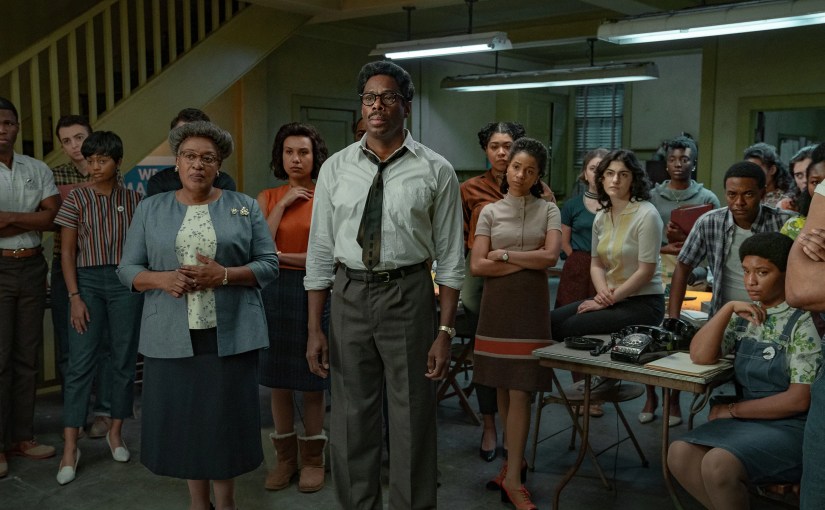
When I saw George C Wolfe’s Ma Rainey’s Black Bottom (with Oscar nominee Chadwick Boseman) my take was that it worked like a stage play on a unit set. The sensational cast of Rustin perform in the same way, catering to what would be a live audience. However, the unit set has been expanded to a headquarters office on the second floor, as well as Rustin’s bedroom, and the steps of the Lincoln Memorial and the National Mall in Washington D.C. While the CGI background of the nation’s capital do not appear seamless against the cast, it is fortunate that very little of it upstages the performances from Domingo, Chris Rock, Glynn Turman, CCH Pounder, and especially Aml Ameen as Martin Luther King Jr.
Colman Domingo portrays this individual with unwavering confidence in his character. Rustin insists on a non-violent two-day march, despite the local authorities who only grant him one day and limited resources. One problem is that there are not enough hotels that will accommodate black guests. Segregation might have ended in 1954, but in 1963, you would believe otherwise. While debating with the police captain in front of Lincoln Memorial, Rustin is accused of raising his voice and yet he reminds the captain that he’s never changed the volume of his tone. Rustin vows that this march will exceed 100,000 people from all different states. He’s also adamant about the police authorities not carrying their service weapons to steer clear of any reason to incite violence.
A bigger problem is bubbling within his own community of civil rights leaders. He’s no longer associated with the NAACP which has Roy Wilkins (Chris Rock) leading the charge. Still, he needs their support. Because he does not have the respect, charm and arguably the good looks of Dr. King, Bayard’s passion falls on deaf ears and a lack of motivation from these powerful men of influence. A large challenge comes from the arrogant Representative Adam Clayton Powell (Jeffrey Wright) who will proudly sit at the other side of the table with his long cigarette, pressed suit and pencil thin salt and pepper mustache. With a gruff tone in Wright’s voice, this is a marvelous antagonist.
Over the radio airwaves, Senator Strom Thurmond, who was still in office at close to age 100, all the way through 2003, is building a campaign against Bayard Rustin. Rustin has a past of suspected ties to the Communist Party, and it will also not bode well if his closeted homosexuality is revealed. On top of that, Mr. Rustin lives with personal problems and imperfections just like anyone else. He is trying to balance a relationship with Tom (Gus Halper) a young, white gay man and strong supporter of the cause, but Bayard is also involved with a married, closeted man as well. None of these issues can be afforded to weigh down what Mr. Rustin and his team of youthful, optimistic volunteers are striving for.
Wolfe’s film is less than two hours, though I wish it could have been longer. It is very engaging and certainly not difficult to follow, especially when text appears on screen to tell us who everyone is from the start. The movie efficiently incorporates all of these dimensions into isolated episodes for Baynard Rustin to confront. Primarily, it reflects the debates he has with the civil rights leaders and the naysayers. There are wonderful moments shared between Colman Domingo and Aml Ameen. Domingo also has great scenes with Gus Halper who plays Tom as someone uncompromised in the mission even if his lover is unfaithful. Domingo is the more compelling scene partner with Chris Rock, though, who I have never considered a strong actor. A good effort is made here, but Rock is not altogether convincing as an NAACP leader.
What I wish for, however, is some more reenacted footage of the actual historic event that famously included Martin Luther King’s “I Have A Dream” speech. There’s a slight tease of that speech but King was so appealing in that moment that it could never be recreated so well. It was already perfect. What I wanted to see was some other happenings going on during this event. We see buses arrive, chairs getting set up, people gathering, mostly black, but other races as well. What other speeches occurred on that day? What else was said?
I recall an episode of The Cosby Show where Theo and Cockroach had to write a school paper about the event and their parents and grandparents talked about how they drove down from New York to D.C. in buses and how hot it was that day. They described people who wore pins that said “Kiss Me I’m Black,” “Kiss Me I’m Jewish,” “Kiss Me I’m Irish,” and so on. It might have been said to lean into Cosby’s brand of humor, but I also believe it was true. That episode seemed much more descriptive in about ten minutes of sitcom dialogue than the film Rustin depicted.
How was the audience on the National Mall responding? Were people fanning themselves from the heat? What were they saying to one another? What songs were they singing? Wolfe’s film only gives a tiny glimpse of this groundbreaking moment in time when 250,000 people assembled. The picture just doesn’t appear entirely painted. Perhaps budgetary reasons were the cause of that.
Rustin is a good film and does a fine job of depicting this unsung man’s achievements despite the challenges he always faced with a smile. Domingo is great at donning the grin with missing teeth and clumsy black framed glasses, and a loose tie with a wrinkled shirt. He is positively absorbed in this period of time. Still, it would have been welcome to see more of his end results.
The picture concludes on a terrific beat before the inevitable footnote text arrives with most film biographies. I have just observed a man who will not shut up and never tire from pursuing his seemingly impossible dream. Baynard Rustin was likely considered a pest who would not let up. Yet, the script closes on the fact that in spite of all I have witnessed, Bayard Rustin was likely the humblest of all of these civil rights servants.
Go learn more about our Civil Rights history and allow yourself to see one of the best performances of the 2023.
 2 UNPAID MOVIE CRITICS!!!!