
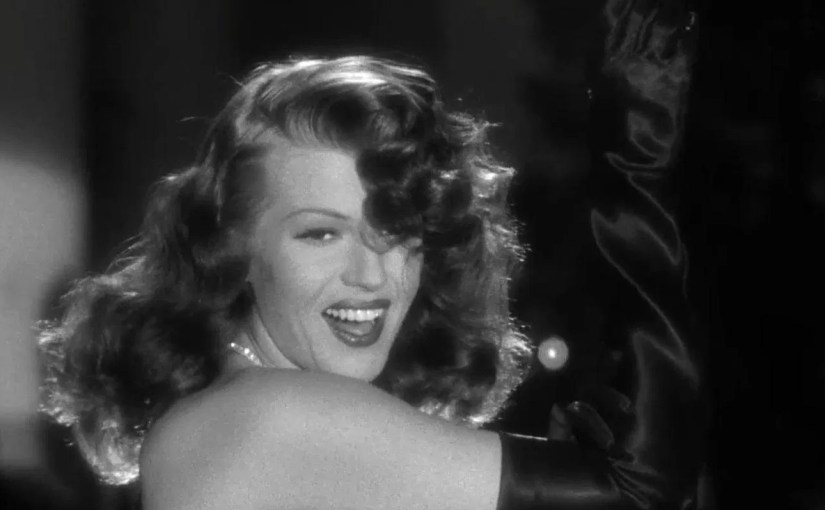
GILDA (1946)

by Miguel E. Rodriguez

DIRECTOR: Charles Vidor
CAST: Rita Hayworth, Glenn Ford, George Macready, Joseph Calleia
MY RATING: 8/10
ROTTEN TOMATOMETER: 90% Certified Fresh

PLOT: A small-time gambler hired to work in a Buenos Aires casino discovers his employer’s new wife is his former lover.


Admit it: we’ve all known a couple like these two: Johnny Farrell (Glenn Ford) and Gilda (Rita Hayworth).  They’re the kind of couple that inspire lifelong celibacy.  You see them together, and you think one of two things: “Why is SHE/HE with HIM/HER?”  Or, “Well, at least they’re saving two other people.”

The irony of Gilda is that they’re not even a legitimate couple, at least not for very long.  The fact that the movie sees fit to give them a semi-happy ending fits more with the period when it was made than with the characters themselves.  Watching them go off together at the end feels…off.  I know there are exceptions to this rule (see Bound [1996], spoiler alert), but this film noir fairly screams for a tragic ending of some kind, appropriate to the genre.  Instead, the two leads get off the hook just a little too easily, for my money.

But I’m jumping ahead.  In case you didn’t know, Gilda is the 1946 seamy/steamy film noir that forever turned Rita Hayworth into a Hollywood sex symbol.  Humphrey Bogart turned down the lead role (that went to Glenn Ford instead) because he figured, with Hayworth on the screen, no one would be looking at anyone or anything else.  He wasn’t kidding.  From the moment of her iconic entrance to the film (hair flip…“Me?”), Hayworth dominates every moment she’s onscreen, as effortlessly as Monroe, Dandridge, or Loren, assisted by those legendary Jean Louis gowns and costumes.  Especially the famous “Put the Blame on Mame” number, with the slinky black strapless “sleeve” dress, and those long black elbow-length gloves that she peels off ever so slowly…

The story!  Right, the story…

Johnny Farrell is a low-rent gambler in Buenos Aires who is hired by casino owner Ballin Mundson – one of the weirdest character names ever – to watch over his operations while he tends to other business in and around post-war Argentina.  One day Mundson returns from a business trip with a new wife: Gilda, whom he married after a whirlwind one-day romance.  Gilda is as tempestuous as they come, brazenly flirting with Johnny in front of her new husband, who can’t help but wonder why Johnny seems so icy towards her…

It doesn’t take a rocket scientist to figure out Johnny and Gilda knew each other a lifetime ago.  Their chance meeting in a foreign country ranks right up there with Ilsa wandering into Rick’s Café Américain in North Africa: unlikely, but it makes for a helluva story.

Glenn Ford holds his own in the film as the scruffy, no-nonsense enforcer who can more than hold his own in a fistfight, but whose physical prowess can’t compete with the psychic hold Gilda still has on him.  Of course, the fact that Gilda mercilessly pokes and teases Johnny indicates she’s just as fixated on him.  It’s easy to see how this material could almost become a standard-issue rom-com, but Gilda is made of darker stuff.  Look at it from a certain angle, and there are hints that Johnny and his boss, Mundson, might share a relationship that goes beyond employer/employee, that Gilda knows this, and is using that knowledge to stick the knife even deeper into Johnny’s stomach, just to watch him squirm.

So, Gilda becomes a psychological battle of the sexes, evoking The War of the Roses at times.  Gilda tosses off some zingers that would have made Mae West blush.  (“If I’d been a ranch, they would’ve named me the Bar Nothing.”)  Johnny gets off a couple of his own.  (“Pardon me, but your husband is showing.”  …and, “Statistics show that there are more women in the world than anything else.  Except insects.”)  In between zingers, the plot moves on in the background, but it’s only a clothesline on which to hang the arguments between Gilda and Johnny.  In that respect, it’s like a John Wick film: you’re not there for the plot, you’re there for the action.  It’s entertaining as hell, don’t get me wrong, but they are so good at being despicable to each other that I found myself hoping they DIDN’T wind up together.  Talk about a match made in hell.  Do they deserve each other?  Discuss.

Gilda robustly lives up to the film noir tradition, in style, substance, and story, RIGHT up until the last two or three minutes, when the darkness gives way to the major-chord strings of “happily ever after.”  For that, I personally can’t call it perfect.  But holy black strapless gown, Batman…as they say at Passover, for that alone we should be grateful.

SUPERMAN: THE MOVIE

By Marc S. Sanders

Richard Donner’s Superman: The Movie is one of the best biographical films of a fictional character ever made.  Yes.  It absolutely is a biography.  How can you call it anything but?  The visitor from the planet Krypton is embedded so deeply within the lexicon of worldwide pop culture and historical significance that he rests within all of our subconsciousness.   When we think of ongoing problems in the world from natural disasters to destructive wars or famines and disease, or to even kittens stuck in trees, for a split second we all consider how simple we could go on with our lives if only Superman were here to rescue us. 

By 1978, forty years after Joel Siegel and Joe Shuster created the character, visual effects were at a more than adequate level to convince us that a man could fly. Thus, the man with the red cape was ready to appear on the big screen.  With creative input from writer Mario Puzo, Donner’s film goes through various stages of life from when the extra terrestrial is a new born baby, to a toddler, then a teenager and on to a thirty something adult.  While living on the planet Earth, his powers may make him virtually invincible, but he’s far from godlike.  He cannot prevent the unforgiving nature of death.  He can’t be everywhere all at once.  He can’t even perform on the same level as his colleagues or friends, who are skillfully beneath him.  It would be unfair to have Clark Kent on your football team.

To watch Superman is to see a mini-series over a span of nearly two and a half hours.  We begin on the white crystal planet of Krypton featuring one of the greatest actors of the twentieth century, Marlon Brando, cast as the father of the superhero to be.  Brando is Jor-El.  He serves the planet as a prosecutor and a political leader with an expertise in science.  He’s championed for his knowledge, but he’s also challenged by his peers when he is certain of his planet’s demise. Thus, he must release his newborn son, known as Kal-El, into the far reaches of space to survive.  The script here takes an almost Shakespearian approach in debates of facing inevitability.  Brando’s authoritative screen presence is perfect here. 

Kal-El moves on to Earth, particularly Smallville, Kansas, and the nature of the film changes personality.  1950s Americana becomes our main character’s environment with endless plains of crop fields and farm land as Kal-El becomes identified as Clark Kent, the teenager who develops a crush on the high school cheerleader and gets bullied in the process while he must deliberately withhold all that he’s capable of by influence from his adoptive parents (Glenn Ford and Phyllis Thaxter).  Life for any of us is never complete until we experience the death of a loved one and Donner showcases that here to demonstrate that Kal-El/Clark can not prevent what’s meant to happen when biologically our bodies shut down.  Not even a super man can save us. 

Clark reaches age 18, usually perceived by most as a turning point into adulthood and through a means of Krytonian process he’s educated until his thirtieth birthday upon the rules and boundaries he must function within while on Earth.  He learns of his ancestry and then Donner changes the setting of his film once again into the furthest extreme from quaint Smallville. 

We have transitioned to sprawling Metropolis where Clark works as a mild-mannered reporter at The Daily Planet.  Christopher Reeve plays Clark/Superman and there was no one who could have filled the role better.  Physically, Reeve is the example by which all super human character portrayals still look towards.  Yet, the Julliard trained actor performs the dual personality so well.  When he dons Clark’s glasses you feel as if you are looking at another actor from when he’s dressed in the blue and red costume of Superman.  His posture and voice inflections are so distant from each character he’s playing.  Christopher Reeve was a stellar actor of versatility. 

In Metropolis, we are also introduced to an impure villain, Lex Luthor (Gene Hackman, who never got enough praise for this role) focused on greed and individual power for him to consume at the expense of everyone else on Earth. 

As well, just as life must bring us towards the experience of loss, it also must introduce us to love in the form of Lois Lane. Margot Kidder does a magnificent job of the hustle and bustle career woman with a sense of romance and need for ongoing adventure.  A reporter’s life will only give you that some of the time.  Superman will let you live that every day.  In life, we all start with valuing one person in our lives beyond our immediate family, and Lois serves that purpose to Clark’s perspective. 

Donner takes advantage of comedy and slapstick when Metropolis comes into play.  It’s not as polished as Krypton.  Nor is it as calm and reserved as Smallville.  Again, the personality changes.  Reeve plays Clark as a persona of the inept and gullible newcomer nerd to hide his powerful alter ego.  Hackman’s Lex is accompanied by Ned Beatty as a bumbling sidekick to play off of. (This same actor was a frighteningly powerful and intimidating corporate CEO in Network just a few years prior!) Valerie Perrine holds her own against Hackman as Lex’ alluring dame to have a tete a tete of sarcasm with. Kidder is the leader of Metropolis’ populace always on the go so much that she’s not even aware of her insensitivity to poor Clark.  A great gag is that as a good as a reporter as she is, Lois has terrible skills in spelling.  (There’s only one p in ‘rapist’.)

Maybe you’ve never seen Superman from 1978, or maybe it’s been too long since you last took it in.  It remains a watch that’s worthwhile.  Donner’s film covers so much of this one individual’s life that also includes two separate ancestries.  I get hot and cold on biographical films, sometimes.  It’s a tough scale to measure.  Sometimes filmmakers don’t show you enough.  I thought the film Ray, ended too suddenly on its depiction of Ray Charles.  Sometimes, it’s an overabundance of material.  The Last Emperor and Chariots Of Fire seemed to never end, and became mired in long, drawn-out, sleep-inducing pieces of dialogue.  Superman allows just the right amount of time to live within these different parts of Kal-El/Clark Kent/Superman’s life that you get familiar with who the main character encounters and how he responds to those around him. You also witness how these environments respond back to him.  You get a sense of what he stands for and where he feels insufficient and where feels strong and secure, as well as valued by others. 

It might be crazy to believe, but biographical writers and filmmakers should turn towards Richard Donner’s film for an outline that perfectly establishes every scene and moment that’s cut into its mold.  Superman: The Movie?  When I want to tell the life story of Golda Meir, or Barack Obama or Joseph Stalin or Jesus Christ?  Yes, Superman.  If we are crazy enough to follow the exploits of a man who wears a cape and flies through the sky, then why can’t we believe he can provide the answers to the great mysteries of life better than any of us?