MAN ON FIRE (2004)

By Marc S. Sanders

A movie that has eluded me until now is Man On Fire featuring Denzel Washington in another Tony Scott film.  I say eluded because with this director/actor combination I’m usually satisfied with the finished product.  That wasn’t the case here, though.

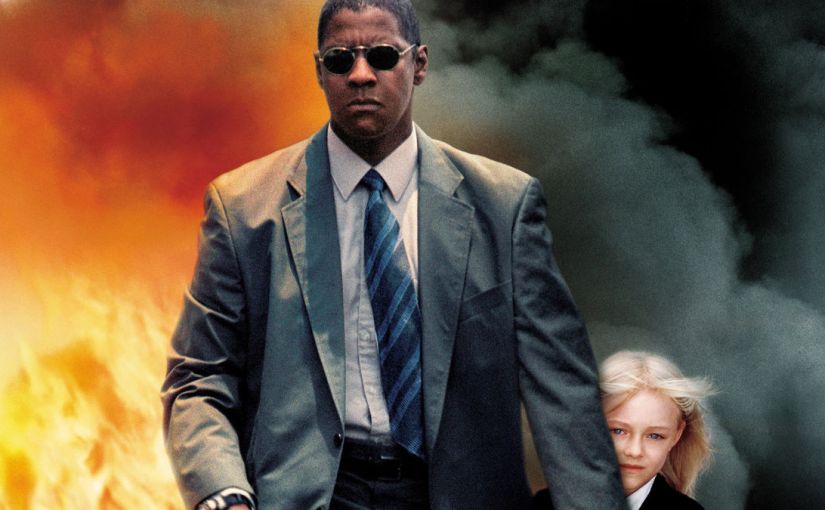
Washington portrays a hard drinking bodyguard named John Creasy.  He’s recruited by his war buddy, played by an uninteresting Christopher Walken, to protect a young girl named Pida (Dakota Fanning), daughter of an automobile industrialist and his always fashionable wife (Mark Anthony, Rahda Mitchell).  Creasy is a cold fish at first who refuses to accept Pida’s friendship.  Jump to a couple of quick scenes later and he’s become her surrogate father and swimming coach.  In a matter of seven minutes of running time, I’m supposed to accept that this guy has turned into a cuddly teddy bear for this kid.  As soon as that happens, Creasy is ambushed and Pida is kidnapped following her piano lesson. We are not even a quarter of the way through the picture, but the remaining hour and forty minutes play like an awful how-to documentary on effective means of torture for bad guys before ruthlessly killing them.

Tony Scott is a director who always seeks to demonstrate that glossy film styles are more significant than the screenplays he directs or the characters who reside within.  (Two exceptions come to mind though, Crimson Tide and True Romance.  Maybe some of Top Gun too.)  Man On Fire is a frustrating watch as Scott’s camera performs like a narrator with attention deficit disorder.  It can never sit still.  The movie jerks around so much with ridiculous quick cuts and deliberately grainy and distressed cinematography.  Just when I’m trying to comprehend a new player who enters the fold, the camera jumps to something else like a street corner or a moving car or Denzel Washington’s sunglasses. There are subtitles for the Spanish speaking characters that appear in a block letter font that looks like it came from a karaoke machine.  There’s also subtitles for what somehow appear to be “important” or “powerful” statements.  A line like “pass the salt” might read like “PASS the SaLt…PLEASE!!!!”  Tony Scott is obviously going for some kind of MTV music video approach, but it’s awfully distracting and downright annoying.  As well, I must ask why.  Why go through all this effort? The cameramen must have been getting motion sickness while fumbling and shaking around their equipment to shoot this picture.  So why bother?

The most interesting plot point happens in the first three seconds of the movie.  A statistic pops up describing how often kidnappings occur in Mexico (one every sixty seconds), and how as many as seventy percent of those incidents end up with a dead victim.  That’s a shocking dilemma, worthy of attention. Through his career, Washington’s selection of scripts has allowed him to tackle important issues with moments of debate and smart dialogue, as well as suspenseful action if there is a call for it.  However, Tony Scott and screenwriter Brian Helgeland are not interested in using these facts as a springboard with Man On Fire

Once the expected kidnapping occurs, and following a very quick healing – as in less than two days – of multiple gunshot wounds to the chest and back, John Creasy goes on a war path of revenge when he learns that Pida is dead.  Creasy doesn’t get to perform with much intellect here.  Having only a partial license plate number, he’s able to follow the breadcrumbs that lead to a crime syndicate notorious for winning millions in ransom demands.  Creasy simply goes up the food chain from one member to the next until he gets to the top of the pyramid.  That’s the movie!  That’s it!

He’ll cut a guy’s fingers off and cauterize them with a car cigarette lighter.  He somehow has access to a rocket launcher to use within the city.  Sadly, the most novel technique is to stick a rectal detonator (yes, I said rectal) up a man and set a timer for the guy to come clean with information before it goes off.  We can thank Tony Scott for putting up a countdown digital clock on the screen to gauge how close this thug is to his demise.

My past experience with movies like these have taught me that there’s always a traitor.  Someone set the plan in motion to abduct the little girl.  That’s not hard to figure out.  Once the character appears on screen, it could not be more obvious.  The motivation is just as ridiculous.

Man On Fire is only imaginative in how the protagonist dispatches one guy after another.  It lacks any effort in creativity towards its hero.  The guy drinks. He torments his enemies.  He’s got nothing interesting to say.  There’s a neglect for a very real and common problem within the country of Mexico.  The only design that is given attention is “artistic style” that Tony Scott adopts to mask away what is not there in any of the writing or character development.

I’d like to learn more about how the Mexican government responds to these kidnappings and maybe the experience that survivors endured.  Show me the torment that the families go through.  Can I see the method to the kidnappers’ plots or how they select their next target?  A very real predicament was offered with Man On Fire, but then it was tossed aside so I could see the effectiveness of an explosive suppository.  Now, is that really a movie that any of us want to see?
QUANTUM OF SOLACE

By Marc S. Sanders

A writer’s strike never bodes well for a film. So the 22nd installment in the James Bond franchise, Quantum Of Solace, suffered because of it. Daniel Craig returns in his second film as Bond which begins as a direct sequel to my favorite film in the series, Casino Royale. Marc Forster (Finding Neverland) directs, but not very well.

Much of the action scenes are very shaky and choppy. Forster seems to have adopted Paul Greengrass’ technique that works so effectively in the Jason Bourne films and United 93. However, Forster does not make clear what is occurring. You can’t recreate Picasso with crayons.

The opening is a rush job of a car chase as Bond races away from enemies in his Aston Martin. Machine guns and heavy traffic and construction sites make way for his car to gradually fall apart but it’s hard to really see how the car becomes damaged in the first place. Just when exactly did the driver’s side door come off? There’s lots of spinning out of control and dirt flying with bombastic gun fire and engine revving. It’s all sensory overload to hide the preciseness in the high speed chase.

Later, Bond is attempting to rescue the girl Camille (boring name, boring girl) played by Olga Kurylenko when she’s held captive on a boat. He jumps into a motor boat and the chase is on. Bond fends off the bad guy by tossing a rope with a hook on it. Just tossing it up. Suddenly the bad guy’s boat flips over. What exactly happened here? How did the rope take out that boat? I didn’t see the connection. Film is visual. So show me the fundamentals from A to Z, please.

The story involves Dominic Greene (Mathieu Almaric) who appears to be an environmentalist with interest in a pipeline in Bolivia. (Bolivia????) At first Bond is under the impression this pipeline must be for oil. Later, it’s realized that Greene intends to charge the country enormous prices as he takes over the water supply. (Roman Polanski’s Chinatown did this all much, much better.). In exchange, Greene will assist a tyrannical Bolivian General in becoming President. This General raped and murdered Camille’s family. Naturally, she wants revenge. As Bond pursues Greene, he comes to learn that Greene is a member of a secret organization called Quantum. Hence the strange title.

Bond follows through with this assignment while trying to determine why his past love (Vesper Lynd from Casino Royale) was murdered, and after MI6 is infiltrated.

The story is kind of all over the place. It has a lot of interesting threads like Bond’s need for revenge, Camille’s need for revenge and a secret organization that MI6, nor the CIA, were ever aware of. Threads remain hanging as threads though if a writer’s strike interferes.

The story for Quantum Of Solace hardly gets fleshed out. We learn nothing of the organization, Quantum. When Bond finishes his mission with Camille, she just gets out of the car and walks away into the middle of nowhere. Where is she going exactly? The climactic battle takes place in a luxury hotel located in the middle of the desert. Unless this is Las Vegas, who goes to a hotel in the middle of the desert? I mean like ever?????

The film is a tremendous disappointment after the creatively artistic success of Casino Royale. Often sequels do not live up to their predecessors, but Quantum really goes off the rails. This film was a make-up as you go.

Craig is fine in the role of Bond; consistent with his first film. Almaric is okay as the villain, but never given much to do. A second woman comes into play, named Fields played by Gemma Arterton, assigned by M to bring Bond out of service. She seems to have a personality that the Camille character lacks, but she’s hardly given much screen time, save for a nightcap with Bond and later an image that harkens back to Goldfinger.

Jeffrey Wright (a great Felix Leighter, that I have not talked about yet) is belabored to share scenes with an obnoxious CIA partner played David Harbour. These two guys seem to be acting in a different movie.

Marc Forster was given a toolbox but didn’t know which end of the hammer to hold with Quantum Of Solace. There are too many things wrong with this film to justify any merits it may have.

Maybe the most interesting moment happens in the epilogue scene as we learn more about Vesper’s past. The scene has next to no relevance with much of the main story beforehand. Still, why couldn’t this film simply stay on this trajectory from the beginning? This is a thread worth pulling on and then tying off.

In other words, Vesper Lynd is far more interesting than the water supply in…ahem…Bolivia. 

CASINO ROYALE

By Marc S. Sanders

Casino Royale from 2006 is the one film in the entire James Bond series that gives the MI6 agent a complete character arc, and for that reason alone, it is also the best film to date in the franchise, and another of my most favorite movies.

Bond becomes a different person, and a different agent by the end of this film. It’s a pleasing and unexpected surprise.

Following the misfire of Pierce Brosnan’s Die Another Day, the franchise was wisely reinvented, going back to the origins of 007 and how he earned his well-known license to kill. Fans immediately protested the casting of a blonde-haired Bond with relatively unknown Daniel Craig. Yet, as soon as the film was released, tensions were overall subdued.

Martin Campbell (Goldeneye) returns to direct the EON Production’s adaptation of Ian Fleming’s very first Bond novel. The super spy quickly completes the necessary requirement of two kills to earn his 007 status and is assigned by M (Judi Dench, still so good in her role) to pursue LeChiffre (Mads Mikkelsen), a mathematic genius and money launderer for high priced terrorists. Bond engages in a high stakes’ poker game at the renowned Casino Royale where he must beat LeChiffre’s bluff or monies from his Majesty’s government will have directly funded terrorism. Along the way, Bond falls in love with the treasury agent, Vesper Lynd (Eva Green), who is assigned to fund his poker buy in.

This film offers a James Bond with faults and mistakes to learn from. He’s never completely perfect and he is subject to losing a bluff in more ways than one, albeit at the poker table or in the face of love. As well, Bond doesn’t necessarily think far enough ahead, as his kill ratio continues to rack up. To M’s displeasure, she wishes he’d have some reservations so that they can question who he comes in contact with. Bond doesn’t seem to consider that.

Daniel Craig gives a brilliant performance of a man who believes he is even wiser than the reputation moviegoers have been accustomed to for over 40 years prior. By the time the film reaches its climax in an action paced shootout within a floating building along an Italian strait, Bond’s steely armor is donned against affection or distraction. James Bond becomes humbled by personal betrayal. I never would have imagined. Death will never affect him again. Love won’t either. This James Bond makes mistakes, but never will he make the same mistake twice.

Mikkelsen is a great villain as the bad guy who gets in over his head. He is not trying to dominate the world. He’s only interested in a profitable return from his dealings with terrorists. James Bond can’t interfere. LeChiffre is a new brand of villain, but still written with a trademark deformity of weeping blood uncontrollably, plus a case of asthma. A far cry from metal teeth and hooks for hands. Mikkelsen plays LeChiffre as cold and terrifying, almost like a vampire with a winning hand.

Eva Green is the best Bond girl of the series. There’s a mystery and a dimension to her performance. Something is driving her and it may play against Bond ever succeeding. Green portrays Vesper as lovely, graceful and suave like her partner, but she is incredibly smart too. She is evenly matched with Craig’s Bond. A great moment occurs when James & Vesper first meet for dinner on a train and size each other up. Eva Green is precise in monologue delivery. She is assured and confident. This woman is able to read Bond before Bond is given the opportunity to seduce her.

Campbell puts together real looking and tangible action sequences where 007 pursues a bomber specializing in parkour, a sport of climbing and leaping on and off of objects within a construction area. There’s also a well choreographed fight scene in a hotel staircase.

The best moments are reserved for the poker match however. Campbell amps up the tension with these ridiculous hands the players have in a fierce match of Texas hold ‘em. Bond gets sidetracked with sword wielding killers and poisonous drinks, but still manages to return to the table time and again with his tuxedo neatly pressed. The interplay at the table with or without dialogue is mesmerizing.

Daniel Craig went entirely different with his James Bond. The wit is there, but the tongue in cheek is not missed. This James Bond doesn’t give a damn if his vodka martini is shaken or stirred. Most of the prior Bond films had the super-agent without any scruples or demons in his closet. World domination, death and casual sex were just all in a day’s work. This 007, however, comes with a heavy background. Craig is great with his silent, seemingly guilty regard for killing someone whether it be by drowning a thug in a flooded bathroom sink or stabbing another one to death amid a museum crowd.

Screenwriters Paul Haggis with Neal Purvis and Robert Wade write a dramatically induced James Bond story. A tale not easily forgotten. It was time to reinvigorate the franchise that was going off into the absurdity of invisible cars and over the top gadgets. The puns are still here, but they serve more as a cover of a necessary internal pain for Bond, rather than disregard for his actions.

Casino Royale is one of the best films ever made. No qualms about me saying that. It’s hard to find great relationships among characters with huge risks at play, and magnificent chemistry for one another, as well as the story that serves them.

Casino Royale is an absolute winning hand at any table.