
AIRPORT

By Marc S. Sanders

Burt Lancaster described his participation in what would become the first of a batch of 1970s all-star disaster epics as the worst picture he’s ever done.  He declared it “the worst piece of junk ever made.”  Perhaps because of this assessment we were eventually blessed with the Airplane! spoofs a decade later.  

Airport is a sudsy soap opera drama from novelist Arthur Hailey.  It’s an indiscreet invitation to make fun of it, but I doubt it was meant to be regarded that way in 1970.  Then, Airport was likely celebrated as that new kind of picture like The Godfather, Jaws and Star Wars would pioneer in their own rights.   

The film was a box office smash for Universal Pictures, garnering an acting Oscar for kindly old Helen Hayes along with nominations for Best Picture, Cinematography and Screenplay.  It spawned three more films following its success.  Yet, it’s terribly cornball, drowning in floods of cheese, and coated in the thickest of sap.  You better swallow that Maalox now.  This airport is all backed up!

Lincoln International Airport is getting blanketed in one of the treacherous, most blinding snowstorms imaginable.  So naturally it’s the right time to launch passenger airlines into the night sky while also welcoming jets to land.  Were harsh weather conditions not so alarming fifty years ago for air travel?

Well, this blizzard is going to be the first of several problems starting with a plane stuck in the snow right in the middle of the airport’s major runway.  Burt Lancaster is Mel Bakersfield, Lincoln’s Controller, who once again puts aside his family and his troubled marriage to oversee the matter.  He recruits the grizzled, cigar chomping Joe Petroni (George Kennedy) to clear that runway.  Mel firmly believes Joe is the only man who knows what the hell to do.  (Best I could tell is that Joe picks up a shovel like everyone else.) Mel’s other issue is that his pesky wife is disrupting his happy affair with Tanya Livingston (Jean Seberg), the no nonsense, yet perky appearing, blond airline executive with the mini uniform dress hemline.

Further upholding the proud chauvinism of this picture is everyone’s favorite lounge singing lizard Dean Martin as Vern Demerest.  These names!!!! If this movie wasn’t taking place at an airport, I’d swear it was a news station.  Vern also has an inconvenient marriage now that he’s learned his cutie stewardess Gwen Meighen (Jacqueline Bisset) is pregnant.  Cue the squeaky violin music as Vern offers to cover the abortion.  Shocking!!!! Gwen might want to have the child, but she’s gracious enough not to make it an obligation for Vern.  She’s gonna let her dreamboat wonder of a man be, so he remains a doting husband on the side.

So we got melodrama for the airport staff, the pilot, the stewardess… Hmmm…Oh yeah!  The passengers!!!!

A mentally ill, down on his luck man (Van Heflin) spends six dollars cash on a life insurance plan for his wife Inez (Maureen Stapleton) before boarding Vern & Gwen’s plane with a dynamite bomb in his briefcase.  Can Inez warn Mel, Tonya and everyone in time before the plane takes off?

Of course, this kind of stressful tension requires some adoring comic relief, and Helen Hayes as kindly old Mrs. Ada Quonsett delivers an Oscar winning performance.  She takes pleasure in being a habitual stowaway on one flight after another.  Gosh darn it if Tonya is going to make sure to put a stop to this lady’s shenanigans.  

The Cinemaniacs (Miguel, Thomas, Anthony and I) watched this together and Mig pointed out the cinematography first.  It’s dull like straight out of a Sunday night TV movie.  Thomas reminded us that this was in the same vein as most of Arthur Hailey’s material, like Hotel – the book that became a movie that became a TV series.  The soap opera occupies the first two thirds of the picture.  Then a potential threat of disaster occurs, and you work to guess who lives and who dies.  

Directors George Seaton (also screenwriter) and Henry Hathaway work to get the audience invested in these people first while trying to educate us on the most up to date operations in a fully functioning airport.  If George Kennedy’s character is not shoveling snow on a runway and giving it all he’s got in the stuck plane’s cockpit, he’s telling the others what to expect from a potential bomb explosion aboard a jet.  And Look!!! There’s telephones in Mel and Vern’s cars.  Push button ones too.  All over the airport are red phones next to white phones.  There’s luggage.  There’s blankets and pillows for everyone on board the plane. There are also unsuspecting women wearing minks and smuggling jewelry into the country, but the seasoned custom security guard has got a good eye. He can see everything, except for the guy with the bomb. And there’s snow.  Lots and lots of snow but the cabs make it to the airport in the nick of time.  There’s also a message about the need for updating construction on our country’s airports with the most sophisticated traffic controls and operations imaginable.  Should the money be spent?  On top of all this, how are Mel and Vern’s wives and families holding up?

Maybe it’s unfair.  It’s hard to embrace Airport when I have already grown up watching the ZAZ team brilliantly spoof the picture with the Airplane! films.  Yet, I’m confident that had I seen Airport upon its initial release, I likely would not hail the romances of Lancaster, Seberg, Martin and Bisset as the next iterations of Rick and Ilsa.  The dialogue and scenarios are eye rolling at best.  The chemistry sputters as soon as we see the characters for the first time.  The men are twenty five years older than the women, but the love is supposedly passionate?

The extras who are granted snippets of dialogue look like they are reading cue cards and the major players truly look bored.  Watch the cast when the bomb goes off on the plane (like you didn’t think it wouldn’t happen).  There’s no adrenaline from Dean Martin.  He looks lost without his signature scotch and cigarette. The passenger extras never got the memo that they are supposed to be on board a plane with a gaping hole in the rear lavatory.  The priest on board slaps the guy next to him, but I need more convincing of the panic that is supposed to persist.

Fifty years later, the legacy of Airport hinges on only one purpose and that is to give it the ol’ Mystery Science Theater 3000 treatment.  More importantly, once you finish watching it, about all you want to do next is watch Airplane! 

“The cockpit!  What is it?”

“It’s the little room at the front of the plane where the pilots sit, but that’s not important right now.”
THUNDERBOLT AND LIGHTFOOT

By Marc S. Sanders

There are good Clint Eastwood films and there are bad Clint Eastwood films. You’d probably guess where I rank 1974’s Thunderbolt and Lightfoot (T & L).

I’m amazed. Director Michael Cimino, at the time, was really only known for polishing Eastwood’s Dirty Harry flick Magnum Force into a great crime drama of cop vigilantism. Then he does this picture, and how did anyone at Warner Bros trust him with The Deer Hunter a few years later? Sure, that film won Best Picture, but should anyone really have been surprised when the box office nuclear bomb, known as Heaven’s Gate came along, and bankrupted Orion Pictures? You think the producers of that turd said, “Fellas, we never considered Thunderbolt and Lightfoot. Hindsight 20/20. We shoulda known better.”

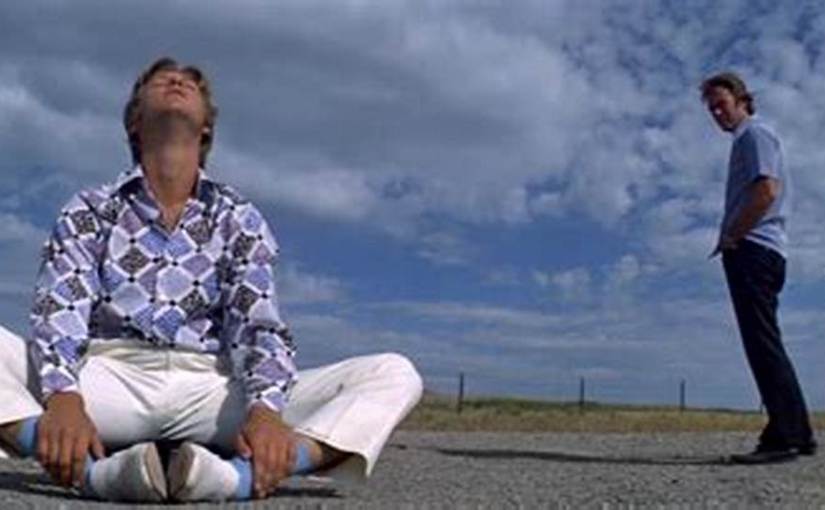
Back to the subject at hand. T & L is mindless of any coherence. Two criminals just happen to find each other randomly on some out of nowhere highway while running from the law (for Lightfoot) and a couple of bumbling henchmen (for Thunderbolt). Their respective crimes are unconnected. Eastwood’s quiet, familiar, tough guy demeanor (Thunderbolt) meets up with wild boy Jeff Bridges (Lightfoot) and then they eventually get to a plot of devising some kind of money heist with early adversaries George Kennedy and Geoffrey Lewis, former crime pals of Thunderbolt. However, they need to arrange to acquire a cannon, get on a job digging water lines for housing properties, work as ice cream delivery guys, hitch a ride in a redneck’s Dodge Challenger, and have Lightfoot dress in drag. There’s also a schoolhouse, no longer located where it once was, with a secret stash hidden behind a blackboard.

Doesn’t this seem like much too much effort for an ordinary bank heist in 1974? Security personnel and systems were probably not as sophisticated back then, no? Eastwood made an easier time of escaping from Alcatraz then all the work put in here.

The movie is sweaty, dirty, stupid, and it just doesn’t make sense really. Bridges actually got an Oscar nomination in the supporting actor category, up against nearly the entire cast of The Godfather Part II, for this film, and I’m…well…perplexed. How was that possible? Best guess, Cimino, who also wrote this dreck, decides to have Lightfoot die at the end. (There!!!!! I ruined it for you!!!!) Problem is I don’t know why or how. He’s not shot or wounded. There’s never an indication that he is ill. The script is too dumb to consider any kind of foreshadowing of his demise. The guys are just driving along with the money in backseat, and Lightfoot appears weak all of the sudden. Thunderbolt pulls over to the side and his partner just quietly dies in the passenger seat. Cimino cues up the Paul Williams music and the end credits appear. Bridges had a death scene. So, Bridges has to get a shot at Oscar glory. The math ain’t pretty but it’s the best logic that I can come up with.

THE DELTA FORCE

By Marc S. Sanders

In the 1980s, a small production company named Cannon Films was started by an Israeli named Menachem Golan.  It churned out at least a dozen Charles Bronsan cheapy crime dramas and gave longevity to his Death Wish series of films.  Cannon also provided another franchise called American Ninja with action star Michael Dudikoff.  Dudikoff, nor any of his films won an Oscar, much less a Golden Globe or even an MTV Movie Award.  The poor guy with twenty bottles of mousse in his hair didn’t even get turned into an action figure. 

While I did see Death Wish 3, ahem…five times in the movie theatres (I mean there’s an outstanding final thirty minutes of a wall to wall shootout action in that film, and it was all a 13 year old boy yearned for at the time), Golan’s best product that I have at least seen to date is The Delta Force, featuring Chuck Norris, Lee Marvin and a host of stars most recently having been featured in every disaster film to crank out of the 1970s; Shelly Winters from The Poseidon Adventure, Robert Vaughn from The Towering Inferno and George Kennedy from every Airport movie under the sun.

Golan directed this film that was inspired by the 1985 hijacking of a TWA flight heading for Athens, Greece and he pretty much directed two different kinds of films in one.  The first hour focuses on the Libyan hijackers, led by an unrecognizable and terrifying Robert Forester, and their hostages.  A plane carrying mostly Americans is taken captive in midair and is diverted to Beirut.  Like the real-life event, a German born American stewardess is forced to select the Jewish passengers (Winters, Lanie Kazan, Joey Bishop and Martin Balsam) and separate them for an unknown fate.  An American Navy serviceman is also brutally tormented and later, an airline pilot (Bo Svenson) is interviewed by the media from the open window of the grounded plane’s cockpit, complete with a gun to his head.  All of this happened during that harrowing event.  Golan does a very good job of capturing these moments with heartbreak, fear and genuine terror.  The Jewish selection process is a scene that I take very personally, and it is not overdramatized as it glaringly hearkens back to the atrocities of the Nazis who sent millions of Jews to certain death, torture and concentration camps.  Remember, this film was released only 40 years after those terrible events.  Golan’s filmmaking makes certain the Holocaust is never forgotten.

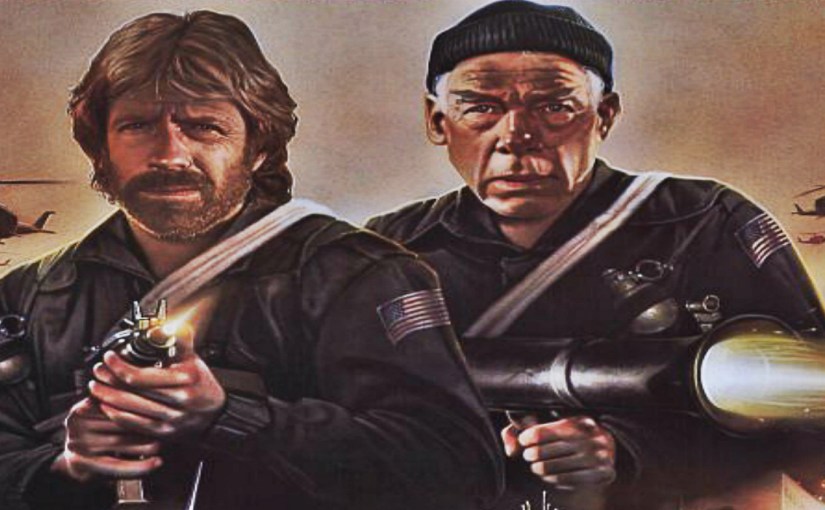
Sprinkled throughout these first hour scenes are bits and pieces of the American strike team known as The Delta Force, led with gruff command by Lee Marvin and silent but deadly Chuck Norris.  These guys gear up, dress in black uniforms, load their aircraft carrier with motorcycles and armed dune buggies, listen to Marvin’s instructions and wait and wait and wait.  There’s something to appreciate in the wait of these skilled snipers and specialists.  Golan doesn’t rush the action.  Material is depicted showing Marvin, Norris and company exploring the options they have for taking out the terrorists and rescuing the hostages.  This is not a typical Rambo movie of destroying the village just to save it.  However, once the action starts, it doesn’t stop and Golan lets Norris do all the things he’s known for while arguably inspiring how POWERFUL Chuck Norris is compared to…well…anything else.  Don’t forget!  Inside Chuck Norris’ chin is ANOTHER FIST!  Also, Superman wears Chuck Norris underoos!  Chuck Norris can unscramble an egg!  Chuck Norris made a snowman out of rain!  It’s hard not to deny these claims when the film boasts a strike team consisting of 20-30 members, but Norris seems to do all the work and heavy lifting. 

It’s hard not to get caught up in The Delta Force.  You wanna see these terrorists get blown up real good.  You also wanna see Chuck Norris ride an agile moped equipped with an endless supply of missiles and ammunition ready to overturn enemy vehicles and bloody up a bad guy until he screams and turns on one foot before dropping dead with his eyes opened.  You also may get a jolt of energy from Alan Silvestri’s rah rah theme music that quickly stays embedded in your subconscious.  I read that his music was used for a time when the Indy 500 would air on TV.  That does not surprise me at all.  Its symphonic themes are as memorable as the Monday Night Football tune.

Unlike, other Norris films this crowd pleaser doesn’t just rely on him and his roundhouse kicks.  There’s a little bit of that schtick for the fans, but I gotta say I was truly touched by the cast as whole.  Lee Marvin (in his final film) echoes George C Scott’s portrayal of Patton.  The collective hostage cast are not overdramatized here.  Golan managed to capture a history to them.  While I thought Shelley Winters was a such joke for fodder in Poseidon, here she is truly sorrowful as she is separated from her husband played by Balsam.  Kazan and Bishop are equally touching.  Reader, this Jewish guy originally from New Jersey, who attended ten years of Yeshiva education, recognizes these folks when they are spirited vacationers early on, and then later tormented prisoners who’ve faced horrors like this before.

I know that Cannon Films also produced another favorite called Runaway Train with an Oscar nominated performance from Jon Voight.  As I write this column, I’ve yet to see that film.  It’s on my radar.  That being said, I have to wonder if Golan and company had stayed on this trajectory of genuine drama like he mustered in portions of The Delta Force, what powerfully impactful films might he also had up his sleeve.  Unfortunately, we were left with too much excess like American Ninja, I’m afraid.

Still, after watching The Delta Force you’ll absolutely believe that Chuck Norris can see things that don’t exist and that he counted to infinity…twice!