HAIL, CAESAR! (2016)

by Miguel E. Rodriguez

DIRECTORS: Ethan Coen & Joel Coen
CAST: Josh Brolin, George Clooney, Alden Ehrenreich, Ralph Fiennes, Scarlett Johansson, Tilda Swinton, Channing Tatum
MY RATING: 7/10
ROTTEN TOMATOMETER: 86% Certified Fresh

PLOT: A movie studio “fixer” in 1950s Hollywood faces his biggest challenge yet when the star of the studio’s most prestigious film in production is kidnapped by a shadowy organization calling itself, “The Future.”


The word “idiosyncratic” feels like it was invented for the Coen Brothers…or maybe vice versa.  Their 2016 film Hail, Caesar! is yet another case in point.  Packed with the kind of early Hollywood detail we wouldn’t see again until 2022’s Babylon, this film is a love letter to the 1950s studio system that produced such classics as All About Eve, Stalag 17, The Bridge on the River Kwai, and Ben-Hur.  However, the comic story surrounding this love letter is a bit rambling and disjointed.  About halfway through, I found myself wondering if maybe the movie wouldn’t have been better if the filmmakers had just ditched the comedy and made a straight-up drama.  But then we got to the climax, and I realized, no, comedy is better for serving up the kind of silliness we get at the end.  It’s no Raising Arizona, but it’ll serve.

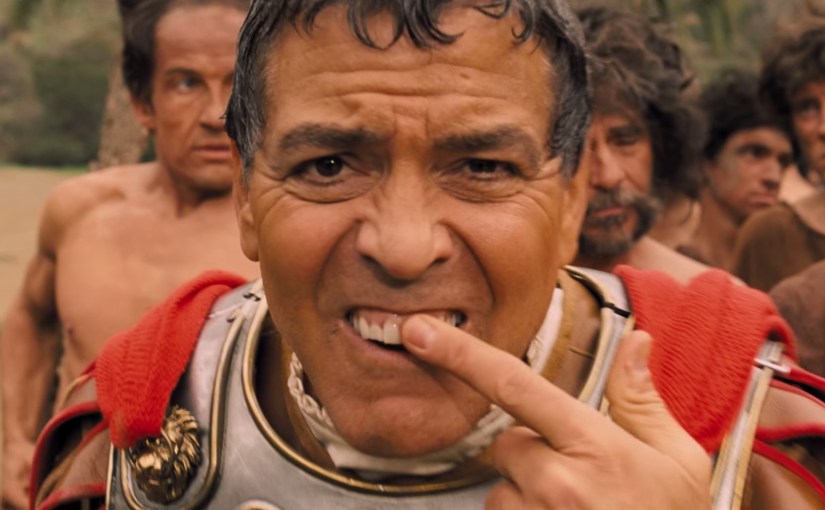
In classic film noir fashion, a narrator (Michael Gambon) informs us that Eddie Mannix (Josh Brolin) is head of production at the fictional Capitol Pictures, which is in the middle of shooting its most ambitious picture ever, an epic Biblical tale called Hail, Caesar!  (Think Ben-Hur with a lower budget and an outright plagiarized screenplay.)  However, their leading man, the improbably handsome and incredibly dumb Baird Whitlock (George Clooney), abruptly goes missing when he is kidnapped by a couple of lurking extras.  Mannix must deal with finding Whitlock while also figuring out what to do about:

  1. DeeAnna Moran’s (Scarlett Johansson) unexpected pregnancy.
  2. Hobie Doyle’s (Alden Ehrenreich) inability to deliver lines without a cowboy accent, which infuriates his director, Laurence Laurentz (Ralph Fiennes).
  3. Two persistent gossip columnists (both played by Tilda Swinton) who are running stories on Whitlock’s disappearance and/or salacious rumors about Whitlock’s past.
  4. A lucrative job offer from Lockheed.
  5. His promise to his wife (Allison Pill in a tiny role) to quit smoking.

Whew!  And I haven’t even mentioned the singer/dancer Burt Gurney (Channing Tatum) or the mysterious group of academics who have apparently kidnapped Whitlock, a group calling itself, “The Future.”  …spooky…

As in many other of the Coen Brothers’ films – not ALL of them, but many of them – the story itself is not really the point.  It just serves as an excuse for Ethan and Joel to present the viewer with scene after scene demonstrating their immense affection for a bygone era of filmmaking.  When Scarlett Johansson’s character, DeeAnna, is introduced, for example, we don’t just get a line or two about what she does (she’s an aquatic star modeled after Esther Williams).  We’re treated to an elaborately choreographed scene with dozens of bathing beauties, ScarJo diving from a great height wearing a mermaid tail, and a mechanical whale complete with a spouting blowhole.

At one point, Mannix visits the chief film editor for the studio, C.C. Calhoun (Frances McDormand), to see how Mr. Laurentz’s film is shaping up.  This scene in particular is lovingly presented, as we get a quick-cut sequence of Calhoun unspooling the film in the dim editing room, re-threading it, punching a button, flipping a switch, click-clack, click-clack, and Mannix watches the opening sequence of “Merrily We Dance” on the tiny Moviola as the projector whirs in the background.  I would bet real money that Martin Scorsese really, REALLY loved this scene.  (Plus there’s a nice little comic button at the end of the scene that is an excellent demonstration of Edna Mode’s immortal dictum in The Incredibles: “No capes!”)

The whole movie is like that.  It’s one of the most nostalgic homages to old Hollywood that I’ve ever seen.  But the movie can’t seem to make up its mind about what it’s about.  George Clooney puts on a clinic of how to play dumb as the clueless Baird Whitlock.  (In fact, this movie serves as the conclusion to the unofficial “Idiots” cycle of films from the Coen Brothers films, which also includes O Brother, Where Art Thou?, Intolerable Cruelty, and Burn After Reading, all of which star Clooney in a lead role…playing an idiot.)  Alden Ehrenreich is pretty convincing as a young star with a pretty boy face and limited acting ability, which I’m sure is far from the truth, but he pulls it off.  His scene where he tries to wrap his Texas accent around the simple line, “Would that it were so simple”, with his director patiently trying to coach him, is hilarious on its own.  But it runs on a little too long, as does the aforementioned scene in the editing room.  The subplot with the gossip columnists feels tacked on, almost as of the Coens were trying to pad the running time.  There’s a magnificently choreographed scene where we watch Channing Tatum’s character do some tap dancing dressed as a sailor for another movie being filmed, but even THAT runs a little too long.

Ultimately, Hail, Caesar! feels more like an intellectual exercise instead of an emotional one.  I hate to keep bringing this movie up by comparison, but Babylon, for example, managed to capture a nostalgia for Old Hollywood AND kept me emotionally involved for its entirety.  There was an energy that kept things moving.  Hail, Caesar! lacks that energy, but I can’t quite bring myself to call it a “bad” movie because I connected with its affection for the monolithic, flawed system that managed to create so many diamonds amid SO many lumps of coal.  (Just like today!)

OUT OF SIGHT

By Marc S. Sanders

In 1998, Elmore Leonard’s best-selling novel, Out Of Sight, was adapted by director Steven Soderbergh, where Federal Marshall Karen Sisco (Jennifer Lopez) falls in lust with Bank Robber Jack Foley (George Clooney), which leads to ridiculous, albeit logical set ups as a high stakes diamond heist is planned along the way.

I know years after Steven Soderbergh’s film was released an ABC tv series based on the Sisco character was produced. That was a misfire. Simply because the beautiful, sexy and most importantly under appreciated and intuitive portrayal that Lopez mastered was a role that could have led to another great film franchise of sequels to come. Carla Gugino played author Leonard’s heroine in the tv show. If you are saying “Carla who?” then ‘Nuff said. Sisco belongs to Jennifer Lopez.

Lopez and Clooney have great chemistry amid gorgeous cinematography on location in sun filled Miami and snow blanketed Detroit. Soderbergh shoots a great scene midway through where the two characters, on opposite sides of the law, throw caution out the door as they seduce each other in front of a hotel window view boasting beautiful midnight blue sprinkled with falling snow. It is one cool and very hot scene.

Sisco is always a step ahead of Foley. Her problem arises when after being held hostage by him in the trunk of her car following his escape from prison…well, she just can’t resist him.

My apologies. Out Of Sight is a far better film than I could describe here thanks also to a boastful cast featuring Dennis Farina, Ving Rhames, Don Cheadle (how many films has he done with Clooney?), Steve Zahn, Albert Brooks (simply great as a hairpiece wearing white collar criminal), Michael Keaton (two Batmans in a film for the price of one) and finally a master of cameos reserved for a smirk inducing final scene. Make an educated guess of who I could be talking about.

Lopez and Clooney should have done more films together over the years. They are as classic a couple as Tracey & Hepburn, Beatty & Dunaway, Hanks & Ryan or Gere & Roberts.

This was a gem of a movie I mistakenly found boring when I saw it in theatres. What was I thinking? On a second viewing, 20 years later, I laughed, smiled and just couldn’t take my eyes off it. It’s just great fun.

Without Out Of Sight, Soderbergh, Clooney and Company would probably never have made an Ocean’s 11. Check out what became before their more successful collaborations to come.

THE AMERICAN

By Marc S. Sanders

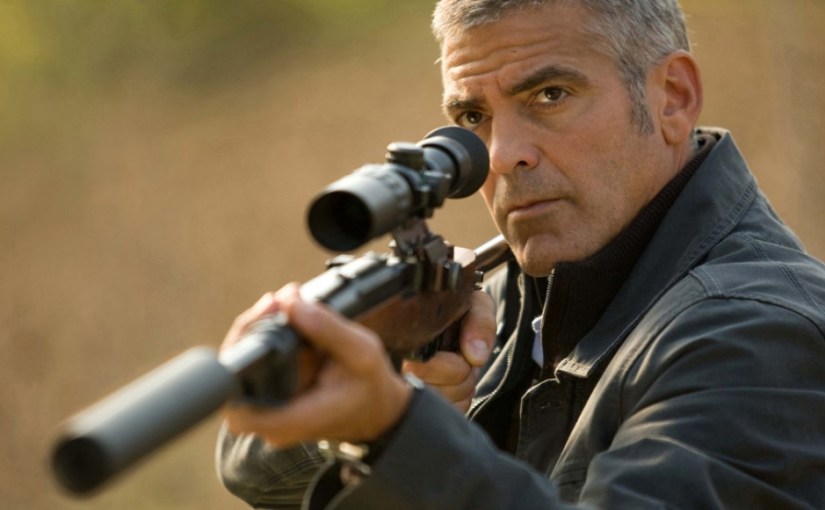
Director Anton Corbijn must have been terribly bored directing George Clooney in The American. All that his top billed star does is brood. He broods a lot, and sips coffee, reads a paper, drives his car, and constructs an assassin’s rifle for a beautiful woman.

Corbjin’s film opens with Clooney playing a man named Jack (no last name offered) who’s an assassin and about to be a target of Swedish men who share the same interest. It’s a good quiet start for a film, with an eye opening surprise to close it out before advancing the story.

Jack is instructed by his confidant to hide out in a small Italian town where a local priest encourages him to admit his sins. It’s not so easy, however, when Jack is busy bedding a local prostitute and building a dangerous weapon for pay.

I saw the ending coming. Yet, it’s a good ending. Getting there is the challenge. I think this was Clooney’s attempt to echo Matt Damon’s Jason Bourne. Brood, hardly speak, look at unusual people and cars in the vicinity, hide in plain sight without altering your appearance, sip coffee, drive a car, and brood some more. Brooding, however, begets boredom…at least for me it does.

The American drags itself slowly through an hour and forty-five minutes of countless close ups served up by Corbjin. There are so many close ups of Clooney that he obviously needed something to do besides appearing stoic all the time. So, he shifts his chin and bottom jawbone back and forth. I wanted to know if Clooney was chewing gum. That’s about all the film offers me to ponder at times. Is George Clooney chewing gum, or is he chewing his cud? Gotta go with the latter because I didn’t see a pack of gum anywhere within this town.

Yeah! That’s about all there is to say about The American. Corbjin gets some breathtaking shots of the Italian countryside, but I didn’t care about that. All I wanted to know was if George Clooney is a gum chewing assassin, or just an assassin, and because there will likely never be a sequel, I’ll never find out.

Darn!!!!

QUICK TAKE: Syriana (2005)

By Miguel E. Rodriguez

Director: Stephen Gaghan
Cast: George Clooney, Matt Damon, Jeffrey Wright, Christopher Plummer, Chris Cooper, Amanda Peet
My Rating: 8/10
Rotten Tomatometer: 72%

PLOT: A politically charged epic about the state of the oil industry in the hands of those personally involved and affected by it.


Syriana reminds me of one of those puzzles made out of twisted nails, where the challenge is to untangle them, even though it appears to be impossible.  The difference is, with Syriana, I don’t get tired of trying.  At least, not yet.

The movie is a pleasure to watch, but hard to explain.  It’s a convoluted tale that starts with an impending merger between two oil companies, detours into political and legal intrigue, and sprinkles in some religious fanaticism by the time we get to the end.  I’ve watched it five times, and I still have questions about the plot.  I JUST watched it, and I’m still not entirely sure who Christopher Plummer’s character is and why he matters at all to the story.

Normally, a movie this confusing would turn me off.  (Examples: Full Frontal [2002], The Fountain [2006], The Counselor [2013])  But when I watch Syriana, I get the sense that, underneath the twisty plot and maddeningly oblique dialogue, there lurks a great truth.  Maybe the plot is confusing because, really, the situation it’s describing is so confusing in real life.  Maybe any attempt to parse the complexities of U.S. relations with oil-producing countries is a fool’s gambit to begin with.  So the movie just jumps in with both feet and separates the watchers from the listeners.  You’ve really got to ACTIVELY listen for two hours to make ANY sense of the movie.

Maybe that’s not your thing.  Fair enough.  This is the kind of movie that I can’t defend on objective grounds.  You’re either gonna like it or not.  For myself, I get sucked into it every time I watch, even if I don’t understand it all 100%.  So.  There you go.

QUICK TAKE: Good Night, and Good Luck. (2005)

By Miguel E. Rodriguez

Director: George Clooney
Cast: David Strathairn, Patricia Clarkson, George Clooney, Jeff Daniels, Robert Downey Jr., Frank Langella
My Rating: 8/10
Rotten Tomatometer: 93% Certified Fresh

PLOT: In the early 1950s, broadcast journalist Edward R. Murrow (Strathairn) looks to bring down Senator Joseph McCarthy.


I feel eminently unqualified to discuss the historical merits of Good Night, and Good Luck.  I am no history scholar.  What I know about the Hollywood blacklist and the HUAC hearings can be traced to sources such as movie reviews, the movies themselves, documentaries, and The Manchurian Candidate.  (The original, not the remake.)

As such, all I can report is that this movie is solidly well-made, photographed in gorgeous black and white, and is an immensely satisfying experience, because a bully gets what’s coming to him, on national television.  If there are times when it lags a little, well, civics lessons can’t be fireworks all the time.

David Strathairn is not quite a dead ringer for legendary newsman Edward R. Murrow, but he’s close enough, and he’s never less than convincing, especially when delivering Murrow’s broadcasts in that inimitable deadpan that somehow sounds more informed than the average reporter.

I especially enjoyed the segment where McCarthy appears on Murrow’s program to defend himself against charges made by Murrow on a previous show.  Shortly thereafter, Murrow goes over McCarthy’s rebuttal line by line, identifying each falsehood and inaccuracy.  That took guts back then, but Murrow stood for truth, as corny as that sounds, and he wasn’t about to let McCarthy’s lies slide.

All in all, Good Night, and Good Luck is a great film, maybe even an IMPORTANT film, because of our ever-shifting political climate.  You never know if another McCarthy will rise up, and you wonder if anyone will be around, like Murrow, to put them in their place.

[TRIVIA NOTE: look fast for Simon Helberg (Wolowitz on “The Big Bang Theory”) in what amounts to approximately five seconds total screen time.]

MICHAEL CLAYTON

By Marc S. Sanders

The corporate world can be murder sometimes.  Just ask a well known “fixer” like Michael Clayton. 

George Clooney plays the title role that’ll leave your head spinning while watching the film, and thereafter keep you thinking about how frighteningly true much of what you’ve seen, in this fictional account from master writer Tony Gilroy, could potentially be all too real.

Michael Clayton is a lawyer who does not practice law but rather “fixes” sticky situations for his law firm.  When the attorneys of the firm don’t have enough imagination to swindle their client from bearing responsibility or surrendering to guilt, they turn to Michael.  Michael will know what to do.  Ironically, Gilroy’s script (which is also his directorial debut) will have you believe that Clayton is at a career midlife crisis moment where he understands that nothing really can be fixed or simply swept under the rug.  Not even money can buy any of us out of a guilty situation when there’s nothing to work with but the black and white facts of actual guilt.  Early on in the film, Michael explains to an aggravated high-priced client that there’s no getting out of the fact that a late-night hit and run is nothing else but a late-night hit and run.  Can’t undent a car.  Can’t bring a bicyclist back to life.  Can’t fix what is permanently broken.

Moving on to the main storyline will demonstrate the same ideal.  If knowing admission of guilt and wrongdoing is documented on paper in plain English, then there’s no getting around this.  Moreover, there’s no getting around the fact that one of the best lawyers in Michael’s firm, played expertly by Tom Wilkinson, is consciously arrested in his own guilt of ethics violation.  To be considered one of the greatest lawyers in the country, would you factor in how to squeak out a win at no costs? Would it be when you can accept that your own client is guilty of wrongdoing and help them from that point?  I don’t know.  I’m not a lawyer.  The point is that Tony Gilroy implies that Wilkinson’s character, Arthur Eden, was once considered among his peers in high esteem in order to earn the reputation he has. Then another way when perhaps that reputation was based on actions not so honorable.  As Arthur struggles with this conundrum, maybe it’s only telling that his wealthy corporate client, an environmental weed killer manufacturer and his law firm colleagues easily think it’s nothing like that.  Arthur must be literally losing his mind.  It’s the only explanation.  He’d have to be crazy to literally strip his clothes off in the middle of a witness deposition, and later run after the witness in a freezing cold parking lot, while stark naked.

The pawn of the corporate client is represented by a shark named Karen Crowder (a brilliant Tilda Swinton, putting on the American Ivy League grad persona).  Karen is only insecure in how capable she’s actually considered when behind her closed doors.  She nervously practices what she will say at presentations for the corporation or interviews that hold her client in the highest regard.  She’s also desperate to maintain a calm and unpanicked appearance of this firm who clearly caused the death of many people that were exposed to their product.  Karen will make certain this knowledge never sees the light of day.  Karen talks to her mirror while stuttering over her lines.  By the way, if Karen was so confident in what her corporate client stands for, then would she even have a stutter to begin with?  This is where Tilda Swinton is great with Gilroy’s script.  What she knows would be the death of her career. Then again, this is her career we are talking about here. 

Tony Gilroy’s script is deliberately muddied in its first act.  Random scenes that carry no relevance to one another occur.  Michael sits at an underground poker table. Arthur spews off endless speeches that give a voice to madness. An army of lawyers led by a shrewd Sydney Pollack are up late at night sifting through piles and piles of documents.  Karen talks to herself while smoothing out the wrinkles of her suit while getting dressed in the morning.  Then a car explodes, and the movie sends us back in time to four days prior.  This might seem frustrating on a first viewing, but I urge anyone interested in seeing the film to be patient.  Gilroy demonstrates that if crime truly occurs within the offices of corporate high-rise buildings, then it’s not going to be anything but complex.  It’s only when it is gradually simplified like a math equation, do we see how justifiable the desperation of these crimes really are.  Murder and attempted murders and violations of law and ethics are committed in the film Michael Clayton, and yet no one is carrying a gun. 

This film boasts a brilliant cast ready for complicated characters.  Clooney is far from his charming other characters that evoke cuteness and handsome tuxedo clad appearances.  He’s a tired professional soul, exhausted on the heavy lifting he does for his firm and their apathetic clients.  He’s failed at his dream of running a New York City restaurant with his recovering alcoholic brother and he’s mounted in debt to loan sharks.  Wilkinson is old and past the age of winning at all costs.  He can’t sleep with the contributions he’s lent to criminals he’s legally served and rescued on paper.  Swinton is the younger one of the trio with a massively rich and successful future ahead of her, while holding on to the same mentality of what Clooney and Wilkinson’s characters once had.  The only issue is that maybe she’s taking a few too many steps way too far. 

Tony Gilroy has written brilliantly faulty characters who must function with strength, but are weakened by their lack in morale or inability to recover from never having morale, and the actors he’s directed in this film deliver the message sensationally.

Michael Clayton is a smart film, and Michael Clayton is a great, great film.