
THE KING’S SPEECH

By Marc S. Sanders

A man can carry the title of Duke Of York, but that doesn’t make him a super man.  After all, he is just a man like any other, and he can possess annoying hinderances like a stammer for example.  However, when you are part of the Royal Family with a historical lineage of thousands and thousands of years, celebrated and honored in majestic paintings and medals, the inconvenience is never acceptable. 

Colin Firth is Prince Albert George (and forgive me but he has assumed two or three other first names as his birthright that I can not recall.  Phillip, as well I think).  The King’s Speech opens when Albert has been tasked by his father, the King of England, to deliver a speech at Wembley Stadium.  Director Tom Hooper never made a small staircase, a microphone or an audience appear so fearful.  As Albert addresses the crowd, the words do not come out and the only one who can lovingly empathize with him is his devoted wife Elizabeth (Helana Bonham Carter).  The archbishop (Derek Jacobi) puts his head down in disappointment along with all the other formally attired spectators.  It’s a heartbreaking beginning of a story for a well-dressed crippled hero.

Following advisors and doctors who offer ridiculous remedies that allow no alleviation, Elizabeth finally finds an Australian speech therapist who just might be the best last resort for her husband.  Albert is stubbornly reluctant to visit with Dr. Lionel Logue (Geoffrey Rush) who insists that their sessions occur in his office.  Albert does not like that he will also not be addressed formally by Dr. Logue.  Lionel will call him Bertie. 

An unorthodox approach, at least for royalty, is what Lionel insists will aid Bertie.  It is certainly better than his doctor’s recommendation of smoking cigarettes directly into his lungs.  Bertie will lie and roll on the floor.  He’ll hum and bellow unusual noises.  He’ll have to loosen up his physique and even allow Elizabeth to sit on his belly to help him with breathing exercises while working his diaphragm.  The art of swearing is especially helpful.

An interesting fact that Lionel shares with Bertie is that no infant is born with a stammer.  It develops from another source.  Perhaps it is abuse or neglect as a child.  When you are a child of royalty you are not necessarily loved directly by your parents.  A nanny is likely closer to you; maybe even more abusive. 

The King (Michael Gambon) is respected by Bertie, but he is fearful of the future of his monarchy.  The older son, David (Guy Pearce) is next in line to assume the throne, but he is an immature bedhopping playboy, and the threats of Hitler and Stalin are becoming more prominent.  The King begins prepping his Albert by insisting he deliver radio addresses.  The father is not the encouraging type, though.  His disdainful demands are not the cure for Albert’s debilitation.

The King’s Speech advances a couple years during the 1930’s towards the precursors ahead of World War II.  The King has died.  David is behaving just as expected and Albert still suffers with his ability to speak, but Lionel has therapeutically made advances with his student and friend.  He just can’t lose his student.  Otherwise, Bertie will not overcome.

The film’s strength relies on a solid friendship that develops between a common civilian and a man of Royalty.  Geoffrey Rush and Colin Firth work marvelously together.  They are very different personalities with backgrounds that could not be more apart from each other.  The chemistry is a beautiful duet of dialogue from an Oscar winning script from David Seidler. This was Seidler’s first script he ever wrote at the age of eighty. 

The entirety of the picture has a set design from Eve Stuart and Judy Farr that is absolutely grand.  Every room of the palace has the most beautiful furnishings and wallpaper designs.  Tom Hooper uses wide distant lens’ that show the enormities of each room of the castle as well as Prince Albert’s home.  Sometimes he shoots from the floor above, pointing his camera at Albert and Elizabeth.  The majesty of royalty looks down upon the Prince and his speech impediment.  It’s an absorbing setting for the film.  Exterior shots also look authentic with the cars and the dreary coldness of the country and London cobblestones.  I love the hardwood floors that the characters walk upon in the picture, particularly in Lionel’s office.  The resonances of their dress shoes speak more clearly than the Prince. It all seems to echo the overwhelming conflict that our protagonist must overcome, and Colin Firth is terrific at demonstrating his frustrated insecurities.  It’s an Oscar winning performance not only earned for the well-timed stammer but also the mournful facial expressions that are caught in close ups.

The triumphant moment at the end of the film occurs after Albert has succeeded the throne from his incapable brother. He is obligated to address his country in a world-famous speech that eventually brought a defiant England into the second world war to fight off Hitler’s undoubted tyranny.  Tom Hooper’s camera follows a strong hearted, yet nervous Colin Firth walk from one room of the palace to the next until he finally reaches the small makeshift studio where his friend Lionel accompanies him to offer assurance as he speaks to his people and allies across the seas.  I don’t simply see a coach or one who lends confidence.  I see a friend working with another friend.  Again, Geoffrey Rush and Colin Firth make a wonderful pair in a long line of cinematic mentors and their students.

As history has taught us, the King’s speech was simply the beginning of a very dark and bloody experience.  The speech itself became a success, but the real challenge was yet to come.  However, confidence is what allowed a generation to survive.  The irony of The King’s Speech is that the hero a people needed lacked confidence in himself.  By the end of this picture, he is sending his faith, his trust, and his own assurance over to his constituents, who needed it the most in spite of a hindering stammer.  It’s a doubly blessed occasion that a lifelong friendship formed out of a troubling time.
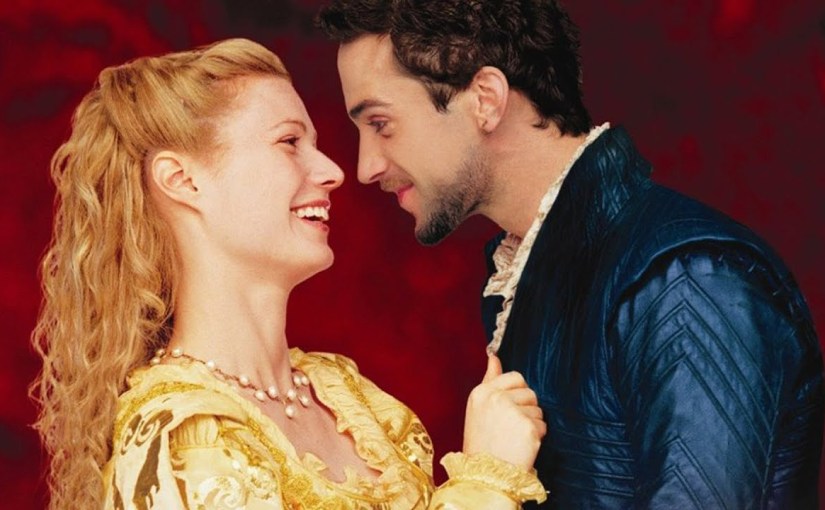
SHAKESPEARE IN LOVE

By Marc S. Sanders

William Shakespeare’s works will always remain timeless.  His accomplishments are simply magnetic.

If you have any love for live theater, you’ll likely have at least a fondness for John Madden’s Oscar winning film Shakespeare In Love.  I loved the movie.  Perhaps that is because as a moonlighting playwright, myself, I could relate to The Bard’s early dilemma in the film – writer’s block.  It’s a gnawing, aggravating experience to go through.  You have an urge to create.  You just don’t know where to begin.  Believe me Bill, I know what you’re going through.

This likely fictional telling of William Shakespeare’s process of conceiving Romeo & Juliet begins with two competing theaters who have purchased the rights to Shakespeare’s (Joseph Fiennes) newest play that he has titled Romeo & Ethel, The Pirate’s Daughter, a comedy of course.  However, he has not yet written one page.  Not only does he suffer through his writer’s block, but William also has to endure the pressure of the theatre companies to stage and cast the play.  Geoffrey Rush and Martin Clunes are the scene stealing theatre owners who pester poor Bill for his script. 

My experiences in theatre allow me to also relate to the frustrations of staging a play.  Casting can be troubling if you don’t have the right selection of actors for the roles to be filled.  Huge egos can also be an annoyance.  Ben Affleck seems perfectly cast for that. (“What is the play, and what is my part?”)  In Shakespeare’s time, women are absolutely forbidden on the stage. As most theater presentations are intended to be comedic, men occupying the female roles only heightens the humor.  Still, as troubling as it is to cast the supporting roles with the available men of the company, including Ethel and her nurse, no one seems right for the role of Romeo. 

A fan of his, and a lover of theater, is Viola De Lesseps (Gwyneth Paltrow), the daughter of a wealthy merchant.  She musters the courage to disguise herself as a man and attend an audition under the name of “Thomas Kent.”  William is immediately taken with Thomas’ stage presence and upon his pursuit of him, encounters Viola.  They are both immediately stricken with love for one another and soon the writer learns of Viola’s deceit and revels in trysts with her while they maintain the secret for the integrity of the play that he now has inspiration to continue writing to its grand conclusion.  Viola is the muse that William has been seeking.

One problem beyond the usual obstacles in producing a play for performance time comes in the form of Lord Wessex (Colin Firth), a snobby cash poor aristocrat, who claims Viola as his soon to be bride as a means of earning a stature of wealth through her family.  Wessex is a demanding and unreasonable fiend of course, and Firth delivers an effectively cruel villain against the heroism found in Fiennes’ Shakespeare.

As the play is rehearsed and the romance between Viola and William continues to blossom, the drama is not left only on the stage.  A grand scene bordering on slapstick occurs when the competing theaters engage in a swashbuckling dual.  Props are tossed, swords are swung and feathered pillows explode.  Later, adventure on the level of Errol Flynn occurs with swordplay between William and Wessex within the theater and its trappings.  Screenwriters Marc Norman and Tom Stoppard inventively imply that theater, as we know it today, was simply inspired by what Shakespeare encounters in his own life.  When I conduct playwrighting workshops at my local community theater, I always tell the class that you have to “write what you know.”  Shakespeare In Love precisely demonstrates that mantra, even if it is elevated for the theatrics of cinema.  After all, this movie proudly boasts its silly comedy as much as it embraces its romance which thankfully never drowns in sap.

A wonderfully well edited centerpiece cuts between Viola and William’s passion for one another against their stage rehearsals with Viola in her guise as “Thomas Madden.”  In bed, they romance each other with recognizable dialogue, originally written by the real Shakespeare, that then makes its way into William’s pages for his script in progress.  This is where Gwyneth Paltrow really shines as she is momentarily depicted as the lovely Viola and then we see her in the guise of “Thomas,” the naturally gifted actor perfect for William’s Romeo character.  Paltrow’s range with the Oscar winning performance is done so well in this sequence alone.

The final act of the film is joyously assembled.  Behind the scenes, actor and writer William Shakespeare stresses over a stuttering actor who has entered the stage to begin the play.  Can he get through the scene?  What about the poor actor who is stricken with stage fright, and suddenly can’t go on as Juliet?  The audience is left in a rapturous trance with open mouths of silence and tears, following the suicides of the lovers on stage.  Yet, they don’t know if they should applaud at the end of the play.  The actors don’t know how to respond to the applause.  As well, are we given an opportunity to bear witness where the well-known phrase “The show must go on!” originated from?

It’s also necessary to point out one of the most favorite side characters to ever grace a film.  Judi Dench is the staunch and intimidating Queen Elizabeth I.  Arguably, this brief role, that I believe amounts to no more than five and half minutes on screen, carried Dench to not only Oscar glory but a celebrated favorite character actress for years to come.  Dench demonstrates how fun acting can be even if she is wrapped up in layers of 16th century wardrobe and caked on makeup.  Her first scene has her laughing at a poor actor performing with an uncooperative poodle.  Her last scene has her tearing down the romantic gesture of men laying down their coats for her to cross over a mud puddle.  It’s an unforgettable appearance in the film.

I take issue with one element of the picture, however.  Forgive me for going against the opinion of the Academy Awards, but Shakespeare In Love would have been an even grander experience for me had it not been for an overproduced and intrusive original score from Oscar winner Stephen Warbeck.  The music cuts into the film too much.  It borders on obnoxious.  Over and over, I was telling myself, these scenes hold together beautifully without any of the blaring horns and trumpets from Warbeck’s orchestra.  This film has an outstanding cast of actors and often I felt like they were being upstaged by the soundtrack of the film.  There are magnificent scenes with witty dialogue delivered by the likes of Imelda Staunton, Tom Wilkinson, Ben Affleck, along with Dench, Firth, Paltrow, Fiennes and Rush.  I could literally envision these moments working based simply on their performances alone.  Imagine watching a live stage performance, only elevator music cuts in at the most inopportune times. 

Still, I refuse to end on a sour note for Shakespeare In Love.  It is worthy of a standing ovation.  John Madden’s film is a grand production in cast performance, art direction, costume and makeup.  The script by Marc Norman and Tom Stoppard is brilliantly clever and witty as they weave inspired references from Shakespeare’s various sonnets, poems and plays into rich, everyday dialogue. 

Sustaining the value of performing arts can easily begin with a viewing of Shakespeare In Love in a school curriculum.  Even better would be to adapt this film into a stage play.  I think to watch Shakespeare In Love, live on stage, would be a wonderous experience.