
By Marc S. Sanders
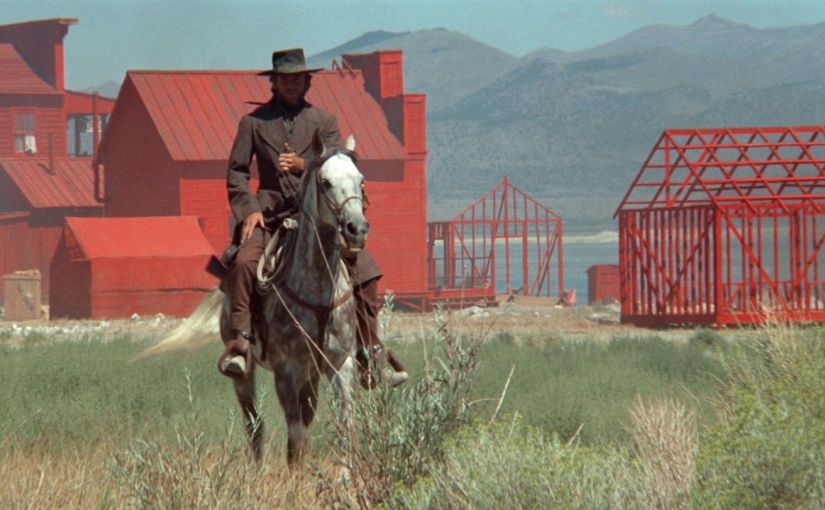
Because Clint Eastwood’s career of acting roles is thematically the strong, silent type, it’s easy to appreciate that in one film he may be The Man With No Name, while in another picture he’s simply The Stranger. In the second film he directed, High Plains Drifter, he’s an intimidating force riding on horseback into the lakeside town of Lago.
He may enter the saloon for a beer and a bottle and then cross the street to the barber for a shave and a bath, but you likely do not want to ever involve yourself with him. He is also horrifically unkind to one of the few women in these parts. Let’s just say it ain’t no roll in the hay. This Stranger is a scary dude in a black hat.
The townsmen recognize a convenience in this man’s arrival though. He’s demonstrated what he is capable of and therefore he appears to be the one qualified to kill three outlaws who were just released from prison with vengeance on their minds as they make a return to Lago.
There’s a hint of supernatural play in High Plains Drifter. The Stranger recalls a harsh night when the local Marshall had been whipped to death by the townsfolk. Could the Marshall be the Stranger? Perhaps. The victimized Marshall is portrayed by Eastwood’s long time stunt double and occasional director Buddy Van Horn (Pink Cadillac, The Dead Pool). While that bloody slaughter occurred, the townsfolk simply watched with no offer to help. For a while, High Plains Drifter was rumored to have been inspired by a real-life rape from the mid-1960s which ultimately led to the need for calling 911 in the event of an emergency. Art imitates life even in the Old West.
The Stranger agrees to help the town prepare for the outlaws’ violent return, but like a fantasy character he makes special requests of his own including reassigning the sheriff’s badge to the town dwarf, plus taking whatever merchandise he wants from the mercantile and occupying the two best rooms in the hotel. Also, he gives instructions to load up on a large supply of red paint. Is the town of Lago getting what they bargained for or are they dwindling into a worse fate? Could be a deal with the devil or as Jewish mysticism might imply, the town of Lago might be inheriting a gollum.
Clint Eastwood salutes his prior directors that prepped him to become an esteemed filmmaker. Don Siegel’s (Dirty Harry) and Sergio Leone’s (The Dollars spaghetti westerns) names are engraved on tombstones within the nearby cemetery built for the set. Eastwood adopts some of their famed techniques while not setting himself apart from what those influencers accomplished. He was still finding his footing behind the camera. High Plains Drifter is just a tale of revenge with recognizable set ups found within typical Hollywood westerns.
Visually, the film starts out mysteriously with The Stranger’s arrival out of a sun soaked desert boil. The photography looks deliberately grainy before the modern twenty-first century film restoration appears. Not a word of dialogue is uttered until after the picture has run for over seven minutes.
Lago becomes a town with a new kind of identity later in the film as mandated by the script. This is where Eastwood finds opportunity to do things with his western that his earlier pictures had not offered yet. A bloody, hellish war is expected.
High Plains Drifter traverses in different directions while primarily staying in this one small town and you may wonder what this storyline has to do with that storyline. Well, the commonality of its various parts is The Stranger’s arrival.
You’ll may question who this unnamed man truly was by the time film ends. Maybe it was not a man at all. There are moments included by Eastwood’s direction to question what precisely occurred.
Is High Plains Drifter a western or is it a ghost story? Like me, perhaps you’ll uncover moments that support either argument.
 2 UNPAID MOVIE CRITICS!!!!