

FROM THE WORLD OF JOHN WICK: BALLERINA

By Marc S. Sanders

Her father gets killed.  She grows up to become a skilled assassin.  She seeks revenge.

There’s your story.

Ana de Armas headlines this extended branch off the John Wick franchise called Ballerina.  She plays Eve.  I like her.  The same way I liked her all too brief appearance in No Time To Die.  

Keanu Reeves’ Mr. Wick makes some scant appearances to escort Eve into the ring where she can use guns, lots and lots and lots of guns, plus a bunch of knives too. Kitchen utensils including stacks of dish ware along with pots and pans.  Grenades to tape inside an goon’s mouth.  There’s also a flame thrower and to counteract against another flame thrower, there’s a fire hose.  

Ballerina takes a break acknowledgment when a flat screen appears behind Eve to quickly show the channels change from the slapstick beatings by The Three Stooges and then over to a Looney Tunes short.  Get the idea?

If there’s a story, it’s not even a full one note.  Gabriel Byrne is the distinguished Chancellor who Eve has a target for.  Despite his armada of endless assassins that come from every corner of the screen, and maybe they leap off from Lilo & Stitch playing in the theater next door, The Chancellor demands that Eve’s controller known as The Director (Anjelica Huston) call off her underling’s agenda.  Clearly though, Eve is under no one’s control.

Ballerina is high stakes action, and you get what you pay for.  However, I’d also pay for the 64 oz porter house and my middle age body will plead with me to slow down my pace before my gastrointestinal system implodes.  Every morsel of this movie is great and terrifically assembled but man is it an overindulging two hours and four minutes of slashing, shooting, exploding, breaking, crunching, pounding, punching, elbowing, kneeing, kicking, choking and strangling.  You drown in the beefy mayhem.

This actioner plays like a combat video game.  Drawn out fight sequences happen in one setting.  Then, Eve traverses to another location and the violence resumes.  It amuses me how Eve will do a number on one bad guy and once he’s permanently put away, only then does the next guy enter.  Wash, rinse, repeat. Whoa!!!! Here’s the next guy and then the next and next thereafter.  No one thug walks in to interrupt a one-on-one fight until Eve’s current opponent is put down with a bullet to the head or a grenade in the mouth or a flame thrower scorching.

It’s fun.  Yes.  However, there is a character that Eve encounters played by Norman Reedus, and I told Miguel later that I could not recall what his final fate was when we last left him in the picture.  I truly forgot that he’s a proud dad to a nine-year-old girl.  I mean, I truly forgot there was a little girl who was seen earlier in the movie.  I don’t even recall Reedus’ pertinence to the film. My mind was so paralyzed of thought process with the action overdose, that the few minute details there are, have escaped my short-term memory. I must have been suffocating in the fast-moving edits of the fight choreography and ballistic weaponry at play.  

After the film ended and considering what I know was left off with last year’s John Wick 4, I inquired of Miguel to piece together when this movie took place.  He looked it up.  I pondered for a millisecond at best, before I finally concluded it makes no difference.  Finally, after the production expended every penny on the last stunt man extra, the movie stops and the credits roll. Time to escape to the peaceful tranquility of my home.

The settings for Ballerina are marvelous and truly worthy of an Art Design Oscar.  I loved running up and down staircases and through underground corridors with Eve leading the way.  A snowy, mountaintop village occupies all of the action in the second part of the film, beginning in the saloon/dining hall, then going upstairs, then out a window, or three, and all over.  Director Len Wiseman cuts in great close ups of Ana de Armas in intense black leather with her hair in a neat ponytail.  Keanu Reeves is granted his own well-placed shots too.  

Wiseman also gets overhead shots to see the twisted stone walkways and stairwells of this area and where they navigate towards.  There are cuts to what comes around the corner and what’s thrust through doorways and windows, or down from the ceilings and rooftops.  It’s maddening and precisely cut.  The editing is superb despite how overstimulating all of the action becomes.  Eventually, you want to say “Oy!  Enough already!”

The script for Ballerina can’t be more than five pages.  It’s short on dialogue and what stands out to me is after Eve has set the whole town on fire and dispatched about three-thousands of The Chancellor’s militia, does his top henchman approach him and request to “Give the order!”  Buddy, after all this, if you have to ask, then this must be your first rodeo.  The Chancellor clearly overpaid for your services.

Ballerina is the female equivalent of the John Wick franchise.  Ana de Armas stands where Keanu Reeves stood for four pictures thus far.  If you’ve seen his four entries in this series, then you’ve seen Ballerina.  

Is it entertaining? Yes.  Is it mind numbing? After fifteen minutes? Definitely!  Do the filmmakers serve the product that was promised? Absolutely!  However, how does that ginormous porter house steak feel when it’s still lodged in your gut two hours later, and on until sunrise?
THE USUAL SUSPECTS

By Marc S. Sanders

There’s something inviting – or maybe intriguing – about seeing a person in a hat with a dark trench coat on.  Just the person’s silhouette will leave you asking for more.  What is it to this guy?  Steven Spielberg does that in the first few minutes with Indiana Jones in Raiders Of The Lost Ark.  Before Indy, there was Orson Welles as Harry Lyme in The Third Man.  Guys like these have a danger to them, and we can’t look away.  In The Usual Suspects, one of many variations of a legend called Keyser Soze has a dangerous reputation that carries him, and we want to know more about the figure in the hat and coat.  In the first few minutes of the film, we see this mysterioso extinguish a kerosene flame by urinating on it.  Who is this guy?  Maybe we, as the viewers, are Icabod Crane looking at an updated inspired spawn of The Headless Horseman.  Perhaps, we are actually catching a glimpse of that boogeyman who hid in our closets or under the beds.

Bryan Singer’s modern day film noir, masterfully written with inventive riddles by Christopher McQuarrie, works towards its ending as soon as the opening credits wrap up.  Each scene hops from a different setting or time period and as a viewer you feel like you are sitting at a kitchen table turning puzzle pieces around trying to snap them together.  Not all of it makes sense by the time the picture has wrapped up.  That’s okay though, because one of the players in the story perhaps played a sleight of hand and we can do nothing but applaud when we realize we’ve been had.  Magic is fun when you never quite realize where or when the deceit began.

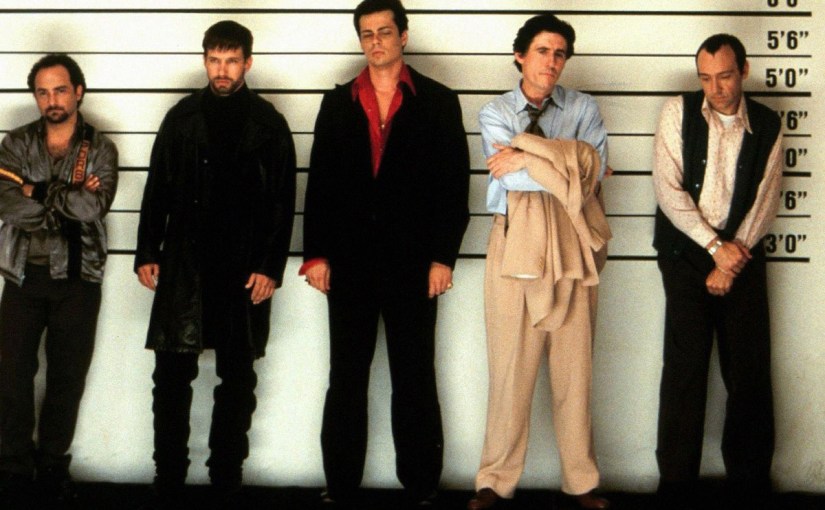
A scenario is set up early on that assembles five different kinds of criminals in a police lineup.  It works as a device to team these guys together to pull off additional heists.  A prologue to the film depicts the aftermath of their last job together.  One holdover, a hobbled cripple named Verbal Kint (Kevin Spacey) is brought into a police precinct to be interviewed by a determined detective named Kujan (Chazz Palminteri).  Verbal might ramble on endlessly in circles about nothing, but Agent Kujan is going to get to the bottom of what happened the night prior on a shipping dock that turned up several corpses.  How did it all go down, and where is the money and cocaine that was expected to be there?

Verbal was one of the five in that lineup, along with McManus (Stephen Baldwin), Hockney (Kevin Pollack), Fenster (Benicio Del Toro) and Keaton (Gabriel Byrne).  Each carries a different specialty or personality, but Keaton is the guy that Kujan is really after.  He’s a master criminal who’s been known to fake his own death, supposedly turn legitimate while dating a high-priced lawyer, and now may be the lead suspect in an armored truck heist.  On the other hand, maybe it was one of these other four guys. 

Amid all of this back and forth and side stepping stories, there is mention of a name – Keyser Soze.  Whenever he comes up in the vernacular of the script, the mood seems to change.  These criminals, usually comfortable in their own cloth of transgressions, get noticeably frightened and concerned if there is even a remote possibility that this Soze character is the engineer behind what follows them. 

It’s fun!  The Usual Suspects is fun.

McQuarrie’s script will toss out names of people we never meet.  It will quickly imply an anecdote from another time.  It’ll share a bunch of short stories with how these five guys work together, like upending a secret criminal sect of the New York City police force while robbing them of their fortunes. Yet, a tall tale of lore will intrude on their typical heists to derail what we may normally be familiar with in other crime dramas or noir films.   

Spacey is the real star of The Usual Suspects.  He earned the Academy Award for Supporting Actor because Verbal Kint is so well drawn out as a weak, unhelpful, and frustrating man.  Often, you ask yourself what the heck is this geeky looking crippled guy even talking about. 

On other occasions, I’ve noted that sometimes with movies I can not determine if I just watched a superior film or dreadful nonsense until I’ve reached the final five minutes.  The final five minutes of a movie can be the verdict.  Sometimes you’ll claim the journey getting there was great, but the conclusion was a big letdown.  If you have never seen The Usual Suspects, then you likely won’t know if the path towards its end is good until you’ve reached the culmination. 

Roger Ebert couldn’t stand this picture, and I’m not going to say he didn’t know what he was talking about or that he was wrong.  Bryan Singer and Christopher McQuarrie’s assembly of scenes don’t make for a well-defined picture, even after the movie is over.  Ebert was less than fond of that technique.  I think that was their intent, though.  Everything you have seen doesn’t have a suitable answer.  Certain parts don’t link well with others.  However, the director and screenwriter were always working towards an ending while piloting the film in swerves and unexpected knee jerk turns.

Unlike Ebert, however, I’m wholly satisfied with the film.  In fact, the first time I saw the movie, I cheered for the conclusion that got more than just one over on me.  On repeat viewings, knowing how the picture wraps up, I treasure the path towards its finale. 

If you study Verbal Kint, you’ll realize that he doesn’t offer easy answers and explanations for what’s occurred, thereby lending to the frustration of Agent Kujan who only demands cookie cutter, fall-into-place arrangements. What can I say Roger Ebert?  How else should I lay it out for you Agent Kujan? Life is messy with no easy answers sometimes.  Especially, in film noir.  

Ironically, one of Ebert’s favorite cinematic characters is Harry Lyme.  So, I guess Keyer Soze couldn’t live up to that threshold or repute.  If that’s the case, then I forgive you Roger.