BEFORE THE DEVIL KNOWS YOU’RE DEAD

By Marc S. Sanders

When it comes to crime – New York crime – few directors come as close as Sidney Lumet to make an audience feel the authenticity of its trappings.  Maybe only Martin Scorsese can stand next to Lumet.  Either with crime on the streets (Dog Day Afternoon, Serpico) or within the courtrooms (Find Me Guilty, 12 Angry Men), or both (Night Falls On Manhattan), Sidney Lumet hones directly upon how the plans should operate and when everything should unfold or derail.  

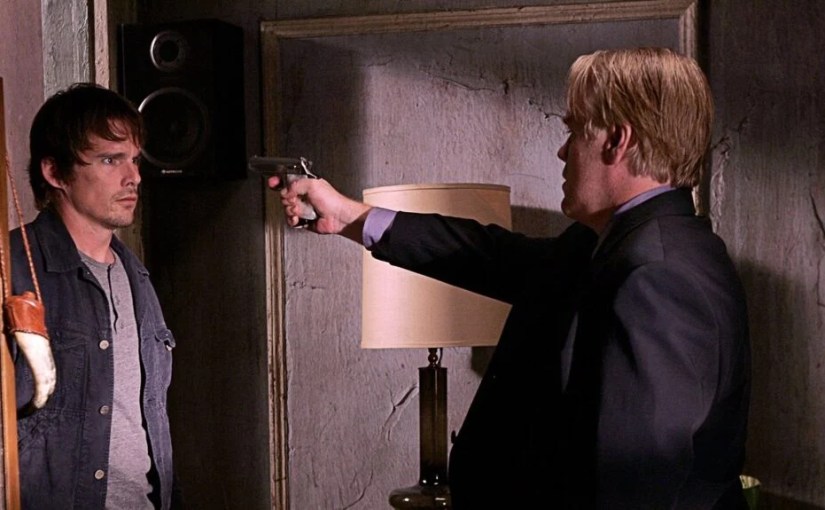
With the last picture before his death, Before The Devil Knows You’re Dead zeroes in on crime within an educated Irish family nucleus.  Andrew (Phillip Seymour Hoffman) has it laid out perfectly for his younger brother Hank (Ethan Hawke) to commit the perfect robbery. No one will get hurt and the insurance company will cover any loss.  The approximate take is around six hundred thousand. These guys carry their own desperate reasons for even considering such an idea, but Andy knows nothing can go wrong.  Hank has some trepidation though, because the target is mom and dad’s jewelry store.

Kelly Masterson’s script shows how quickly everything comes undone with bloodshed and unaccounted for details that could lead straight back to the two brothers.  It’s all told through three different perspectives – Andy, Hank and their father Charles played by Albert Finney.  Often, Lumet will return to the very same scene you saw moments earlier to show two sides of a phone call or in what direction one character goes versus that of another following a particular action that has occurred.  The timeline even jumps back in time a few days to show the direct perspective of any of these three particular characters ahead of showpiece scene – the robbery. Charles was retaking his driver’s license test. Elsewhere, Hank was struggling to pay spousal and child support with an angry ex-wife (Amy Ryan). Andrew was scheming and committing other clandestine acts both at work and in his free time.

However, Masterson’s script weaves all of these side details into how much more complicated this botched robbery becomes in the aftermath. All of what they commit following the robbery compounds into potentially making it worse for everyone involved.

Some of the breadcrumbs don’t carry enough water at times though. You might have to tolerate the characters being more intuitive than they likely should be.  Andrew leaves a business card with a side character.  When the film circles back to this item, it seems a little too easy for someone else to get wise about what has transpired.  I just chose to go with it.

Marisa Tomei is also part of the cast, caught in a love triangle as Andy’s wife and Hank’s mistress.  Tomei is really good, lending some authenticity with unscrupulous nudity in scenes with both Hoffman and Hawke.  This storyline serves as character exposition and only briefly scrapes against the crime drama at play.  It could have been excised from the film, but because the dialogue and scenario is written and performed so well, it effectively held my attention.

Albert Finney is magnificent as the patriarch owner of the store.  Simply his devastated, echoey breathing and the way he fumbles to put his eyeglasses on to learn more about what has occurred is absolutely genuine.  A late middle-aged man discovering horrible truths.  Finney plays it beautifully.  That being said, I wish the film offered more backstory to his character.  There are few hints suggesting how he regarded Andy as the first born who needed be thrown to the wolves and learn to fend for himself.  Contrarily, Hank is the younger and more disappointing son.  Yet, the script is short on material that further explores the relationship between the father and his sons.  I felt the film demanded more because Charles is quite significant to the conclusion of the story, which carries an unexpectedly abrupt ending.  

The acting and assembly of time and perspective are so finely tuned by the whole cast under Lumet’s direction.  Still, Before The Devil Knows You’re Dead needed another twenty to thirty minutes of storytelling.  One character runs out of frame with an unfinished storyline.  Another, seems too hasty in making a final decision with an easy convenience.

Don’t get me wrong.  I strongly recommend this last effort from Sidney Lumet.  It’s a unique crime yarn with an especially conniving Phillip Seymour Hoffman doing some of his best work.  The set up had me riveted and I couldn’t wait to see how all these terrible scenarios were going to fix themselves or make things horribly worse.

LEAVE THE WORLD BEHIND

By Marc S. Sanders

Anxiety and the unknown are the themes of Sam Esmail’s apocalyptic Leave the World Behind.  Actually, I can’t even be sure it’s apocalyptic or not until the end arrives.  Even then I wasn’t so sure.  

A family (Julia Roberts, Ethan Hawke as the parents, Farrah Mackenzie, Charlie Evans as the kids) make an impromptu getaway from New York City and rent a luxurious upstate air B & B for the next five days.  Upon arrival they are quickly relaxed amid all the amenities and beautiful outdoor pool.  A visit to the beach is refreshing until an oil tanker arrives from the deep ocean waters and drifts upon the shore with no warning.  Strange, but okay.  No need for that to ruin the vacation.

Then other unexpected occurrences happen.  A charming gentleman dressed handsomely in a tuxedo and his formally dressed daughter appear on the doorstep of the home in the middle of the night.  They are played very well by Mahershala Ali and Myha’la.  The man claims that he’s the owner of the house and while attending a concert in the city, they needed to make a quick exit and the best place to hold up was at this house.  Conveniently, he does not have any ID to prove his identity along with no specific personal items in this home he claims to own, not even the title ownership papers.  No photos of family tucked away anywhere.  He does have a key to the liquor cabinet, however.

Quickly, the scene is set where the internet goes down.  Federal blue screen warnings appear on every television channel.  Cell phones don’t work.  Deer, lots and lots of deer, appear in the backyard and then disappear.  Pink flamingos wade in the pool.  Elon Musk’s white Tesla cars have a stand out scene.  Roberts then recalls seeing a grizzled Kevin Bacon collecting an abundance of supplies when she made an earlier shopping trip in the local town.  

The paranoia starts to set in beginning with Julia Roberts’ character Amanda.  Amanda declares early on that she fucking hates people.  Hawke’s husband character, Clay, is not ready to hit any panic button and is happy to accommodate the strangers on the doorstep and just wait for the internet to be restored with a logical explanation.  Ali’s character, known as G.H., lends a welcome smile but it’s clear he’s not sharing all that he’s thinking or maybe what he knows.  

Sam Esmail’s film wants to provide a demonstration of how people respond when they don’t know all that’s going on, particularly when modern technology fails us.  A more relatable inconvenience is suggested as Mackenzie’s character Rose is frustrated that her streaming channel shut down just as she was starting to watch the final episode of the sitcom, Friends.  I felt her anguish immediately as my daughter consumes the trials and tribulations of Ross and Rachel on a repetitive cycle.  Ironically, streaming goes down and now the girl can’t watch Friends.  Netflix is the distributor of this film.  Yet, I think they just gave a ringing endorsement for a dying medium.  If only this girl collected the DVDs.  

My problem with Leave the World Behind is the slow pace of it all.  This is one of those movies where its triumphs hinge upon the final five minutes or so.  Either you applaud what sums up the last two and a half hours you invested, or you roll your eyes at where the picture drops you off with the urge to throw your popcorn at the screen.  

Watching Leave the World Behind brought back experiences of shows like Lost or The Walking Dead.  The set ups are brilliantly intriguing from one development to another.  The follow through on each new happening amounts to nothing or at least not anything where I can suspend my disbelief.  Questions are answered with questions.  It’s like calling an insurance company for information following a car accident.  You just want to slam the phone down.

When Ali’s character chooses to check on a neighbor, he sees a watch embedded in the sand nearby.  He picks it up only to get a fright that makes us jump.  The viewer sees nothing else and we are led to believe that Ali sees nothing else, until Esmail goes to a wide overhead shot showing the massive wreckage of a commercial airplane crash, complete with black smoke and flames and endless amounts of luggage and debris.  It’s hard for me to buy a scene like this.  G.H. doesn’t smell any burning fire nearby?  He doesn’t hear anything? He doesn’t see any other debris left mere inches away from the wristwatch only until Esmail’s direction goes from closeup to wide?  I cannot accept the character’s tunnel vision.  My eyes would go towards the crashed plane before I’d ever discover a wristwatch.  It’s just eerily quiet.  The director’s manipulation is a set up shock for me, the viewer, to grab my attention.  Yet, it backfires because it’s completely implausible.  There are many moments like this in the film.

Other than Marhershala Ali (who I still insist should be considered a viable candidate for the next James Bond or a 007 adversary), the rest of the cast is not dynamic enough.  Julia Roberts is working a little too hard.  Ethan Hawke is not working hard enough.  The dialogue is often boring arriving at no conclusions.  Thankfully, most scenes are enhanced by unusual camera angles from Esmail’s artistic freedoms with his lens.  It’s reminiscent of the deliberately weird structure that Stanley Kubrick often did with The Shining.  Nevertheless, it’s exhausting after a while.

Sam Esmail’s work is no doubt shown through long ponderous imagination.  I certainly felt Julia Roberts’ frustration on display, but still, I got the point.  I see no reason to repeat the same lines at higher volume.  I got the point of a lack of trust between the two parties being brought together.  However, I just got tired of the act.  The racial elephant in the room is even suggested.  Though I wish it wasn’t. People quickly forget that George Romero’s Night Of The Living Dead steered clear of any racial factor, and just look at the legacy of that film from the era of the Civil Rights Movement.

The ending that arrives seems inevitable.  Without revealing anything literal, it is doom and gloom.  However, I might have had more appreciation if suddenly the TV and internet got restored and these odd occurrences all just happened to be one big nothing.  At the very least, then I’d understand that this whole freaking planet would just go nuts without their You Tube, Instagram and Netflix.  

You might have had a conversation at one point in the last decade or so that began as “How did we ever manage to survive before the internet?”  The truth is we did just fine.  The adults in Leave the World Behind never stop to remember that though. 

EXPLORERS (1985)

by Miguel E. Rodriguez

DIRECTOR: Joe Dante
CAST: Ethan Hawke, River Phoenix, Jason Presson, Robert Picardo, Dick Miller
MY RATING: 7/10
ROTTEN TOMATOMETER: 72% Fresh
Everyone’s a Critic Category: “Watch a Family-Friendly Film”

PLOT: Three friends try to unravel the mystery of these strange dreams they’ve all been having, at the same time.


I’m probably biased, but one of the best times to be a teenaged movie fan had to be the 1980s.  In the wake of his stupendous earlier successes, Steven Spielberg began to produce movies, letting other directors do the heavy lifting while he contributed behind the scenes.  This led to Gremlins, The Goonies, Young Sherlock Holmes, and of course, Back to the Future.  All in a two-year period.  Awesome.

In an attempt to replicate the success of these box-office favorites, director Joe Dante (The Howling, Gremlins) presented a film unabashedly aimed at its target audience, starring a cast of unknown, but immensely likable, teenagers, including two young men making their Hollywood debut: Ethan Hawke and a nerded-up River Phoenix.  While Explorers lacks the polish and sophistication of its predecessors, it is undeniably charming and, for a while at least, even a little spooky, even if the ending flies spectacularly off the rails.

Ben Crandall (Hawke) is a teenage kid obsessed with 1950s sci-fi movies.  He’s been having these strange dreams filled with what look like electrical schematics.  He draws these pictures as best he can and shows them to his best friend, Wolfgang (Phoenix), a science prodigy.  Ben also makes friends with Darren (Jason Presson), the stereotypical kid-from-the-wrong-side-of-the-tracks, and brings him along when Wolfgang decides to turn on the machine he built using Ben’s drawings.

What this machine eventually enables them to do is fly around inside a converted Tilt-a-Whirl car using an Apple II computer to steer.  (Did I mention this was made in 1985?)  One night, though, a phantom signal takes control of their little craft and starts sending it up, up, up…into space?  I wouldn’t dream of saying.

As a fourteen-year-old kid watching this movie, I strongly identified with the idea of receiving a message from space, not to mention being able to fly in a makeshift spaceship.  To say I envied those kids on screen is a monumental understatement.  Their dialogue may not have been as refined as it could have been, and the sub-plot about Ben’s crush on the “gorgeous blonde” in his class is a little ham-handed (not to mention that plot point never really goes anywhere), but I didn’t care.  SPACE, man!  Just imagine being able to go to SPACE!  What a bunch of lucky kids!

Well, naturally, after a couple of false starts, the three of them actually make it to space, where they have a close encounter of the…goofy kind.  If you’ve seen the movie, you know what I’m talking about.  You see, the aliens who were sending these schematics have been listening to and watching decades worth of TV signals.  So that’s how they communicate with our heroes.  Close Encounters it ain’t.  And the way these aliens look…any sense of wonder at being in space and communicating with an alien species gets torpedoed by the fact these guys look like a kid’s version of an alien.  Even Ben realizes something’s amiss when he says, “They don’t make any sense.”

So, yeah, Explorers is no Contact.  But let’s be fair, it was never meant to be.  Sure, it does kind of lead you down that garden path, but the final reels leave you in no doubt that this is sci-fi comedy, not drama.  It has not aged as well as its Spielberg-produced contemporaries.  But I watch it today, and I still get that little thrill of discovery when they turn that machine on for the first time.  And flying around in a spaceship that you built?  Who wouldn’t find that idea exciting?  Am I right?


QUESTIONS FROM EVERYONE’S A CRITIC

Which character were you most able to identify with or connect with?  In what way?
Shoot, are you kidding?  Ben, played by Ethan Hawke.  He was my age at the time.  Loved movies.  Loved sci-fi.  Wanted to be an astronaut.  Had a crush.  (Christine Day.  Went to my church.  Red hair.)  And also thought those aliens at the end made no sense.  Man, that was ME.

What elements do you feel are necessary to create an entertaining family-oriented film?  Do you feel this movie had those things?
Explorers has everything necessary to create an entertaining family-oriented film…in the first half.  The second half goes for easy laughs and cheapens what could have been something wondrous.  Alas.

TRAINING DAY

By Marc S. Sanders

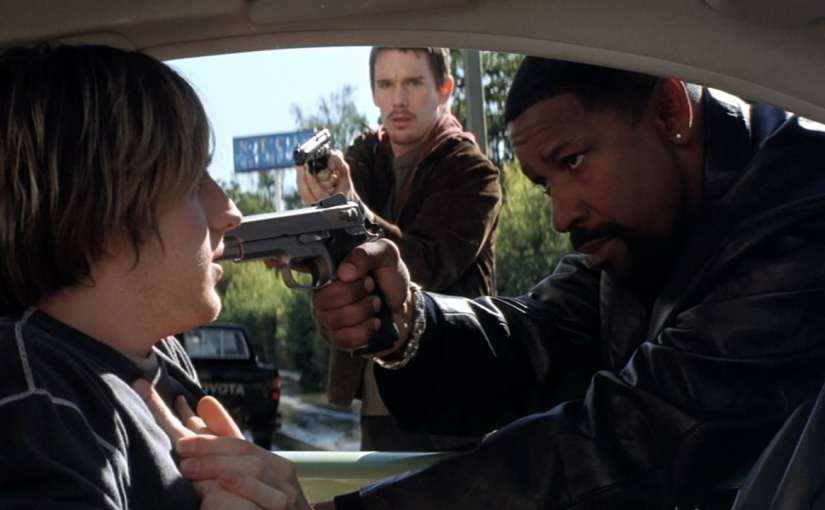
When I first saw Antoine Fuqua’s Training Day in theaters, I found it difficult to watch. The violence or the induced police brutality is very strong. There’s no humor and there’s no thrill. Just an in your face pull over excuse for a cop to exercise his strong arm with his two strapped nickel played Barettas.

Jump to the present and it’s even harder to look at because what the film perpetuates is quite parallel to how many parties view law enforcement and people of color today. Training Day isn’t pretty, nor is it assuring. It’s more or less glamorized evil with a good-looking Denzel Washington driving a gorgeous looking pimped out black Chevy Monte Carlo.

Washington gives an Oscar winning turn (though I’ve seen him in more deserving and nuanced roles; Hello? Malcolm X, anyone?) as narcotics detective Alonzo Harris. He begins his day taking on a new partner named Jake Hoyt (Oscar nominee Ethan Hawke), a boy scout looking cop fresh out of his uniform and into street clothes eager to advance his career and eventually get the kind of big house that other high salary detectives reside in.

Alonzo knows the streets of Los Angeles so well that he can literally stop his car in the middle of an intersection and every other driver will circumvent around him with no protest. Alonzo is here to show Hoyt how to learn the streets for himself and earn the respect of the various gangs and pushers that will lead to the big busts. Only thing is that Alonzo Harris is not a good man. This is a cop who uses his badge as a way of power and intimidation. In this one day, with each passing moment, Hoyt questions his own training and considers if crossing line after line is how you get ahead. Does Alonzo truly know what it means to be a cop making a difference? Does Alonzo care? Does Hoyt care, or does he only concern himself with his career aspirations?

There’s no question that Fuqua’s film is very well made. His dirty, criminally ridden Los Angeles is very convincing and the command that Washington has with his corrupt cop role is all the more intimidating. However, I didn’t feel good with the film after it ended. I didn’t learn anything about race or social classes in America. I didn’t learn that a cop can be a hero. After all, Jake Hoyt doesn’t exactly take the noble approach to surviving his first day in the new job.

There’s a lot of preaching monologues from Alonzo Harris, who is a pretty frightening guy. He’ll his gun at his apprentice’s head, as a means to convince him to smoke some street PCP, because it’s a first step in knowing these streets. Hoyt gives in to the pressure. Still, none of this tells me anything.

Harris goes from one questionable incident to another and Hoyt gives merely dubious expressions but not much else. Eventually, as things boil over between the two men, Hoyt takes the law into his own hands rather than following procedures.

Training Day dictates who is the good guy and who is the bad guy. In the film, however, the good guy more or less becomes the bad guy by the end. That simply didn’t sit right with me. All the necessary ingredients are here for a good cop/bad cop thriller, but I didn’t feel quite good about myself when the film closed out. There really is no one who comes up triumphant. There’s nothing to question about my own view of the world we live in, and there’s too much edge to allow for any kind of suspense. Alonzo Harris is just a bad, bad guy and John Hoyt is never really a good guy. He’s a wimp succumbing to an evil brainwash.

So, then what’s left is to wonder exactly what is there to truly appreciate in Training Day, and the answer is practically nothing except the construction of the film and Washington’s performance. Otherwise, the film is a harsh fiction never concerned with conveying a message within a real problem area of the United States. I would’ve appreciated a response to a harsh reality.