
By Marc S. Sanders
When a movie works beyond formulaic conventions, it takes risks. A storyteller will either really impress their audience, or they will leave them feeling shortchanged. You’ll either get a “Whoa! Now that’s cool.” (The Usual Suspects, The Sixth Sense, but I did call that ending when I saw it in theatres. Ask my wife if you don’t believe me.) On the contrary, you’ll arrive at “That’s it?” (The Happening, Signs or any other M Night Shyamalan reach for the rafters but come up foul kind of flick.)
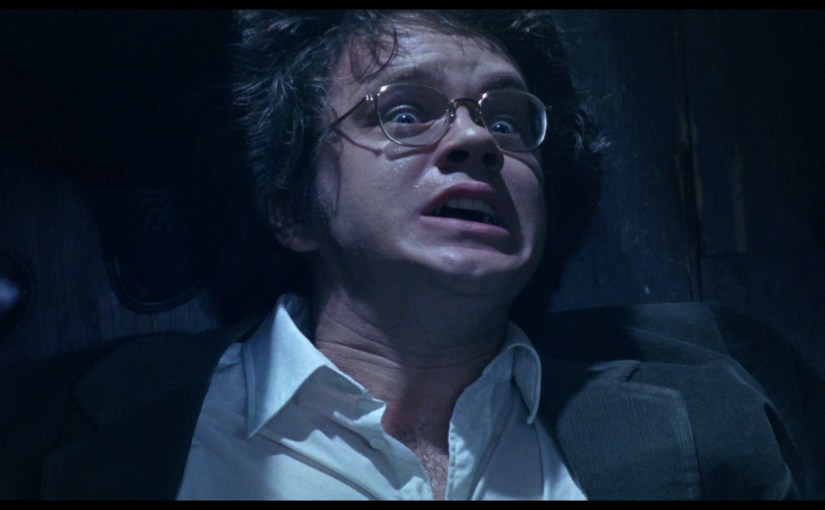
A movie like Adrian Lyne’s Jacob’s Ladder is anything but standard and it asks you to trust in its ambiguity in order to arrive at its big payoff. For most of the picture it is unclear what you’re watching. What keeps you engaged is Lyne’s approach to atmospheric indicators, like dark tunnels, dim bulbs, distant echoes and a disturbingly scared and depressed Tim Robbins. The creepier the film looks and the more ominous it feels, then perhaps it will lead to a conclusion that will leave you satisfied. Jacob’s Ladder functions like an M Night Shyamalan film where you just want to arrive at the twist. When it finally reached its destination though, I was ready to turn the car around and go home.
Tim Robbins is Jacob Singer, a Vietnam veteran. The picture opens up with Jacob returning from the dense jungles to reunite with his squad after what was his like hundredth bowel movement, it seems. The squad jokes about with men’s locker room talk and then a disturbing occurrence takes place. The next scene, thereafter, has Jacob dressed in a mailman uniform awakening from a nightmare aboard a New York subway train. He gets off at his stop, but then he cannot find his way out of the subway station and then he encounters unsettling images like perhaps a demon or two on board a train that just misses running him down.
Much of Adrian Lyne’s film sets up sequences like this where the unexplainable cannot be explained. Jacob now lives with a girlfriend, Jezzie (Elizabeth Peña), who is growing frustrated with Jacob’s unusual behavior. It seems he suffers from PTSD following his time in the war, but also he mourns the death of one of his three sons (Macaulay Culkin) from his first marriage.
Robbins is especially good at not going for big moments in his role. He’s a quiet, cheerless individual working with very little dialogue. That’s impressive but it’s also a little boring, especially considering that for most of the film it’s near impossible to decipher what is going on, nor what is the exact story to uncover in Jacob’s Ladder. My patience was trying, up until a stand at attention moment that came from nowhere. Still, not much arrives thereafter.
Jacob receives a call out the blue from one of his old army buddies. When they meet up, it dawns on Jacob that his friend is encountering similar kinds of feelings. When he reunites with the rest of the squad it occurs to them to sue the United States government for experimental drug treatments that were administered to them while serving in the war. They turn to an attorney played by Jason Alexander in a role far off from his Seinfeld sitcom days to later come in his career. This lawsuit may uncover a link for Jacob. Unfortunately, I think it diverts away from Adrian Lyne’s intended lack of clarity for another kind of movie altogether. The movie goes in this detour with Alexander’s attorney role and then finds its way back on the main road for the third act. Hardly any new mileage was to be gained from this rerouting though.
This new development may give a more literal understanding into Jacob’s psyche and condition. However, I think the film fails to pounce on a new opportunity to attack a topical storyline that had become suspect during the actual timeline of the war. As the film arrives at its conclusion, the script seems to rush to the surprise ending it wanted to garner.
Frankly, an early conversation with a Jacob’s chiropractor (Danny Aiello) easily spelled out the twist for me. Alas, perhaps that took me out of the film early on.
There are good ideas and good performances to be had in Jacob’s Ladder. Yet, I don’t think the film entirely works because of Adrian Lyne’s attempt to push it’s vagueness. Demons that come out of nowhere during Jacob’s hallucinations should be scary and have a fright shock to them, but instead these moments come off like abstract art that only frustrated me.
I always thought I knew the ending, and I was right for the most part, but why does a runaway car have to chase Jacob down an alleyway to deliver the point? Arguably, a boogeyman like Freddy Krueger might have done a better job at disturbing a threat of death than what was ever going on in Jacob’s Ladder.

 2 UNPAID MOVIE CRITICS!!!!