M*A*S*H

By Marc S. Sanders

Forgive me.  I’m not sure my position on Robert Altman’s film will be fair.  All my life, I think I deliberately eluded seeing the motion picture of M*A*S*H as I have been so accustomed to the classic television show that ran for eleven seasons on CBS.  As I expected the two properties couldn’t be further apart from one another.

Altman’s movie still carries a zippy kind of perspective to the horrors of war.  With their hands and surgical scrubs in the thick of gory, blood red surgery, the characters are so much more apathetic to the turnaround of wounded that arrive at the 4077th American mobile army hospital, located three miles from the explosive front lines of the bloody Korean War.  The well-known characters were first given live action roles here following the published novel by Richard Hooker.  

Most surprising is near the end of the film when two doctors realize they are being sent home. One surgeon who is in the midst of operating on a head injury actually instructs a colleague to take over.  This guy has his hands covered in brains and blood and chooses not to finish saving his patient’s life.  Alan Alda of the television show, as a writer, director or while portraying Hawkeye Pierce, would never respond in such a manner. Yet, this is the approach that Robert Altman chose to follow, having infamously always despised the TV series that eclipsed his film in popularity.

Altman’s movie is a slap in the face to the famed oxymoron called “military intelligence.” In 1970, we say bravo for finally saying something frank and honest while a Vietnam War has carried on far too long for not necessarily any of the right reasons.  It’s not so simple to declare war is hell.  It’s much more complicated and horrifying than that.

The film’s opening bylines are quotes by celebrated military leaders of the time, like MacArthur and Eisenhower.  However, these championed commanders are lampooned as we watch shlubby Hawkeye Pierce (Donald Sutherland) arriving in Korea.  He heads directly towards a General’s jeep and steals it, plain as day.  From there on, M*A*S*H operates like a precursor to Animal House with a series of hijinks and a lack of care for military leadership or the U.S.’s purpose in this conflict.  

About the only time, there is any care or forthright anger from anyone is when the jerky Major Frank Burns (Robert Duvall) chastises an underling.  Trapper (Elliot Gould) and Hawkeye punch his lights out and the schmuck ends up in a straightjacket.  Nonetheless, these guys could care less about criticizing and exposing the truth about the institution they have been drafted to serve.  Their purpose is not to make an ironic statement like a Doonesbury comic strip.  They just punch the commanding officer in the face and drink.  The TV show was at its strongest when it relied on the wit and delivery.  Trapper and Hawkeye never use irony or intelligence to belittle a buffoon.  They punch, or they embarrass an authority who’s taking a shower. Regretfully, it’s the dialogue that’s lacking. Robert Altman encouraged much improv on the set and overlayered conversations within his scenes. He found nothing organized or neat and pretty about war, including daily functioning. Chaos did not only reign on a battlefield.

The pace of M*A*S*H moves episodically, and it is likely what led to the idea of a half hour TV show that dominated the airwaves for the better part of eleven years.  A character called Painless contemplates suicide and so a Last Supper reenactment before he sends himself off is inserted. It’s a funny caption from these halfwits, but a storyline focused on deliberately ending a life does not connect with me in a humorous way here. Burt Reynolds, the dark comedy Heathers, and even more recently Tom Hanks toed the line of humor to be found in death by suicide. I think it worked better in those examples. With the somber, well known theme song of “Suicide Is Painless” that is forever linked with M*A*S*H, I just could not muster the laughs for this bit.

There’s also time to build comedy against another regular army brat like Major “Hot Lips” Houlihan (Sally Kellerman, also the best and most memorable of the cast).  The iterations of shower hijinks has been duplicated so often since the release of this picture. Therefore, this gag is dried up. It does not hold its impact fifty years later after dozens Porky’s movies. As well, there’s golfing off the helicopter pad, heavy drinking and a long, drawn-out final act of an overstayed football competition which leads to one of the first times the F-word was used in a mainstream American film.  

In 1970, Robert Altman delivered a bold, risky and daring film to counteract against a losing Vietnam War and the heroism of John Wayne’s bravado in war pictures.  The chutzpah to lash out against American politics likely felt relatable to many who saw different and more realistic images when they understood their young sons and daughters were not coming home and were thus forever changed.  Richard Hooker’s properties and stories lent an understanding to the animosity of those who forced the war on America’s children and loved ones.  War has never been consistent with the short film propaganda asking you to buy war bonds. M*A*S*H negated the heroism of Hollywood sensationalism found in machine gun fare and overtaking a hill while draped in green fatigues with shiny bronze ammunition hanging off their shoulders. These soldiers of war deserve our country’s utmost respect, but they did so much more than what John Wayne demonstrated. They offered up parts of themselves they would never get back.

M*A*S*H deliberately left out the heroes.  However, seeing the film for the first time, over fifty years later, I wish that at least we could follow the escapades of doctors who also directed a bed side manner to the pawns who were dying while upholding their leaders’ cause.  The doctors of Robert Altman’s interpretation hardly emulate a reason to care. 

The film interpretation of M*A*S*H is outdated of its time of release and the period in which it takes place.  I like to think we live more humanely than not just how our military leaders functioned.  I wished these physicians used their scalpels with a much less obtuse absence of empathy.  Hate the puppet masters, yes. Yet would it kill these guys to still care about the puppets? 
THE LONG GOODBYE (1973)

by Miguel E. Rodriguez

DIRECTOR: Robert Altman
CAST: Elliott Gould, Nina van Pallandt, Sterling Hayden, Henry Gibson
MY RATING: 9/10
ROTTEN TOMATOMETER: 95% Certified Fresh

PLOT: Private eye Philip Marlowe does a favor for a good friend, and as a result he loses his cat, spends three days in jail, and incurs the wrath of a mobster looking for his missing $355,000.


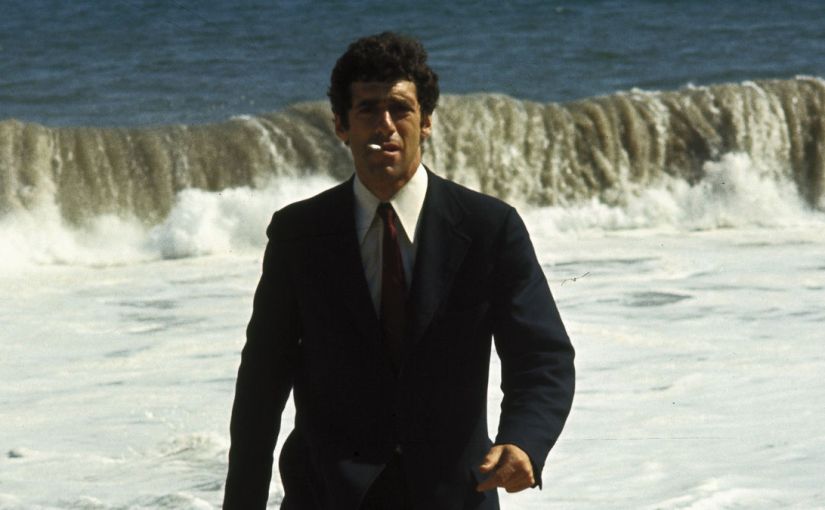
Elliot Gould’s version of Philip Marlowe is a far cry from Humphrey Bogart’s classic interpretation in The Big Sleep [1946], and I’m okay with that.  Who wants to see any actor, no matter how talented, try to follow in Bogey’s footsteps?  Gould resembles no one so much as Walter Matthau as he shambles from one fine mess to another, cracking wise to cops and hoodlums alike, smoking cigarettes like there was no tomorrow, and bemoaning the loss of his cat (played by the original Morris the Cat…no, seriously).

I mention all that because, apparently, there were (and maybe still are) Raymond Chandler fans who were none too pleased with Robert Altman’s film The Long Goodbye when it was released, as Gould did not fit the image they had in their mind of one of fiction’s greatest hard-boiled detectives.  In my opinion, it just doesn’t matter.  Bogey is Bogey and Gould is Gould and, as Marlowe himself repeats throughout the movie, “It’s okay with me.”  Just had to get that out of the way.

The Long Goodbye is one of the finest private eye flicks I’ve ever seen.  With Robert Altman’s trademark style and wit, we first encounter Philip Marlowe as he wakes up in the dead of night to feed his cat.  Much has been made of this opening scene, as the filmmakers apparently intended it to be a metaphor for the Marlowe character being transposed from the ‘50s to the early ‘70s, like a “Rip van Marlowe” suddenly having to deal with a new world after being asleep for 20 years.  I get it, but the movie plays just as well without that kind of metaphysical layering.

Next thing you know, Marlowe’s best bud, Terry Lennox, shows up at his door with bruised knuckles, scratches on his face, and a sudden desire to visit Tijuana, Mexico…indefinitely.  Marlowe does what any friend would do: drives his buddy to Mexico and drops him off at the border.  But when he gets back to his apartment, the cops are already there, interrogate him, and bust him on a phony charge until he tells them where Lennox is.  Three days later, Marlowe is released because Lennox has turned up dead, with a suicide note and a confession to murdering his wife at his bedside.

That’s just the setup.  Next thing you know, he’s hired by a ritzy dame, Eileen Wade (Nina van Pallandt), to find her drunkard husband, famous author Roger Wade (the always dependable Sterling Hayden), who apparently has a nasty habit of taking his drunken frustrations out on Eileen’s face.  That leads to an encounter with a mean little mobster named Marty Augustine (director Mark Rydell) who makes Roger Wade look like Tiny Tim.  HE wants to know where his $355,000 is, that TERRY was supposed to deliver to him in Mexico.  Are these three plot threads connected?  Is the sky blue?

Even if the mystery plot of The Long Goodbye weren’t meticulously plotted and virtually airtight, the movie would still be a pleasure to watch and listen to because, hey, it’s a Robert Altman movie.  I’ve only seen one movie of his that I HAVEN’T liked so far, but I’m reluctant to say what it is for fear I’ll get a deluge of comments about how wrong I am.  Anyway, Altman’s style is in full force in this movie: overlapping dialogue, the occasional cameo (David Carradine as a cellmate, and a certain Austrian bodybuilder as one of the mobster’s muscle men), and characters who never, ever look like they’re acting.

Altman frames his actors and directs them almost as if he’s shooting a documentary, although there are very few (if any?) hand-held shots, so you can tell that there was a method to the…well, not madness, but spontaneity.  Watching them deliver their lines is like watching the scene play out through a keyhole, or like we’re watching them on a hidden camera.  There’s a voyeuristic feel to the whole movie that, while it lacks a certain polish, is nevertheless compelling and absorbing.  I wanted to know what happened next, not because the mystery still hadn’t been solved, but because I simply wanted to see what these characters were going to do or say.  This is a vibe that I don’t even REALLY get, at least not to this degree, in some of Altman’s later films, like The Player [1992] or Short Cuts [1993].  There is something about the synergy between Gould, Altman, and the Marlowe character that struck a chord in me, and I was just happy to be along for the ride.

Naturally, I wouldn’t dream of revealing any of the secrets to the mystery of Terry Lennox and the mobster and the author’s wife.  But I do want to mention one specific scene, between Marty Augustine and his beautiful mistress.  To say that the payoff of this scene was a jolting is a vast understatement.  I can’t even say what other films it reminded me of, but it’s safe to say that it took me completely by surprise.  You’ll know what I mean when you see it.  (And how about that ending!?  Altman had a clause written into his contract specifically stating the ending of the film could NOT be changed by studio interference or whatever…and thank God he did.)

Based on the movie posters for The Long Goodbye, I had always assumed this was Altman’s stab at madcap, screwball comedy.  I could not have been further from the truth.  This is a great film noir, or I guess neo-noir, that does its best (and mostly succeeds) to capture on screen the grittiness and fatalism of only the best dime store detective novels, as well as some of the more highbrow entries in the genre.  Only Altman could have made a movie specifically like this, in this way, and only Gould could have captured that precise mix of “here we go again” and “I’m smarter than you and we both know it”.  I wouldn’t call it a forgotten film, but it’s worth digging up if you’ve never seen it.

YOU PEOPLE

By Marc S. Sanders

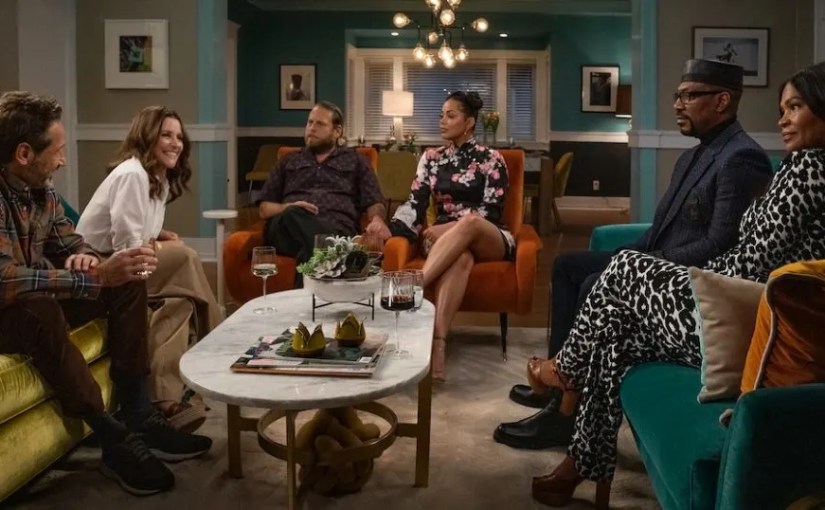
You People has me wondering how we could have stepped so mind bogglingly far back in social tolerance and understanding.  I give people far more credit than the foundations that Jonah Hill and Kenya Barris, who wrote the film together, describe in this movie.  (Barris directed, as well.) People cannot be this cruel and stupid, can they?  Someone give me hope! Give me assurances, please!!!!!

You People is a send up of the Meet The Parents formula, or more specifically Guess Who’s Coming To Dinner? In the latter example, an African-American doctor is brought to the home of his Caucasian fiancée to be introduced to her parents.  Later, the woman meets his parents.  There is an understandable sense of surprise for the characters in both scenarios.  Yet, none of the parties carry the instinct to embarrass each other or allow them an opportunity to lie just to impress and speak with moronic naivety.  The film was never catered for big laughs, but rather more towards awareness and understanding. 

With a cast that includes Jonah Hill, along with Julia Louis-Dreyfus and Eddie Murphy, all well known for huge comedic achievements, You People is designed for the laugh out loud moments.  That’s great.  It sounds very promising, and it was a movie I was looking forward to watching.  However, did the comedy have to come at the expense of stereotyping Black Muslims as angry and intimidating and freely dropping the N-word, while White Jews are dumb, ill informed, clumsy lying cocaine users?

The pattern of Barris’ film is very structured.  For every scene of father-in-law to be Eddie Murphy paired with Jonah Hill, there is also a scene on the other side of mother-in-law to be Julia Louis-Dreyfus paired with Lauren London, portraying Hill’s fiancé.  Murphy does his comedic best in expression and stature with or without dark sunglasses on, while Hill sits very uncomfortably next to him, whether it is in the car or at his bachelor party getaway in Las Vegas where his buddies ask him to call his cocaine dealer.  Cuz, you know, all Jewish guys have a go-to cocaine dealer on speed dial. 

Julia Louis-Dreyfus does her comedic best trying to impress Lauren London by acting aware of what a black person has had to endure and over-complimenting her hairstyles and appearance.  She’s ready to go all “Karen” at the front desk of a luxury spa when she suspects racial discrimination towards London’s appearance.  Later, she will commit slapstick sin by accidentally pulling off the hair weave extensions of one of London’s friends.

I refer to comedic best because the two SNL alumni are so good on camera even if their script is nothing but insulting junk, devoid of validity.  Their expressions are reminiscent of Murphy’s best stand up routines and Louis-Dreyfus’ hilarious sitcom portrayals.  However, these collection of scenes are written with an obnoxiously overabundance of cringe and discomfort.  How these characters treat one another is utterly disgraceful.

Upon an initial meeting at the dinner table, a comparison of suffrage by means of black slavery vs the Holocaust is brought up.  You know what?  Neither incident within our world history is worse than the other.  They’re both horrendous and could never merit comparison.  Yet, here they are being presented as punchlines for outrageous comedy in terms of one upmanship.  Murphy’s character, along with Nia Long as his wife, will announce their admiration for Louis Farrakhan, while Julia Louis-Dreyfus will point out the speaker’s antisemitic doctrines.  In response, she will accidentally light fire to Murphy’s prized Muslim hat gifted by the minister.  If I were to translate this mathematically, Black Muslims celebrating antisemitic gospel equates to White Jews as insensitive klutzes. 

You People is nothing but one insulting moment after another.  In every scene, someone is the punchline at the expense of the writers’ unfair and incorrect blanket approach categorization for what these two demographics must be like. What a huge misfire. 

These are some of my favorite comedic actors.  Lauren London even looks like she can hold her own in scenes with her co-stars.  The potential for talent is hard to match here.  There could have been debates as to who should officiate the wedding and what themes the reception should have, or what the bride and groom should wear. Imagine an argument over the cake topper.  Actually, as I recall there are moments like this in the film.  Nevertheless, they dwindle into conclusions that demonstrate Black Muslims should be feared while White Jews are clueless morons. 

As a conservative Caucasian Jew myself, none of what is depicted in You People could be further from the truth.  I’ve known a few Muslim people and I never caught this kind of vibe from them or who they associate with, or what they practice.  I’ve also never felt uncomfortable in their presence.

The failure of this film lies within the insensitivity of its ignorant script.  This movie could have demonstrated a clash of cultures.  Instead, it relies on moments to squirm at uncomfortably with some of the worst people any of us could ever know.

The next time Jonah Hill and Kenya Barris want to make a movie, they need to read a book and speak with who they select for their subject matter.  Even better, just turn on the camera and let Eddie Murphy and Julia Louis-Dreyfus start talking…about anything!  They are far more intelligent and creative than anything on display here.

A BRIDGE TOO FAR (1977)

by Miguel E. Rodriguez

DIRECTOR: Richard Attenborough
CAST: Sean Connery, Ryan O’Neal, Gene Hackman, Michael Caine, Anthony Hopkins, James Caan, Maximilian Schell, Elliott Gould, Denholm Elliott, Laurence Olivier, Robert Redford, and MANY others
MY RATING: 7/10
ROTTEN TOMATOMETER: 63% Fresh
Everyone’s a Critic Category: “A Movie Set During an Historic War”

PLOT: A detailed account of an overly ambitious Allied forces operation intended to end the war by Christmas of 1944.


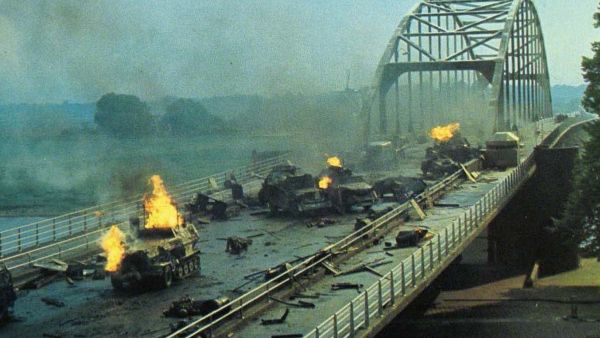
In September of 1944, in an attempt to land a finishing blow to Germany following D-Day, Allied forces launched Operation Market Garden, a bold offensive that would drop over 30,000 soldiers behind enemy lines.  The objective was to capture and hold three strategic bridges in the Netherlands, over which a massive column of British tanks would then roll straight into the Ruhr, the heart of Germany’s industrial complex.  Neutralize the Ruhr, and taking Berlin would be inevitable.  However, as with so many other simple plans in history, multiple factors led to the operation getting bogged down at the third bridge, and after massive Allied casualties, the offensive was abandoned.

Based on a bestselling novel by Cornelius Ryan (who also wrote the novel The Longest Day), the movie of A Bridge Too Far resembles the actual Operation Market Garden, not just in appearances, but also in its ambition, scope, and ultimate failure to achieve its goal.  However, as a pure combat movie, I give it credit where it’s due.

First off, look at this cast.  There had not been an assemblage of so many of Hollywood’s leading men since 1962’s The Longest Day (“42 International Stars”, that movie’s posters proclaimed).  Naturally, most of the actors are pitch perfect in their roles, with one glaring exception.  Whoever thought Gene Hackman was just the right guy to play a Polish general was either desperate or foolhardy, or both.  Hackman is a talented actor, without question, but his attempt at a Polish accent is a MAJOR distraction from whatever he’s saying.  Every once in a while, it even pulls a disappearing act, not that it matters.

ANYHOO.  The all-star cast.  To offset the lengthy running time, the story is told in semi-episodic fashion, which makes me wonder if someone hasn’t thought about rebooting this movie as a Netflix/HBO/streaming miniseries.  I’d watch it.  Within each of these episodes, it helps if we remember right away that Michael Caine is the leader of the tank column, Sean Connery is heading up one of the ground units, Anthony Hopkins is holding the bridge at Arnhem, and Elliot Gould is the cigar-chewing American trying to get a temporary bridge put together, and so on.  It’s a rather brilliant way of using visual shorthand to keep the audience oriented during its nearly three-hour running time (including an intermission at some screenings).

There is one “episode” featuring James Caan that has literally – LITERALLY – nothing to do with the plot.  He plays an Army grunt who has promised his young captain not to let him die.  After a grueling ground battle, Caan finds his captain’s lifeless body and, after improbably running a German blockade, holds an Army medic at gunpoint, forcing him to examine his dead captain for signs of life.  I read that, unlikely thought it may seem, this incident really did happen as presented in the film (more or less).  All well and good.  But what does it have to do with capturing bridges?  I’m sure the story is in the novel, but the movie takes a good 10-to-15-minute detour from the plot to follow this bizarre story.  Did director Richard Attenborough think we needed comic relief or something?  I remember liking that story as a kid, but watching it now…is it necessary?  Discuss amongst yourselves, I’ll expect a summary of your answer at tomorrow’s class.

I want to mention the combat scenes in A Bridge Too Far.  First off, I never served in the armed forces.  Well, never in combat.  I was in the Air Force for about a week.  (Well, Air Force boot camp in Oklahoma for about a week…LONG story.)  So, my observations of the combat scenes are less about historical accuracy and more about how they compare to other films.  While some of the combat portrayed is rightfully horrific in its own way – the river crossing in those ridiculous canvas boats, the slaughter of the paratroopers, the seemingly endless holdout at Arnhem – a lot of the combat, particularly the tank shelling and the skirmishes at Arnhem, is…I have to say, it’s kind of fun to watch.  There’s something, I don’t know, charming about it all.  It reminded me of how I used to play with my army men and Star Wars figures, or how I used to run around with neighborhood friends wearing plastic helmets and pretending we were “good-guys-and-bad-guys” while throwing dirt clods at each other and making fake explosion noises.  It was movies like A Bridge Too Far that shaped my young impressions of what wartime combat was like, and whether it was realistic or not was irrelevant.

Anyway, enough nostalgia.  Here’s the sad truth: A Bridge Too Far, despite its thrilling combat and all-star cast, falls short of delivering a truly meaningful war film.  There are half-hearted attempts to drum up some dramatic impact with scenes in a makeshift field hospital and a speech in Dutch from Liv Ullman wearing her best “isn’t-war-awful” expression, but for some reason those scenes fall flat.  (I did like the “war-is-futile” scene with that one soldier who runs out to retrieve the air-dropped canister, only to discover…well, I won’t spoil it, but it’s a good scene.)

After writing almost 1,000 words, I’m no closer to explaining why A Bridge Too Far falls short.  It’s still an entertaining watch, but I’ve really got to be in the mood for it.  It’s rather like reading a historical novel that isn’t particularly thrilling like a Crichton or a Clancy, but it does deliver some eyebrow-raising information.  It doesn’t hit me in the heart, but it does feed my brain.  Maybe that’s not such a bad thing in the long run, but if movies are about stirring emotions, I must say: A Bridge Too Far is no Saving Private Ryan.

(Sure, I probably could have just said that instead of writing this long-ass review, but where’s the fun in that?)


QUESTIONS FROM EVERYONE’S A CRITIC

Best line or memorable quote:
“Remember what the general said: we’re the cavalry. It would be bad form to arrive in advance of schedule. In the nick of time would do nicely.”

Would you recommend this film?  Why or why not?
Ultimately, I would recommend it to film buffs who have not yet seen it.  If nothing else, it’s an interesting time capsule movie.  This would be the last time for a VERY long time that anyone would attempt to make an epic film with a truly all-star cast.  …come to think of it, I can’t think of a major, epic drama since A Bridge Too Far with an actual A-list cast.  Can you?