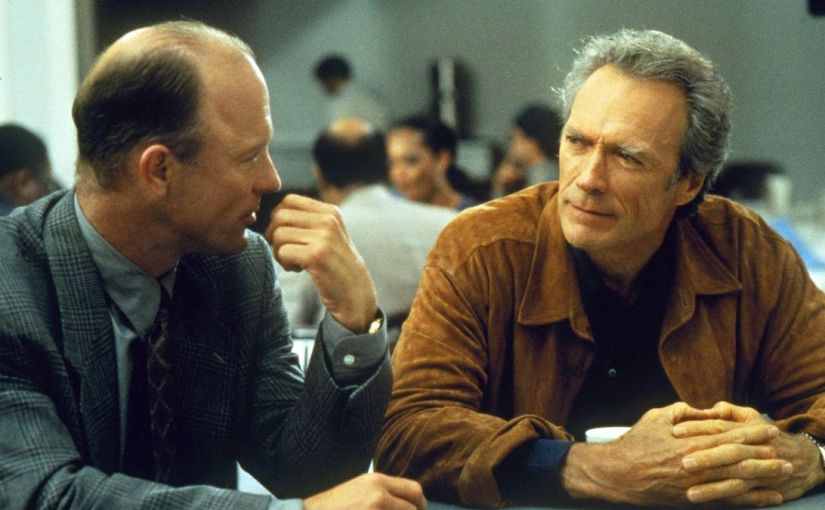
ABSOLUTE POWER

By Marc S. Sanders

As Clint Eastwood’s Absolute Power was unfolding I started to think this plays like one of those hardcover bestseller political thrillers from the 90s that my dad would scoop up off of the neatly designed stack at the front of Barnes & Noble.  You know with the glossy book jacket that has the blood stain and a dead girl’s nail polished hand next to a bloody letter opener.  The graphics are elevated to feel the crime scene with your fingertips.  The intrigue is summed up on the inside tab.  You turn to the back of the book to see the picture of the author.  Then you buy it with your membership card.  Go figure!  William Goldman adapted the screenplay from a novel by renowned author David Baldacci. Absolute Power has an engaging set up, a who’s who of a cast, it’s directed, produced and starring Eastwood. Still, it evolves into utter eye-rolling preposterousness.

Eastwood directs his own portrayal Luther Whitney, an expert jewel thief.  He might be getting up there in age but he scopes out the mansion of a billionaire tycoon (E.G Marshall, in his final on-screen role) and locates the vault hidden behind a large two-way mirror.  Everything is going to plan as Luther bags up the valuables and a lot of cash but then a drunken couple enter with Luther hidden behind the mirror to watch their tryst turn deadly.  The President of the United States (Gene Hackman) avoids being stabbed to death by the young lady (Melora Hardin) when his secret service detail (Scott Gleen and Dennis Haysbert) enter to shoot the girl dead.  The President’s Chief of Staff (Judy Davis) arrives soon after.  Luther observes the four as they rush the Commander In Chief out of the house and alter the crime scene.  They get careless and just as Luther makes a quick exit, he retrieves evidence that will hopefully work to his advantage.  Now he’s in danger of the President and the other three as they work to permanently contain the situation.

Elsewhere is Ed Harris as the detective out to solve the murder and uncover everything we already know.  When he realizes a thief must have been at the scene of the crime, he actually approaches Luther for some guidance as to who could have been there.  Later, he will use Laura Linney, playing Luther’s daughter, for assistance as her father seems to be the prime suspect. 

The tycoon, the President’s biggest supporter, also wants to resolve his personal vendetta by hiring his own sniper (Richard Jenkins) to take out Luther. 

Absolute Power has all of these players, with recognizable actors in the roles, and yet cannot work the magic necessary to fix this outrageous conundrum.  I can believe that a President could get in more trouble than he needs with a one-night stand and a dead girl on the floor.  I can believe members of his staff will work to tie off all the loose ends, even if it means more murder and mayhem must occur. 

What is hard to swallow is how neatly the story wraps up literally within one afternoon leading into an evening.  It’s fortunate that window washers are present to throw off a couple of snipers with an inconvenient glare at the most inopportune time.  Otherwise, there will be no more movie.  It helps that a character with remorse happens to take his own life, thus exposing the conspiracy, just as Eastwood’s character is steering his own way to exoneration.  All in the same night!!!!

To ramp up the suspense, the bad guys go after Linney’s character, the one person Luther cares for the most.  She ends up in a hospital.  Message has been sent.  Luther better surrender himself along with what he knows to the President’s squad.  Yet, they try one more time to permanently eliminate her and I asked why.  What purpose does that serve to kill her now?  If you kill her, then Luther has nothing to protect or care about anymore.  He can just reveal the entire breakdown of what really happened complete with evidence and so on.

A few years earlier, Eastwood starred in In The Line Of Fire where John Malkovich played a master of disguise assassin.  Luther is also a craftsman at hiding in plain sight.  However, there’s no way I can believe that.  We are looking at Clint Eastwood here.  He’s got his own unique and very tall and square stature.  Put a white mustache and a pair of glasses on the guy, and it is still Clint Eastwood.  Put a hat and beard on him and it is still Clint Eastwood.  Wrap him up in a trench coat and have him walk the city streets in broad daylight where fifty cops are awaiting his arrival and you’ll be able to see the one and only Clint Eastwood.  It just can’t work.  James Bond can hide in disguise.  John Malkovich can hide in disguise.  Go anywhere in the world and Shaquille O’Neal and Clint Eastwood would never be hidden in plain sight. 

William Goldman (The Princess Bride, Butch Cassidy And The Sundance Kid) is one of Hollywood’s most celebrated screenwriters.  He did not think this story all the way through.  You may believe Gene Hackman (second billing behind Eastwood) would have had more of a presence in this picture but oddly enough he’s hardly there. The real bad guy roles belong to Judy Davis and Scott Glenn who are not nearly as exciting as what Hackman could have delivered.

There was a potential for a good conspiracy thriller. The problem is the audience knows too much following the first fifteen minutes of the film.  We know everything that happened and therefore I could care less about the progress that Ed Harris’ detective makes.  Absolute Power likely would have performed better had it opened after the crime had occurred.  Run the opening credits over the dead girl in the room and open the two-way mirror for Luther to enter the frame.  He makes a run for it and then the film can gradually reveal what precisely happened.  A mystery for the characters and the audiences who are watching them only works if the questions are offered before the answers are revealed.

Absolute Power offered a lot of promise with a lot of talent but it’s devoid of both.
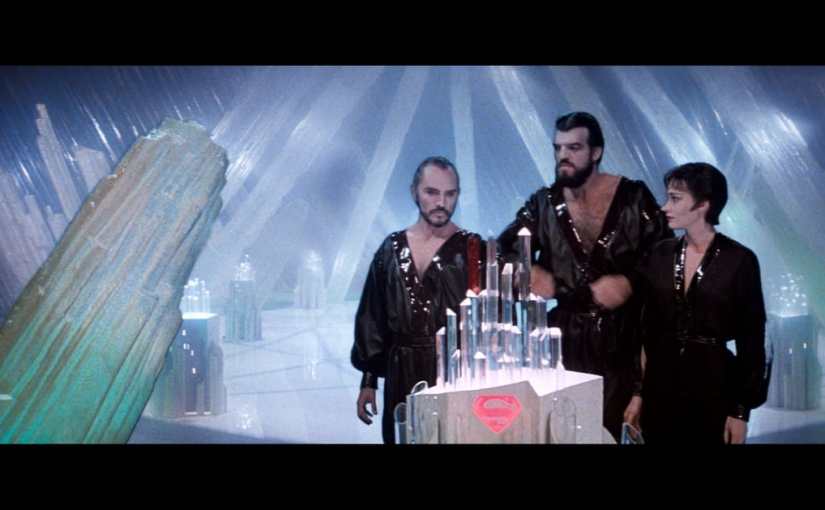
SUPERMAN II

By Marc S. Sanders

It’s time for the man in the red cape and blue tights to fall in love with Lois Lane, but wouldn’t you know it?  Three Krytonian criminals possessing the same powers as our hero have arrived on Earth with a means to dominate the planet and exact revenge on the son of their jailer.  Superman II picks up where Richard Donner’s original 1978 smash left off.  It remains a fantastically fun and breathless sequel.

Richard Lester (A Hard Day’s Night) gets the directing credit on this film following one of Hollywood’s most infamous behind-the-scenes stories.  While I’m a big admirer of Donner’s body of work, I think it was a blessing that Lester finished the job.  I’ve seen what Donner was intending to do on a special Blu Ray cut, and it just does not work. The characters make odd choices that seem inconsistent with how they were perceived in the first film.  That’s all I need to say about that comparison right now, though. 

In the original theatrical release, the story expands on the relationship between Superman & Lois (Christopher Reeve, Margot Kidder) as well as Clark Kent and Lois.  Eventually, both relationships intersect with one another, and Lois realizes the man she’s been admiring and the one she hardly takes notice of are one and the same.  The problem for Superman, known by his krypton name Kal-El, son of Jor-El, is if it is acceptable to be intimate with an earthling. 

Meanwhile, Lex Luthor (Gene Hackman) has escaped prison to entice three villains from Krypton into a partnership that will allow them to take over the Earth and destroy Superman.  The trio is led by General Zod (Terence Stamp) with the wicked Ursa (Sarah Douglas) and the mindless and mute Non (Jack O’Halloran).  Following their attack on Houston, or as they call it the “Planet Huuston,” and the White House, it is on to Metropolis in search of Kal-El.

I’ve offered up quite a bit of what Superman II provides and I am not even close to sharing all it’s adventurous features and character dynamics.  This is a solid picture all the way through, and it begins with the casting.

I’ll be bold by declaring that Christopher Reeve as Clark Kent/Superman is one of the best casting decisions in film history.  Think about this for a moment.  As good as Henry Cavill was in Zach Snyder’s films, thirty years later, and how well some of the WB iterations have been, the contrary point that most people make is that none of them are Christopher Reeve.  From the smile, his handsome face, clear voice with perfect enunciation and even the signature hair curl over the forehead, no one has looked as good as a superhero come to life better than Mr. Reeve.  When he’s flying, even with outdated visual effect backgrounds, you are still convinced that Christopher Reeve knows exactly how to fly.

Following the director shake up on this picture, it is said Gene Hackman refused to shoot some scenes or do follow up edits.  You can tell when there is a double in place for him and you can hear the different vocal sound bites from Lex Luthor.  Nevertheless, what survived from Hackman’s participation is silly and twisted like you would expect from a modern-day, dastardly villain or as he declares himself to be “the greatest criminal mind of our age.” Some of these lines look hokey on paper, but Hackman invests his showmanship once again in the character.  I love it.  On all of those top ten lists, Gene Hackman as Lex Luthor is the one that everyone is regrettably forgetting about.

Margot Kidder is just as committed.  Lois Lane is best when she is the go-getter and Kidder is thoroughly convincing at not just being seen in the stunts and action but actually performing through Lois’ fears, sense of daring, and adoration for the love of her life.  Near the beginning of the film, there’s a great close up of Kidder looking up into the heights of the Eiffel Tower as Superman flies a hydrogen bomb out of danger.  No dialogue, but you can read it all over Margot Kidder’s face.  There goes my hero.  Watch him as he goes.  Few love interests in superhero films have ever matched what Margot Kidder accomplished in these pictures.

The action scenes are great set ups.  I get a chill down my spine every time I watch the showdown in Metropolis between the three baddies against the man in blue and red.  However, Richard Lester never neglects the acting throughout the whole two hours, particularly by the leads, as well as the Shakespearean maniacal performances from Stamp and Douglas.  Furthermore, the extras throughout Metropolis, Houston and even in Niagara Falls are performing very well and therefore turning the various settings into characters themselves.  Just as the fight over Metropolis is to begin, a cabbie declares “Man, this is gonna be good!”  Isn’t that guy speaking for the audience?  I remember the room applauding in the theater at that line.  When Superman rescues a child in Niagara Falls, a woman utters “What a nice man!” Clifton James, from a couple of James Bond movies, resurrects that redneck persona and it works better here as the guy who clashes with the imposing new visitors.  All of these walk on characters further shape the purpose of the visitors from space.  None of it depends on B-movie tripe like declaring “Peace!”  The personality of the folks meet the strangers from a strange land.  Sometimes it is done for means of slapstick, but it is always very entertaining.

Superman II is a perfect complement to the original film thanks especially to the cast.  Reeve gives multiple performances of Clark and Kal-El that could not be more different.  Kidder takes her character in new directions upon learning the surprises the script has in store for Lois.  Hackman is doing the same routine, but fortunately it’s welcome because I can not get enough of his antics.

This sequel really set the bar high and the next installments for Reeve came nowhere close. Though I actually have an affection for Superman III with that internal struggle depicted in the junk yard scene; one for the ages. 

The first two movies are legendary and Warner Bros/DC films realize they still have not superseded what was done over forty years ago.  The studios are not trying hard enough. However, more to the point, the filmmakers back then got it absolutely perfect, and you cannot beat Superman, nor can you beat perfection.

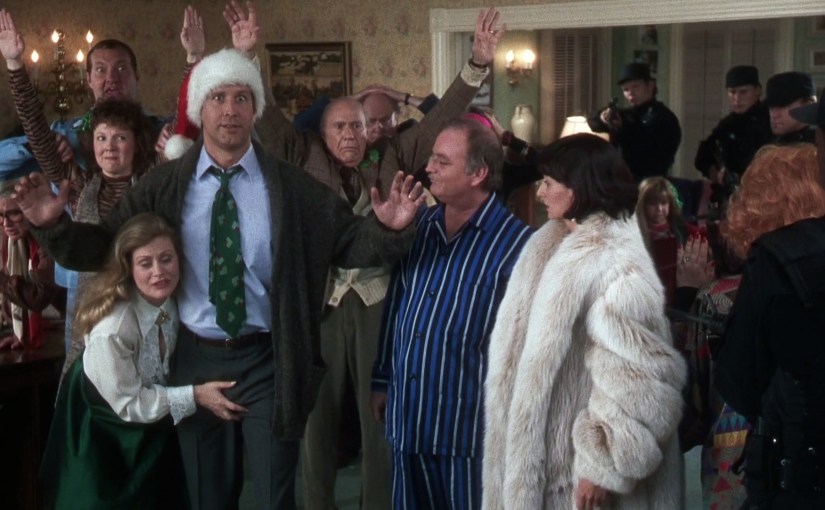
NATIONAL LAMPOON’S CHRISTMAS VACATION

By Marc S. Sanders

Not until December 25, 2021, had I seen National Lampoon’s Christmas Vacation.  Friends and colleagues couldn’t believe it, the same way they can’t believe I’ve never eaten a cheeseburger.  I’m not a big Chevy Chase fan.  I think the one film I like of his, because of him, is Neil Simon’s Seems Like Old Times.  The guy is just not a draw for me.  My fellow Cinephiles (Thomas Pahl, Miguel Rodriguez and Anthony Jason) introduced me to Fletch earlier this year.  Wow, did that movie start with a really interesting premise that just stumbled like 2,000-pound stone slowly sinking to the bottom of a very deep and empty sand trap.  The film didn’t work because of Chevy Chase.  Once it got past its exposition, Fletch relied too heavily on boring and unfunny schtick from a very unfunny Chevy Chase.  I was waiting for Christmas Vacation to fall into that same trap.  For a fraction of the film, thankfully, it didn’t.

By and large, what works with Christmas Vacation is because of its writer John Hughes, who writes with the consistency of humor that worked in Ferris Bueller’s Day Off and especially Planes, Trains and Automobiles.  The slapstick is most apparent here, then in other Hughes film released before.  (Home Alone would win that record title a year later, of course.)  As I said, Christmas Vacation relies entirely on the slapstick element.  There is no sensitive allowance for warm hugs or coming of age realizations and character arcs.  Clark Griswold gets in one predicament after another.  Like a mediocre Three Stooges short, some of those predicaments work.

Pun intended, the biggest highlight is when Clark decorates his Chicago suburb home with an infinite number of lights, eventually disrupting the next-door neighbors intimate candlelit dinner and blinding them into pratfalls.  The timing is pure John Hughes craftsmanship; John Hughes…not Chevy Chase

Stupid set ups include Clark getting trapped in the attic, unbeknownst to the rest of the family, as well as him hanging from the outside gutters and losing control of a tall ladder.  What works in these moments are what worked for the humor in Ferris Bueller with the school principal character, or Steve Martin’s character in Planes, Trains… .  Clark tries to come up with a way to get out and tip toe across the floor beams of the attic, trying to avoid a haphazard accident in the process.  The floors creak.  The items he finds in the attic squeak and grind.  When he’s hanging from the gutter, the rusty piece of metal is gradually giving way as he holds on for dear life.  I appreciated the prop humor.  The victim might be Chevy Chase, but that could’ve been anybody.  I guess sometimes, the pie is funnier than the one who gets it in the face.  So, there are moments that work.  I like the beginning as well where the dumb patriarch takes his family out to the forest to literally cut down a tree and then carries his optimism that he can actually fit it in the living room.  Moe, Larry and Curly had this kind of positivity when they convinced the Hoi Polloi that they could repair a plumbing problem in a mansion.

Much doesn’t work here either, though.  An overabundance of relatives show up to celebrate the holiday.  The set up is the same as in Hughes’ first film, Sixteen Candles.  However, in that film, each grandparent was given a moment to stand out among the masses.  Christmas Vacation doesn’t capitalize on that so much despite great talent that features Diane Ladd, Doris Roberts and EG Marshall.  No relative is a given a personality or unique and humorous annoyance.

The most remembered relative is Randy Quaid’s Cousin Eddie, but honestly, I found nothing funny about the guy and I thought he only served for irritated facial expressions to capture Chevy Chase in close up.  I know.  I know.  Before seeing this film, I was well aware of the “Shitter’s full” routine.  Okay.  Okay. Shit, poop, doodie, whatever you want to call it is funny.  Shit is God’s endless joke on the living beings he/she/they created.  A two word sentence of dialogue while draining a hose full of shit does not a movie make, though.  Otherwise, there is nothing marvelous about Randy Quaid in this film or the other relative extras that appear.  Clark’s (third time recast) kids could have also been funny but the script doesn’t let them.  There was just no material for these people on the page.  We know how pitch perfect actors like Juliette Lewis and Johnny Galecki have become over their careers.  I’d argue they are funnier and more talented actors than Chevy Chase ever was, but like the other supporting players the script didn’t consider the talent.  Beverly D’Angelo is back as Clark’s wife too.  Moving on…

I could have had regretted watching this film.  I finally, finally, FINALLY gave in per the insistence of practically everyone I know, on a whim, when I saw it available on HBO Max.  I don’t regret watching it.  Truly I don’t.  Yet, I don’t feel better having done so either.  Christmas Vacation is not an all-time great comedy or holiday film.  I don’t believe it did anything for anyone’s career.  Notice I didn’t mention the director’s name, because it doesn’t matter and I haven’t heard from that guy since this picture.

The film is just there, I guess, and as each passing December comes and goes, it is awarded new life…. unlike the electrocuted, exploding cat that perishes under a love seat.  Now that’s funny! Thankfully, this precious feline gave up his lives for a chuckle from me.  Had it been Chevy Chase though, then this review might have gone in another direction.

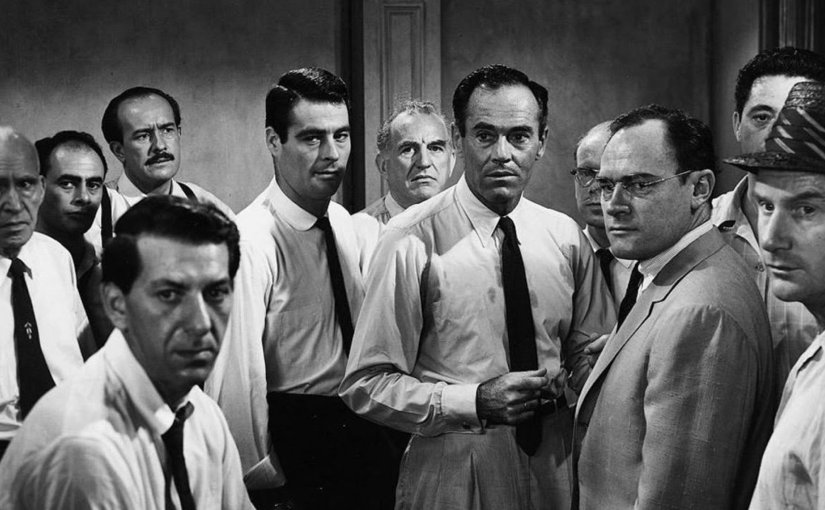
12 ANGRY MEN

By Marc S. Sanders

This film lives up to its reputation.

This was the great Sidney Lumet’s first theatrical film, and for a project limited mostly to only a claustrophobic and hot room, it boasts a lot of talent; Henry Fonda, Martin Balsam, Lee J Cobb, Jack Klugman, Jack Warden, EG Marshall.

For a black and white picture Lumet and his crew are effective at showing tiny details like sweat on brows and shirt stains, a broken ceiling fan, and the mental exhaustion of limited breathing space as twelve citizens debate over the guilt or innocence of a young man on trial for killing his father by stabbing. Lumet’s camera (just like when I watched The Verdict) is constantly traveling, even if it’s in a tiny confined space. He zooms in when he needs to and he changes angles to get the most of 12 different perspectives. Lumet keeps it interesting by changing up his use of lens. As the afternoon proceeds into early evening, the camera navigates more closely to the table they sit at. The men are uncomfortable, frustrated with each other, more impatient and more concerned with their consciences about sending a man to death. The actors do well with translating these factors, but Lumet sends the message home.

What I found most interesting is the different variations of how each juror eventually comes to changing his mind. Almost all of them arrive at that point in a new or different way. Credit goes to screenwriter Reginald Rose for that. Additional credit for the different variations of how the jurors repeatedly cast a vote; raising hands, notes, anonymously, not anonymously and so on. Rose changes it up each time to keep the viewers’ attention.

Rose’s script will only tell you so much. The attorneys don’t appear in the film, deliberations are done, we only get a close up of the defendant but there’s not enough material for a viewer to cast judgment. The film opens with the judge giving a boring routine instruction as to how the jury should proceed. He might as well be telling them how to complete an SAT exam.

Yet what we are treated to are the faults and overcomings of the human spirit. Ed Begley is a juror who gives a brilliant monologue that stereotypes the defendant’s ethnic background, though we never know what race or ethnicity he is. As he continues to rant, every other juror steps away from the table. Begley seems to get more ashamed of his thought process as he carries on, but he doesn’t stop until he’s ordered to by another juror. Amazing!!! In 1957, when Jim Crow and McCarthyism were on the horizon or rampant, this film was not having it. It’s the best scene in the film.

Henry Fonda is great as the one who only asks for sensibility. He adds weight to the case they are deliberating over that the others are sadly failing to recognize. A man’s life is in their hands.

I’d argue that the facts of the case and evidence presented carry very little complexity to what a real murder trial might offer. I’d also argue that what serves as a fulcrum to sway each vote is maybe a little too convenient (presuming the time it takes for one witness to walk or whether a witness wore glasses), but that doesn’t matter. What’s most important is whether each of these men can live up to the demand of recognizing reasonable doubt; the necessary requirement for a trial by jury. In that sense, 12 Angry Men succeeds.