
By Marc S. Sanders
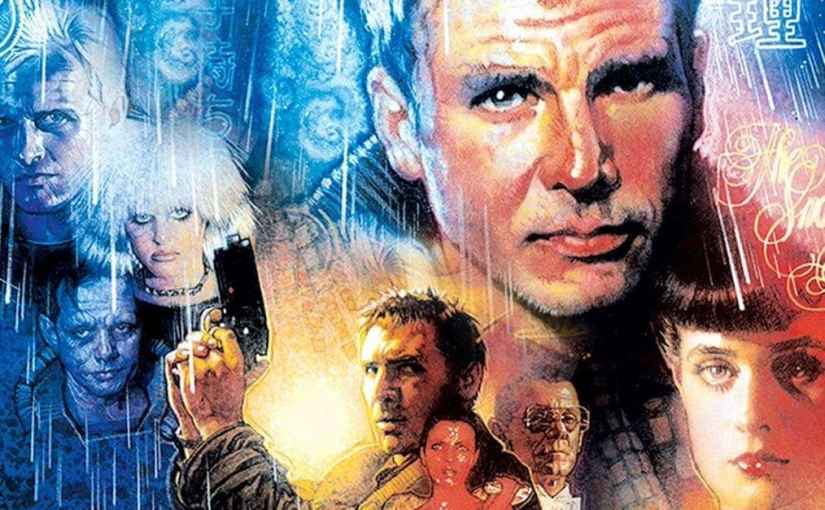
Ridley Scott’s Blade Runner is a technical and special effects masterpiece…however thin-very thin-its story may be.
When the film was originally released in 1982, its period setting of November 2019 seemed unimaginable. So, it was easy to accept that the dystopian future first conceived by author Phillip K. Dick (in his book Do Androids Dream Of Electric Sheep?) could actually happen. With the Vietnam War behind us, and shopping malls becoming the happening place to be in our Members Only jackets and Jordache jeans with Swatch watches, the 1980s seemed like eternal bliss. Middle class America felt prosperous and free and comfortable with a President on his way to eight years in office. Bright pastel and neon colors took over. A hopeless, dreary future was all but fantasy. Therefore, just like Star Wars, a gritty, urban Los Angeles seemed like another possibility where science fiction had become as trendy as super hero movies are today. It was cold and rainy and dirty, but we wanted to see that because that was nowhere near what we were living in, much less envisioning.
Ridley Scott achieved greatness with visuals never thought possible. George Lucas might have introduced moviegoers to desert and swamp planets and industrialist Death Stars, but Scott delivered an Earth where Coca-Cola, Pan Am, Atari and Cuisinart still existed amid a dark, rainy Chinatown section of Los Angeles with glowing umbrella handles, flying police cars and cabs, hovering electronic billboards, and exhaust flames that spewed out of the rooftops of cylindrical skyscrapers. Ridley Scott might have supervised this palette of futuristic film-noir, but the real heroes of Blade Runner belong to its Oscar nominees Lawrence G. Paull, David L. Snyder, and Linda DeScenna for set decoration, as well as Douglas Trumbull (already a legend for 2001: A Space Odyssey), Richard Yuricich and David Dryer for visual effects. All these years later, there’s much to explore within the appearance of Blade Runner, but the storyline still remains shallower than a puddle of water.
I’ve watched Blade Runner a number of times because fellow peers and colleagues carry such admiration for the film. I cannot deny the first third of the film holds your attention as you acclimate yourself to this enveloping world. Once your accustomed however, the story is what has to carry you through to the end, and the journey is as slow moving as a rickshaw on one wheel. Harrison Ford is Rick Deckard, a blade runner and the best one there is. Upon learning of an escape of four Replicants from an off-world slave site, Deckard is tasked with coming out of retirement to hunt down these Replicants and “retire” them. Retire is the polite word for kill, exterminate, slaughter or execute.
A replicant is an android that looks completely human, bleeds like a human and talks like a human. It’s near impossible to tell the difference on sight between a human and a replicant. As well, replicants are manufactured with four-year life spans and are not permitted on Earth. They are intended for the sole purpose of slavery towards their human creators. Yet, what makes them so exemplary or offensive? What trait do they carry that threatens their human counterparts? Racism often occurs because of fear derived from skin color or appearance. Antisemitism will have you believe that Jews have horns growing out of their heads under their yarmulkas. What is so terribly misconstrued or offensive or threatening about Replicants? The film never makes clear, and that’s frustrating. What makes a villain a villain?
M Emmet Walsh comes on early enough to tell us through dialogue that he needs the best of the blade runners back and that’s Deckard. When I’m to understand that I’m watching the absolute best of something, whether it be a cop, lawyer, baker, student, doctor, painter or blade runner, I want to see what exactly makes them the best. In Top Gun, I saw the aerial maneuvers that potentially justified why Maverick could be the best of the best fighter pilots. The problem with Blade Runner and the script, written by Hampton Fancher and David Webb Peoples, is that I never see in its two-hour time span when or how Rick Deckard is such an exceptional blade runner. How is a blade runner different from an ordinary cop or a simple person with a large gun? No matter which of the various cuts of the film I’m watching, with or without Harrison Ford’s voiceover narration, I fail to see any outstanding fighting skills or clear thought-provoking intuition. This guy is neither as good as Dirty Harry or Sherlock Holmes or even James Bond. He’s not even as personable as Sam Spade, the original noir detective. Rick Deckard just looks like Harrison Ford with a very large hand gun. Furthermore, where does the term “Blade Runner” derive from? Is it just there because it sounds cool? The moniker wasn’t even created by Philip K. Dick.
The film’s eventual sequel, Blade Runner 2049, is a far superior film. It’s longer, but it’s much more fleshed out in tone and character and understanding of its setting. The original film stands on the heels of its cult like legendary status. Some of the best filmmakers today cite Blade Runner as an influence in how they construct their own movies. I buy that. The assembly of whatever cut I’m watching is evident of how mind blowing its appearance is. You can see some of the blue print visuals that carried over in to Christopher Nolan and Denis Villeneuve’s pictures. But I’m past all that. Now I need to appreciate what it’s all there for, and who is playing in its yard.
I cannot simply rely on IMDb trivia and endless social media sites that speculate on whether Deckard is a replicant himself, or why he dreams of a unicorn and why Ridley Scott opted not to include said dream in the original cut. I cannot just tickle my curiosity with the picture’s eerie foreshadowing of the various product placements that suffered real life eventual downfalls after its release. Beyond the visuals, what am I watching Blade Runner for? This is not just a riddle in the Sunday paper.
The film boasts an eclectic cast that work well together. I just wish they were provided with something much more insightful with background and personal experience. Rutger Hauer became a familiar name following the release of this picture. When he’s finally given the opportunity within the second hour of the film to come off as hideous and terrifying and strange, it’s worth looking at. His famous “tears in the rain” closing dialogue is beautifully poetic, as it was personally written by him. It’s as ambiguous as the film. Yet, Shakespeare can be vague too. I might not understand what anyone is talking about, but the performance can keep my attention. Regrettably, he does not do much else in the film beyond his closing fight scene with Ford. Ridley Scott insisted on casting Sean Young as Rachel, as her appearance was reminiscent of Vivian Leigh. She’s intentionally mysterious as a likely replicant and/or niece of the wealthy creator of the replicants, Dr. Tyrell. It works, but again, if the viewer is going to be questioned on the mystery of this major character early on, then why doesn’t the film follow further into that enigma? You don’t have to say for sure, but at least give me evidence to argue one way or the other. The same goes for the speculation on Deckard. Had it not been for outside references, I’d never question who or what Deckard really is. Daryl Hannah, Brion James and Joanna Cassidy round out the rest of the cast/replicants within the film. Edward James Olmos is here too with a curious and odd habit of making origami. They all have their unique way or look about them. In science fiction, every character should stand apart. Yet, again, it’s all about appearance. What is the motivation here? What is the motivation to live on earth or off earth? What is the motivation to kill a human? What is the motivation to kill a replicant?
I’ve beaten my head enough over this film. Blade Runner has always been frustrating to me. Maybe I’m not being fair to myself, as I try to find something else or some underlying layer each time I watch it. Why do people love this movie so much? Why does it consistently appear on “greatest of all time” tabulations? Ultimately, I’ve come to the conclusion that I’m just pounding sand, or maybe as Rutger Hauer’s Roy Batty suggests, I’m impossibly looking for tears in rain.
 2 UNPAID MOVIE CRITICS!!!!